LGBTQ Black History: Activist and Actress Josephine Baker

By Kelly McDonnell

This article was first published February 3, 2021 in Tagg Magazine here.

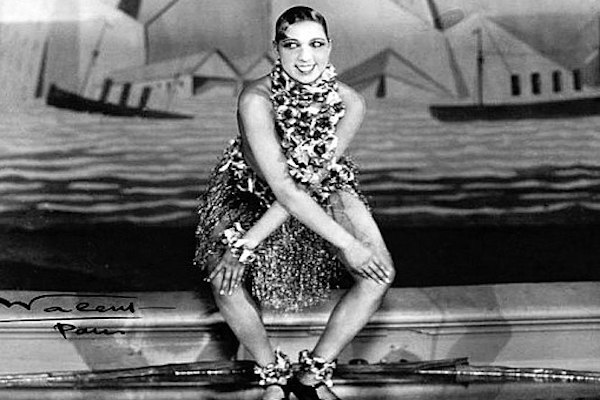
Actress and activist Josephine Baker found the stage when she was barely a teenager, struggling with homelessness and poverty in St. Louis, but her enchanting presence on stages across the world would make her a memorable queer and Black icon.

In 1922, Baker performed in Shuffle Along, one of the first popular American Broadway musicals written and composed and performed by Black artists and Black actors. After this debut, she quickly became a star on stages both in the theatrical and political worlds.

Baker was celebrated during the Harlem Renaissance in New York City, a time of artistic and personal growth that championed Black identity and creativity in America. She eventually moved to Paris and performed on iconic stages and became one of the first popular Black silver screen stars in 1930.

During World War II, she assisted French operations to resist Nazi’s occupation of France. She reported Nazi secrets she overheard when performing for French rebels.

Baker returned to the United States in 1951, as the Civil Rights Movement began taking hold of politics and society. In 1963, she was one of the only women who spoke during the March on Washington for Jobs and Freedom. She toured with the NAACP and raised funds for France’s International League Against Racism and Anti-Semitism.

Baker was forthright about her sensuality and beauty as a Black woman. She did many photoshoots dressed in revealing clothing as well as in men’s tuxedos. Baker had four marriages throughout her lifetime and intimate relationships with women like Maude Russell, Clara Smith and Colette.

Baker died in 1975 in Paris, a few days after her final, sold-out performance.

When she spoke at the March on Washington, she expressed her power and resilience as a Black woman: “When I get mad, you know that I open my big mouth. And then look out, ’cause when Josephine opens her mouth, they hear it all over the world.”

PBS Spotlights Local Black Artists in New Documentary, Kindred Spirits

By Kelly McDonnell

This article was first published February 4, 2021 in The DC Line here.

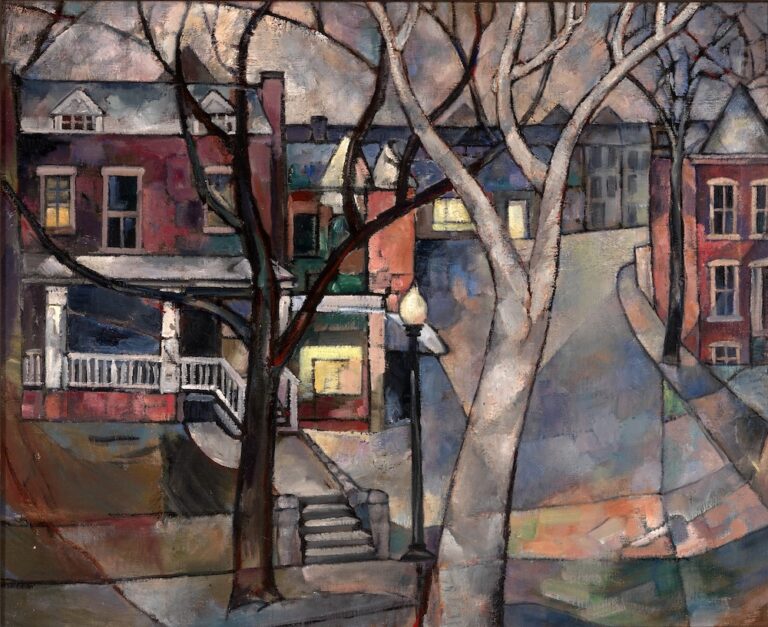
When documentary filmmaker Cintia Cabib was showcasing two films at the Historical Society of Washington, D.C.’s 2014 conference on local history, she spotted an intriguing painting of the corner of Rhode Island Avenue and 3rd Street NW while perusing a small brochure. The modernist, geometric red hues of homes lining the LeDroit Park street and a gleaming, leafless tree bisecting the frame compelled Cabib to explore the work of the artist, Hilda Wilkinson Brown.

Years of research culminated in a new documentary produced and directed by Cabib called Kindred Spirits: Artists Hilda Wilkinson Brown and Lilian Thomas Burwell. The short film is being broadcast locally by PBS stations WHUT and MPT on Feb. 4 and by WETA’s World Channel on Feb. 10. PBS stations around the country have scheduled airings of the film for Black History Month programming.

The film rediscovers Brown, a mid-20th-century artist who painted DC’s neighborhoods and scenery; was a professor at Miner Teachers College in DC at a time when schools were segregated; and influenced her niece, Lilian Thomas Burwell, to become an artist as well.

Hilda Wilkinson Brown’s “Third and Rhode Island,” oil on canvas, is in the collection of the Smithsonian American Art Museum as a gift of Lilian Thomas Burwell. (Image courtesy of Lilian Thomas Burwell)

In the film, Burwell, now 93 years old, recalls the life and artistry of her aunt and talks about growing up in DC — struggling against segregation and discrimination as she pursued her own abstract expressionist art career.

Cabib said her goal with this film was to bring both women’s art into public view. Brown has pieces in collections of the Smithsonian American Art Museum and the Metropolitan Museum of Art in New York. Her piece Third and Rhode Island, which initially caught Cabib’s eye, is part of a traveling exhibit by the Smithsonian. Burwell is opening a new exhibit of her abstract pieces in the Berry Campbell Gallery in New York City in April.

Cabib believes both women deserve more credit, especially during Black History Month.

“I hope [the film] makes people think about other Black artists,” Cabib said. “Who else has been unrecognized? Who else is out there?”

The influence that Brown and Burwell had in nurturing Black artists still resonates in DC’s artistic space. As an educator, Brown encouraged many Black women to pursue careers despite discriminatory and segregationist barriers. Burwell also taught art for years, building on the legacy of her aunt. Alongside its exploration of these women’s histories, Cabib’s film also details the stories of the historic Black institutions and neighborhoods that shaped their artwork.

The documentary shows that Brown’s work was celebrated in the Barnett Aden Gallery, the nation’s first Black, privately owned gallery. It opened in LeDroit Park as an integrated art space and after World War II became primarily an exhibitor for Black artists who were rejected from white-owned galleries. Cabib said she wanted to feature the history of the LeDroit Park neighborhood, which was bursting with Black creatives like Brown, scientists, civil rights activists and more.

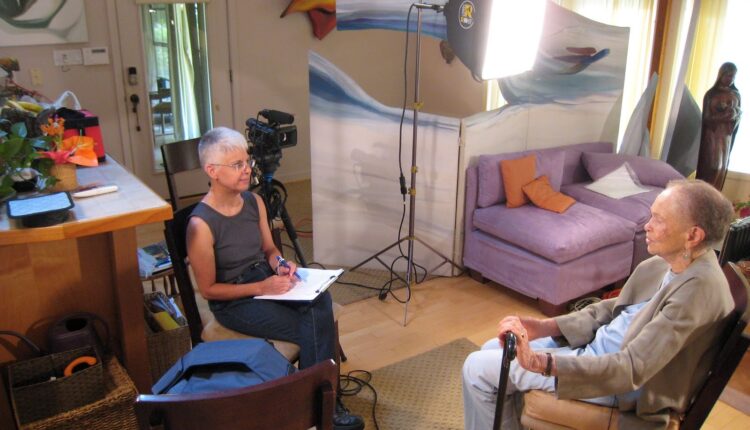
Documentary filmmaker Cintia Cabib interviews Lilian Thomas Burwell at her home in Highland Beach, Maryland. (Photo by John Z. Wetmore courtesy of Cintia Cabib)

Brown’s artwork was featured during her lifetime in The Crisis, the official NAACP publication founded by W.E.B. Du Bois, and The Brownies’ Book, the first magazine for Black children.

“It’s important to recognize the opportunities Black people made for themselves and each other after they’d been denied,” Cabib said.

The documentary was an official selection of the Martha’s Vineyard African American Film Festival and has been shown locally at events like the DC Black Film Festival and Alexandria Film Festival

Cabib was able to host one in-person screening of Kindred Spirits at the Avalon Theatre in March 2020, just before DC declared a public health emergency due to the COVID-19 pandemic. The film was shown to high school students, and Cabib said she was encouraged by the attendees’ questions and engagements with the film and history. At subsequent virtual screenings, Cabib said Lilian was able to join discussions and share more of her story with audiences. 

Cabib’s story came full circle in November when she showcased her film virtually at the 2020 DC History Conference, bringing Brown’s and Burwell’s stories into focus — not just in a brochure, but on screen.

Haunting last words from a Black cop on death row in Meshaun Labrone’s ‘Spook’

An incisive and visceral exploration of American race relations, policing, and the criminal justice system.

By Jordan Ealey

This article was first published January 31, 2021 in DC Metro Theater Arts here.

“It’s not what you are, it’s what you don’t become that hurts.” This quote by musician Oscar Levant is what opens the film Spook. Based on a solo stage piece by the same name, written and performed by DC theater artist Meshaun Labrone, Spook follows the final hour in the life of Darryl “Spook” Spokane, a Black former police officer. He is awaiting lethal injection for committing what is described as one of the biggest mass shootings in American history. His story has attracted significant media attention. It is in this set-up that Spook explains what was behind his violent crimes, resulting in an incisive, haunting, and visceral exploration of American race relations, policing, and the criminal justice system.

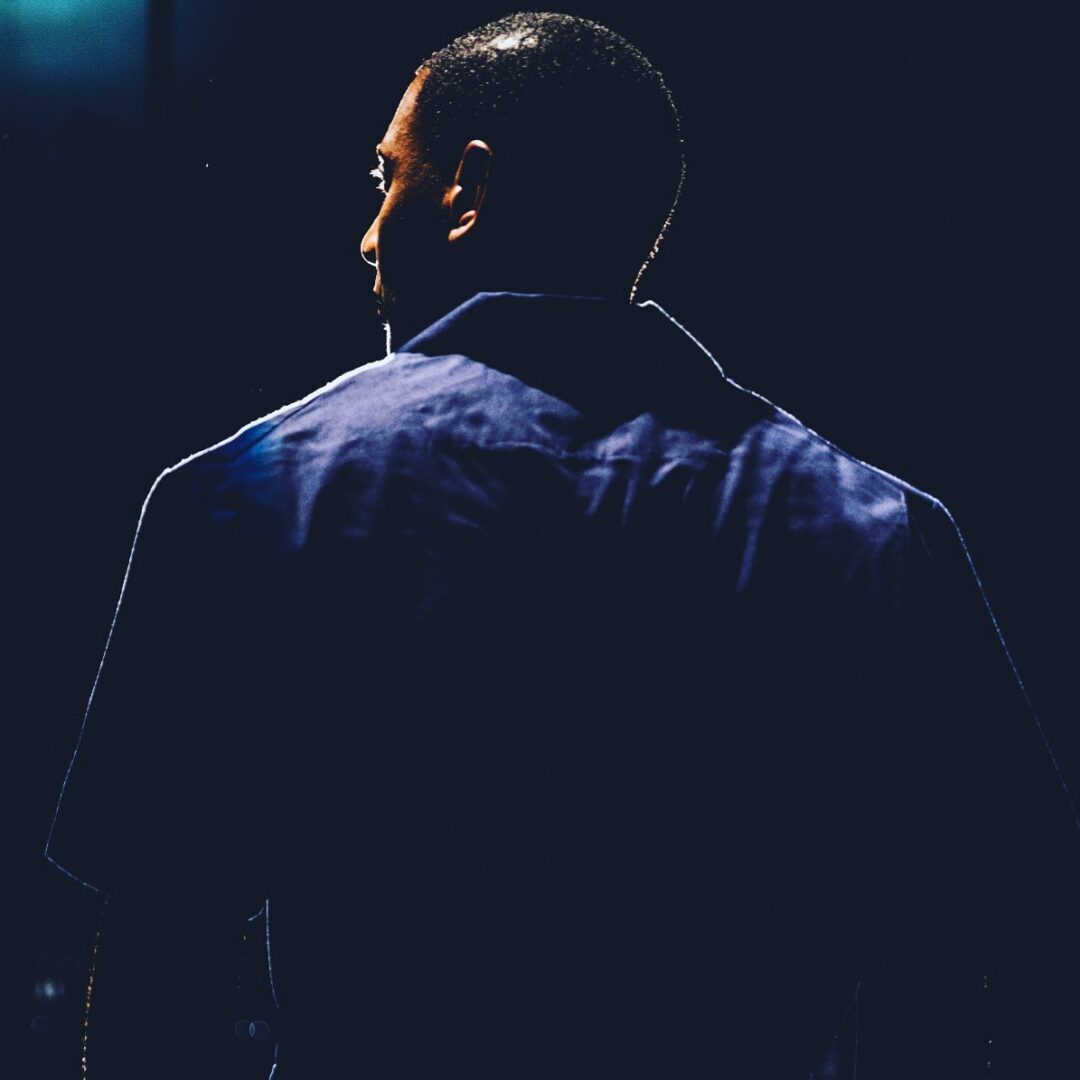
Meshaun Labrone in ‘Spook.’ Photo courtesy of Justin Featherstone.

Unlike many plays that are transformed into films, Spook (produced by Flying Scoop Productions) enhances its theatrical qualities rather than attempting to diminish or get rid of them. For instance, a common device in scriptwriting is “raising the stakes” to infuse a narrative with tension. Labrone skillfully and cleverly accomplishes this with the countdown timer, ever looming in the upper left corner of the film. We, as the audience, get to experience this man’s life slowly ticking away, literally running out of time. The narrative frame additionally includes a live televising of the lethal injection, the first one to be done in American history. Though Spook himself never touches upon this fact explicitly, one cannot help but think about what it means to see a Black man die as a part of a live broadcast, what it means for this to be the first of its kind. There were many horrific murderers in history who were still granted privacy at their deaths. Though at the film’s beginning, we learn that there is a chance for him to be granted a pardon by the Governor, it becomes clear through Spook’s story that he is not going to receive one. Spook shows no regret for the crime that he has committed; like the Levant quote that opens the film, he only mourns what he could not and did not do.

Spook’s dubious and ambiguous morality is a part of what makes the film a strong one. There are moments throughout Spook where it is both easy and difficult to “root” for him, wondering whether he is an anti-hero or a villain. The film’s darkly comic moments come unexpectedly, such as Spook’s joke about 1-800-HEP-A-NIGA, a short interlude of a “commercial” for a fictional hotline to help incarcerated Black people. Another rootable moment comes when Spook discusses his heartbreaking reason for joining the police force: to help Black people due to the injustices he both experienced and witnessed. It seems that while he does not regret the crimes he committed, he regrets that he could not be the change he wanted to see in the police force.

Certainly, moving from a stage to a screen can present problems for many productions; however, Spook skillfully navigated the adaptation. A haunting, eerie image of Spook early in the film of his darkened face gradually becoming darkened so that only his eyes remained was striking. Direction by Nate Starck leaned into the script’s dark thematic moments, retaining its theatricality in its one-room setting with focus only on the character of Spook. Labrone’s performance as Spook was captivating; though he was the sole person on screen for most of the film, he infuses the narrative with such conviction that my attention was rapt the entire time. A particularly virtuosic moment where all of the production elements coalesced beautifully was where Spook was criticizing the Black church and an organ scored his speech. The original music by Devin Spear, which could faintly be heard through the duration of the film, enhanced the dark visuals and haunting themes.

Labrone’s past as a police officer in the Washington, DC, area undoubtedly seeped into his stunning indictment of American policing. John Stoltenberg notes a similar sentiment in his 2018 review of the stage version, which debuted and ran at the Capital Fringe Festival, linking the commentary of the play to Labrone’s own lived experiences. The narrative unfolds in a way that audiences will be constantly questioning their personal biases and baggage, forced to confront realities about race in this country. But it was exactly this question of “audience” that I sat with as I viewed the film: for whom and to whom is Spook speaking?

Lawrence Glover (Prison Officer), Meshaun Labrone (Spook) and Jennifer Knight (Reporter) in ‘Spook.’ Photo courtesy of Justin Featherstone.

I could not help but cringe when the film opened and a dead Black female body covered in pools of blood flooded my screen. I viscerally reacted when Spook discussed how hard “niggas” made his job as a police officer. Yet I appreciate the ways that Spook broaches some intracommunal issues. One of Spook’s victims, a Haitian immigrant, was blatantly discriminatory toward Black Americans. Often, online spaces such as Black Twitter discuss what is referred to as the “diaspora wars,” where Black communities outside of the United States will air their grievances with the so-called monopoly on Black culture held by Black Americans. As the U.S. is a colonial force with far-reaching control of countries in the Global South, it is easy to see where the disdain comes from. My discomfort, as a Black American viewer, comes from this sentiment from Spook as an “explanation” for his crime. Though Spook is ambiguous as to whether its central character is supposed to come off as a sympathetic protagonist, I do worry about the perpetuation of certain narratives in the film.But ultimately, I found Spook, even in its violence, to be compelling, well-done, and sharp. Perhaps its strength lies in its resistance to ease and comfort, in its place critique and challenge. It was difficult for me to believe that a Black man, who grew up surrounded by the effects of anti-Blackness, would place faith in this violent and anti-Black system, but that in and of itself could be Labrone’s own critique of Black neoliberals. At the film’s conclusion, after Spook’s execution, the screen was black for a long time. I stayed there, along with the blackened screen, deep in contemplation about what I had just witnessed. Spook is a whirlwind hour of complex and uncomfortable narratives around race in America, but it will leave you plenty of time to reflect.

Breaking Gender Norms: Mainstream Invisibility of Black LGBTQ Fashion

By Kelly McDonnell

This article was first published January 28, 2021 in Tagg Magazine here.

When Harry Styles graced Vogue’s pages in a floor-length, faded blue gown in early November, social media and pop culture discourse erupted. Most fans were elated and praised Styles for his consistent disregard for gendered, masculinized fashion. In the interview, Styles says, “There’s so much joy to be had in playing with clothes. I’ve never thought too much about what it means.”

On the other side were people like Candace Owens, a politically conservative author, who ridiculed the end of “manly men” in a tweet that targeted Styles’ cover. Owens later went on to say during an Instagram livestream that she loved the dress, but that Harry didn’t look feminine, but just “stupid.”

Does breaking gender fashion norms contribute to a liberation of gender identities? When we ask questions like these, we seem to be focusing on white, cis-gendered celebrities, bestowing them praise and recognition for their one-night-only red carpet designs that bend fashion rules. It’s just enough to capture attention, but not enough to make anyone uncomfortable.

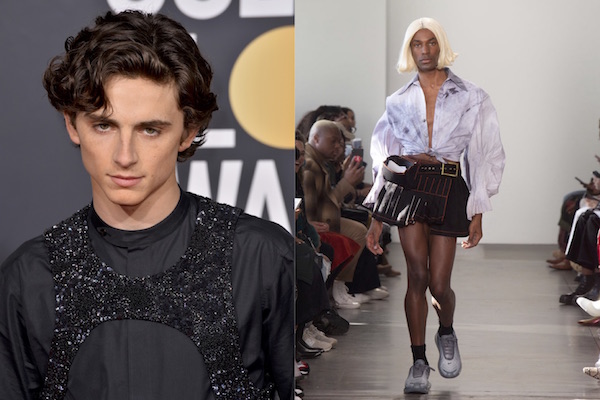
During the 2019 Golden Globes, actor Timothee Chalamet wore a glittering harness and received much love for embracing a feminine silhouette. At the same event, Julia Roberts wore pants (with a golden train skirt) and was met with equal attention for going after a masculine-type style.

Someone who consistently raises eyebrows for gender-breaking fashion is actor Billy Porter. He’s graced red carpets in dresses, skirts, feathers, sequins, and glitter. His outfits mix fabrics, colors, and shapes, and people always commend his style. However, the same praise for breaking norms isn’t always applied. No Twitter trends are amplified or debates started over his fashion, like what happened with Harry Styles.

Do we only give praise to straight celebrities who break from the binary of fashion when it’s unexpected? What about those who make it their mission to disregard gender when it comes to fashion?

We expect queer people to dress exuberantly, flamboyantly, outrageously, because the identities of LGBTQ people are also often viewed as “other.” When straight people adopt the fashion standards LGBTQ people created, they receive praise while Black, queer people are overlooked. They are not seen as the revolutionary icons that they truly are.

Paris Is Burning, the amazing documentary that glimpses briefly into the lives of many Black drag queens and queer men in the 1970s New York ballroom scene, showcases that gender bending fashion is not the product or brainchild of influential white celebrities but of less fortunate yet imaginatively creative and resourceful young Black people competing for recognition and self-identification.

One notable figure in Black queer history and in fashion was Dorian Corey who stars in Paris Is Burning.

When talking about fashion in the film, Corey says, “Black people have a hard time getting anywhere, and those that do are usually straight. In a ballroom, you can be anything you want. You’re not really an executive, but you’re looking like an executive. You’re showing the straight world that, ‘I can be an executive if I had the opportunity because I can look like one,’ and that is like a fulfillment.”

Over decades, Black women have been the ones altering fashion trends. Starting in the 1930s, Josephine Baker embraced feminine glamour while also trending towards clothes that emphasized her boyish facial features. In the 1940s, blues icon Gladys Bentley, who openly shared her queer identity, dressed often in pantsuits and top hats for performances, though she rarely received the red carpet credit for breaking the rules that white celebrities constantly get today. Androgynous style is still empowered by Black stars like Janet Jackson and Rihanna.

When Rihanna began her own fashion lingerie company, Fenty, she became the first Black woman in charge of a major luxury fashion house. In an interview with the New York Times, she catalogued her simplistic view of fashion: “It’s sweatpants with pearls, or a masculine denim jacket with a corset. I feel like we live in a world where people are embracing every bit of who they are.”

That idea, of embracing yourself, despite racial discrimination or gender boundaries, is why so many Black LGBTQ people use fashion to rebuke gender binary ideologies in culture. It’s not about being reviewed on a red carpet look but about finding an authentic self.

Black gay designer Willi Smith is constantly overlooked for his Philadelphia-based fashion that introduced the concept of streetwear in the late 70s. His styles embraced varied body types, average fabrics, and mixed patterns to encourage the everyday lay person to break gender binaries in fashion.

Today, a Los Angeles brand named No Sesso, which translates from Italian to “No Sex,” embraces agender fashion styles. Designed by Pierre Davis, who is a Black trans woman, these styles upcycle fabric that can fit any body, as long as it makes them happy.

Black LGBTQ designers have been and continue to be critical in expanding the fashion industry into one that allows white men like Harry Styles to wear dresses and receive praise. It’s encouraging that celebrities across race or gender identities are expanding their closets and bending gender norms, but the constant recognition of their images rather than the hard work and legacies of LGBTQ individuals, primarily Black people, jeopardizes any actuality of allowing fashion to be truly non-binary or racially conscious.

Love Wins: Travel Style Company Unveils Black LGBTQ Beach Towel

By Clare Mulroy

This article was first published January 9, 2021 in Tagg Magazine here.

Kinyatta Gray, founder of FlightsInStilettos, has a vision for the future of travel — accessories that look and feel representative of her customers.

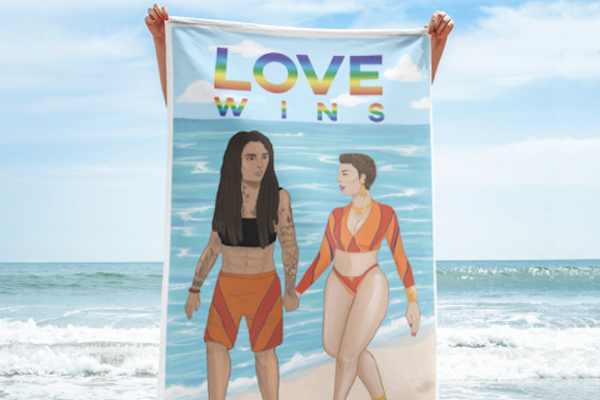
Her latest endeavor is the first ever LGBTQ beach towel that features a Black lesbian couple. Gray released the latest design, the “Love Wins” beach towel, as part of her 2021 Glam Girl Beach Towels collection. The “Love Wins” towel features a Black queer couple holding hands on the beach.

“You don’t see a lot of these images on beach towels at all, and then to drill down even deeper, you definitely don’t see a lot of images of people of color,” says Gray. “Go even deeper, [images of] Black lesbians…it does not exist.”

The design is inspired by Gray and her wife, who got married in 2017. Gray’s motivation was to create a towel that featured images of a lesbian couple, opposed to the typical pride colors or designs. The microfiber beach towel is also in response to the lack of images of people of color in travel accessories.

Since the release of the “Love Wins” towel, Gray says she is impressed by the outpouring of support from the community. Women who have similar hair or tattoos see themselves in the images represented in the new beach towels. The entire 2021 Glam Girl Collection features women of different races and body types sporting unique beach outfits.

“I’m very confident that it may really be one of the first beach towels that has that kind of image on it,” she says. “It’s almost shocking, and it’s surprising. [Customers] are like, ‘Gosh, someone is thinking about us.’” According to Gray, she even submitted the towel to the Guiness Book of World Records to confirm the “Love Wins” towel as the first ever Black LGBTQ beach towel.

Not only does Gray incorporate representation in the images of women, she also tries to weave it throughout her entire business. FlightsInStiletto originally started as a travel blog but quickly turned into a brand once Gray realized that she didn’t see a lot of accessories that represented her or reflected her personal style.

She began designing products in mid 2018. Now in 2020, FlightsInStilettos has appeared in New York Fashion Week and has a growing presence online. Between customizable luggage sets and the “Traveling Tiaras” children’s travel accessories with images of young jet-setting girls of color, Gray’s mission is to incorporate representation of her customer base and her own travel style.

Ultimately, Gray believes there is an opportunity for the entire fashion and travel industry to step up and increase representation.

“I think there are a lot of organizations that are really stepping up to the forefront. [We need] to see advertising, and clothing and all kinds of travel destinations that really speak to you and let you know, ‘Hey, you are welcome,’” says Gray. “It’s something that we’re seeing more and more, but we can always do better.”

Children’s Book Under Our Roof uplifts LGBTQ families

By Kelly McDonnell

This article was first published January 8, 2021 in Tagg Magazine here.

Indiana-based author Rebecca Stanton wants children to know that love is love.

Stanton self-published her first illustrated children’s poetry book, Under Our Roof, in September 2019. She said she’d always wanted to write a children’s book, but she never thought that it would be so personal.

When Stanton’s oldest daughter was planning her birthday party and a sleepover, another parent refused to let their child sleep over because of Stanton’s same-sex marriage. Stanton saw her daughter endure hurt and confusion, and she said she had to “step up as a parent” to do something to heal that pain and counter that discrimination.

Colorful, two-dimensional illustrations by Kristy Gaunt, a Florida elementary school art teacher, depict happy moments between two mothers and their two children. The family flies a kite, plays a board game, catches fireflies and holds each other when they cry.

“Everything you see in this book, you see any other family doing,” Stanton says.

Stanton said the images were inspired by her own favorite memories with her three children and wife. When Gaunt would share sketches with Stanton, she always showed them to her children for their approval. When writing, Stanton asked her kids to help her come up with rhymes for the book.

“I wanted them to see themselves in this book,” Stanton says. That’s the reason she decided to self-publish, even though it was difficult and expensive. Self-publishing kept her writing and editing process “personal” and “authentic.”

Without a publisher, Stanton has been primarily promoting her book through social media and in freelance articles with Gay Parent Magazine, but she’s struggled making a profit on her book.

Despite this, she’s been reminded how important books like these are for representation of the LGBTQ community. Stanton said she was worried how her local community would react to her book, since she tends to lead a private life. She said she also knows that some people believe that children are too young to talk about LGBTQ topics.

In her small town, she doesn’t know many other LGBTQ people. While her two-year-old daughter is comfortably expressive about having two moms, teachers and other adults don’t know how to address same-sex families.

“They kind of stumble,” explains Stanton. “I struggle finding words for it, but they just need to know it’s okay to talk about it. … [The book is] not about sex, it’s just about family.”

One powerful quote in the book is, “Love is what you do and not what you say.” It accompanies an illustration of the family huddled inside having a picnic on a rainy day.

“We teach the kids, no matter what we do, we make sure we’re here, present,” Stanton says. “They know we mean it. Instead of saying it, just show it.”

A League of Her Own Hosts Virtual New Year’s Eve Bash

By Clare Mulroy

This article was first published December 28, 2020 in Tagg Magazine here.

For the first time since the coronavirus pandemic began, Jo McDaniel will be bartending without a mask on.

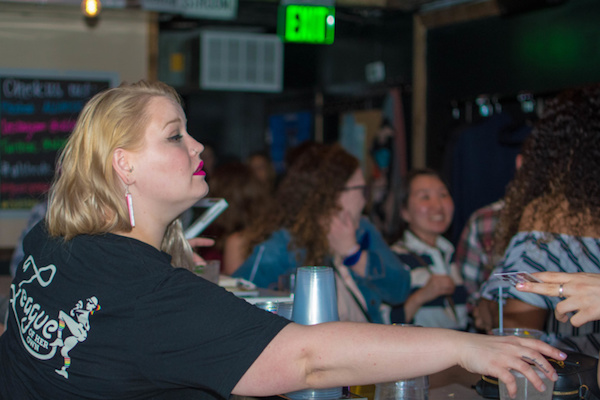
McDaniel, the manager of Washington, D.C. queer bar A League of Her Own (ALOHO) will host a virtual New Year’s Eve bash. ALOHO’s virtual party will feature live music from DJ MIM and special guests throughout the night.

“Our bartenders are going to be dancing and making cocktails. We’re going to have a good time,”  McDaniel says. “Everybody can feel connected and we can be safe in our homes.”

Like many bars and restaurants, ALOHO has been working to maintain some sense of normalcy amid pandemic restrictions. The bar opened a “streatery” from June to October but was unable to accommodate space heaters for outdoor dining as the weather got colder. Now, McDaniel is trying to take advantage of virtual community events.

“When we brought things inside and it got really slow and less busy, that was when I was able to focus more on how we can still serve our community, still stay afloat, and really keep people connected, which is absolutely the mission of ALOHO,” she explains.

This paved the way for ALOHO to experiment with more online events. McDaniel says she was inspired by the Lesbian Bar Project comedy show hosted by podcast Dyking Out, which she appeared on as a guest in November.

When D.C. Mayor Muriel Bowser announced a shutdown of bars and restaurants at 10 p.m., McDaniel knew it wasn’t realistic to try to host an in-person NYE event.

With the help of Boiscouts DC, a marketing group aiming to create community awareness of local events for queer women, McDaniel began putting together the “Bring On 2021” event. The party will stream live on YouTube and feature commercials from local organizations and businesses. McDaniel says the planning process is exciting because she gets to collaborate with bartenders she hasn’t seen in a while. She’s also excited to see the community’s reaction.

“I’m just excited to give everybody a highlight of the D.C. community as well as our staff,” she says, “And just have a good time that feels reminiscent of the ALOHO we all miss so much.”

The ALOHO virtual NYE bash takes place on December 31 from 9 p.m. to 12:30 a.m on January 1. Tickets are for sale on Eventbrite. General admission is $20. The $50 ticket level gets you a cocktail kit swag bag from Republic Restoratives and ALOHO. The “Plus Swag for the Party Pod” tickets are $100 and include enough supplies for 10 cocktails.