Browsing Category

Visual Arts

Reel Affirmations Film Festival Returns with More Queer and Transgender Representation

This article was first published on TAGG and can be read on their site here.

To be able to live your truth every day is a blessing. To be able to make art that can help others do the same is a blessing and opportunity that should not be taken lightly. Reel Affirmations Film Festival, Washington D.C.’s annual international LGBTQ film festival, aims to showcase media that not only promotes representation, but increases visibility for the entire community, no matter where they are on the spectrum. The four-day festival will feature director talk-backs, Q&A sessions, and a filmmaker reception.

The DC Center Director of Arts and Cultural Programs Kimberley Bush, who first joined the film festival as a volunteer, emphasized that the film festival has steadily become more inclusive since its 1991 inception. “[When I first joined], the organization was run by cisgender gay white men,” says Bush, whose love of film brought her to the festival. “A lot of the films we were screening did not affect people of color, women, and non-cis people.”

Bush and her programming team, comprised of individuals of diverse and varied backgrounds, sort through every submission they receive and sometimes solicit films for the festival. They find a common theme within the chosen submissions and then start to program a showcase for the short films. What is unique about the Reel Affirmations Film Festival is the division of film categories into women’s films, male-focused films, and transgender/gender non-conforming films, which help to hyper-focus on proper representation for audiences.

Bush emphasized the importance of having these categorical distinctions, particularly one for those who are not cisgender. “[The transgender/gender non-conforming category] is so necessary, especially with the multitude of gender expression that is out there,” says Bush. “It’s important for people to see themselves out there on the screen.” Within these categories are stories that represent intersecting facets and topics within the LGBTQ community.

The short film Right of Passage explores the stories of transgender refugees and the multitude of struggles they face as they leave their homes and into new foreign territory. Other films such as Will & Nicki and Finding Pride discuss the distinction between being transgender and gay, all the while emphasizing that transgender individuals are people who deserve the same rights as cisgender individuals. In Right of Passage, one refugee summed it up best: “I deserve to live in a place where I don’t have to worry about tomorrow.”

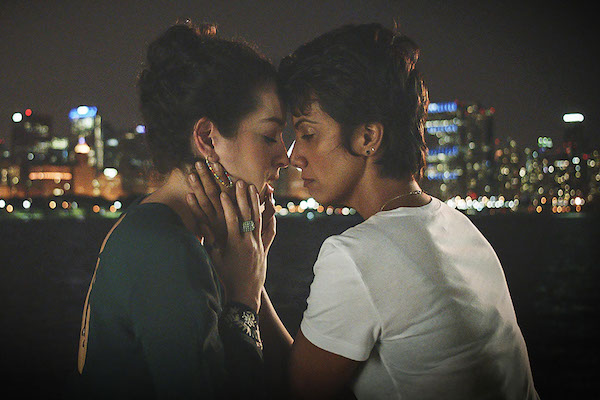
Attendees will also be able to see films such as Be Right Back, a short film whose playful and warm-toned aura features a vintage store shop owner who fantasizes about the customers that walk through her shop. Other short films like Giovanna Cheslar’s Java and Jessica Fuh’s Us touch upon topics of burgeoning sexuality, unrequited love, and acceptance in a 21st century backdrop. Bush stressed that the stories from these works are often directly from the filmmaker’s life and are not “just some frivolous storyline.”

Above all else, the film festival intends to be a place of comfort and affirmation for all those who attend, and especially for those who never see versions of themselves properly represented.

“I see firsthand individuals enter our film screenings questioning themselves and their place in this world and exit substantially impacted and with an uplifted and positive shift in their energy and outlook in their lives,” she says. Bush’s dedication to LGBTQ representation in film prompted her to start Reel Affirmations XTRA, a monthly LGBTQ film series that continues beyond the four-day festival.

The Reel Affirmations Film Festival will be occurring from October 19–22 at the Gala Hispanic Theater. You can find the full schedule for the Reel Affirmations Film Festival here.
Artists Cause/Change at Gallery Opening in Columbia Heights

Every artist dreams of a gallery show or even a museum retrospective dedicated to their singular artistic vision. In the reality of the working artist, however, more often than not one must find a way to let individual artistry shine in group exhibitions. One gallery show opening last week is confronting that challenge head-on by presenting a variety of artists who share little but passion.

On November 5th, Columbia Heights arts and community center BloomBars hosted an opening-night reception for Cause/Change, a new art exhibition bringing together an eclectic group of artists. The exhibition features seven creators, billing themselves cheekily as The November 5thArtists Group: Rebecca Clark, Richard DuBeshter, Joel Bergner, Pat Goslee, Clarke Bedford, Sean Lee Bourne and Andrew Krieger.

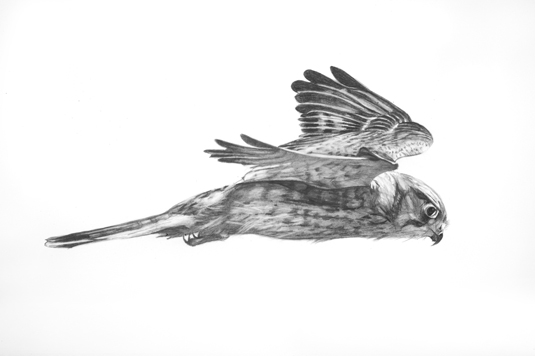
“Kestrel 1”, a drawing by Rebecca Clarke, is one of the pieces featured in the show Cause/Change, opening this Saturday at Bloombars

The exhibition description states that the artists share a “skilled passion” that might “change the way we see and respect our roles in the greater harmony to one another and the cosmos.” Just as broad as their aesthetic range are the artists’ backgrounds and level of notoriety.

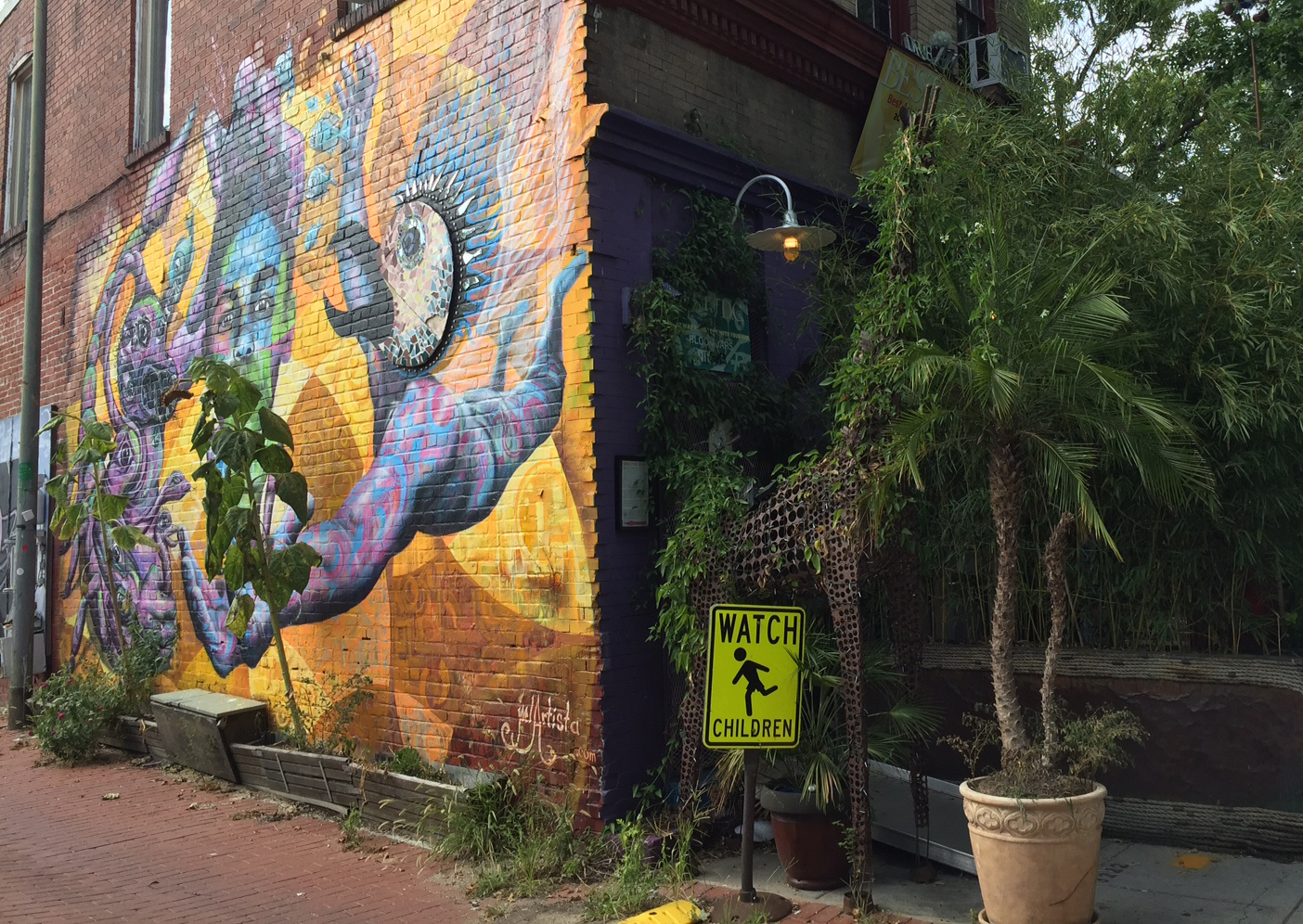
Most prominent of the bunch is Joel Bergner, – otherwise known as Joel Artista – a mural artist, educator, and activist who has facilitated community art projects all over the globe. Bergner is perhaps best known for the Kibera Walls for Peace project, which sought to empower youth and promote peace in the lead up to the 2013 election in Kenya through graffiti.

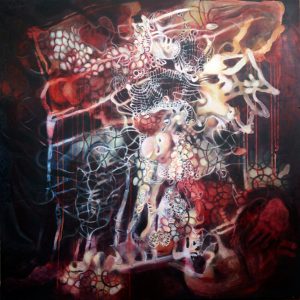
Rebecca Clark, who creates realistic line drawings of both flora and fauna, and Pat Goslee, whose work reminds one favorably of both Picasso and mammalian entrails, have similarly impressive CVs, with a number of group and solo exhibitions both in the United States and abroad.

Nocturne Angelus by exhibiting artist Pat Goslee

Some of the artists are more experimental with form: Andrew Krieger works in multimedia, creating three-dimensional pieces which often blur the lines between painting, sculpture, and installation. Others live a multi-hyphenate life: Sean Lee Bourne has used his skill as a painter to design album art for DB Records record company and manages a record store, in addition to his art.

While it has no overarching theme or central political statement, Cause/Change includes everything from colorful, politically active murals to stirring black and white line drawings – perhaps something to suit the tastes of every regular gallery-goer.

Cause/Change will be on display at BloomBars from opening night November 5th at 7pm to its closing on December 11th. The BloomBars gallery is open Sunday’s 1-5pm, and by special appointments. More information is available on the exhibition’s Facebook event and the BloomBars website.

This article was originally published on UrbanScrawl.

Make Film Great Again?

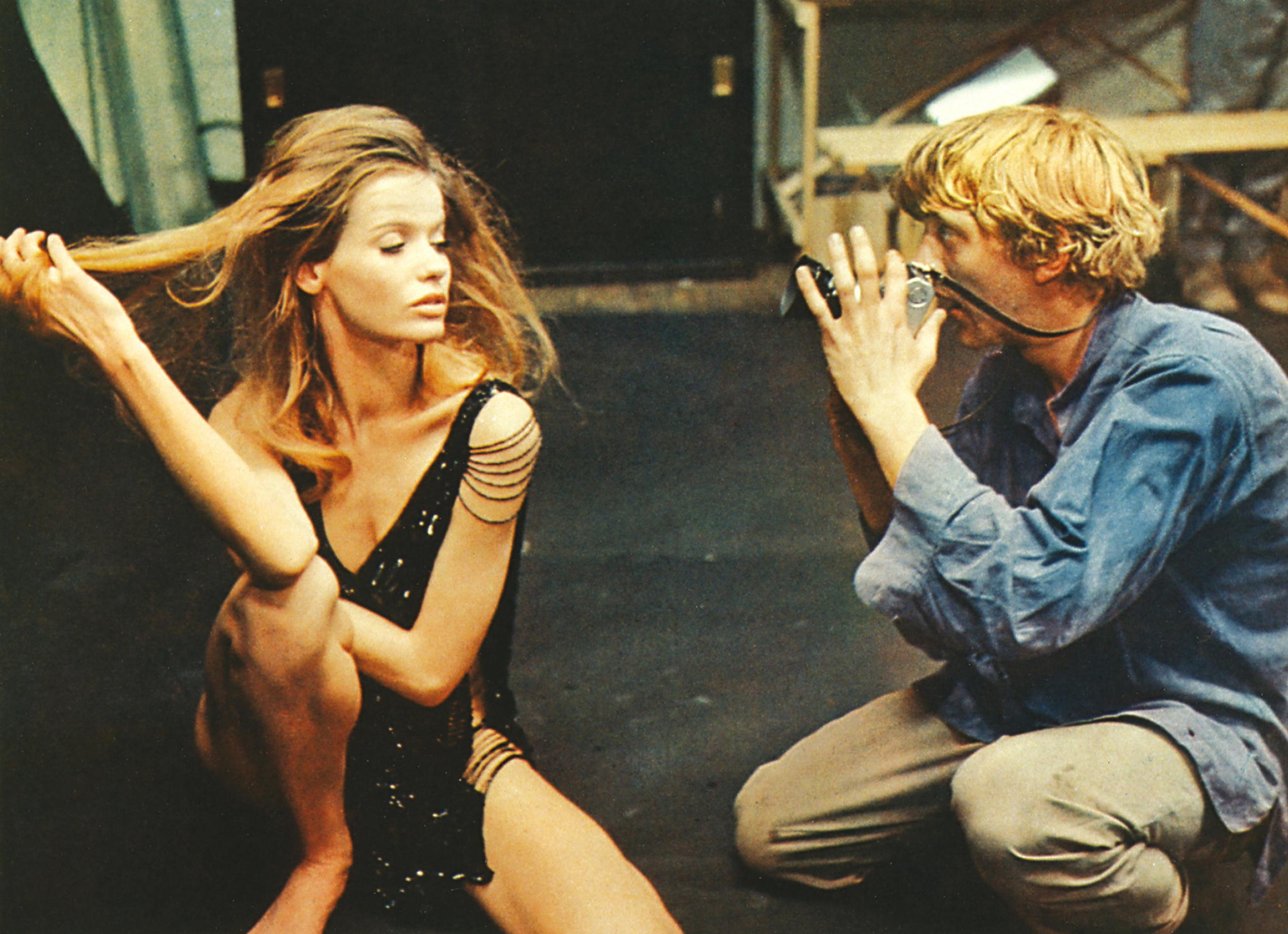
A still from “Blow Up”, one of the films screening in the Noir City DC Festival at AFI

Before the late night screening of Blow-Up at the AFI Silver Theatre on Saturday night, film scholar Foster Hirsch joked in his introduction, “It’s the witching hour … perfect for a drug-laden, sexy film.” The late hour of the screening was indeed an ideal complement to the evening’s context, as it brought to a close the first day of the AFI’s Noir City DC festival.

The festival, running through October 27, will screen 20 significant films from the film noir genre as curated by the Film Noir Foundation. Film noir is difficult to define, but characterized by its brooding dark themes, equally dark lighting, and an obsession with the gumshoe detective story. It has birthed such mid-century American classics as The Maltese Falcon and Rear Window, but its influence can be seen in today’s thrillers and parodies like Who Framed Roger Rabbit? The genre is considered a distinctly American form, and a representative from the Foundation – joining in Hirsch’s jovial mood – joked that she believed preserving it was “the most important work in the world.”

While she was clearly joking, the representative’s statement inspires a real question: Why have a film noir festival in 2016? With its morally gray male heroes and often villainous femme fatales, what about the film noir is worth preserving or reliving? During this final wind up to the election, one is reminded of Donald Trump’s campaign slogan, “Make America Great Again.” Those focused on preserving film noir – which had its heyday in post-World War II America – are in a sense idealizing the genre, making film great again, as well.

Saturday night’s screening brought audiences to another politically fraught period in our national history.

Blow-Up is an outlier both from the rest of the festival’s offerings and from film noir as a whole: it was released in 1966, it was filmed in color; and it was directed by Italian auteur Michaelangelo Antonioni. All of these elements make Blow-Up a far cry from the stark black and white Los Angeles so often seen in noir films. However, Hirsch argued in his opening address, the film is a “neo-noir” pulling plot tropes from those older films with nostalgia.

Blow-Up follows one day in the life of hip fashion photographer Thomas (David Hemmings) as he photographs models, cavorts around London, and stumbles upon a possible crime in a public park. After photographing a mysterious beauty (Vanessa Redgrave) in the park, he notices something suspicious in the photos as he develops them. It’s not clear to Thomas that he may have photographed a murder until he makes blown-up prints of the photos, tightening his focus on key details until the truth comes to light.

The film is an intriguing take on the film noir plot, possibly enhanced if you’re familiar with other films from the genre. The crime at the film’s center takes place in a park during the middle of the day, which is an unsettling contrast to the shadowy ne’er-do-wells of classic noir. Antonioni’s meandering cinematic eye also gives the viewer freedom to put the pieces of the puzzle together independently.

Blow-Up uses color to great effect within Antonioni’s well-crafted and visually stunning shots. The earth tones of an antique shop, the bright green of park grass, and startling blue of Hemmings’ eyes all make for memorable scenes. The film’s famous and fluffy scenes of fashion shoots are especially delightful; it’s almost as if Antonioni knew how outrageous Technicolor 1960s fashion would seem to future viewers.

What stands out most about Blow-Up in the current political climate is its representation of gender and gender roles. Most film noirs center on a shady man and a shadier woman, but this film turns that subtextual battle into text. As a fashion photographer, Thomas spends his entire day rolling around his studio with half-naked models (scenes which, again, add little or nothing to the plot.) His own femme fatale uses her sexuality to play him for a fool. His lover similarly refuses to leave her husband. What’s being communicated to straight men, then, about relationships is to always be the player and not the played; photograph the women, but never let them get to your heart because they are often cold, deceptive, untrustworthy …This may appropriately begin to sound like the public characterization of a certain candidate for the presidency.

That brings us back to the question posed earlier: what is being preserved when we preserve film noir? If film patrons hold nostalgia for genres from a time when civil rights were minimal for any but white men; when LGBTQA folks were unsafe outside the closet; when women were shackled to the home, perhaps they are then also holding nostalgia for that time more broadly. The Film Noir Foundation does important work preserving films, and making sure they’re not lost to history, but should some films (like some social attitudes) be lost to history?

Interested readers will have a good time taking these questions into the theater and deciding for themselves. The Noir City DC festival runs through October 27 at the AFI Theater in Silver Spring. Show times and more information is available here.

The article was originally posted on Urban Scrawl.

Not Short on Substance: LGBTQ Themes Featured in DC Shorts Film Festival

Just because a film is short does not mean it lacks substance. At least that is the philosophy of Derek Horne, Programming Lead for the DC Shorts Film Festival and Screenplay Competition.

“To explain films that have substance, I would like to use a food analogy,” he prefaced. “The films that I select for the ‘Menu’ taste good but are made with natural ingredients that are organic to the filmmaker’s experience and not made from artificial intentions. They have a substantive quality so the audience can process them more fully and they will stay in their system longer in a constructive way.”

Substantial themes and subjects are the focus of the 2016 DC Shorts festival, which will begin next month on September 8 and present 131 short films from 33 different countries.

After an open submission process earlier this year—yielding over 1300 submissions—the programmers initially created traditional screening groups offering diversity in terms of genre, subject, and style. However, eventually they reorganized the films based on common themes, creating 18 showcases, which cover everything from the scary to the seductive. These thematic showcases are an experiment by Horne and Joe Bilancio, who are taking the lead on programming for the first time since festival founder Jon Gann stepped down.

As Horne says, substance was essential to their selection of the films and their organization into showcases. That is most clearly reflected in a group of showcases called “Tackling the Issues,” which groups together filmmakers confronting particular political or social issues.

That emphasis on substance is also present in “10% Cinema,” the screening group for films with pertinent LGBTQ themes. The six shorts in the showcase encompass a variety of genres—drama, documentary, romantic comedy—but all highlight issues impacting the community.

Of particular note are the documentaries featured in that screening, two award-winning D.C. premieres.

These C*cksucking Tears, directed by Dan Taberski, comes to the festival after winning the coveted Jury Award for Documentary Short at the SXSW Film Festival in March. The short profiles Pat Haggerty, the man behind the only gay-themed country album ever made, a “gay urban myth:” the self-titled 1973 debut of his band Lavender Country.

A Scene from Pink Boy, DC Shorts

A Scene from Pink Boy (Courtesy of DC Shorts)

Eric Rockey’s film Pink Boy, another winner on the film festival circuit, explores the complexity of queer identity and gender in the relationship between parents and children. Jeffrey, the boy of the title, shocks his butch lesbian mother BJ when he starts to wear dresses. The film follows BJ and Jeffrey as they navigate how to live safely and happily as their most authentic selves.

Other films in the 10% Cinema screening include Vessels, a drama about a trans woman turning to the black market; two romantic comedies, Spoilers and Seeking: Jack Tripper; as well as Spunkle, a comedic short wherein a man considers becoming the biological father of his sister and her wife’s baby.

Special attention for LGBTQ themes and filmmakers during the festival is no surprise given Bilancio and Executive Director Kimberly Bush’s work with the LGBTQ-focused Reel Affirmations festival Bilancio has served as the festival’s Director of Programming. Bush began volunteering with Reel Affirmations soon after she came to DC in the late 90s and has since become its Director following a hiatus between 2012 and 2014.

Beyond highlighting substantial issues, the festival organizers have also focused on making DC Shorts more accessible to the community: 75 of the festival films will be available for streaming online and special family showcases will be available free of charge at public libraries throughout the District.

These accessibility programs are standard for DC Shorts, but Bush, Horne, and Bilancio have ambitious plans for new initiatives in the future.

“We would like to really be able to support the filmmakers through initiatives that not only help to ensure that their films get screened, but also to help them get made,” Bilancio said of preliminary plans for the 2017 festival. “The more we can do to ensure that shorts films will be seen is to help them get made and in the US that is a difficult thing to do.”

In the meantime, Bilancio and the rest of the programming team are focused on getting audiences engaged with all that the festival has to offer now.

“We hope that people understand the hard work and dedication the filmmakers go through to get the films made,” he said. “We hope that people take advantage of not only the films, but the parties and panels and take the time to interact with the filmmakers.”

While panels, parties, and films with innovative style are essential to the festival, Horne—extending his food analogy—continues to emphasize that audiences can expect authentic connection to the films, above all else.

“Sure, a film can be a taste sensation with exciting new ingredients, but the style is really just the cherry on the top. I want the audience to reflect on these films and remember them for a long time.”

Tagg readers can check out the DC Shorts Film Festival and Screenplay Competition starting on September 8, with the 10% Cinema showcase screening on September 11, 13, and 15 at E Street Cinema. Tickets and more information are available here.

This article was originally published with Tagg Magazine.

Queer is Beautiful in Outwin Exhibition at the National Portrait Gallery

Portraiture has long been a stand-in for political power — from the paintings of kings and nobles hundreds of years ago, to more recent snapshots taken in the struggle for civil rights. The National Portrait Gallery’s Outwin: American Portraiture Today exhibition, on display through January 2017, in part highlights the fight for LGBTQ+ rights and features five artists worth watching.

The exhibition was sourced from entrants to the Outwin Boochever Portrait Competition, founded in 2006. The Outwin Competition is open to any artist over the age of 18. While a panel of experts selects the pieces for exhibition, the open submission format results in an unusually diverse group of artists for a major museum exhibition.

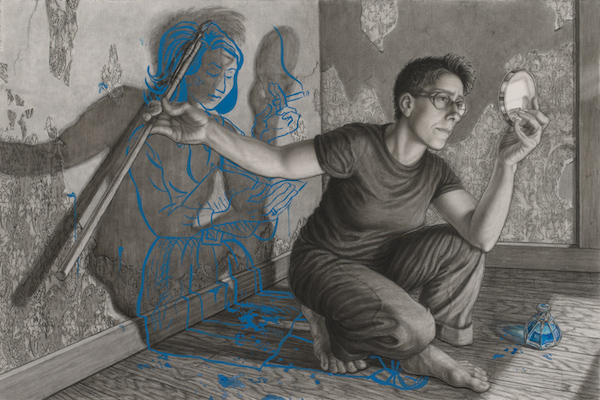
Riva Lehrer’s portrait of lesbian cartoonist Alison Bechdel was created on top of an image of Bechdel’s mother drawn by the cartoonist. Lehrer’s Bechdel may be haunted by the apparition of her mother, is crouched, perhaps about to spring up as if loosed from a cage.

Bechdel may not be a household name but she’s a celebrated subject, having won a MacArthur “Genius” Award following publication of her Pulitzer Prize nominated graphic novel (that has since been adapted into an award-winning Broadway show.)

Lehrer’s story is less well known. She was born with spina bifida and wrote, “Disability is the fuel of my work and the engine of my career.” In an interview with Allison Meier in 2013 she said, “Keeping biography with the body matters,” and a lot of the Outwin exhibit does exactly that.

Jess T. Dugan

Jess T. Dugan (Image courtesy of the National Portrait Gallery)

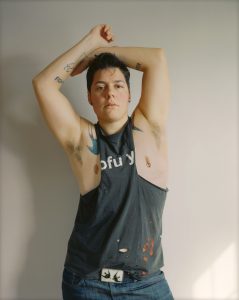
Photographer Jess T. Dugan’s image shows her standing with arms raised over her head, drawing the viewer’s eye to the hair on her armpits. Her eyes lock with the viewers and she is confident, vulnerable, and strong. Through a successful Kickstarter campaign Dugan recently published a book of photographs. In an interview about her work Dugan said, “I’m part of trans community; I’m not a lesbian and I’m not a gay man but I hang out in those spaces. I think I’m hyper aware of how my identity changes in different contexts.”

Continue Reading

Photographer Jim Dougherty’s Portraits of Mother Nature

Photograph by Jim Dougherty

Some lawyers attending a Sierra Club Board meeting in California might do a side trip to Hawaii, or San Fransisco. Jim Dougherty’s agenda is a little bit different. While he continues to work as a lawyer, his work as a photographer is gaining notice. And his side trip from a recent Board meeting to hike for a week in Utah could result in a solo exhibition at an art gallery.

“I don’t fly in airplanes for pleasure or photography, in order to reduce my carbon footprint,” Jim said recently. “And I haven’t used A/C for 20 years at home. My photo expeditions are taken only in conjunction with eco-business. I take side-trips to Yosemite or stop in Utah on the way back. My adult life has been devoted to defending nature… I take pictures to remind people of Mom Nature’s majesty – and to inspire them to step up to their responsibility to defend her.”

Death-Valley-Dunes-31

Photograph by conservation photographer Jim Dougherty. All rights reserved.

Dougherty is a heavyweight as a litigator (“I’ve done more sea turtle litigation than any other American lawyer,” he said) but during a quick tour of the Sierra Club headquarters last week, Dougherty paused to flip through a special edition book printed on the occasion of the Sierra Club’s centennial and paid special attention to the photographs. “I most appreciate,” he says, “the photos that say to me ‘This place should be enjoyed or protected.’”

The Sierra Club has a long history with conservation photography, a genre that captures the beauty of nature as an advocacy tool. Ansel Adams took photographs for the Sierra Club, and served for years on the Board of Directors. Still today the Club supports a conservation photography award in his honor.

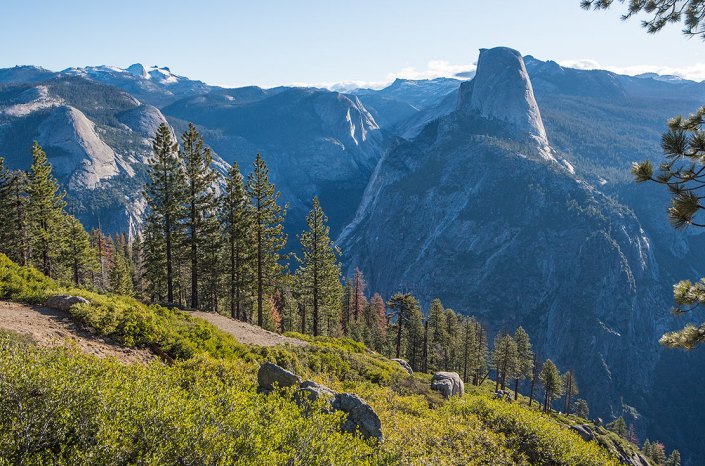
Dougherty continues in Adams’ tradition and the results are similarly majestic portraits of American terrain, at times surreally so. A dune in Death Valley lightly touched by the footsteps of a bird. Clouds perched between massive stone faces in Yosemite.

Taking the photographs requires immersion in the natural world, something you might sense as your eyes linger in the images. “The longest I’ve hiked for an image is two days out and two days back,” Dougherty said. “I wanted to take a shot of the sun setting on the Tetons from the west side, not the east. To do that you walk about 7 miles each way, but if you’re going to catch the setting sun you have to spend the night. That ended up being a 4-day, 30-mile backpack to get that one shot.”

For Dougherty, that kind of story is not uncommon. “Last February,” he recalled, “I hiked the 2.6 mile trail from the west side of Island-in-the-Sky, in Canyonlands National Park, to shoot the False-Kiva cave. I nailed the sunset shot and decided to wait to try and get a starry-sky image. I’d brought a sandwich and a liter of water, just in case. But the walk back, in the dark, proved treacherous. The trail was snowy and rocky and steeply uphill. At one point I got turned around and had to re-locate and at another point I slipped on a snowy rock and slid about 8 feet on my arse – with no damage but it was scary in the dark, and I dropped my flashlight.  It took over two hours to get back out, and I finally reached the car around 11.”

All of that for a shot that didn’t work out.

“The sunset shot was a winner, but the second not so hot,” Dougherty reported.

27719416086_80f7036814_o

Photograph by conservation photographer Jim Dougherty. All rights reserved.

If you visit the Sierra Club’s national headquarters a trio of Dougherty’s photographs face you in the lobby. Corporate art collecting continues to evolve as a business priority, and the practice recently received strong endorsements in Forbes and Seattle Business.

It’s not just in the lobby that you’ll see Dougherty’s work. Dougherty’s landscapes adorn much of the open wall space on two floors. The utility of displaying art has been confirmed by for-profit corporations including Progressive and Microsoft: it makes the spaces more welcoming to work in.  Studies have shown a positive correlation between office artwork and productivity.

Co-working space COVE, which has seven locations in DC, features local art on the walls of all its locations. Adam Segal, founder of COVE, said, “Art plays such an important role in the creation of place, particularly in the look and feel of a physical space. We know art helps us create spaces where people feel welcome, productive and connected to their surroundings.”

“People want to feel loved, and when any worker sees that the company has spent some time and expense to make the workplace beautiful it helps the office culture,” Dougherty said. “When you look at these photos, your eyes have a longer focus… They help you look out into the world.”

Overall, Dougherty’s outlook is grim: “We are losing the war to defend the environment.” But he has an optimistic outlook for the future of conservation photography. “Maybe there’s so much access to these kinds of images that people develop an appreciation that there is a whole beautiful world out there,” he said. Looking at his images its impossible not to agree that there is.The well-trafficked Sierra Club offices ensure that Dougherty’s work has some consistent exposure, but he’d like to do more to distribute his photographs in the name of activism. He happily sells his work at cost with the goal of getting more eyes on nature, and more hearts dedicated to the work of nature’s preservation.

This piece was originally posted on UrbanScrawl.

DC African-American Artists Challenge Stereotypes at Phillips Collection

During a recent panel at The Phillips Collection, Washington, D.C.-based art collector Henry Thaggert asked the public to consider an ongoing debate in the art world: whether or not art shows that only showcase artists of one race are “good” or “bad.”

Historically, African-American artists have been disenfranchised from the gallery/museum system, but new efforts at inclusion also create new complexities. Even writing about these issues is complex. Are we talking about Black artists, or African-American artists?

Does it matter if a work of art is made by an African-American? Broader still, does the identity of any creator matter to the artwork?

Organized by D.C.-based organization Millennium Arts Salon the panel June 11th focused on the issue in relationship to contemporary visual art. Founded by the wife and husband team of Juanita and Melvin Hardy, the vision of Millennium Arts Salon is to “advance cultural literacy,” and the Salon manages a collector’s club focused on the collection of African-American artists.

Thaggert was joined on the panel by Phillips Collection curator Vesela Sretenović, artists Sheldon Scott and Amber Robles-Gordon, and moderator Jessica Stafford Davis (of The Agora Culture.)

Thaggert posed his question in the context of the well-regarded 2013 exhibition 30 Americans, which featured 30 African-American artists. Thaggert, a patron of the Corcoran Gallery of Art, noted he was “instrumental in bringing 30 Americans to the Corcoran.”

“The exhibition fed a certain hunger and a certain interest,” Thaggert said.

That exhibition received broad coverage not only for the included artists and artwork, but as a call for galleries and curators to stop overlooking and undervaluing art by African-Americans.

However, as a thought experiment, Thaggert raised a number of potential concerns presented by single-race exhibitions like 30 Americans. Single-race exhibitions can become complicit in diminishing the universal power of art, can force art to serve as an ambassador for racial issues, and can over-simplify the diversity of included artists.

According to Thaggert, some critics describe 30 Americans as being “enslaved by generalizations.”

Playing devil’s advocate, he asked the audience, “Why should a Kara Walker painting hang next to a Kehinde Wiley painting when these artists and the objects themselves have virtually nothing in common, except the most general of generalizations?”

He continued by noting that several commercially successful African-American artists have subsequently expressed ambivalence and even anger about their inclusion in the show. “These black artists felt like they lost control of their own narrative,” he said.

All-That-I-Am-by-Amber-Robles-Gordon

“All That I Am”, 2015, by DC artist Amber Robles-Gordon

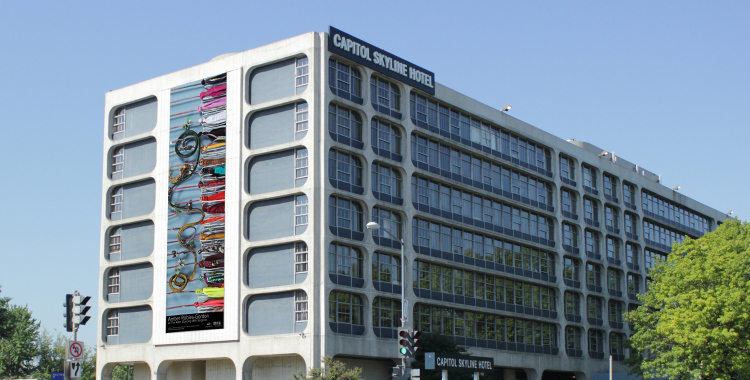
Panelist Amber Robles-Gordon stated that her racial identity is an essential part of her narrative as an artist. Robles-Gordon’s fabric creations sometimes suggest the braids of a young woman, or traditional African artworks. On close inspection the individually torn strips of fabric from which she creates indicate trauma, but the completed works – tethered to the wall of a gallery or the side of a building – are more elevated and nearly-religious.

“My artwork is an intricate part of my identity…. It is an expression of myself as a whole person; art is a reflection of the artist who is producing it,” Robles-Gordon wrote.

Phillips Collection curator and panelist Vesela Sretenovic argued that though the artwork should be central, the context of history and the artist is nearly as important. “[Y]ou cannot decontextualize a work of art,” she said. “You have to be responsible to your community, so you have to factor in the historical conditions.”

Art collecting regularly intersects with unresolved and complex issues of race and identity. Highly-coveted pieces of classical and contemporary art have inadvertently celebrated racist stereotypes and imagery. Curators have questioned the segregation of “indigenous” art from the commercial mainstream. And artists of color have been notoriously neglected by major museums.

The effects of racial identity are not always obvious, according to Amber Robles-Gordon. “While, I have never been explicitly told you didn’t get this award, grant money or get into this exhibition because you are a black woman, I have found that the signs have been relayed in the subtext, micro aggressions, tone of voice, choice of words and or body language.” Even worse, she adds, is “being utterly ignored.”

With the presentation and collection of art nearly saturated with issues of gender and racial identity, it’s hard to believe that an artists’ race will be unimportant in the near future. African-American art collector and curator Dr. Kenneth Montague expects fewer general surveys like 30 Americans and more exhibitions of individual African-American artists. Rather than a future with an inhibited focus on the racial identity of the artist, he sees a future that is able to study the many different ways of being African-American.

Montague suggests the problem with general shows like 30 Americans is that it can cause the public to believe that those are the only African-American artists worth collecting, but went on to note that in the last 10 years he’s seen awareness of African-American artists, and the value of their artworks, increase.

“[10 years ago,] you didn’t see them in magazines and journals. You didn’t see a lot of articles written. I would save the articles because they were so few and far between, but now I can’t keep up,” Montague said.

To maintain this trend and ensure it doesn’t eventually fall off, Montague said that there need to be more African-American curators, gallery directors, and collectors.

Robles-Gordon, however, questioned whether curators, gallerists, and collectors are the right authority to determine art’s organizing principles: “The fact that we give the perceptions that collectors, critics or commentators have more value [than artists] is a metaphor for the structure of our society.”

This post has been updated (7/6/16) to clarify panelist Henry Thaggert’s position on single-race exhibitions, and involvement with the exhibition 30 AmericansThe post was originally published on UrbanScrawl.com and features reporting by Michelle Goldchain.