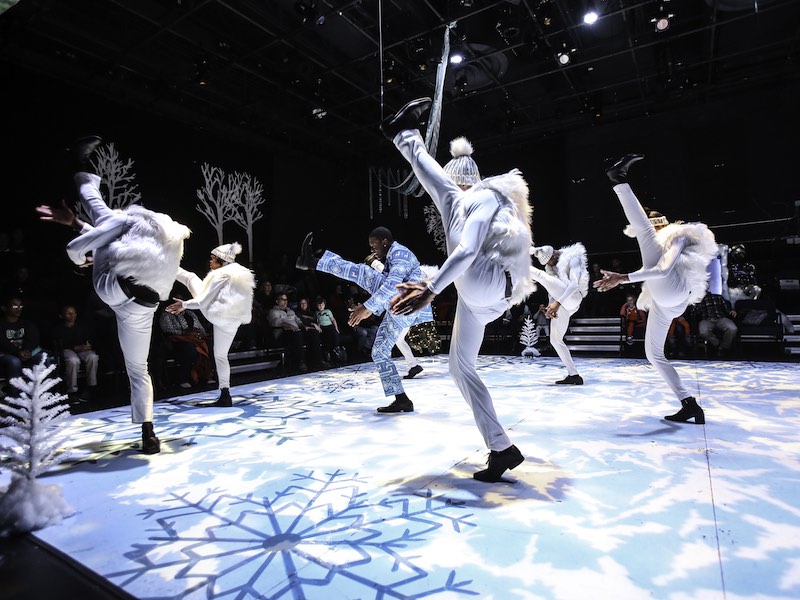
Step Afrika!’s Magical Musical Holiday Step Show dazzles at Arena Stage

By Ajani Jones

This article was first published in DC Theater Metro Arts on 12/16/22 here.

Amidst these times of holiday cheer and yuletide merriments, Step Afrika! throws its hat into the ring of festivities with an hour and a half of unabashed excitement and step-themed entertainment.

Step Afrika!’s Magical Musical Holiday Step Show is indeed magical. In roughly an hour and a half of unapologetic fun and joy, the Step Afrika! team rings in the holidays by seamlessly combining beloved classics and modern hits, all the while dazzling the audience with the nonstop energy one would expect from a step show.

Step Afrika!’s Magical Musical Holiday Show is divided into several performances and fun segments that all leave the audience awed. The show is led by a dynamic duo, the splendid host Ariel Dykes and the energetic DJ Nutcracker (Jeeda Barrington). The pair do a phenomenal job of engaging the audience and maintaining energy as the show transitions between a slew of dazzling performances. From a fantastic drum and dance spectacle to a later step-off between factions of the Step Afrika! ensemble, the dancers’ energy never wanes as they take the stage with unwavering charisma and give their all in stellar displays of talent and powerful and graceful moves.

From start to finish the show keeps its audience engaged. There is never a dry moment, especially as many of the show’s segments allow for plenty of audience participation through cheers, calls and responses, and even an all-out interactive dance lesson courtesy of Ariel and DJ Nutcracker. On another occasion, DJ Nutcracker invites the audience to the dance floor to fully embrace the spirit of the show and dance. And dance they did. Audience members flocked to the beautifully decorated stage to demonstrate their dance moves. Moments like these interspersed throughout the already fantastic choreographed performances cemented this show as a fun time for all ages.

Beyond its high energy, the show is steeped in unrestricted creativity, from fantastic costumes to thrilling musical accompaniment. As the raw rhythmic flair of several of the unaccompanied step performances captivates the audience, modern beats tie into familiar holiday classics helping to really elevate the show while keeping the audience grooving alongside the dancers.

The show also excels in its less active but equally phenomenal technical elements. The intricate detail put into designing the show is honestly breathtaking. From a stage made to look like an ice-skating rink to minute details like light snow falling in intervals throughout the show, the scenic design helps enhance the already amazing energy of Step Afrika!’s performances and deliver on the holiday magic advertised for the show.

The lighting and sound elements, designed by Marianne Meadows and Misha Michel respectively, are also incredible. The show is brilliant and colorful, but never overwhelming in its displays of dazzling lights that add an extra layer of magic to each new segment. The sound design is also clear and bright, perfectly punctuating moments of high energy with brilliant beats and tunes that never overwhelm performances or drown out the performers.

Ultimately, the show was nothing short of incredible. With its high-energy cheer and magnificent displays of stepping, Step Afrika!’s Magical Musical Holiday Step Show is a holiday season must-see.
Gay Men’s Chorus rings in the holidays with LGBTQ warmth, joy, and love

By Jakob Cansler

This article was first published in DC Metro Theater Arts here.

I heard the Gay Men’s Chorus of Washington, DC sing “Underneath the Tree” by Kelly Clarkson twice during their Holiday Show. The second wasn’t planned, but it did speak to the chorus’s commitment to spreading joy through music during the holiday season.

The show was going great when, just five songs in, a hauntingly beautiful rendition of “Noel” featuring soloist Cooper Westbrook was interrupted by a rather rude fire alarm, which sent the chorus, myself, and the rest of the audience outside temporarily.

Rather than bemoan the inconvenience, though, the chorus saw an opportunity. In the back parking lot on a chilly night, they reprised the opening number a capella ⁠— like a backlot version of Christmas carolers. How they sounded didn’t matter this time. It was a delightful moment ⁠— one of many at the Holiday Show.

An annual tradition, the Gay Men’s Chorus Holiday Show this year once again continued its theme of spreading warmth, joy, and love while uniquely celebrating the LGBTQ community.

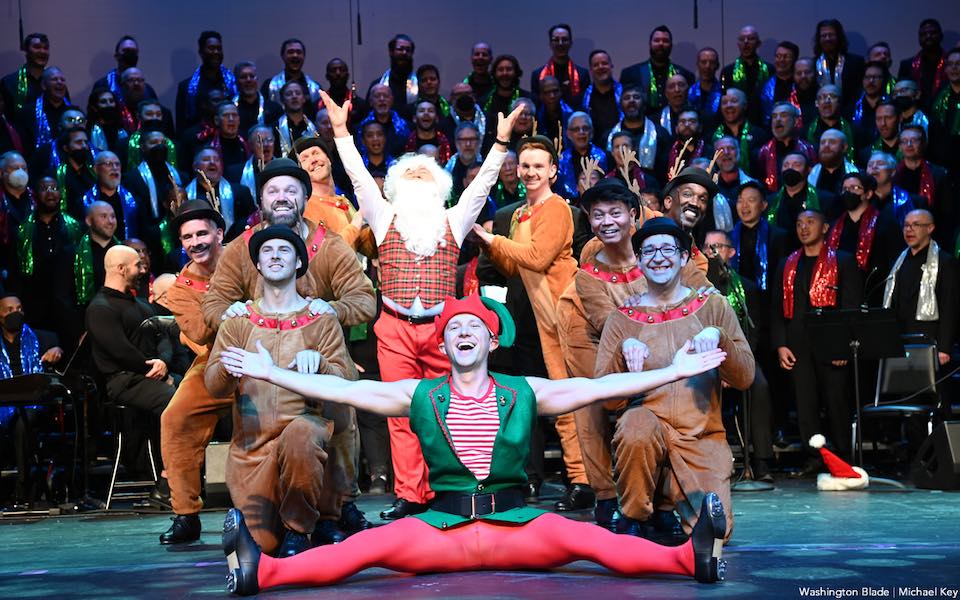
Those themes were on display in exciting numbers like “Underneath the Tree” or “Sleigh Ride,” the latter of which featured a downright jolly set of tap-dancing reindeer choreographed by Danny Aldous.

Those performances set the tone for an all-around entertaining evening and a great way to ring in the holidays. From there, the chorus displayed an impressive variety of styles that showcased the depth of their talent.

Led by Artistic Director and Conductor Dr. Thea Kano, who has helmed the chorus since 2014, the ensemble’s vocal strengths were particularly on display in “God Rest Ye Merry, Gentlefolk” and the aforementioned “Noel” (which Westbrook did get to restart and sounded just as good the second time). Perhaps most haunting, though, was Bilvavi, a beautifully performed song in Hebrew that demonstrated the strength of the ensemble.

The Seasons of Love ensemble also showed their chops with songs “Mary Sat a Rockin’” and “Joyful, Joyful.” The singers brought a passion and warmth that was infectious. The GenOUT Youth Chorus, meanwhile, performed a stirring “Los Pastores a Belén.”

And of course, it wouldn’t be a Gay Men’s Chorus show if it wasn’t, well, gay. “Bells, Bows, Gifts, Tree” ⁠— Todrick Hall’s holiday version of one of his ballroom hits ⁠— certainly fit that bill. Featuring choreography by Craig Cipollini and James Ellzy, who also choreographed many of the other songs, “Bells, Bows, Gifts, Trees” was a spectacle to behold. That number also featured the Chorus’ traditional Holiday Queens, who were literally dressed as Bells, Bows, Gifts, and Trees, as costumed by Jeffrey Hollands and Gary Turner.

In another tradition, the show featured multiple songs from the queer canon that had been hilariously spun to fit both an LGBTQ and holiday theme. That means “It’s Raining Men” became “It’s Snowing Elves,” sung by the Potomac Fever ensemble.

Later, “Holding Out for a Hero” got a Christmas twist in a show-stopping performance in which Santa is the hero of the song. Soloist Gabriel Lopez commanded the stage (and audience) in that song, which made for a great buildup to the finale.

“12 Rockin’ Days,” a high-spirited rendition of “Twelve Days of Christmas,” closed out the show, and it carried with it the overarching theme of the night: pure, unadulterated holiday spirit. Sometimes that meant over-the-top joy. Sometimes it meant a thoughtful, heartfelt note. Without a doubt, though, the entire time was a great way to ring in the holidays.

Richard Burton makes a cameo in ‘Playing Burton’ at Scena

By Jakob Cansler

This article was first published in DC Metro Theater Arts here.

There are, I would guess, two kinds of people who might be interested in a play like Playing Burton, a one-man show about the life of Richard Burton

The first would be someone who has a particular interest in Burton, someone who already knows a lot about the star of stage and screen and wants to see him brought to life and maybe learn a thing or two about him.

The other would be someone who is less interested in Burton specifically and more interested in the larger themes present in Burton’s life ⁠— fame, celebrity, tragedy, etc. ⁠— and what they can tell us about humanity.

Both are technically present in Playing Burton. Unfortunately, neither are executed in a particularly compelling or dynamic way, even as glimmers of a more effective show appear from time to time.

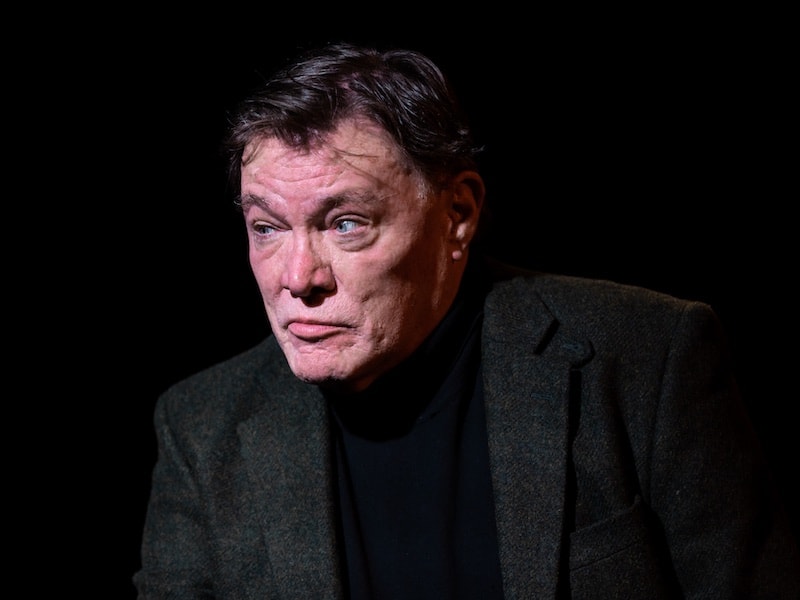
Playing Burton, which was written and directed by Mark Jenkins first in 1992 and is now being presented by Scena Theatre at the Atlas Performing Arts Center, begins with radio reports of the famed actor’s death in 1984. Burton, played by Brian Mallon, appears in the darkness to tell us his story. In a stream-of-consciousness monologue, he weaves his way through his life: how he was born Richard Jenkins, how he grew up in Wales and was adopted by Philip Burton, who taught him to speak and act. He recounts his rise to fame, his critics, his marriages, his affairs, his adventures, his alcoholism.

He jumps from moment to moment quickly, picking up subjects and dropping them like toys to keep his mind busy. Sometimes that means reenactments. Sometimes it means tableaus. Often, it feels like you might be one step behind.

There isn’t any information in this show that can’t be found elsewhere. Frankly, most of it can be found on Burton’s Wikipedia page. But there is, at least in theory, something to be said for embodying a memory rather than reading it. A Wikipedia page has, after all, just two dimensions. Live theater has three.

In an ideal world, Playing Burton would bring the man and the myth to life ⁠— to present us with an understanding of Burton that can only be experienced live.

Unfortunately, Jenkin’s script doesn’t ever quite succeed in doing so. Burton’s oration relies heavily on telling rather than showing. He reveals the things that happened to him but rarely communicates how he feels about it. That makes for a monologue that often feels like a lecture, like a professor who gets distracted and starts talking about their personal life.

To be sure, Mallon’s performance does feel life-like. He puts on an impersonation of Burton that does seem three-dimensional in nature. It is an embodiment that is necessary for a show like this, but one that also requires a strong foundation in the script, and that foundation is largely missing.

The staging, too, doesn’t give much of a foundation for Mallon to build a dynamic performance off of. The bare-bones set by Carl Gudenius serves its purpose well, but doesn’t offer much beyond basic functionality. The staging, too, often appears either arbitrary or monotonous ⁠— long sections are delivered standing in one spot.

Still, there are certainly moments when Playing Burton seems to find some narrative to tie all these disparate recounts and tableaus together. In particular, there is the repeated theme of Richard-Burton-as-a-Shakespearean-character. He played, after all, many famed Shakespearean heroes in his life, and he longed to play more. In Jenkins’ play, Burton sees his life through the lenses of King Richard III, of Hamlet, of Macbeth. Burton likens himself to them and their fame, power, and influence. He perhaps also likens himself to their tragedy.

There is a similar recurring theme likening Burton to an invented character. “The greatest role Richard Jenkins ever played,” he says, as if he somehow separated from his true self and became a persona in order to achieve the fame he desired. This raises questions: Does Burton regret leaving his old self behind? Was the fame worth the sacrifice? Is Jenkins gone forever?

The latter theme is clearly the more compelling, but it is also less explored, relegated to a few minor references. It’s a shame, because it is in those moments that the potential of Playing Burton becomes visible.

As a result, either type of person interested in a play like Playing Burton will surely find suggestions of what they are looking for, but also a disappointment that the show rarely capitalizes on those suggestions to become the more compelling work that it could be.

Kid-friendly ‘Rapunzarella White’ at Best Medicine Rep is a fairytale mashup

by Ajani Jones

This article was first published in DC Metro Theater Arts on 11/29/22 here.

With their simple premises — a beautiful princess rescued from her wretched fate by a chivalrous prince — and often compelling narratives, fairytales have cemented themselves as a beloved staple in pop culture. And over time, many artists have challenged themselves to flip this formula on its head and defy expectations, often with amusing and charming results.

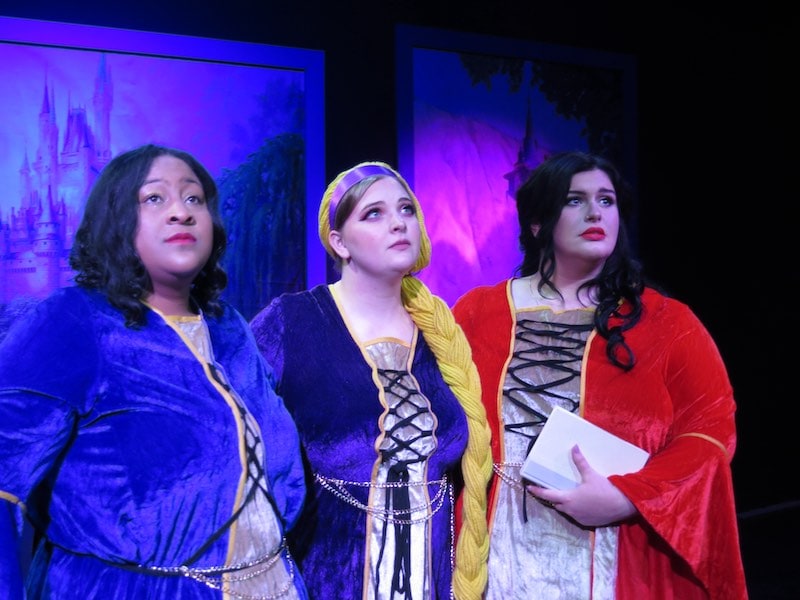
Rapunzarella White takes this challenge head-on in a uniquely charming fairytale adventure. The family musical by June Rachelson-Ospa and Daniel Neiden follows three classic fairytale princesses: Rapunzel, Cinderella, and Snow White. The three, now sisters, have been separated from one another and condemned to ill-conceived fates brought on by a curse at the hands of a wicked witch. Hijinks ensue in this fun family adventure progresses as the princesses await their fated princes to break their wretched curse.

Despite its unique premise, Rapunzarella White falls flat with its narrative. The musical’s story leans heavily into its fairytale roots and plays on every trope imaginable: wicked witches, curses, and the fan-favorite true love’s kiss. But rather than taking a unique approach to each of the above-mentioned fairytales, Rapunzarella White relies heavily on the cultural significance of these tales and never feels like it gets to tell a story of its own. The musical takes no real narrative risks and as a result feels like a disappointingly haphazard story born of an infinitely more compelling premise.

Make no mistake, the cast in the production at Best Medicine Rep is phenomenal. Under the fantastic direction of Jacqueline Youm, each cast member does an amazing job of bringing their respective roles to life, a respectable feat especially as most of the cast had to take on dual roles. Nathan Peterson’s Syd the Fairy Godbrother, Rebecca Heron’s Witch, and Carolina Tomasi’s Burly Bob were especially noteworthy as these characters felt the most unique and genuinely interesting throughout the performance.

In spite of the entertaining cast, though, there was simply not much to work with for the audience to resonate with. The one-note characters left much to be desired in terms of motivation, leaving adults in the audience struggling to connect with them.

The humor of the show similarly struggles. Throughout, the jokes are far from explicitly bad but rather consistently boring. There were a few chuckle-worthy moments, but as a whole, the show made no real effort to play around with its premise and expand on the humor that could have been born from this.

Where the show really shines is its musical elements. The roughly hour-long show is almost entirely composed of songs, and each is more charming and sonically pleasing than the last. Where the narrative and humor lack, the show more than makes up for it in music. The sisters’ rendition of “Woe Is Me” is incredibly touching and helps to truly contextualize their shared yearning to be rescued by a prince. “Razzle Dazzle ‘Em” and its reprise are upbeat and fun, leaving the audience genuinely entertained as Syd prepares Cinderella (Jessica Long) for the ball. Each member of the cast is also musically gifted, which shines through most in ensemble numbers like the final “Love Is All,” where their voices blend beautifully. Alongside the cast’s excellent musical delivery, the instrumental accompaniment, directed and arranged by Angela Small and Charles Czarnecki respectively, were phenomenal.

The overall technical aspects of this production of Rapunzarella White were also wholly entertaining. The brilliant lighting and sound design by John Morogiello elevated what was otherwise a simplistic set to something truly whimsical and straight out of a fairytale. These technical elements breathed a welcome breath of fresh air into the production.

In hindsight, Rapunzarella White struggled due to the limitations of family theater. It was clear throughout that many of the authors’ choices in the material, from its safe narrative to its simplistic characters, were only made to appeal to the younger end of the “all ages” spectrum. While this is understandable, the musical’s compelling premise and phenomenal cast could have thrived in a less restricted format.

Ultimately, Rapunzarella White does what it’s supposed to. Despite its flaws, the musical is still enjoyable in a general sense and able to fulfill its primary goal: to tell a story fit for the family, clichés and all. Although the show does nothing particularly interesting with its narrative or characters, it also doesn’t do anything so overtly poorly that it would dissuade all audiences from giving it a chance.

Civic and silly meet in new Washington Improv Theater series at Studio

By Jakob Cansler

This article was first published in DC Metro Theater Arts here.

Can improv comedy change the world? Can it move society forward, instead of setting it back?

Those are the questions Washington Improv Theater is asking over the course of the next month in its new series now running at Studio Theatre,  Ask Me Anything: Changemakers.

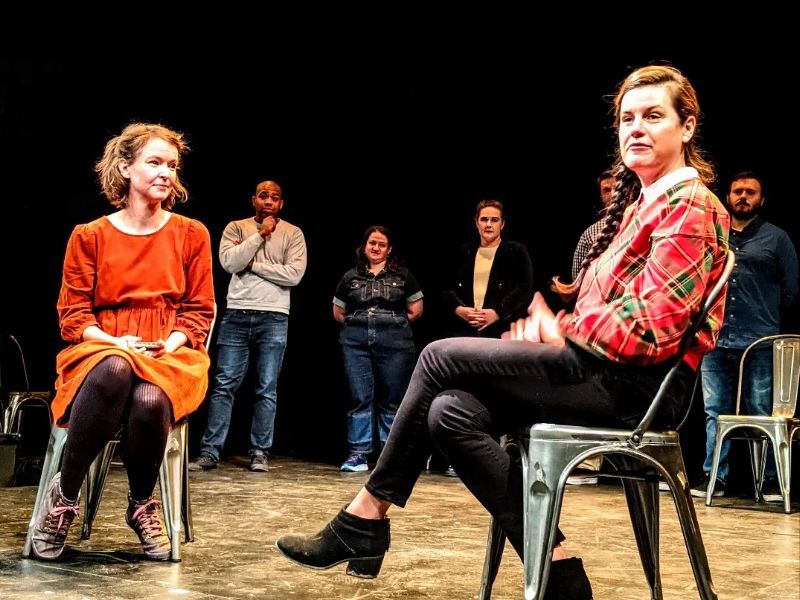
Each performance in the series features an interview with a DMV resident who is “working to make the world a better place,” which the improvisers then use as inspiration for a comedic performance right after. WIT has lined up an impressive slate of local activists, artists, and policymakers for the series, and since each night features a different interviewee, every performance is unique for both the performers and the audience.

A recent performance featured Erin Palmer, a DC activist who serves as an Advisory Neighborhood Commissioner (ANC) ⁠— a hyperlocal elected volunteer position designed to advise the DC City Council (a job description that Palmer very helpfully explained to the audience). She also recently ran a surprisingly competitive primary challenge against Council Chairman Phil Mendelson.

In the interview portion of the show, Palmer described her background as a lawyer, the experience of local politics, running a campaign against Mendelson, the changes she’d like to see in city government, and what it’s like working with residents to improve her neighborhood and the district at large.

One resident, for example, was obsessed with solving the citywide rat problem, which meant Palmer needed a rat platform.

“What is your rat platform?” an audience member immediately asked.

Palmer’s “rat platform” ⁠— dry ice, for what it’s worth ⁠— led to a hilarious recurring bit during the improv portion of the show in which the rats of the city campaigned to have their own ANC. The candidate? John Quincy Ratams, who is firmly anti-dry ice and pro-dumpster.

That’s just one example of how the performers spun Palmer’s interview into a unique comedic performance that blended together typical improv techniques with specific local humor. The performers also poked some good-natured fun at neighborhood cleanups, Palmer’s job as a lawyer, and Rock Creek Park.

“I was afraid going in because change-making ⁠— sometimes it’s very serious business,” said Bill Nelson, one of the performers, after the show. Instead, Nelson found the discussion to be low-stakes and conversational, so the audience got to hear both the “serious business” and the sillier side of local politics, the latter of which provided inspiration to the improv performers.

The result was a show that took a normally complicated and serious topic and turned it into something accessible and funny.

“I think a lot of people don’t care for local politics,” said Palmer after the show. “When you put it in a way that’s enjoyable and easy to digest and humanizing, that can grow people’s interest, and maybe they’ll see something different that they didn’t see before.”

Indeed, the hope for WIT is that the entire series can have that effect ⁠— that the interviews and performances put together can serve as education and inspiration as much as they are entertainment.

“I think it’s really great to get community members like Erin talking about something so important that many people may not be invested in initially,” said Eddison Wilkinson, another performer. “It’s awesome that you get to have a nice, funny night as well as learn about these wonderful, important things in our community.”

Nelson and Wilkinson also said they see a lot of similarities between improv and local politics, and that hopefully a performance like this can help the two distinct fields inform each other.

“One of the key elements of improv ⁠— successful improv ⁠— is shutting up and listening,” said Nelson. “Clearly, in the world of politics, there needs to be a lot more listening.”

It’s not just local politics, though, that WIT intends to tackle through this production. Coming up, WIT has shows featuring highly acclaimed local artist and activist Holly Bass (November 26), trans activist Charlotte Clymer (December 9), and Dixon Osburn (December 10), who played a pivotal role in dismantling “Don’t Ask, Don’t Tell.”

As a result of the wide variety of guests, each night will be completely unique. For the audience, that means a lot of exciting and distinct viewpoints on change-making. For the performers, it presents a unique challenge and an opportunity for learning and inspiration both onstage and off.

Onstage, Wilkinson said, he tackles that challenge by always thinking: “What can I listen and take away from this person to help us push forward and not just be at a standstill or be at a moment where no one can say anything and no one can move anywhere?”

That question, he said, applies offstage too, and he hopes it’s the question audience members take away from the show. It’s also the question embodied by the slate of guests Washington Improv Theater has lined up.

“It became very clear that Erin Palmer is just an ordinary person who then saw something that needed change,” said Nelson. “I hope that we can all take the idea that no matter how ordinary we are, we can participate. I think that’s pretty inspirational.”

A fresh look at ‘La Llorona’ Latin American folktale from We Happy Few

By Jakob Cansler

This article was first published on DC Metro Theater Arts here.

Who knew a scarf could be so many things?

Evidently, the directors of We Happy Few’s production of La Llorona do. The numerous scarves featured in the show are folded, knotted, bundled, and waved in a variety of ways throughout the show. They drape over the sets and stand in for weapons. They signify wealth and gender. And yes, of course, the scarves are also a symbol.

The use of fabric, though, is just one example of the creative staging on display in the premiere production of La Llorona, written by local playwright and actor Gabby Wolfe and now performing at Capitol Hill Arts Workshop.

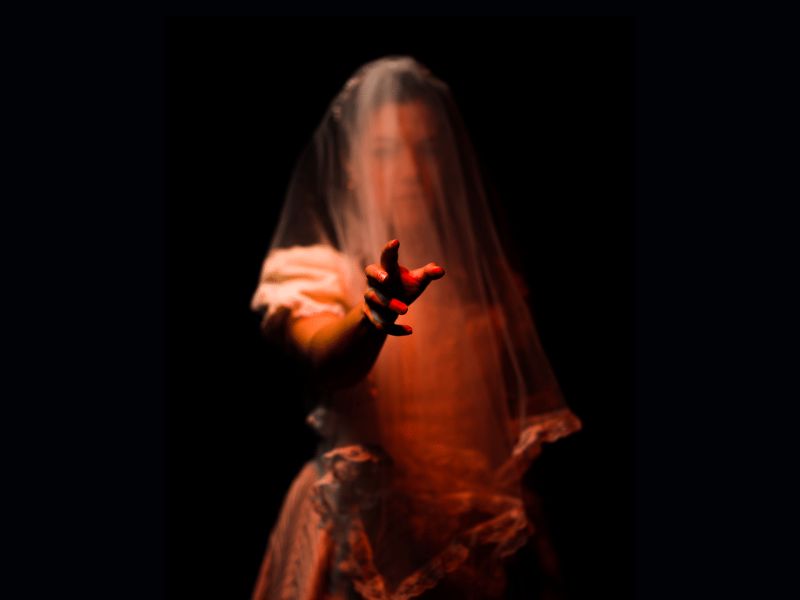
The story of La Llorona ⁠⁠— which literally translates to “the wailing/weeping woman” ⁠— is not new. It is based on an oral story that has been passed down for centuries throughout Latin America and is pervasive throughout the culture there. It is a tale told at bedtime, a warning for children, a ghost story ⁠— I saw the production on Halloween, which was fitting. It is a staple of Spanish-speaking popular culture but has never managed to break through American culture more broadly.

Wolfe intends to change that with this production, at least on a local scale. Her version of La Llorona was first presented as a staged reading last year as part of We Happy Few’s “Expanding the Canon” initiative, which aims to shed light on classic stories and works by minority and non-Western artists.

To tell this story, Wolfe has expanded the original tale to a more fleshed-out narrative. This La Llorona now centers around the story of Esperanza (played by Wolfe), a seamstress in a small town in Latin America who is swept off her feet by Don Hernan (Victor Salinas), the heir to the local mining operation who has moved there from Spain. They fall in love quickly, but differences in class, ethnicity, and gender threaten to tear them apart. The story quickly turns more tragic than romantic.

After all, this is a ghost story, not a love story. That much is clear from the beginning.

Wolfe bookends the story of Esperanza with a present-day conflict between mother and daughter. It’s a smart storytelling technique that links the folktale of “La Llorona” to the present day, an important connection to make since audiences here are likely not aware of how well-known the story still is today throughout much of Latin America.

And yet, this connection could also have benefitted from deeper exploration. As with any oral story that is passed down for centuries, there is an overarching question here: Why has this story remained pervasive for so long?

There’s room in this play to explore more of what “La Llorona” can and can’t tell us about Latin American identity (or more specific sub-regional identities) today. After all, understanding the stories that shape cultures helps us understand those cultures, and I’d be interested to hear more of Wolfe’s perspective on that through this play.

Still, as presented, La Llorona works well for a theatre company like We Happy Few, which specializes in stripped-down, imaginative stagings. This production is no exception.

The three-person directing team of Rachel Dixon, Esteban Marmolejo-Suarez, and Kerry McGee has utilized a small space to its fullest, turning a tiny blackbox into an intimate thrust stage that gives the production a gathered-around-a-bonfire feel, as if you’re seeing a late-night ghost story come to life before your eyes.

The use of fabric only adds to that, and gives the production a spooky air. Cloth makes up almost the entirety of the haunting scenery by Megan Holden and versatile costumes ⁠— the ensemble cast switches out scarves to differentiate the dozens of characters ⁠— by Sabrina Simmons.

The cloth and scarves also successfully give the show a simultaneous cultural specificity and symbolic universality: Esperanza is both one woman and every woman as her story is passed down from her time to our time.

And therein lies the thematic heart of Wolfe’s work. La Llorona is a ghost story, yes, but the monster we see is haunted just as much as she haunts ⁠— and that feeling will sit with you long after it scares you.

Heartfelt hilarity among two castaway couples in Andy Weld’s ‘Stranded’

By Ajani Jones

This article was first published in DC Theater Arts on November 17, 2022 here.

What would you do if you were stranded on a deserted island?

At some point, many have been asked this strange yet common ice-breaker at one social gathering or another. Despite the seeming randomness of the question, the scenario itself is just enough within the realm of possibility to yield genuinely thoughtful, more often than not satirical, responses.

This uncanny hypothetical has somehow crept its way into all facets of pop culture, from books to movies and even theater. In his own unique attempt to capture the unique blend of satire and insight that this odd question breeds, Writer/Director Andy Weld has repurposed the time-honored desert island scenario into the wonderfully hilarious but equally insightful Stranded.

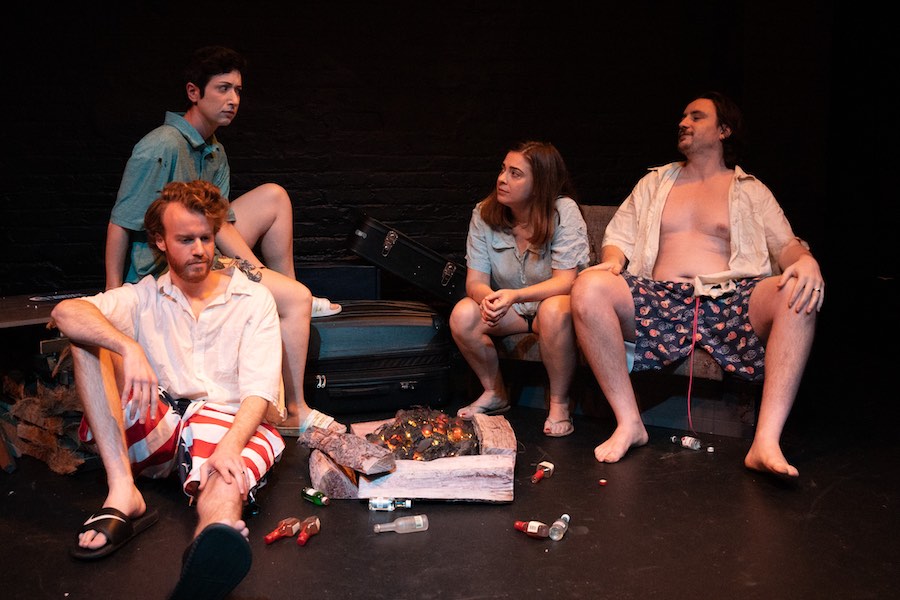
Stranded follows two couples cast away on an uninhabited island following a freak plane accident. After four months of surviving together, the two couples, while navigating the immense stress that comes with such a life-changing accident, have fallen into a strangely comfortable rhythm. However, this new routine is put to the test as the couples continue to learn about one another and face new challenges in their relationships that threaten to exacerbate the stress they are already facing.

The play opens as Serena (Isabelle Solomon) makes yet another, ultimately fruitless, attempt to leave a message for passing planes to come to their rescue while her partner, Jack (Drew Larsen), watches amusedly. As the play progresses, the other couple, Harry (Griffin Duy) and Emma (Sabrina Shahmir), join the pair, and the two couples continue to navigate their strange new dynamic together. It’s later revealed that Harry and Emma have an open marriage, and the fallout of this revelation is felt throughout the rest of the show.

From the play’s opening minutes, it’s clear that these two couples have genuine chemistry. Within each pairing, the actors convincingly portray the tender love and care that exists for them: as Harry gently reassures Emma after she kisses Serena, the audience is easily roped into the sincere love and appreciation the pair has for one another. Furthermore, although each couple is unique in their individual dynamics, their interactions are equally endearing to the audience. While Jack and Serena seem to be the strait-laced couple that eventually learns to explore past their mutual comfort zones, as opposed to Harry and Emma’s innate spontaneity, both pairs seem to deeply care for each other, which helps the audience invest in their journey.

Even on their own, the cast of Stranded is wonderfully charming. Each of the four castaways has a moment in the spotlight where their unique personality is on full display: from Jack’s dry delivery to Harry’s outrageous humor, each member of the cast brings something different that is undeniably compelling and perfectly complements the others, resulting in an incredibly cohesive and fun-to-watch show.

Although marketed as a comedy, Stranded is a surprisingly multifaceted and sincere experience. Weld’s comedic prowess is undeniable as there are countless hilarious moments throughout the show that had the audience genuinely amused. But as the play delved into its themes of polyamory, sexuality, mental health, and trauma, Stranded tactfully explored what it means to love beyond the typical heteronormative experience, and in doing this, adopted a tone of genuine sincerity that elevated the show from just another comedy to a genuinely heartfelt experience.

The technical aspects of Stranded are also rather delightful and work well within the context of the play. In spite of the small stage, the set design by Sara Hussey feels as large as the characters’ dilemma: the scene is set with scraps and driftwood that really sell the deserted island locale. The play also makes creative use of lighting and props to further enhance the audience’s experience. The lighting direction by Jaimie Swann is absolutely stunning and, when paired with the charming fireplace that features as a central gathering point for the couples during night scenes, really helps immerse the audience.

As a whole, Stranded is a delightful experience. In spite of its (unfortunately) short run, its charming wit, charismatic characters, compelling story, and tactful treatment of its themes all work together to cement a wholly positive audience experience.