Pride and Less Prejudice Brings LGBTQ Representation to Young Students

By Clare Mulroy

This article was first published October 5, 2020 in Tagg Magazine here.

When Lisa Forman began to reflect on the lack of LGBTQ representation her queer daughter Rebecca had growing up, she asked herself a question: “What can I do to make a difference?”

It was that question that pushed her to create Pride and Less Prejudice (PLP) — a non-profit organization that raises money to donate books featuring LGBTQ characters to preschool through third grade classrooms. Since its creation in November 2019, PLP has received requests from 36 states.

A music therapist and a preschool teacher from Massachusetts, Forman understands the impact that early education has on children and the way they see the world. After her daughter came out as queer, Forman noticed she was drawn to LGBTQ storylines on TV.

“That seemed to make a huge difference for her, when she saw those people represented,” she explains. “It must be true for so many other kids out there — what a big hole it was in her childhood.”

In its origin, Forman gathered 14 books with LGBTQ representation to donate to classrooms with young children. She first reached out to friends that were teachers and her daughter utilized her connections from internships and Smith College. According to Forman, the books are “age appropriate” for preschool through third grade audiences.

“This is when they’re learning to discriminate, and we need to teach acceptance and inclusion and community,” she says. “From that very young age we need to normalize it.”

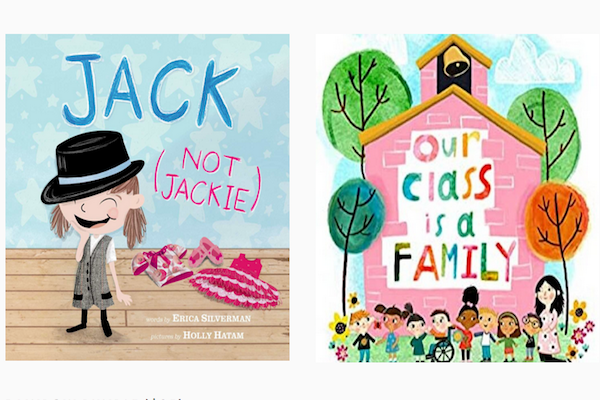
What “age appropriate” looks like is a variety of stories about acceptance and understanding, Forman says. There are books where LGBTQ issues are not the central storyline, like “A Plan for Pops,” a book about a child’s adventures with their two grandfathers. There are also history books like “Stonewall: A Building. An Uprising. A Revolution” which illustrates the story of the Stonewall Inn Riots and the start of the LGBTQ rights movement.

When PLP reached a point where they were getting more requests than they had donation money, the team launched a celebrity campaign to boost awareness.

The campaign, #ReadOutProud featured 13 celebrities from Olympic figure skater Adam Rippon to Hairspray actress Nikki Blonsky.

“If I would’ve had books with LGBTQ characters or themes in classrooms while I was growing up, I think maybe I would’ve felt a little bit at home maybe a little sooner,” Blonsky says in the video.

Noah’s Arc actor Darryl Stephens also contributed to the campaign. “Seeing characters whose experiences reflect our own affirms that our feelings are valid, and that we too, deserve to be loved,” Stephens explains.

The organization is hosting a professional development workshop with music educator Mia Ibrahim on October 12. “Combating Prejudice Perpetuated by Normativity: Creating an Inclusive Classroom Environment” will facilitate conversations around intersectionality and the perception of “normal.”

Forman and her team are determined to reach their goal of $10,000 and continue to donate books to classrooms across the country. More than that, they are confident in their ability to create a sustainable donation stream to pursue their mission of inclusivity in young classrooms.

“If I can’t change the minds of some people whose minds are already very set, let’s start with the new generation and see if we can start it out right,” says Forman.

DC Shorts International Film Festival to Virtually Showcase LGBTQ Films

By Clare Mulroy

This article was first published September 8, 2020 in Tagg Magazine here.

Despite the coronavirus pandemic halting most in-person events, the annual DC Shorts International Film Festival will continue for its 17th year. This year’s showcase will look different than others, returning virtually with 163 films and free online events. The event kicks off on September 10 and runs through September 23.

The festival includes 21 LGBTQ films with queer characters of diverse ages and backgrounds. While many of these films are within the designated LGBTQ category, eight of them will be shown across different showcases. Throughout various genres are examples of queerness at the intersections of race, family, love, and heritage.

According to Joe Bilancio, DC Shorts’ programming director, the variety of LGBTQ films throughout the festival are a way to bring LGBTQ experiences to the masses.

“We have the luxury of working with two different audiences because we do have a queer audience within this general audience,” says Bilancio.

Some of the LGBTQ films that will be available at the virtual event include:

BLACKN3SS: Between melanin and far away planets, BLACKN3SS proposes a dive into the journey of the black youth of the São Paulo city. A documentary on blackness, queerness, and spacial aspirations of the diaspora’s children.

The Fabric of You: Unable to show his true identity, Michael, a grieving tailor mouse, recounts sand reckons with the memories of a past lover in this animated short film.

I Love Your Guts: Two girls working the graveyard shift at a fast food restaurant fend off a belligerent drunk guy while also confronting their own friendship.

Kama’āina: Mahina, a queer 16-year-old girl, must navigate life on the streets in Oahu, until she eventually finds refuge at the Pu’uhonua o Wai’anae—Hawai’i’s largest organized homeless encampment.

T: A film crew follows three grieving participants of Miami’s annual T Ball, where folks assemble to model R.I.P. t-shirts and innovative costumes designed in honor of their dead.

Translucent: In this short documentary, filmmaker Azzan Quick documents their struggles and triumphs exploring their own gender identity and figuring out unapologetic ways to explain it to friends and family.

Although the festival loses the personal connection of hosting filmmakers and film lovers in person, Bilancio is confident the virtual component will add rather than subtract.

“We’re trying to keep a lot of the things that made us who we are—it’s just a matter of transferring them and seeing how they translate into this online world,” he explains. “We’re still trying to do virtually everything we did in the past.”

Shattered Space: Between Zoom and film, creating a new theatrical experience

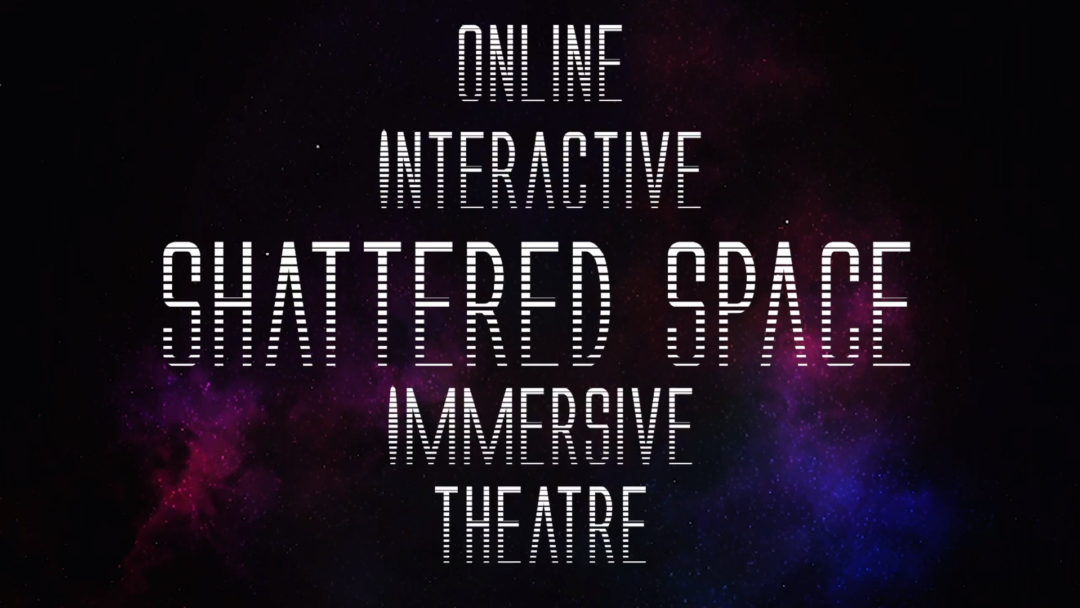
The text "Shattered Space: Online Interactive Theatre" is set in a futuristic font and set against a galaxy background.

By Julian Oquendo

This article was first published June 16, 2020 in DC Theatre Scene here

A new company is launching audiences into space with an exciting confluence of new technology and theatre. In Shattered Space by The Scattered Players, audiences take on the role of Star Jockeys aboard a spaceship which travels through a solar system visiting different planets on the verge of a major cataclysmic event.

The concept of Shattered Space, and the sophisticated programming underlying it, is a promising harbinger of what’s to come as people like Shattered Space Lead Engineer Chris Uehlinger continue to create new digital theatrical experiences.

Shattered Space is very impressive work. How did you achieve it?

Chris Uehlinger: … the 2 big web technologies that underlie this project (the WebRTC streaming stuff and the WebGL 3D stuff) are “both shallow and deep”. To truly understand WebRTC you’d need to do a deep dive on the history of streaming protocols, VoIP and telecommunications, but you can also follow a simple tutorial and learn how to use the user’s webcam and microphone in a web app pretty easily. You can (and many people do) spend years learning how to build beautiful worlds with 3D, but you can also get surprisingly far by just following the tutorials on the ThreeJS website and then looking through their open source examples for things you’d like to use in a project. These topics both look unapproachable from a distance, but once you’ve got a single foot in the door they can feel very empowering in terms of the kinds of things they let you create.

How long has your team been working on this? 

In early March (as all my spring shows were getting cancelled) I approached Lance (Bankerd), Matt (Payne) and Ben (Abraham) with the idea of doing a fully online immersive show. I was inspired by a recent immersive show I’d seen by Submersive Productions in Baltimore called “See Also”, and it had gotten me thinking about having a show with a non-linear story that the audience can explore in any order.

How long did it take you to program, design the ships, create a working system, etc?

It’s been about 3 months of work, and while a lot of it involved things I’d done before, a lot of it was happening at a new scale. For instance, I’d prototyped a video conferencing app at my day job, but never built one for a production product. This app has to work immediately on whatever device the audience members want to use, which meant we not only had to build a video conferencing app, but we needed an admin dashboard with real-time reporting of errors and audience connection issues.

I’ve got to shout out to our Stage Manager Liz Richardson, Marketing Director Donna Ibale, and Marketing Intern Mark Uehlinger (my brother) who are our crack tech support team. As each show is about to begin, we’re all on a Zoom call monitoring the company email account, the error logs, and other metrics to make sure everyone who bought a ticket is able to get in and isn’t having issues with their microphone and camera. They’ve gotten really good at finding patterns where certain errors can be solved quickly with certain solutions, and to the extent this show successfully runs, it’s down to their diligent efforts behind the scenes.

The 3D models of the ships and stations were mostly purchased from CGTrader (mostly chosen by Lance based on the visions put forward by the devisers), the planet materials were designed using an awesome open source tool by Rye Tyrell that creates procedurally generated planet materials based on a whole bunch of parameters. Certain parts like the “Cosmic Rapids effect”, the Ansible and the blue AI face were built by me whole cloth, and in a perfect world I would’ve liked to work exclusively with custom 3D assets. But given our limited time and resources, building 21 custom models wasn’t in the cards for this show.

What was training like with the actors?

The first rehearsals were on Zoom, since I was still building the app deep into the rehearsal period. The cast was split into 5 rehearsal groups for a lot of the process, and on one particular week we brought the groups into the app during their rehearsal time so they could see what the actor experience would be like. We collected feedback and iterated based on that to make sure the app would work with each person’s setup.

For instance, many of our actors are using mobile phones for their performance, so both the audience and actor apps have to work on mobile, and have almost all of the same features as the desktop versions. We also have a “headless” version of the actor app without the audio/video stuff that some actors use to look at the ship’s chat, inventory, etc. All of this came from having a tight iteration loop where we sought actor feedback and responded to it quickly, sometimes within a day.

I’ve gotta give a lot of credit to the actors here: They were patient, understanding, and quick to adapt to a platform that was changing under their feet every day. This kind of tech can only work if folks on the artistic side trust the folks on the technical side, and us folks on the technical side have to earn that trust by holding ourselves to a high standard of quality and accountability.

How do you see this kind of technology affecting local theatre going forward?

We’re going to be in quarantine for a while, and it’s going to be extremely rough for local theatre. But the good news is that people still want theatre if we can find ways to bring it to them.

I’ve seen a lot of people using Zoom to put on productions of existing plays, and I think that is a totally valid choice. But I also feel like when you take normal linear theatre and move it from the real world to digital, it starts to blur the line between theatre and film. At a certain point, if we want to do film we have to get good at cinematography, editing and the other skills that make good indie film good.

If we want to be different from film, we have to do what film can’t do, and make something that is undeniably live. That’s not easy: Most of the current canon of plays weren’t built for this at all, and the technical tools available are still rough. Shattered Space required a humongous technical effort, and is not something many companies can probably reproduce. I’ve seen folks like the Pandemic Players in Baltimore use Zoom and some other apps (which hide the Zoom UI) to put on shows that play with the videoconference medium in clever and thoughtful ways. I feel like there’s a middle ground that combines the nonlinear storytelling of a show like Shattered Space with a slightly modified off-the-shelf video conferencing app (like the Pandemic Players use) to allow more companies to put on shows like this.

And if they can, they may find (like we have) that they are no longer really “local” theatre. Although most of our cast is Baltimore-based, we have some folks in Boston, New York and Florida in this show, and we’ve had audience members from other continents. We could see a real flattening of the theatre economy, where good local work starts getting international recognition. And if that’s how things play out, that would be really exciting.

What if other producers want to replicate this experience, or build projects like this?

My plan is to open source the code when we’re done. If someone else has the technical know-how to deploy servers and get this thing running, I’d like to give them a good starting point. But the codebase for this show has a ton of duct tape, vestigial parts that no longer do anything, workarounds for the different ways Chrome and Safari handle audio/video stuff and weird tie-ins to the ARKit app that I’m using for the AI motion-capture stuff. And so it won’t be an easy plug-and-play kind of thing.

Now, if anyone in the web tech world wants to help the theatre world, this would be a great opportunity to do so. It’s hard to find folks with the kind of streaming tech expertise needed to build tools like this, but a few folks working together on an open source solution for this would probably help a lot of people out. If anyone has the desire and the time (a lot of time) to help, feel free to contact me via chris dot uehlinger at gmail.

What can we expect from The Scattered Players next?

We’ve got a lot of ideas for similarly nonlinear immersive shows, some of them specifically kid-oriented, some of them exploring different genres or mechanics. Right now our focus is on making Shattered Space successful, but in a month or so we’ll probably be able to talk more about what’s going to happen in the fall. Stay tuned!

Theatre artists gather in vigil to honor black lives lost to police violence

By Daniella Ignacio

This article was first published June 5, 2020 in DC Theatre Scene here

On Monday, June 8, Galvanize DC and Actors Arena will host “Making Space To Breathe/Gathering To Grieve” outside Arena Stage at 7 p.m.  The artist-driven vigil is being held to create a safe space to acknowledge what everyone is going through and to honor the lives of George Floyd, Tony McDade, Breonna Taylor, Ahmaud Arbery and countless others taken by police brutality.

Local artists and prominent DC theatre community members will speak. The current list of presenters (subject to change) includes Jade Jones, Temídayo Amay, Psalmayene 24, Felicia Curry, KenYatta Rogers, Kasai Rogers, Jefferson A. Russell, Ines Nassar and Lady Dane Figueroa Edidi. The team has planned an invocation, and appropriate songs and spoken word recitations.

The water facing Molly’s Study will be the front of the event. The organizers plan to maintain proper social distancing and encourage all attending to wear masks. There will be a plot laid out with “X”s marking places six feet apart to stand. The crowd will, if needed, wrap around the sides of Arena as well.

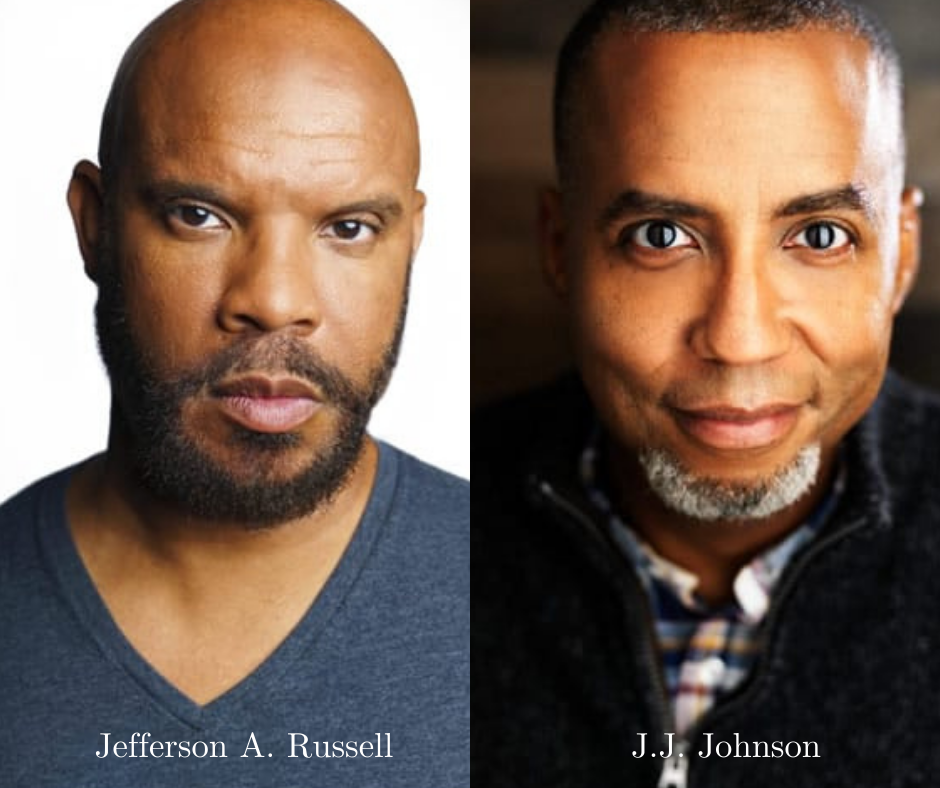
We spoke with two theatre artists and Galvanize DC organizers: Jefferson A. Russell (he/him/his) and J. J. Johnson (he/him/his).

Russell is confident that there will be enough space to safely accommodate a decent enough crowd. For those who cannot attend in person, the vigil will be streamed through Facebook Live and Instagram.

Russell and Johnson want everyone to come to, or stream, the vigil: theatre folks and non-theatre folks, black folks and white and non-black POC allies alike.

“We are gathering in an effort to make people know they’re not alone, to acknowledge that we are in this together, that we are seen and we are heard,” Russell said. “It’s to be able to acknowledge that, yes, we are all feeling this. It’s a safe forum to put these feelings and speak those truths. We live it, so there it is.”

Johnson agreed, saying that when incidents occur, it can sometimes feel very lonely. “It’s nice to reinforce community, to reinforce that we’re not alone and that there are methods to deal with this,” he said.

Russell has a uniquely personal perspective on the behaviors of the police.

“I used to be a Baltimore police officer, and I’m not ashamed of it, but I don’t live in that place. I’ve always been the person I am, even though that was over 20 years ago. But at the same time the reasons why I became a police officer are completely counter to the sh*t that we see, pardon my language, but the things that we see especially in the past few days.” Regarding the police presence at some of the protests:  “They’re aggressive. It’s counter to the ideals of law enforcement. They come in and it is not a thing of the objective being to de-escalate a situation. They, generally speaking, bring the energy to escalate the situation. And it’s like a personal thing that these police officers have, it’s a shallow sort of ego thing. They can’t be wrong.”

“It takes everyone to do the work, you know,” Russell said, “I would think and I would hope that it’s not just the DC theatre community, but the country and the world. It’s not just about, ‘Oh, they just want to be heard, so let’s let them be heard.’ No. It’s never been about that. We recognize we gotta take one step at a time, but, good God, man, what else does it take? Folks don’t like us protesting in any kind of way; there’s an issue with every which way a protest is made regarding equity and black lives. And it’s a thing where white people are uncomfortable with that, and I’m okay with that, because we have to be okay, because that’s the only way for something true, something real…to change.”

Russell and Johnson spearheaded the efforts. Jjana Valentiner, a co-organizer, worked with Arena Stage to get the outdoor space. All three are members of the steering committee for Actors Arena, an organization that previously collaborated with Galvanize DC on mental health workshops for black people at Arena Stage, including “Conscientious Theatre Training”centered around dismantling racism led by Nicole Brewer.

“We had talked about something for Galvanize to step forward and do, centered around black mental health,” Russell said. “Little did we know.”

Social media is being used to spread the word about the vigil, as well as email outreach and connecting with their built-in communities. Johnson said that he hopes black folks will find their community and find ways to engage with like minds online.

“When I was 20-something, I was just getting introduced to the Internet and social media wasn’t a thing, so we weren’t so connected back then,” Johnson said. “When you were alone, you were really, really alone. And so now you have the option of connecting with like minds and nurturing yourself almost instantly, which is a great privilege…that’s different for every demographic and group of people.”

Galvanize DC was established in 2005. Johnson and Russell’s previously worked with #BlackLivesMatter efforts include working with the group to create a video and collage to honor Trayvon Martin and town forums at Forum Theatre and the Silver Spring Black Box. One forum was to come together as a community, similar to the vigil planned for Monday, and another was a conversation with the Montgomery County police chief about creating better understanding between both communities.

Russell and Johnson said that this vigil continues the Galvanize DC mission of supporting artists of the African diaspora and all black lives. Both spoke to the importance of standing with trans black people.

“Our trans brothers and sisters are being beaten and killed, sometimes by our own,” Russell said.

“Just for existing,” Johnson said.

“Just for being who they are,” Russell said. “And that is the most ridiculous thing. So yes, all black lives matter.”

Moving forward, Russell and Johnson believe that DC theaters must commit to anti-racism efforts. As Russell put it, “Making Space To Breathe/Gathering To Grieve” is on June 8.  Protests will eventually subside, but the work continues.

“It’s gotta be real, it just can’t be cosmetic. It just can’t,” Russell said.  “Especially at this time, when there is severe lack of national political leadership, we have to do the work ourselves. That goes without saying. That would be the case even if 44 was still in the office. We have to do the work ourselves. He would be out there saying that. He said that yesterday. The work is up to us.”

Comedy series Rebecca and Becca in Space addresses isolation in the age of covid

By Julian Oquendo

This article was first published May 22, 2020 in DC Theatre Scene here.

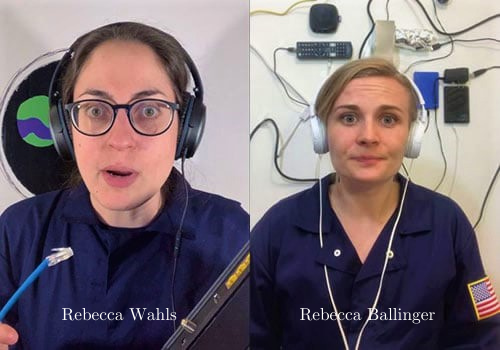
In the early days of regional stay-at-home orders, theatre artists Rebecca Ballinger and Rebecca Wahls were not ones to waste any time. They secured the equipment they would need: some quick decorations and the FaceTime app on their phones, and produced a series of very funny shorts.

A few weeks later, their 9 episode mini-series, Rebecca and Becca in Space, is available on YouTube for a quick binge (most episodes are under 5 minutes), another example of how local artists continue to produce work during the crisis.

The web series, set in 2033, features two astronauts stranded in space after the government pulls the plug on their research program. With no means of returning to Earth and isolated on their respective space stations, they do what any resilient astronauts would do: they live-steam their games of truth or dare.

“My favorite joke is when Rebecca’s character thinks everybody can shove their fist in their mouths,” Ballinger says during an interview with DC Theatre Scene, “and realizes it’s not true.”

“Watch till the end of the credits,” Wahls adds.

The script, written by both Ballinger and Wahls, started in 2019 and revisited this year, began from a simple premise.

“We wrote a number of sketches,” Wahls says. “Then we did a brainstorm exercise where we wrote a list of everything  we wanted to be when we grew up. And we both had ‘ASTRONAUT’ at the top of our list.”

The series is one of a number of projects funded by George Mason University’s College of Visual and Performing Arts’ Mason Arts At Home. Their program has been offering a series of live-streamed and recorded performances since early April.

For Ballinger and Wahls, the importance of producing the series helped add a much needed routine to their new normal.

“Honestly, those two hours really helped because we started filming this, like right when everything was shutting down and the stress was super high,” Ballinger says. “I could go sit on the floor of my closet [and film] for two hours every night. It really helped ground me in the normal of rehearsing and there was a structure.”

Ballinger and Wahls also hosted a live Q & A session, in character, after their show premiered. Ballinger recounts one of the submitted questions relating on how to deal with isolation in space.

“The most important lesson I have learned in space… It can be really hard to be by yourself all the time,” Wahls answered during the livestream, “If you can create ways to connect with other people, that can make all the difference. Even if you feel alone, you’re not alone.”

The series ends on a positive note, their “Christmas Special” (spoilers) suggesting a return home for the astronauts.

“When we were talking about this, before the pandemic happened, we were [considering] if at the end of this season we find out that we’re stuck forever? And then the next season, we’re like really dealing with an existential crisis,” Ballinger shares.

“We ended up knowing people didn’t want that right now. People want help. And so that’s why we wrote a Christmas special to wrap up the season, just to kind of give a little bit of light at the end of the tunnel to these characters.”

Rebecca Wahls is currently pursuing her MFA in directing at Carnegie Mellon University. Rebecca Ballinger remains in the DC area, and looks forward to her next performance with Monumental Theatre.

The 2020 Helen Hayes Awards go virtual

The 2020 Helen Hayes Awards

By Julian Oquendo

This article was first published May 19, 2020 in DC Theatre Scene here.

On Monday, May 18, the night when the DC area theatre community would have been celebrating the 2020 Helen Hayes Awards at The Anthem, honoring theatre excellence in area productions for 2019, theatreWashington took to its Facebook page to announce that the celebration will go on as a virtual event.

The move comes amidst a slow and uncertain reopening of the greater Washington area as state governors and mayors propose the reopening of their respective jurisdictions, for which social distancing measures and venue capacity limits remain in place.

“We have reached the decision to move the celebration online as a completely virtual event, foregoing an in-person event in late summer,” theatreWashington wrote on its Facebook page, “and will present the Helen Hayes Awards, open to everyone, at a date to be announced soon.”

DCTS confirmed with Amy Austin, President and CEO of theatreWashington, that the event is coming together now and will take place this summer.

“It is also important to us to preserve the tradition and prestige of the Helen Hayes Awards. We want the virtual ceremony to be joyful–to find beauty, comfort, reflection, and inspiration in each other and in our art,” the Facebook announcement continued.

“We’ve heard great feedback and ideas and we’re in the middle of the deliberative process of re-shaping the event.” Austin confirmed that the show will retain its original co-hosts, Felicia Curry (2018 recipient and 2020 nominee) and Naomi Jacobson (13 time nominee and two-time recipient).

“First and foremost,” the Facebook announcement continued “we are committed to allocating as many resources as possible in direct support to our community as we face the uncertainty ahead.” A signature program for theatreWashington has been its support all theatremakers in need through the Taking Care COVID-19 Emergency Fund.

“While it’s sad that we aren’t able to gather in person, this email felt like an inevitability, and theatreWashington is absolutely making the right call,” Amber Gibson, a nominee in the “Best Ensemble” category, said. “This isn’t a year for us to gather in-person, and their resources are better directed to assisting out of work artists and theaters through the Taking Care fund.”

The 2020 Helen Hayes Awards nominees and presenters.

Up-and-coming company Like Fresh Skin pushes the boundaries of live Zoom theatre

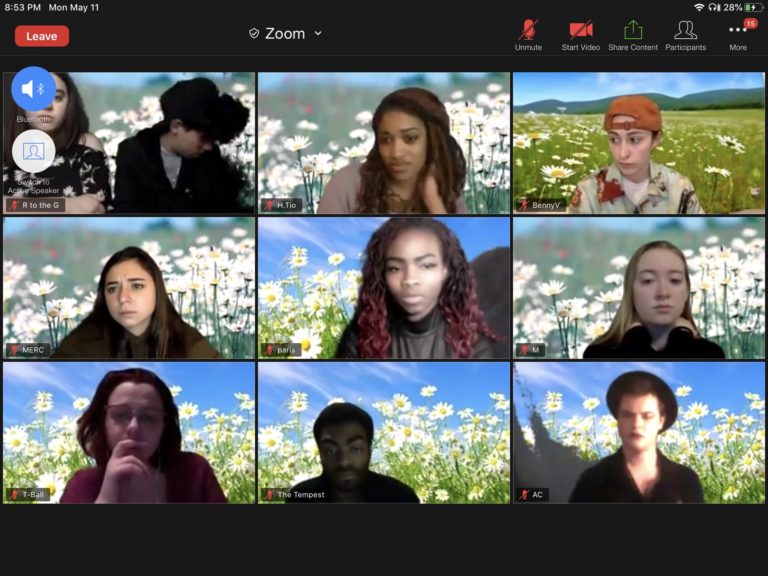
A screenshot of Zoom. The cast of Too Solid Flesh is rehearsing for their upcoming live performance. A sunny meadow is seen in the background of each actor's screen.

By Daniella Ignacio

This article was first published May 15, 2020 in DC Theatre Scene here

“O that this too solid flesh would melt, / Thaw, and resolve itself into a dew!” Hamlet cries out in his first soliloquy of the eponymous Shakespeare play. And as Shoshana Tarkow (she/her, resident director) and Megan Lohne (she/her, resident playwright) of Like Fresh Skin discovered, many young people in the midst of the COVID-19 pandemic find themselves feeling the same way.

Through Too Solid Flesh, written by Lohne and inspired by the young characters from three Shakespeare plays and Adelphi University theatre students’ stories, young artists were given the chance to process their feelings as their lives have been affected by the coronavirus and to explore a new form of immersive, technology-driven theatre.

The play incorporates live performance, pre- recorded videos, apps like Tik Tok, a video game, chat boxes and other games like Pictionary and presents it all over Zoom.

WHAT IT IS

When the COVID-19 quarantine hit New York, Lohne and Tarkow did a Zoom call together. Playing around with the platform, Tarkow said “Let’s push this platform to its limit in seeing what it can do, and let’s try to use it in ways no one else is using it and let’s create something that’s interactive and immersive and is narrative-driven and all of those things,” she said.

Lohne sent out a questionnaire for the Adelphi students. 18 students responded and are now part of Too Solid Flesh, with original characters written for them by Lohne, inspired by the experiences that they shared.

“The answers that came back to us were so genuine, truthful and honest, that we really just thought, this is a great springboard to create something,” Lohne said.

“You’ll see that it’s not the text, it’s not the Shakespeare, but it’s the ideas and the feelings of how big it is to not be able to graduate in real time, to not be able to finish out a semester, to be relocated to a family home where there’s all kinds of things happening there for you that make you almost feel not empowered anymore,” Lohne said. “It’s like you’re a kid again, right at this moment when you’re about to become an adult. And I think that’s very powerful. It’s so interesting when we see this with teens, with people who are age appropriate. I think they attach onto it very easily and it means something.”

The play, as it has evolved, concerns an anxiety-ridden student, O, who tries to find a connection while trying to do online distance learning, to “save her from her thoughts and herself,” as well as many other young characters inspired by those in Hamlet, Romeo and Juliet and The Tempest.

HOW THE SHOW WAS MADE

Too Solid Flesh uses various emerging technologies, from Zoom to next-generation apps. Among these technologies include specific sections that have been pre-recorded for different purposes; Tik Tok, used in both a presentational and interactive way; a video game in an observational capacity; Pictionary; chat boxes; and the Zoom live performances themselves.

They are constantly developing the piece, actively fixing it and changing it throughout the rehearsal process. For Tarkow, in both this virtual setting and in the previous theatre work Like Fresh Skin has done in the past, rehearsing a show that requires an active audience can be unpredictable.

“When you invite them to interact, you have to prepare for all of the ways that could go wrong, as well as all of the ways that could go right,” Tarkow said. “It’s sort of this teeter-totter between making sure that the narrative is there and the acting is solid…and all of that stuff you have in any normal production, and then simultaneously, structurally – it is working? – technically – are things falling apart? – there’s sort of two conversations after every rehearsal, in a debrief. And then we move forward.”

In order to ensure that all of the different modes of technology can be used efficiently for performances, four stage managers are on the project, including one designated stage manager as the media and content supervisor. All of the materials are on one Google Drive.

“It’s really been a team effort to accomplish that,” Tarkow said. “We are 100% blessed to have all of them on board for this.”

“A lot of it honestly came from the students, things they are interested in, things that are inspiring to them on social media,” Tarkow said. “It feels very timely and very contemporary to be using things that are their means of expressing themselves anyway.”

Beyond the performance, students are also taking to social media, using Tik Tok, Instagram and even one Tinder account to interact with each other and audiences as their character. They’ve also started doing Instagram Story takeovers to help share who their characters are and to help create buzz.

“I will say that as the director, in the room, I’ve noticed a sizable difference in how connected they are to their characters since they’ve started doing this,” Tarkow said.

CONTEXT FOR TODAY’S CLIMATE AND TECHNOLOGY

It’s been a learning process to explore new ways of playwriting and engagement with Zoom.

For example, the company has been attempting to re-create the experience of immersive theatre where oftentimes the audience gets subdivided into multiple spaces and has experiences in smaller, more intimate settings, and then gets brought back into a big physical space, where they have a group scene. To emulate that physical movement, Lohne and Tarkow  tried using Zoom breakout rooms.

“Our experience thus far has been that there’s a lack of forward momentum that is caused by doing it in Zoom that doesn’t exist when people are walking in a physical space,” Tarkow said. “So in order to not halt the narrative, and have there be this waiting to see what’s next, we are going to be cutting back on our use of breakout rooms, and sort of re-evaluating.”

According to Tarkow, it is important that whenever you’re doing something, any kind of theatre, but specifically something that is groundbreaking or changing structures, to always sit back and say, “What is the value of doing this thing? What are we gaining?”

For Lohne, the process of playwriting over Zoom has allowed for quick and efficient troubleshooting and communication. While in Zoom rehearsals, Lohne can rewrite in real time, and she has been revising the play to account for technical elements and timing.

“We’re very collaborative, and I think that generates these very cool, exciting new forms of theatre that we’re really trying to push the bounds to what that can be for us and our company,” Lohne said.

A NEXT STEP PROCESS

This kind of innovation is vital in a world where many educational institutions have not yet made final decisions on whether students will be returning to the classroom in the fall, and pre-existing online universities that offered arts programs could benefit from more streamlined live performances. Like Fresh Skin hopes to make performances like this a “next step process.”

According to Lohne, some of the early responses from audiences who have come to rehearsals were that it really hit home, which is what the company wants to do with this piece. She hopes people will leave the play thinking about what’s next and allowing themselves to live in their emotions a little more.

I do hope that it actively makes them consider, ‘What do I miss?’” Lohne said. “I can’t tell you one conversation I haven’t had with a friend, who brings up missing something, however small it might be. I miss walking down the street to get frozen yogurt. I miss meeting up with friends and sitting, like less than six feet apart, on a park bench. It’s very simple little things and I think if we can ignite that big universal truth, we’ve done our job.”

Tarkow agrees. She said that when they first sent out the questionnaire, she thought that she would receive reactions from students asking for something light and fun, an escape. It turned out that what they really wanted was to process what was going on and work through it in the best way they knew how: the performing arts. Tarkow said that it excites her to create a new kind of theatre, and she wants theatre makers to be excited, as well.

“I hear so much dismay and so much giving up on the arts right now, like ‘We will come back stronger than ever,’ but it doesn’t address what happens until we come back,” Tarkow said. “And I think there is the potential to create moving, affective, beautiful entertainment given the technology available to us now, and that I hope that we move beyond live streams and pre-records and staged readings. Not that there isn’t value in all of those things. But I hope we move into something that feels a bit closer to what you feel when you’re in a theater.”