Pulled in part from Corcoran Legacy Collection, exhibit at AU Museum reveals Tony Podesta’s aesthetic eye

by Athena Naylor

This article was first published on The DC Line and can be read on their website here.

An expansive new exhibit at American University’s Katzen Arts Center offers a survey of contemporary sculpture and photographs through works donated by lobbyist and internationally influential art collector Tony Podesta — including many originally given to the Corcoran Gallery of Art.

The Gifts of Tony Podesta— on display at the American University Museum through March 17 — highlights the work of 26 artists while celebrating Podesta’s aesthetic eye.

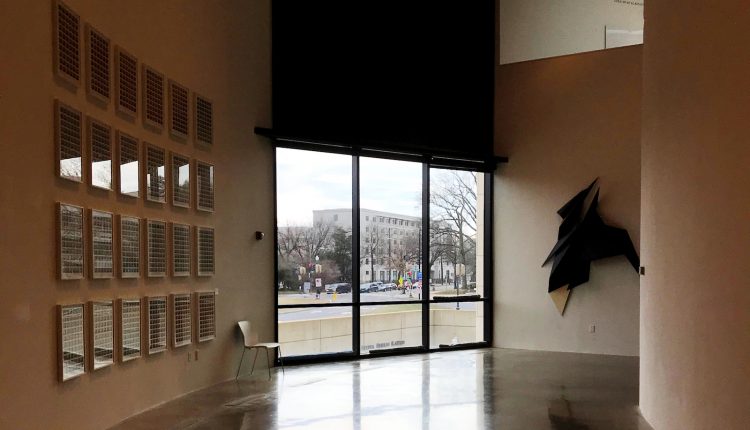
The exhibit, the first major show drawn from American University’s Corcoran Legacy Collection, takes up two floors of the museum. It showcases items from the holdings bestowed to American when the Corcoran was folded into The George Washington University in 2014, along with work that Podesta has donated directly within the past five years.

Podesta has been a longtime champion of contemporary female artists. The Katzen’s last show featuring his collection — 2011’s Inner Piece: Works From the Heather and Tony Podesta Collection — focused specifically on this aspect of his holdings, displaying the work of four notable women photographers and painters. The Gifts of Tony Podesta offers a broader exploration of his collection.

Photography steals the show in The Gifts of Tony Podesta, comprising the majority of items on display. Jennifer Sakai, an art professor at George Washington who curated the photographic portion of the exhibit, remarks in wall signage how Podesta’s photographic collection “creates beguiling and mysterious narratives.” Almost all the photography included in Gifts provides some sense of story, often creating visual tension through the incorporation of both familiar and unexpected narratives.

One of the first pieces the viewer encounters in Gifts is Mwangi Hutter’s If, a 50-inch-by-66-inch chromogenic print that displays a disorientingscene. The 2003 photograph is based off a propaganda image of Hitler, in which he is depicted surrounded by a cluster of “ideal” Aryan women. Mwangi Hutter, an artistic collective made up of partners Ingrid Mwangi and Robert Hutter, reimagines this scene, placing a superimposition on Hitler’s face and replacing the women with repeated images of Ingrid Mwangistaring at the Hitler stand-in, toward the camera or off to the side. Her clones wear different outfits, take on different gestures and crowd the image. The viewer feels invited into this grouping that explores the layered racial and historical dynamics of Mwangi Hutter’s identity-focused art practice.

If introduces the viewer to the kind of decoding required of many of the narratives featured in Gifts, as multiple photographs in the show consider decontextualized stories and subverted archetypes. Prints by Anna Gaskell, a contemporary photographer whose work often references gothic fiction and fairy tales, place viewers in the middle of unexplained stories. In Gaskell’s 1998 print Untitled #44 (Hide), a limp, wet hand lays in a puddle on a hardwood floor, while in Untitled #47 (Hide) from the same year, a blond girl in white pins down a possible doppelganger in a shot from above that obscures both characters’ faces, offering snippets of a longer narrative at which viewers can only guess.

Even in works not so figuratively focused, there is a sense of narrative sequence. A standout inclusion is Darren Almond’s Six Months Later, a 24-part piece composed of 1,440 tiny photographs that depict the artist’s studio minute by minute over the course of 24 hours. In this 1999 work, the viewer can track the passage of time via the black digital clock on the wall of each identically composed shot, which differ onlyin the quality of light shining through the scene as the day progresses. These small, incremental photographs form a monumental installation, creating a simultaneously intimate and imposing portrait of time.

The sculptural portion of The Gifts of Tony Podesta, coordinated by Klaus Ottmann, chief curator of the Phillips Collection, simultaneously seems to connect and diverge thematically from the photographic work presented.

A highlight of the sculpture in the show is artistic duo Jake and Dinos Chapman’s 1999 Rape of Creativity, a miniature diorama that depicts a man who has chopped off his own hand (one assumes accidentally) while carving a female wooden torso from a log. The diorama delights with remarkably minute details, such as the miniscule beer bottles visible when one peers inside the man’s tiny RV. Circling the small scene, one notices a dog with a sheep’s head carrying the man’s dismembered hand in its mouth. The play between mundane familiarity and surreality within the scene clearly relates The Rape of Creativity to the kinds of beguiling narratives offered by the photography in the rest of the show.

A similar sense of surreal narrative permeates the work of Australian artist Patricia Piccinini, whose installation Siren Mole: Excellocephala Parthenopa from 2000 is an animatronic sculpture of two imagined creatures in a glass enclosure like those commonly found in biology labs. Swedish artist Ann-Sofi Sidén’s fountain Fideicommissum offers another figural sculpture for the show, depicting a self-portrait of the artist urinating that makes the viewer aware of one’s body and privacy. The peeing woman’s eyes are closed, positioning the viewer as a voyeur. However, when squatting to admire the sculpture, we find ourselves in the same peeing position as Sidén, transforming us from a distanced observer into a self-conscious, vicarious participant.

Other sculptural selections — such as Jone Kvie’s Untitled globular stainless steel mushroom cloud, Janaina Tschape’s suitcase filled with two water-filled latex balloons, and Gyan Panchal’s two standing pieces of foam board titled Papyri, all from the 2000s — may seem too abstract and out of place in contrast to the other, more figural components of the Gifts of Tony Podesta. However, the diversity of work on display is no detriment to the exhibit. After all, The Gifts of Tony Podesta makes no claim to coherence besides the fact that Podesta collected all pieces on display.

While the works on display in The Gifts of Tony Podesta portray people and places, the exhibit as a whole functions as a portrait of Podesta himself and his avocation as an art collector. In the foreword to the exhibition catalog for the show, the guest curators and contributing essayists — including National Museum of Women in the Arts director Susan Fisher Sterling and NMWA chief curator Kathryn Wat — provide insights that “add another level to an already satisfying experience.”

The “gifts” in The Gifts of Tony Podesta extend beyond the physical objects on display to more broadly include Podesta’s aesthetic taste as a collector. It is best to experience the collection in person and create one’s own connections to the presented objects and narratives. There is inevitably more to see and say about such a dense and rich exhibit. To view it is a worthy time investment, especially for anyone who has missed being able to access the Corcoran’s old holdings.

The Gifts of Tony Podesta is on view through March 17 at the American University Museum at the Katzen Arts Center at 4400 Massachusetts Ave. NW. Regular museum hours are 11 a.m. to 4 p.m. Tuesday through Sunday.
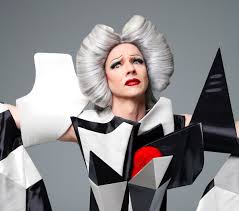
John Cameron Mitchell’s Origin of Love Tour

by John Bavoso

This article was first published by DC Theatre Scene and can be read on their site here.

They say you should never meet your heroes, but what about crowd-surfing them? That was what I was thinking the night of February 8, as I helped keep John Cameron Mitchell aloft as he made his way through the orchestra on the hands of adoring Hedwig and the Angry Inch fans. We had gathered to bask in the glow of The Origin of Love, a punk-rock live Behind the Music episode of sorts and a gift to Hedwig heads everywhere.

The evening of songs, storytelling, and sass was the first stop on a national tour, and DC audiences got a tailored experience that few other audiences may have. Mitchell lived for a bit in Falls Church, his grandfather owned a house in Bethesda, and he had even had cousins in the audience. Throw in a few jokes from Hedwig about Melania, and you had a concert experience that was unique and surprisingly personalized.

Mitchell—who was joined on stage by members of his original Broadway band and powerhouse performer Amber Martin—sported a black, white, gray, and red costume that transformed into six different outfits over the course of the night. He also was crowned with Hedwig’s classic wig, this time tinted light gray or white, a sly nod to the fact that Mitchell has been embodying the trans East German rock ‘n’ roll songstress for literally decades at this point.

As Mitchell worked through some of the most beloved numbers from the Hedwig songbook—“The Origin of Love,” Sugar Daddy,” “Wig in a Box,” and “Wicked Little Town” among them—he filled in bits of personal history and trivia to give context to each song. Whether it was a story about meeting songwriter and co-Hedwig creator Stephen Trask on an airplane, or describing his first time taking the stage as Hedwig in a downtown punk rock drag club (and being way too theatre-kid prepared), he spun bits of lore behind one of the most beloved cult musicals ever created. When he explained that he and Stephen originally performed “The Long Grift” on the lawn of the rehab clinic where Jack, Stephen’s bass player and John’s lover, was trying to get sober, there was nary a dry eye in the house.

Ever the magnetic and dynamic performer, Mithell held the crowd in the palm of his manicured hand the entire night, despite moments he described as “more punk rock than Broadway.” Yes, he forgot the lyrics to a couple of songs and had to start “Sugar Daddy” over completely (although my guest had a theory that the band and lights reset so quickly, that that might not have been a totally spontaneous restart), and there was a mic stand he simply could not get to stand up straight, but not a single member of the audience cared—if anything, it only made him more human and relatable.

The night wasn’t only about Hedwig; Martin was given her time to shine with a David Bowie cover and solo performance of the song “Bermuda” from the soundtrack to Mitchell’s 2017 film, How to Talk to Girls at Parties (which, yes, also got me a little misty-eyed, thanks for asking). As part of the encore, he sang a couple of songs from and previewed his new musical, Anthem, a six-hour epic that will be released as a podcast first, and will feature the talents of legends like Glenn Close, Patty Lupone, and Cynthia Erivo.

The Origin of Love was a love letter to Hedwig and John Cameron Mitchell’s gift to fans less than a week before Valentine’s Day. Leaving the theater with a crowd of people filled with such love and joy in their hearts, just blocks away from the White House, was an experience I won’t soon forget and would happily repeat anytime.

The Origin of Love performance was one night only: Friday, February 8, 2019.

Ouroboros: Dawn of the Cabaret iS choose-your-own adventure in a DC mansion

by John Bavoso

This article was first published in DC Theatre Scene and can be read on their site here.

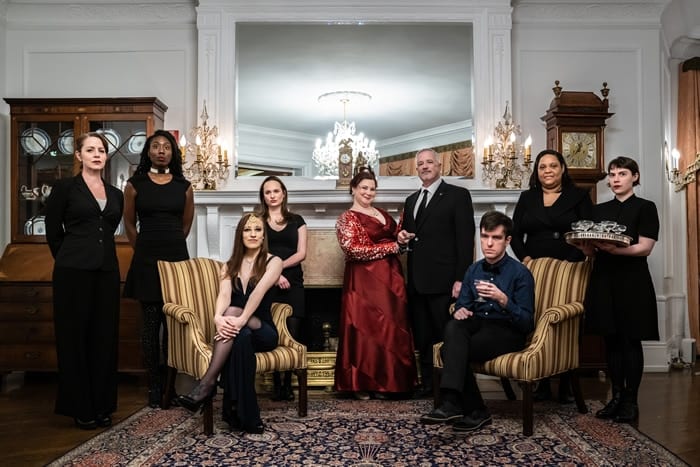
Few words strike fear into the hearts of wide swaths of the theatre-going population than ‘Audience Participation.’ But when said participation involves sipping champagne, swanning around a mansion in Dupont Circle, watching fire spinners perform in the snow, and solving puzzles with strangers, that pill becomes a lot easier to swallow. Thus is the experience created by TBD Immersive in their new interactive performance piece, Ouroboros: Dawn of the Cabaret.

If it sounds like there’s a lot going on, well, that’s just the beginning. As an audience member, it’s up to you to join a side and undertake quests at the request of your fellow guests. There are at least three or four paths you can take, which is exciting, but can also lead to wide variations in not just the content, but also the quality of the experience amongst audience members.

For instance, my guest and I started out on one track at the beginning of the evening, but then unintentionally switched halfway through, meaning we never really got the whole story for either path. As we watched a climactic fight play out in front of us, for example, we had no clue what was going on, because the inciting event occurred upstairs while we were down in the basement. While this is realistic in terms of how things actually work at real-life parties, it did create some moments of confusion that weren’t always of the fun and intriguing variety. Perhaps a slightly more streamlined narrative arc may have led to certain attendees not being left out in the proverbial cold.

This is not the say that I didn’t enjoy my time at the Wescotts’ abode; in fact, I had a marvelous evening. This is due in large part to the wildly talented cast, who almost universally nailed both their scripted scenes and 2+ hours’ worth of improvised interaction. Lange ate up the role of the despised stepmother with the suspiciously short courtship and abrupt elopement, and was liable to break into song at any moment (much to the chagrin of many of the other characters). Bradshaw’s Drew practically vibrated with nervous energy, while Hart’s Astrid hid her cunning and desperation to get to the bottom of what really happened to her mother behind a ditzy, party girl façade.

The Whittemore House proved to be the ideal venue for this performance, offering three levels of indoor and outdoor space for the cast and audience to play with. From the fortune teller in the parlor to the burlesque dancer in the ballroom to the fire performers working their magic in the garden, there was always something to engage with and admire. Despite the mansion’s sprawling nature, the cast managed to create small moments of genuine intimacy and delight. For example, my guest and I and about five other people were treated to a stunning command performance by Angelique (Chaseedaw Giles) in a linen closet in the basement barely big enough to fit us, in what turned out to be the most memorable moment of the evening.

Many theatre companies have mission statements that include nods to breaking down the fourth wall and inviting the audience to participate in the creation of the work, but few have made good on this promise to such a high degree. With Ouroboros, TBD Immersive has created an event that is impressive in both its scope and its nuance, and in doing so, has filled a vital niche in the DC area theatre landscape. I, for one, am excited to see where they lead audiences next.

Joshua Harmon’s scathing comedy ‘Admissions’ big hit with Studio audiences

by John Bavoso

This article was first published on DC Theatre Scene and can be read on their site here.

A couple of weeks ago, the satire site McSweeney’s published an article entitled, “How Can I Help to Promote Diversity Without Relinquishing Any of My Power?” This title alone could serve as an incredibly succinct synopsis of Joshua Harmon’s Admissions, now playing at Studio Theatre, where Harmon’s previous play Bad Jews holds the distinction of being the company’s best-selling production ever.

Like Bad JewsAdmissions skewers a very specific subset of the population—in this case, upper-middle class white progressives. Harmon comes by his disdain for this particular kind of liberal sanctimoniousness honestly, having grown up in Westchester, NY, a wealthy suburban community just outside of the city. “The people who were the most progressive and vocal also tended to be the first people to pick up the phone and make a call to make sure that their kids got everything they wanted out of life,” Harmon explains to dramaturg Lauren Halvorsen.

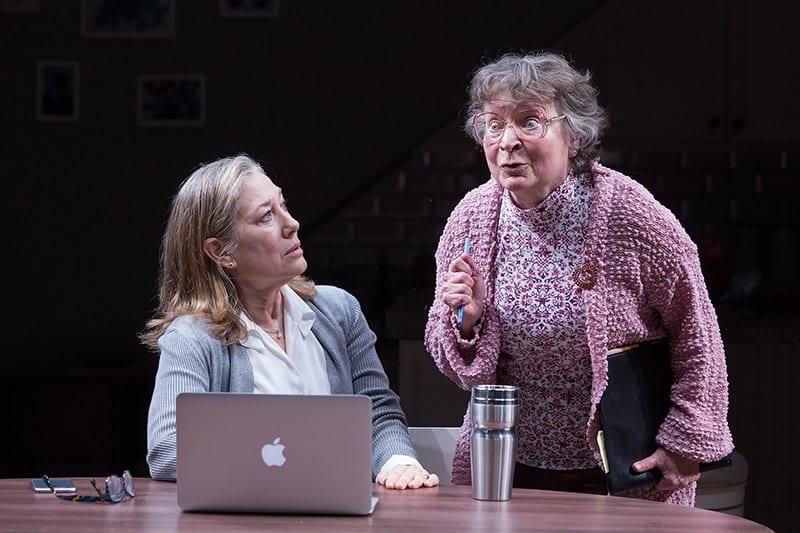
Admissions is set at Hillcrest, an elite boarding school in rural New Hampshire. Sherri Rosen-Mason (Meg Gibson) oversees admissions for the school, and is proud of the fact that, under her decade-and-a-half watch, the number of students of color has jumped from 6% to 18%. We’re introduced to her particular brand of cold professionalism in the opening scene, in which she chastises Roberta (Sarah Marshall), a member of the institution’s development department whose ties to the school go back generations, for not including enough people of color in the new admissions brochure.

When Roberta protests that she included Perry, the son of a white mother—Ginnie Peters (Marni Penning), Sherri’s best friend—and half-Black father, Sherri counters that while Perry counts as Black for the purposes of her statistics, he doesn’t photograph Black enough to count for the brochure. Right off the bat, we know we’re in for a wild ride.

Back at home, Sherri opens a bottle of wine to share with Ginnie while they both wait to hear whether their sons—best friends Perry and Sherri’s son, Charlie (Ephraim Birney)—have gotten into Yale. Ginnie is delighted to get the call that Perry has been accepted, while Sherri and her husband, Bill (Kevin Kilner, who you may recognize from The Good Wife or House of Cards), who is also the school’s headmaster, are left to wait until Charlie comes home from screaming in the woods for four hours to learn that his application has been deferred.

This propels Charlie into suggesting that Perry only got in because he’s mixed race and launches him into a screed (that impressively goes on for 15 to 20 minutes, easily) about the entire notion of diversity and seats at the table and who even counts as a person of color anyway. It also sets into motion a series of events that tests his parents’ convictions and puts all of their relationships in jeopardy.

Director Mike Donahue keeps things moving at a quick clip as the characters move around the bland affluence of scenic designer Caite Hevner’s kitchen set and open endless bottles of white wine. Birney’s work is a true standout for that marathon-length monologue alone, but he’s given a harder bill of goods to sell in the second half of the play (I’ll get to that in a moment). The B plot scenes between Gibson and Marshall are quite funny, highlighting generational differences and the imprecision of language around race and diversity.

Overall, though, Harmon’s words are the real star of the show, and this can be both a boon and a detriment. The monologues sparkle and Harmon’s capacity for glancing one-liners seems infinite, but some of the dialog can feel more wooden than natural. And this may be in part because he sometimes takes his characterizations to the extreme—Bill, for instance, basically calls everyone in the world a racist at one point or another without allowing for any nuance whatsoever.

The thing that most pulled me out of the story, however, is the aforementioned action that Charlie takes (and I won’t spoil here) about two-thirds of the way through the play, which reveals his parents’ true hypocrisy. My problem is that the change of heart that inspires this act seems totally unearned—there’s no moment of epiphany that the audience is privy to, nor are there any consequences for Charlie’s previous diatribes that incentivize him to change his attitude. It struck me that what he does he only does so that he can move the plot along and say the lines Harmon wants spoken at the end of the play. These moments feel more like the playwright speaking directly to the audience rather than a character speaking genuinely from his heart, and threatens to turn character into caricature.

Harmon and the entire Admissions team give audiences a lot to think and talk about as they exit the theater. In fact, a gentleman behind me, when the lights went up at the end of the show, wondered aloud whether the composition of the audience itself even remotely approached the 6% Hillcrest’s student body began with. These are important conversations to be having, and while Admissions may not offer up any solutions, it does give the audience the chance to laugh—primarily at itself.

Jeffrey: Paul Rudnick’s comedy of love in the time of AIDS

by John Bavoso

This article was first published by DC Theatre Scene and can be read on their website here.

There’s no such thing as love without risk. Risk of rejection. Risk of your partner finding someone else. But for gay men in the ‘80s and ‘90s, at the height of the AIDS crisis, love and sex carried more than just emotional risk—there was physical, mortal danger to be dealt with as well.

And so, at the top of Rainbow Theater Project’s production of Paul Rudnick’s play, Jeffrey, the titular character decides that dealing with sex and love cheapened by the kind of paranoia and fear induced by the virus isn’t worth the hassle, and swears them both off. Hijinks, of course, ensue. Yes, I said hijinks. Yes, in New York City during the height of the plague.

In an impassioned pre-show speech, Artistic Producing Director H. Lee Gable spoke specifically to the gay men of a certain age in the audience, of which there were many, about what it was like to be a gay man during that era, his voice cracking with emotion. He also pointed out that out of that time came what are widely considered to be the two great AIDS plays—Larry Kramer’s The Normal Heart, and the less widely produced Jeffrey. The latter, he noted, helped mark the shift from “dying of AIDS” to “living with AIDS.”

The disparity between the success and acknowledgement of the two works (although, it should be noted, it took much longer than it should have for The Normal Heart to get its due) was no fluke; it came down to the two playwrights’ difference in approaching a heavy subject. In 1992, when Rudnick was trying to find an Off-Broadway home for Jeffrey, he had many a door slammed in his face, not simply because his play was about AIDS, but specifically because it was a comedy about AIDS. Once it did find it a home, thankfully, it was a hit, and served as Rudnick’s breakthrough play.

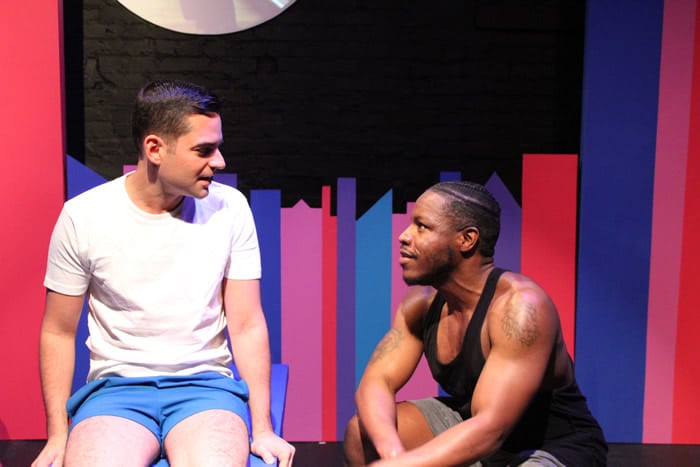
The plot is relatively simple: Jeffrey (Rinaldo Martinez), is a Midwestern transplant living in Manhattan, making his living primarily as a cater waiter while trying to land acting gigs. He decides that negotiating sex while the specter of the virus looms large is too much of a downer and quits it cold turkey—no small feat for an avowed sexual compulsive. Of course, the moment he commits to celibacy, he meets Steven (Reginald Richard) at the gym and they both feel an immediate attraction. There’s only one problem—Steven is HIV positive, and in a world punctuated by memorials for otherwise-healthy men in their 20s, Jeffrey isn’t sure he can handle the pain of falling for someone just to watch him die.

Rainbow Theatre Project’s production is directed by Robert Mintz, who also directed Rainbow Theatre’s reading of the play in 2016. Mintz does a superb job of preventing the script’s swings in tone from giving the audience emotional whiplash; after all, no matter how many quips you sprinkle into a play about the AIDS crisis, it’s still a play about the AIDS crisis. (My favorite example of this juxtaposition occurs when a gay basher, mid-hate crime, asks Jeffrey what kind of weapon he’s carrying and he replies, “Adjectives? Irony?”)

Honestly, I approached this play with slight trepidation, as stories about the AIDS crisis are my kryptonite—nothing turns my tear ducts from merely decorative to functional quite like them. But Mintz and his cast keep the tone as buoyant as a balloon, while still allowing the more serious moments to make an impact.

Martinez is the engine driving the show, and he does a masterful job of imbuing Jeffrey with an earnestness and authenticity that belies his jokes about his own promiscuity. He’s the audience’s cypher, but in Martinez’s capable hands, he’s hardly a blank slate. Richard exudes charisma and charm as Steven, negotiating with nuance a character who’s drawn to Jeffrey but also disgusted by his retrograde attitudes toward dating an HIV positive man. In fact, Rudnick’s script doesn’t go a long way toward making a solid case as to why Steven is so willing to not only overlook his mistreatment at the hands of Jeffrey, but is, in fact, so enthralled by him that he’s willing to chase him for months—so it’s a credit to Martinez and Richard that they’re able to sell the mutual connection as convincingly as they are.

Jeffrey and Steven’s journey is aided by their mutual friends, Sterling (Matthew Pauli), an older, style-obsessed interior decorator, and his young lover, Darius (Randyn Fullard), a whimsical Cats dancer with an 8th-grade education. While these characters, as written, could easily veer into caricature, Pauli and Fullard keep them grounded and infuse both with real emotion—especially in a pivotal scene toward the end of the play.

The rest of the cast is rounded out by a talented ensemble consisting of Craig Houk, Emily Levey, Joshua Street, and Rick Westerkamp, who expertly transform themselves into a variety of comedic characters, from a lascivious Catholic priest to a game show host to patrons of the Lower Manhattan Gentlemen’s Masturbation Society. Levey, the cast’s lone female member, in particular shines as the host of a Hoedown for AIDS fundraiser and as Debra, a postmodern televangelist self-help guru.

The flamboyance of the subject matter is reflected in PJ Carbonell’s candy-colored confection of a set that allows for maximum versatility. The clever use of projections also assists in seamlessly transforming the small black box at the DC Arts Center into a dozen different locations. Hannah Katherine Herold’s costume designs don’t always scream early ‘90s New York fashion to me, but she also had a huge number of different characters to clothe, and I was hardly pulled out of the moment by it.

To that point, Jeffrey is essentially s a time capsule of a very specific time—a recent period piece of sorts. And, to that end, some of references and jokes are made even funnier by our modern context (Rudy Giuliani being called out as wearing chaps at the Hoedown for AIDS, for example, elicited quite a few chuckles), while others certainly land differently than they did at the time, (like when, early in the show, Jeffrey declares that “sex was never meant to be safe or negotiated… or fatal,” which felt slightly uncomfortable to my #MeToo era ear).

And yet, Jeffrey asks questions that are both timeless and universal: What subjects are appropriate fodder for comedy? Is falling in love with another person, fully knowing that every relationship has a built-in expiration date, still worth the risk? Rudnick’s script can be a little preachy at times in providing the answer to that second question, but his characters have the right idea: “Life sucks, it always will, so why not make the most of it?”

Neon sculpture exhibit at Georgetown gallery shows possibilities of light

by Athena Naylor

This article was first published in The DC Line and can be read on that site here.

Each winter, DC offers a variety of spectacles that coincide with the Season of Light, from ZooLights at the National Zoo to the public light art display GLOW in Georgetown. This year, the Susan Calloway Fine Arts gallery contributes its own luminous display to the season with its show Drawn by Light, a retrospective of neon sculpture artist and DC resident Craig Kraft on display through Friday.

You may have seen Kraft’s work without realizing it. His studio in Anacostia is responsible for the neon sculpture outside the Shaw (Watha T. Daniel) Neighborhood Library, along with an array of other commissioned light sculptures brightening public spots in Silver Spring, Rockville and Arlington. At the Susan Calloway gallery in Georgetown, the Drawn by Light exhibit acquaints viewers with Kraft’s smaller, more personal projects, offering a concise yet eclectic selection of works from his 35-year career.

Kraft is a master and devoted advocate of neon light as an artistic medium, which he appreciates for its versatility in color and form. He has taught neon light sculpture at the Smithsonian Institution Studio Arts Program since 1992.

On his website, Kraft describes the nature of light as something “tangible but intangible” that “begs questions of perception and importance.”

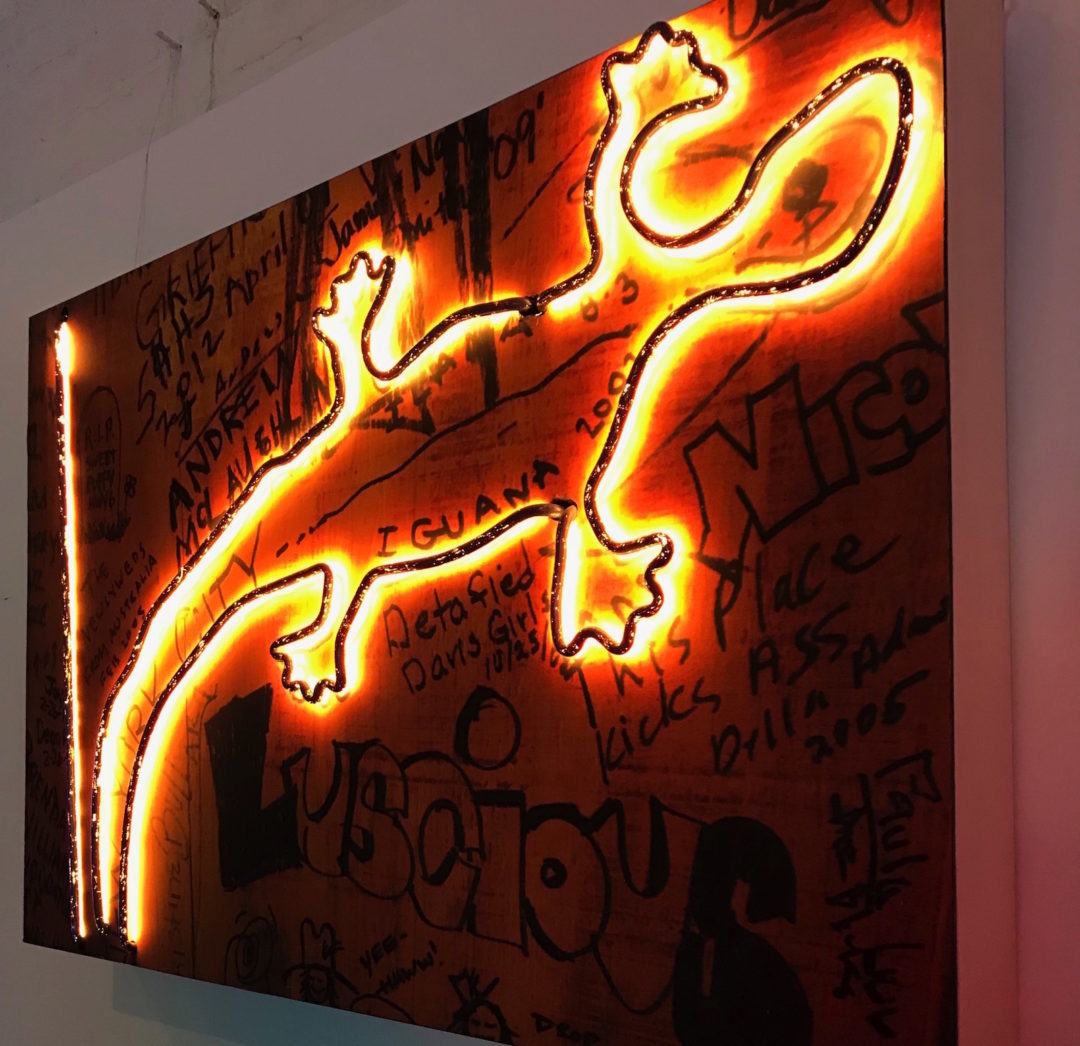
This artistic philosophy can be seen in various works in the gallery show, including “Ground Zero III.” In this piece from 2013, Kraft uses neon tubing to highlight a drawn lizard in a photograph of dense graffiti inside the Ground Zero Blues Club in Clarksdale, Mississippi. The neon tubing interacts with and transforms the photograph, altering our perception of the graffiti and its symbols. Kraft adds his own mark to an image already filled with layered inscriptions that span the history of the Ground Zero establishment.

The concept of mark-making has been a significant focus of Kraft’s practice in recent years, and has motivated him to travel to Africa, Southeast Asia and Europe to view some of the oldest known human rock and cave drawings. These trips inspired several works in Drawn by Light, including “Castillo Hands Flickering Light.” This piece re-creates the prehistoric hand stencils found in the Cave of El Castillo in Spain through acrylic paint on paper, which Kraft backlights with a pulsing glow that mimics the flickering light on a cave wall.  

Kraft’s travels also inspired one of the more striking pieces in the exhibit, “The Damaged Spirit of the African Elephant.” Made of parallel layers of bright blue aluminum and neon tubing bent into three dimensions, the piece depicts the head of an elephant with glowing red marks dissecting its trunks, referencing the ongoing poaching of this endangered species.

Regarding this piece and a related larger elephant sculpture in his studio, Kraft writes that light can represent the simultaneously material and immaterial of an animal spirit, suggesting “an inner spiritual world much more complex than its outer appearance.”

Pieces like this do lose some impact, however, because they are isolated from their companion pieces from Kraft’s full series. In particular, “Castillo Hands” would benefit from the contextualizing company of the other light sculptures in Kraft’s “Cave Drawings” series.

In Drawn to Light, the works that really shine (both literally and figuratively) are those that explicitly celebrate neon light, without using the medium to illuminate or represent another visual or physical component. “Pulsing Neon,” for example, comprises an abstract tangle of different-colored neon tubes crammed into a shadow box. The neon jumble emits a gently pulsing light that makes the piece feel alive, like a breathing, organic circuit.

“Unintentional Drawing III,” from 2009, presents the viewer with an abstract drawing composed of swirling tubes of blue neon light. The title is engaging because it seems contradictory to the artwork. Nothing appears unintentional in this piece, the only one in the exhibit that allows viewers to peer behind the back panel and see the electrical wiring — a glimpse of the immense forethought that must go into each neon work.

Both “Pulsing Neon” and “Unintentional Drawing III” highlight Kraft’s interest in recognizing the overlooked, reconstructing new pieces out of random discarded materials in his studio. The neon tubing in the latter piece is a translation of a mindless doodle Kraft then reimagined into a massive light sculpture, suggesting the meaningful significance in unconscious actions and creations.

The pieces reviewed here are a small selection of the works displayed in Drawn by Light. To present 35 years of work in a small, upstairs gallery is a challenge, especially for a retrospective show, but the exhibit offers a succinct introduction to Kraft’s artistry beyond his more monumental public sculptures. The gallery show is a welcome stop for anyone who appreciates the manifold possibilities of light during a dark winter.

Drawn by Light opened on Nov. 30 and will be on view through Dec. 28 at the Susan Calloway Fine Arts gallery at 1643 Wisconsin Ave. NW. To learn more about Craig Kraft and his studio, you can visit his website and read about his travels through his contributions to the magazine Timeless Travels.

Comedian Judy Gold Comes to City Winery

This article was first published by TAGG and can be read on their site here.

Comedian Judy Gold has been in the comedy scene for years, watched the industry expand and become a better representation for what the world looks like today. With 36 years as a stand-up comedian under her belt, Gold is a veteran, yet still finds new ways to remain creative and connect deeply with audiences.

“I started [stand-up] in college,” says Gold. “Someone dared me to do it and I got this high I had never gotten from anything else I had ever done.”

Her deep-seated passion for comedy translated into a career where she’s gained a lot of knowledge into the comedy industry. “The time I spend on stage is my favorite,” Gold explains. “I’ve seen a lot of great things happen and a lot of horrible things. Especially as a female comic to go from seeing people not hiring any women and now seeing women run networks and write shows. But there’s still a long way to go.”

Gold is an active member of the Jewish and LGBTQ communities, the intersections of her identities coloring her work, especially in later years.

“You can’t be a comic unless you’re honest about who you are,” says Gold. “Comedy is only funny when it’s the truth.” Gold emphasized how she’s never been shy about talking about being Jewish and her sexual orientation, especially after she became a parent.

After Gold’s first child was born, she naturally wanted to talk about being a parent and having a family onstage, which marked her coming out on stage. “[But] I didn’t want to be pigeonholed as a lesbian comic,” she says. “I just wanted to be a comic who was a lesbian. Everyone talks about their families on stage, so of course I’m going to talk about mine. What kind of message are you giving your kid if you don’t talk about your family?”

Gold incorporates stories about her partner and family into her work, feeling a responsibility to be out and proud about being gay and a comic.

“I definitely feel an obligation,” she says. “I’m gay, I’m in a gay relationship, I have children, and I’m doing what I love. I want every LGBTQ kid to know that you can do that too. You can have a family, a job that you love, and enjoy your life. There’s no reason not to have those dreams.”

In the 80s, when Gold was just starting out, there were very little comedians, much less lesbian comedians that were out. Homophobia was at “an all-time high” and Gold rarely saw LGBTQ representation within the industry.

“I know comics who won’t come out of fear,” she says. “It’s hurtful because there are so many kids out there who need to see themselves represented.”

Beyond being a comic, Gold has been spearheading her own podcast for a few years entitled “Kill Me Now,” which she calls “a labor of love.”

“I just love interviewing people and finding out what makes them tick,” says Gold. “It’s not a typical comedy podcast. I talk a lot about growing up. Those things those experiences that teach you and make you a different person and make you who you are – that’s the kinds of things I find fascinating. Everyone has a story.”

On her enduring role as a comic, Gold simply said: “It’s what I do. It’s who I am.”

Judy Gold will be at the City Winery on December 24, 2018. For more information or to purchase tickets click here.