Washington Revels celebrate Yuletide

by Athena Naylor

This article was first published in The DC Line.

The Washington Revels’ annual holiday production returns to Lisner Auditorium this weekend to welcome Yule with a romping production of Elizabethan music and dance that celebrates the group’s 35 years in the District.

The latest version of The Christmas Revels invites viewers to Elizabethan England to follow the exploits of professional fool Will Kemp, a comic actor who historically served in Shakespeare’s theater company and famously Morris danced from London to Norwich in a nine-day publicity stunt. The 2018 production, which debuted last weekend, imagines a scenario in which Kemp (played by Mark Jaster) arrives in Norwich at the same time as her majesty Queen Elizabeth I (played by Katrina Van Duyn), who has come to enjoy rustic entertainment and celebrate Christmas away from the trappings of court.

The Christmas Revels is a yearly seasonal celebration showcasing traditional folk dances, the art of pantomime, music and participatory theater for all ages. Revels Inc., under which Revels groups across the country are affiliated, was founded in 1971 in Boston, but the phenomenon soon spread — first to New Hampshire in 1975, and most recently to Santa Barbara, Calif., its 10th location, in 2007. DC’s production group launched in the early 1980s and annually hosts a variety of participatory events such as Community Singssummer paradesMay Revels and, of course, its largest event — The Christmas Revels, which each year focuses on a different time period and folk tradition.

As a historical variety show, the 2018 production excels. Upon entering the theater, each audience member receives a program that not only provides sheet music for the eight singalongs included in the production, but also features a veritable history lesson on English folk culture. The program offers a concise but thorough explanation of the cultural origin and purpose of each song and dance performed on stage.

Within the show, musical performances are heightened by the accompaniment of Piffaro: The Renaissance Band, which imbues the production with sounds of the time, showcasing beautiful medieval and Elizabethan instruments, from horns and recorders to giant lutes.

The size and spectacle of The Christmas Revels is part of its public appeal, and the production company boasts an extensive cast that includes players from “age 8 to 88.” Accolades must go to artistic director Roberta Gasbarre and the Revels costume shop for making period costumes for a cast of nearly 100 people. The large and varied cast is indeed a feat and a highlight of the show. The children players are particularly charming in their period-specific song and pantomime numbers.

However, occasionally the sheer size of the Revels cast works against the production’s visual definition. The large folk dances, in particular, lose focus due to the significant number of performers cluttering the Lisner stage. The number of players in the production works best in one of the comedic highlights of the show, when each villager of Norwich, in an attempt at theatrical acting, cries out a line of a Shakespearean tragedy before dramatically perishing, resulting in the absurd and hilarious staged mass death.

When the production provides space for less crowded scenes, individual players within the production are allowed to shine. A purple-lit nighttime scene in the beginning of Act 2 opens with the Abbots Bromley Horn Dance, an ancient ritual whose meaning has been forgotten but whose impact remains engaging and mysterious. Dancers adorned with antlers and accompanied by a traditional recorder weave around the stage, creating a dreamlike atmosphere that serves as a respite to the more raucous rustic entertainment that fills the rest of the show.

Soon, Kemp — adorned with a donkey’s head from his rehearsals with the village players for their Yule play — encounters Queen Elizabeth sleeping outdoors in her nightgown. With his identity disguised, Kemp promenades with the queen in a comedic scene that makes full use of Jaster’s training in pantomime.

The sequence pays homage to A Midsummer’s Night Dream and the Shakespearean motif of strange and fantastical encounters occurring at night in the woods. When Kemp and the queen recognize each other the next morning in the village, both visibly decide to say nothing of the experience. What happens in the woods stays in the woods.

The Christmas Revels delivers what it sells as a revival and celebration of Elizabethan and Yuletide cultural traditions. If there is any reservation attached to the show, it would be toward how well these traditions translate to the current day. For example, in the second act of the show Queen Elizabeth delivers a monologue about the joy of the holiday season with the promise that “the gloom of the world is just a shadow.” This speech fits the historical purpose of  Yule as a solstice celebration that marked the end of days growing shorter and the beginning of increasing daylight. However, the reaction to this line, which was clearly meant to engender hope, was rather subdued at the Saturday matinee on Dec. 8. Perhaps having a monarch assure the poorer working class that their struggles are “just a shadow” falls a little flat after a rather tumultuous year, especially for a politically minded Washington audience.

The crowd reserved its cheers and applause for other moments, such as when the all-female troupe of the Rock Creek Morris Women gave Kemp a run for his money in a Morris dance duel. Raucous laughter also followed jokes about Canadian and American health care during the amusing play-within-a-play sequence in Act 2. It is 2018, after all, and there is benefit to focusing on the “expansion” aspect of the Revels’ mission to “revive, sustain, expand, and celebrate cultural traditions.”

Any recommendation to see The Christmas Revels should come with a caveat — you must enjoy participatory theater and be receptive to singing along with large groups. To say the experience is for everyone would be presumptuous. But for those looking for a family-friendly alternative to more standard holiday outings such as The Nutcracker or A Christmas CarolThe Christmas Revelsis a festive way not only to welcome Yule, but also to learn about unique historical traditions and gain a better appreciation for DC’s local performers and varied, thriving community ensembles.


To purchase tickets for The Christmas Revels: An Elizabethan Celebration of the Winter Solstice, visit the Washington Revels website. Performances are Friday at 7:30 p.m. (Family Friday); Saturday at 2 and 7:30 p.m.; and Sunday at 1 and 5 p.m. Tickets cost $18 to $60 for adults and $12 to $40 for ages 18 and younger. George Washington University’s Lisner Auditorium is located at 730 21st St. NW.


Wilson Building display of political cartoonist’s work shows long history of voting rights struggle

by Athena Naylor

This article was first published in The DC Line.

Last month’s pivotal midterm election provoked heightened frustration over DC’s lack of a vote in Congress. District residents on Nov. 6 may have found themselves longingly gazing across the Potomac River to spy on Arlington County, where ballots provided choices for voting members of the House and Senate and where residents did not drive to the polls with license plates that decry the continued condition of “taxation without representation.”

This scene of a lonely and left-out DC (minus the detail of motor vehicles) is reflected in one of the seven C.K. Berryman cartoons now on display indefinitely on the fifth floor of the John A. Wilson Building, which houses the offices of the District’s mayor and council. This tribute to Berryman, in addition to celebrating a distinguished DC cartoonist, pointedly illustrates the longevity of the city’s struggle for a political voice.

Clifford Kennedy Berryman was an influential political cartoonist who began his career during the Gilded Age, a post-Civil War period marked by superficial displays of wealth masking deep social inequalities. That time also coincides with the golden age of American political cartoons and the rise of print publications such as Harper’s Weekly, Puck and Judge.

In 1891, Berryman began working for The Washington Post before going on to work for the Washington Star from 1907 until his death in 1949. He received a Pulitzer Prize for his editorial work in 1944.

Berryman is perhaps best known for penning the drawing of President Theodore Roosevelt refusing to shoot a bear that inspired the production of teddy bears. In fact, visitors who view the cartoons in the Wilson Building should keep an eye out for a trumpeting bear in one of the illustrations. This bear became a recurring character and mascot for Berryman’s career, often appearing as an additional commentator to his scenes and linking the artist’s later works to the famous cartoon that made teddy bears a national phenomenon.

Berryman also drew the 1898 cartoon that popularized the well-known rallying cry “Remember the Maine!” during the Spanish-American War. The tribute in the Wilson Building highlights another dominant motif of Berryman’s career: his frequent commentary during his tenure at the Washington Star on DC’s lack of congressional power.

Around the corner from the Council Chamber and near the office of DC Council Chairman Phil Mendelson, visitors can find prints of seven cartoons about “voteless DC” surrounding a painting of Berryman by Richard Sumner Meryman Sr. that was previously part of the Corcoran Gallery of Art’s collection and is on long-term loan to the DC Council from American University, the current owner. In each illustration, Berryman represents DC as a stout man in 18th-century clothing, including a powdered wig, tricorn hat, buckle shoes, and small round glasses. DC’s relatively stout stature serves as a visual contrast to lanky Uncle Sam, who appears in several of the selected cartoons either ignoring DC or requesting taxes and soldiers despite DC’s complaints of taxation without representation.

This all-too-familiar slogan often appears on the image of a ball and chain that keeps Berryman’s DC anchored to Revolutionary-era sentiments and frustrations. In one cartoon, Berryman draws DC gazing up at a painting depicting the “beginning of the war against taxation without representation, April 19, 1775” while DC remarks, “That war was never won, if you ask me!”

Other illustrations directly reference the Boston Tea Party, including one cartoon recognizing the 163rd anniversary of the event and another showing a waterlogged DC in the tea-filled harbor exclaiming, “Hey! It was the tea, not me, to go overboard!”

Either cathartic or frustrating in their illustration of DC’s long and continued fight for voting rights, the Berryman cartoons in the Wilson Building — created more than seven decades ago — remain relatable to the modern eye. Considering their shared political content, the illustrations’ current location beside municipal offices is appropriate.

Visiting the Berryman tribute during its indefinite tenure in the Wilson Building is certainly worthwhile for an up-close view of Berryman’s detailed, cross-hatched pen illustrations, and to contemplate the history of political cartoons in a city where editorial illustration continues to thrive.

With only seven cartoons on display, the Wilson Building tribute that debuted this fall can hardly give a sense of Berryman’s prolific career. For those interested in further exploring Berryman’s extensive oeuvre and the other subjects his cartoons illustrated, the Library of Congress holds many prints, and the DC Public Library holds a digital collection of 108 Berryman cartoons that are accessible online.

How to Keep an Alien, a comedy about love and red tape

by John Bavoso

This article was first published in DC Theatre Scene.

Several years ago, a good friend of mine married a Swiss citizen. Over many glasses of wine, she detailed to me having to provide emails, OkCupid messages, photos, and receipts to prove they actually loved each other so he could gain his American citizenship. At no point during her tales of navigating red tape like a member of the Mission Impossible team dodging laser alarm systems did I think to myself, “This would make a hilarious comedy!”

Not true for Irish playwright and standup comedian Sonya Kelly, apparently, who used a similar experience from her life as the basis for her romantic comedy How to Keep an Alien, which is being given its regional premiere courtesy of Solas Nua at the Dance Loft.

This production represents not only the first time the piece has been performed in DC, but also the first time the playwright has not played herself on stage. In Solas Nua’s lighthearted and spirited production, that duty falls to the dynamic and captivating Tonya Beckman. Kelly admits to being influenced by table monologists like Spalding Gray, but Beckman isn’t alone on stage—she’s joined by the versatile Nick Fruit, who plays Sonya’s stage manager, Justin, as well as a variety of roles including a snobbish choreographer; two drunken, brawling nightclub patrons; a taxi driver; and the object of Sonya’s affection herself, Kate from Queensland.

Kate, you see, is our inciting incident. Sonya, a disaffected Dublin-based actor, meets Kate when they’re working together on a production of a Russian play, produced in an Irish castle, during which everyone speaks with a British accent. The two fall head first into a whirlwind romance that’s cut short by the expiring of Kate’s one-year work visa and her deportation back to Australia. What follows is an unconventional journey through Ireland’s immigration system to try to get Kate to stay permanently in the country, all while trying to navigate a new romance.

Kelly’s background as a comedian shines through in her snappy bon mots (I particularly related to line, “I hate camping… it defeats the purpose of evolution!”), which Beckman delivers with wit and a wink. Director Tom Story keeps action moving and creates rousing bits of physical comedy and tender moments between Sonya and Justin. These two characters have an easy and lived-in relationship that would suggest years of working together.

Beckman and Fruit do their work on a set designed by Brigid Kelly Burge, who created a space that’s warmer and softer than any made up of shelves, desks, file boxes, binders, and other bureaucratic detritus has a right to be (I’d love to get some tips on her paper plane-making techniques, if nothing else). Marianne Meadows’ lighting design and Michael Winch’s sound design come together seamlessly to create magical moments and transport the audience across the globe and through time.

How to Keep an Alien is billed as “a comedy about falling in love and proving it to the government.” This may be the ultimate proof that I’ve been living in DC too long, but my main quibble with an otherwise fantastic script is that I wanted to know more about the bureaucratic red tape the couple is forced to deal with—for as boring as governmental policies and procedures are, when they intersect with real lives, the results can be quite dramatic. While, as an audience member, I appreciated the play’s overall comedic tone, I couldn’t help but think about how Sonya and Kate were in some ways charmed, especially compared to the nightmare that so many are going through with regards to the immigration system these days. I’m not faulting Kelly for this—her goal was clearly not to make a documentary of the minutia of Ireland’s immigration system—but it was something tugging at me from the back of my mind each time I laughed at a cartoonish portrayal of their visa agent.

What Kelly has created—and Solas Nua has so expertly brought to life—is a new twist on a rom-com set against the unlikely backdrop of deportation and paperwork. How to Keep an Alien gets to the heart of one particular couple going through the immigration process with humor and humanity—something the real-life immigration process is often deeply lacking.


How to Keep an Alien by Sonya Kelly. Directed by Tom Story. Featuring Tonya Beckman and Nick Fruit. Scenic and props designer: Bridgid Kelly Burge. Lighting designer: Marianne Meadows. Sound designer: Michael Winch. Artistic director/movement director/producer: Rex Daugherty. Assistant director: Jake Owen. Associate producer: Daven Ralston. Stage manager: Sam Reilly. Produced by Solas Nua.

Interplay between DC artist’s portraits, geometric work creates engaging experience at AU Museum

By Athena Naylor

This article was first published in The DC Line.

The contrasting pursuits of DC artist and American University professor Ian Jehle are both on full view in a new exhibit at the university’s Alper gallery space, with Jehle’s well-known, large-scale figurative drawings of prominent members of the DC arts community displayed alongside his abstract, geometric work that’s rooted in his training as an engineer.

Jehle was initially hesitant about placing these two aspects of his artistic practice side by side, according to curator Laura Roulet’s introductory wall text for Ian Jehle: Dynamical Systems at the American University Museum in the Katzen Arts Center. Visitors will be thankful his skepticism was short-lived. Sharing a space, Jehle’s mathematically inspired work and his large-scale portraits create an engaging and imaginative gallery experience.

The exhibit’s title refers to a mathematical concept. In scientific models, “dynamical systems” convey the evolution of a certain state over time, such as calculating the mechanics of a moving point through space (the swinging of a pendulum, for example). In broader terms, dynamical systems illustrate the relationships between variables in space and time.

This nod to the mathematical influences in Jehle’s abstract work also points to the show’s larger theme of interrelation. In the introductory text for the show, Jehle explains that his aim in combining his portraiture and abstract work was “to focus [the] geometric work on distorting, stretching and augmenting the Alper Gallery space and then placing the portraits within that augmented space and seeing how they react.”

Jehle’s abstract work complements his portraiture. The exhibit’s first geometric installation — “Tile/Trial: Anti-Tiling Permutations in the Form of a Game” — represents the result of a game played by American University students in adherence to Jehle’s instructions. Competing teams equipped with red and blue tape laid down patterns in order to block the opposing team’s tiling efforts, resulting in tessellations of red and blue tape that cover the glass doors, floors and walls of the Alper Gallery and guide visitors toward the first portrait of the exhibit, “The Gallerist.” Further inside, intersecting red, blue and green bungee cords arc across the walls and ceiling to create a visual frame for the largest and most striking drawing in the show, “The Collectors (Richard Gould and Lena Skanby).”

The interrelations between other abstract pieces and Jehle’s portraits are not as straightforward. Separated from the rest of the exhibit via a partition, the tape mural “The Transit of a Hilbert Space onto a Hilbert Space is itself a Hilbert Space” depicts a maze-like area folded into itself, a two-dimensional representation of a convoluted three-dimensional construction. Across the way, two portraits of local art collectors — “Philip Barlow” and “Lisa Gilotty” — seem to look out past “Hilbert Space” at the viewer.

Rather than seeking to draw conclusions from the physical orientation of these three pieces, it seems more appropriate to consider the relationships among them conceptually. “Hilbert Space” encapsulates Jehle’s aim to augment space by distorting our understanding of two dimensions and three dimensions on a theoretical level. “Philip Barlow” and “Lisa Gilotty” similarly provoke questions of space, though they do so in terms of interpersonal distance.

Interpersonal distance arguably affects all portraiture, no matter the style or subject, since the genre’s conceit is to create a two-dimensional stand-in for a three-dimensional person. However, Jehle’s portraiture particularly emphasizes the push and pull of familiarity and detachment. “Philip Barlow” and “Lisa Gilotty” draw the viewer to the nearly life-size subjects, only to find both portraits so faintly rendered in colored pencil that they seem to glow with immateriality, appearing translucent and insubstantial.

In other drawings — “Iona Rozeal Brown” and “Henry Thaggert,” for example — Jehle opts to leave his subjects’ faces unfinished and floating in a void, relying on viewers to complete the portrait in their mind. In “The Collectors (Richard Gould and Lena Skanby),” Jehle challenges notions of interpersonal distance by depicting an intimate moment on a monumental scale. The beautifully rendered 72-inch-by-151-inch drawing depicts partners Richard Gould and Lena Skanby in the midst of an open-mouthed kiss, their tongues colliding in the center of the composition.

Though Jehle’s drawings represent people he knows “to varying degrees,” he inserts interpersonal distance between himself and his subjects through his drafting process. Jehle does not ask his subjects to model for him. Instead, the artist creates composite images of friends and acquaintances by relying on photos of his subjects, along with other models whose body type is similar to that of his chosen subject.

Jack Rasmussen, director and curator of the American University Museum at the Katzen Arts Center, describes Jehle’s portraits as “right-brain feats” and his geometric installations as products of the artist’s left brain. This description, while acknowledging the differences between Jehle’s drawings and abstract artworks, also insists on their similarities, as the left brain and right brain necessarily connect to create a cohesive whole.

So it is with Jehle’s geometric and figurative work in Dynamical Systems. Both the mathematically inspired installations and portraits are well-executed and enjoyable on their own, but their union encourages comparison and conjecture. The harmony of Jehle’s two artistic approaches is difficult to articulate, but to leave the gallery with concrete conclusions seems antithetical to the exhibit’s intentions. As curator Laura Roulet writes of the show, “The conditions are set for wonder.”

Ian Jehle: Dynamical Systems, presented by the Alper Initiative for Washington Art, opened Nov. 10 and closes Dec. 16. Jehle will join curator Laura Roulet to discuss the site-specific installation on Thursday, Nov. 29, at 5:30 p.m.; admission is free, but reservations are required. The Alper gallery space is part of the American University Museum at the Katzen Arts Center, which is across from the university’s main entrance at 4400 Massachusetts Ave. NW.

BETTY Comes Home to D.C. Better Than Ever

This article was first published in TAGG and can be read on their site here.

It has been two years since the iconic three-woman band BETTY has graced their hometown of Washington D.C. with a concert. Comprised of Alyson Palmer and sisters Elizabeth and Amy Ziff, the band has reached people beyond the scope of music and in the realms of social activism, humanitarian work, and more.

BETTY’s presence has been felt since the 1980s, when the band originated at the 9:30 Club. With a focus on not just making genre-bending music, BETTY has always been rooted in their efforts in social change.

“Musically, we’ve always had different influences and styles,” says band member Elizabeth Ziff. “What kept us together [all these years] was our politics.”

The band’s dedication to making their shows inclusive and tinged with their personal beliefs from the very beginning of their career drew skepticism. Ziff said that they were told this would “destroy their careers,” but has instead become a major touchstone for the band’s perception. And though the band has never been signed to a major label or had a manager, they’ve cultivated a wide-reaching, diverse, and devoted fan base.

“We have an incredibly loyal following,” says Ziff, emphasizing how some fans have shown up again and again over the decades. “We tour not in the way people make millions of dollars, but in a way where we can make friends everywhere. We are able to stay longer in places when we tour. We see things and are a part of a great cultural and political exchange.”

The band’s passion for equality and empowerment on a political and social level is unsurprising given their origins in Reagan-era D.C. Ziff recalls times where concerts had to be carried out with discretion, specifically playing at Pride in the 1980s on P Street beach.

“We have to be vigilant,” Ziff explains. “Our country has never been equal. But I feel encouraged right now. Activism has always been an art – you just have to look in to the corners for it.”

They’ve carried that passion and dedication into the 21st century, connecting with new and old audiences across the country in the midst of a tumultuous political climate.

“We really believe in connecting with the audience,” says Ziff. “We are especially conscious of being a feminist group and seeing our similarities rather than differences.” The band’s own intergroup diversity (Ziff identifies as a lesbian and Palmer is African-American) has spurred on their activist efforts. Their concerts act as safe spaces for the LGBTQ community and other marginalized identities, but still place a large emphasis on just having fun being around people like you.

“There’s a time you want to be on your own and that’s valid,” says Ziff. “But there’s a time in art and music that you want to be around other people and you’re dancing and laughing and singing the same song.” It’s this sentiment that has followed BETTY’s career for years and continues to be something the band is defined by.

BETTY’s Holiday Show takes place Sunday, December 2 at City Winery in Washington, D.C. For more information or to purchase tickets, click here.

Local Filmmaker Answers the Call to Document History of DC Black Pride

by Athena Naylor

This article was first published in The DC Line.

DC’s annual LGBTQ film festival, Reel Affirmations, showcased a wide variety of films that highlight LGBTQ subjects and issues during its four-day run in early November. Notably, the film roster included a 50-minute TV special by first-time producer Marvin Bowser titled DC Black Pride: Answering the Call, which archives a disappearing history and contextualizes the annual DC event as both a celebration and a legacy.

Marvin Bowser, older brother of Mayor Muriel Bowser, is a proud DC native, a retired U.S. Air Force captain and an active member of the LGBTQ community who, after working as a defense contractor for 18 years, is now developing and pursuing his artistic talents. While he mainly focuses on acting, writing and photography, Bowser felt the need to produce Answering the Call after conducting research for a Washington Blade article on DC’s first Black Pride event, a celebration and commemoration of the area’s black LGBTQ community held each spring. “I realized that the history of DC Black Pride is poorly documented and remembered and that I needed to do something about it while some of the leaders are still alive to tell their stories,” Bowser writes.

Created in collaboration with the DC Office of Cable Television, Film, Music & Entertainment, DC Black Pride: Answering the Call collects the stories of the original organizers and attendees of DC Black Pride as well as those of current members of the District’s LGBTQ community to communicate a compelling account of Black Pride’s history and importance.

While it’s true that the first DC Black Pride was established in part as a counterbalance to Capital Pride — DC’s primary Pride event founded in 1975 — the main motivator for the event’s launch in 1991 was the AIDS epidemic. In the 1970s and 1980s, DC relished its reputation as “Chocolate City” with a thriving black population, which included a gay community that flocked to the city’s clubs and discos. Yet by the late 1980s, what had begun as a nameless disease was disproportionately affecting the once-flourishing black LGBTQ community, inciting fear on all fronts. To talk about AIDS was taboo, since doing so meant discussing homosexuality, which was still illegal under sodomy laws.

Organizers of the first DC Black Pride sought to raise money for critically needed services that would help combat the AIDS crisis and serve those already affected. The event also connected and celebrated the black LGBTQ community, which was struggling with the inconceivable loss generated by the epidemic.

Original co-founders Ernest Hopkins, Welmore Cook and Theodore Kirkland faced skepticism as they tried to organize the inaugural Black Pride. The choice of Banneker Field in Northwest DC as the event’s location and the very nature of the gathering were seen as deterrents for anyone who might attend. However, the first Black Pride proved a great success, and since 1991 the event has inspired the establishment of Black Pride celebrations throughout the country and abroad.

Bowser’s DC Black Pride: Answering the Call succeeds by utilizing an impressive roster of interviews with LGBTQ activists to tell the story of the first DC Black Pride — which Bowser attended — and to express the continued impact of the event.

Along with Bowser’s revealing interviews with leaders of the first DC Black Pride, the documentary also explores current LGBTQ issues in the District through the insights of figures such as Philip Pannell, a political activist in Ward 8; June Crenshaw, executive director of the Wanda Alston Foundation; and Sheila Alexander-Reid, director of the Mayor’s Office of LGBTQ Affairs.

Bowser notably expands the discussion of DC Black Pride beyond its typically cis-male-centric perspectives. The audience gets to hear from Anika Simpson, director of Women’s, Gender and Sexuality Studies at American University, who describes the need to incorporate voices of queer women of color in academic curricula. Also featured are local trans activists Earline Budd, non-medical case specialist at the DC sexual health and rights organization HIPS; and Achim Howard, founder and coordinator of Trans Men Rising Inc.

Bowser also considers the District’s elderly LGBTQ community through a conversation with Dr. Imani Woody, founding director and CEO of Mary’s House for Older Adults. Besides archiving the disappearing history of the first DC Black Pride, Bowser clearly prioritizes increasing the visibility of other LGBTQ narratives while looking to the future of the District’s black gay community.

DC Black Pride: Answering the Call emphasizes the importance of understanding the past of Pride to progress into the future. Today, a major concern for DC is the large number of homeless youth who identify as LGBTQ and often find themselves on the street because their families do not accept their sexual orientation or gender identity.

Black trans lives continue to be endangered, and AIDS, the main motivator for the first DC Black Pride, remains an issue today. During an interview in Answering the Call with an advocate from the organization Impulse Group, which promotes healthier lifestyles for gay men in DC and 17 other cities around the world, Bowser becomes visibly disturbed when told that half of gay black men — an even greater percentage than in the early 1990s — will become HIV-positive in their lifetimes.

Answering the Call suggests that perspective is the main difference between older and younger generations of DC’s LGBTQ community. As expressed by various interviewees in Answering the Call, in the late 1980s and early 1990s it was common for members of the LGBTQ community to attend an AIDS-related funeral each week. Friends watched friends wither away, and fear of HIV was so great that often hospital employees, fearing infection, would not take food into the rooms of AIDS patients. Instead, they would deposit meals in doorways, to be carried bedside by visiting friends.

Today’s LGBTQ youth are distanced from that fear and horror since many have access to Pre-exposure prophylaxis (PreP), drugs taken to prevent HIV infection. With more resources to combat AIDS, the stigma surrounding the disease is not as great as it once was. Answering the Callemphasizes, however, that the lack of support for HIV research funding from the Trump administration and general restrictions on the U.S. Centers for Disease Control are cause for concern. Not all LGBTQ people will have access to health care services to fight HIV if they become infected.

The Reel Affirmations screening of DC Black Pride: Answering the Call on Nov. 4 concluded with a brief Q&A, which emphasized where the documentary succeeded and where it could be improved. Many younger viewers appreciated the contextualization of Black Pride that Bowser’s film provided, and spoke of the disconnect between younger and older generations regarding the AIDS epidemic and the purpose of Pride.

One older woman expressed appreciation but said she would have liked to see better explanation of the role African-American lesbians played in the organization and success of 1991’s Black Pride. More trans inclusion was also suggested, and one older gentleman described the TV special as “only the beginning” of the story, saying he hoped Bowser would follow up on the subject with another documentary.

Conceding that 50 minutes wasn’t enough time to provide a comprehensive history of DC Black Pride, Bowser asked the members of the audience to raise their hands if they either attended or helped organize the first DC Black Pride. Many hands went up. Bowser encouraged everyone to give him their contact information, saying an extension of the project was possible.

DC Black PrideAnswering the Call aired for the first time over the Memorial Day weekend in conjunction with Black Pride 2018. One hopes it will air again during DC Black Pride 2019, or perhaps be featured as part of Reel Affirmation’s monthly film series Reel Affirmations XTRA. Bowser says the special can be streamed online and also will air periodically on Channel 16 of the DC Cable Network. The feedback and reaction to the Nov. 4 screening demonstrates the continued relevance of DC Black Pride and the value of sharing its history — both to celebrate DC’s black LGBTQ community and to encourage a continuing dialogue about its past, present and future.

In This Hope: A Pericles Project

by John Bavoso

This article was first published in DC Theatre Scene.

In fraught times, where do you go to find hope? Assuming the answer is not “within yourself,” might I suggest the basement of a church where, seated in a circle with a group of strangers, you recount personal stories and cherished memories? If it sounds like I’m pointing you in the direction of a support group, well, I am, sort of—in the form of Hannah Hessel Ratner’s In This Hope: A Pericles Project, being produced now by The Welders at Spooky Action Theater.

Using Shakespeare’s Pericles, Prince of Tyre as a starting point, an ensemble of four actors tell the tale of not only the Greek hero, but also their own personal and family histories, and coax the audience to do the same. In doing so, they transform the classic tale into something more modern and personal, updating some (generally the sexist) parts and finding relevance in contemporary life in the process. And in doing so, the cast of In This Hope stitches together an evening filled with memory, storytelling, and community.

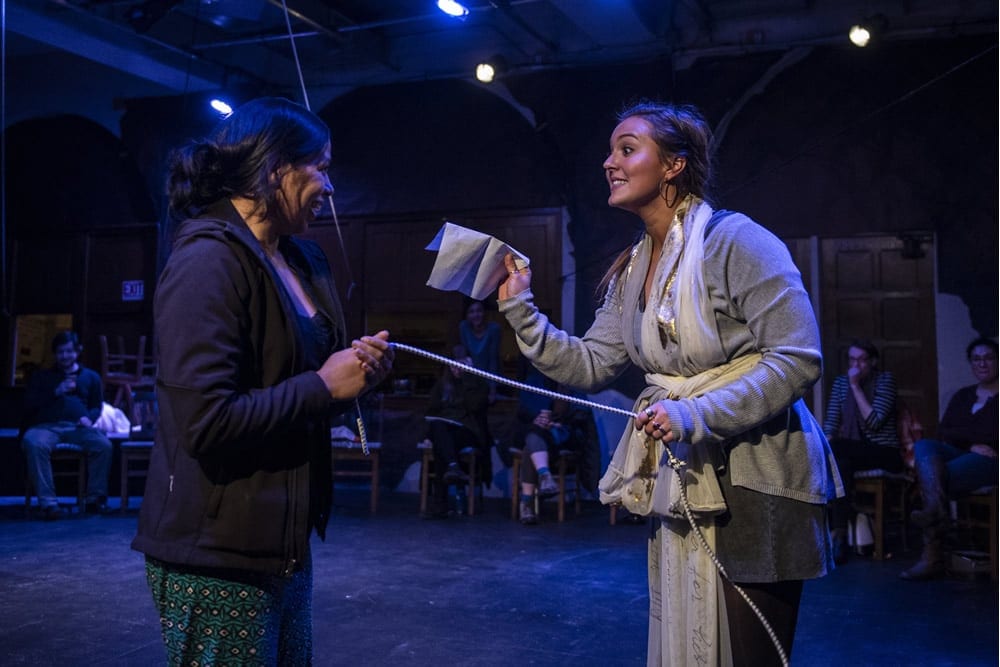
Upon entering the Universalist National Memorial Church on 16th Street, audience members are led downstairs and through the kitchen to a big, open space filled with a circle of wooden chairs. On the walls surrounding this circle is a map of the ancient world with the cities of Tyre and Antioch and the like marked off. Above the space hangs several ropes or cords crisscrossed, like a tapestry waiting to be woven.

Our guides and our bridge between the ancient source text, the Jacobian retelling, and the present interpretation are four talented and versatile actors— Lida Maria Benson, Rocelyn Frisco, Raghad Makhlouf, and Lori Pitts. Under Anna Brenner’s deft direction and using little more than a few infinity scarves and a crown made of forks, these four assume a variety of roles from Pericles, but also play themselves, sharing bits of memory and personal anecdotes from the Ukraine (Benson), the Phillipines (Frisco), Lebanon (Makhlouf), and here in DC (Pitts).

In This Hope is billed as a ritual as well as a performance, and the audience is encouraged to not only participate, but help to create the piece from the ground up—this play literally could not exist on a proscenium behind a fourth wall. Given that Hessel Ratner’s primary vocation is that of a dramaturg rather than a playwright, it’s no surprise that deep excavation and group work are main features of the piece. From sharing a memory with a neighbor to inviting an audience member to play a role in the original tale, but with a choose-your-own-adventure twist, the audience is welcomed in and made to feel a part of the story in a genuine, non-threatening way.

The interwoven nature of the past and present, of myth and memory, is interesting and thought-provoking, but at times can lead to a somewhat muddled experience. For example, the death of Pericles’ wife, Thaisa, as she gives birth to the couple’s daughter, Marina, is used as a touchpoint for discussing how the maternal mortality rate in DC is more than twice the national average, especially among African American women.

While this aligns with the idea of blending the past and present, and literature and reality, it doesn’t seem to fit as neatly with either the world of the Pericles story or the personal lives of the actors—it’s important information, but it feels slightly out of place. Similarly, there are other moments when the drama of Pericles or the stories of the actors or the memories of the audience is reaching its height, only to be cut off by another narrative. When the intermingling of these different threads works seamlessly, it casts a spell; when it doesn’t, it can be jarring for the audience.

“What world is this?” This line, written by William Shakespeare and repeated several times by In This Hope’s cast, is not one that is easily or happily answered by many people these days. But the team behind In This Hope: A Pericles Project is creating its own world from scratch, in which strangers are vulnerable and open and stories are shared without judgement—and that’s a space I wouldn’t mind inhabiting for more than 2 hours at a time.


In This Hope: A Pericles Project by Hannah Hessel Ratner. Directed by Anna Brenner. Associate Director Jess Phillips . Featuring Lida Maria Benson, Rocelyn Frisco, Raghad Makhlouf, and Lori Pitts. Environmental designer: Colin K. Bills. Costume designer: Pei Lee. Sound designer: Roc Lee. Design assistant: Cody Whitfield. Artistic consultant: Isaiah Matthew Wooden. Stage manager: Emma Heck. Assistant stage manager: JJ Hersh. Production manager: KayCee Tucker. Produced by The Welders.