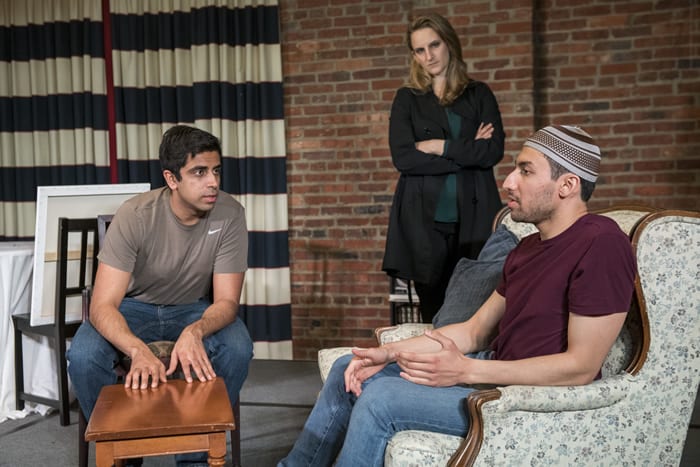
Disgraced from Compass Rose Theater

by Angela Carroll

This article was first published in DC Theatre Scene

Ayad Akhtar’s Pulitzer Prize winning Disgraced is a thoughtful character study about American Muslim identity. Driven by casual conversations, the play reveals earnest and unsettling disclosures about the perceptions and misconceptions we all maintain and project about those with differing world views. Compass Rose Theater offers a fresh production with direction from James Bunzli at a temporary location in Annapolis, Maryland. 

Disgraced takes place in the Upper East Side Manhattan apartment of married couple Amir, a successful Pakistani lawyer (Park Juneja) and Emily, white visual artist (Katie Wicklund). Audiences are immediately made aware of their divergent political and philosophical beliefs. Emily is deeply inspired by classical Islamic visual culture. “It’s time we stopped paying lip service to Islam and Islamic art. We draw on the Greeks and the Romans, but Islam is part of who we are too!” she explains. She appropriates Islamic art aesthetics to bolster her career as a contemporary artist. In contrast Amir, who allows people to think he is from India rather than Pakistan, is vehemently critical of anything associated with Islam, a religion he considers “backwards”.

Amir struggles to come to terms with his relationship to Islam and fears that it could destroy his American dream to assimilate, attain wealth and not be viewed as a terrorist. His nephew Abe (Joe Mucciolo) counters Amir’s perspective with a keen pride in Islamic culture and religion, but ironically prefers his newly adopted western name over the Pakistani one he was born with. Abe begs Amir to provide legal counsel to a local imam who is accused of aiding terrorists. Initially Amir adamantly refuses, but eventually agrees to attend the trial as a neutral observer. That decision proves disastrous for Amir’s professional and personal life.

Still reeling and dazed from events following the trial, Amir wearily agrees to cohost a dinner party Emily is throwing. In the hopes of solidifying the acquisition of her paintings, Emily invites mutual friends over for dinner: Isaac, a respected Jewish art dealer (Sam Midwood) and his wife Jory (Aunye’ Boone), an African American lawyer and colleague of Amir. The dialogue between Isaac and Amir is especially revealing– both men maintain problematic and inconsistent conceptions about the religion, culture and traditions of the other.

In that scene, one of the highlights of the production, Juneja and Milwood deliver passionate performances. Isaac asks Amir if he was happy about the September 11 attacks.  “Are you telling me you’ve never felt anything like that? An unexpected blush of pride?”, Amir asks. “Blush? No! I don’t feel anything like a blush.” Isaac retorts. “When you hear about Israel throwing its military weight around?” Amir comes back. Isaac, “I am critical of Israel. A lot of Jews are.” Amir, “And when you hear about Ahmadinejad going to the Mediterranean? How do you feel about that?” Isaac, “Outraged like anybody else.” Amir “Not everyone feels outraged.”

Compass Rose Theater presents a satisfying production of a timely work about America’s tenuous relationship to Islam. While the company transitions to a new venue, they are preforming in a space tucked inside the Power House Building adjacent to the Loews Hotel. It’s a little tricky to find. Arrive early to ensure a good seat.

—————

Disgraced by Ayad Akhtar. Director: James Bunzli. Featuring: Par Juneja, Katie Wicklund, Sam Midwood, Aunye’ Boone, Joe Mucciolo. Stage Manager: Caitlin Weller. Lighting Designer: Caitlin Weller. Production Supervisor/Properties: Mary Ruth Cowgill. Costume Designer: Katie Boothroyd. Produced by  Compass Rose Theater. 
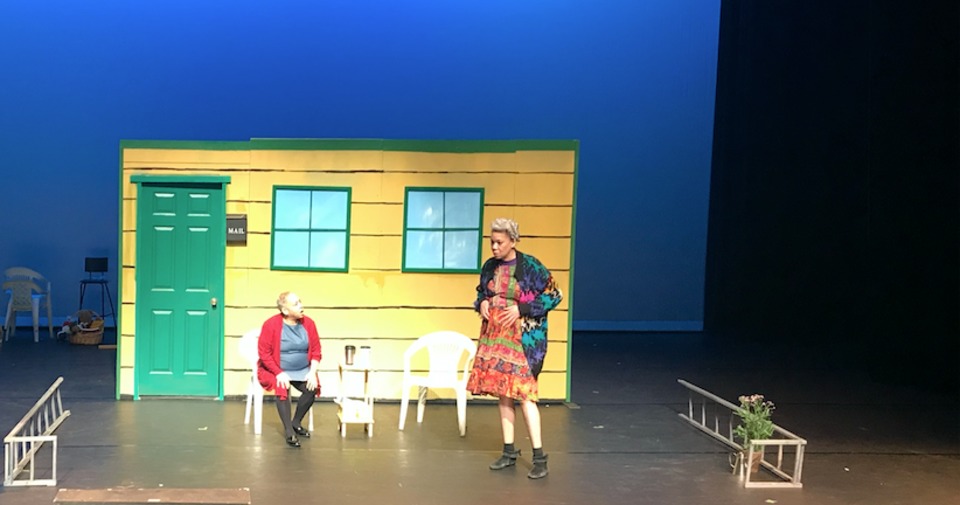
The Intruders Takes on Gentrification in DC

by Angela Carroll

This article was first published on DC Theatre Scene

Hope Lynne Price-Lindsay’s The Intruders  is an entertaining satire about the contemporary wave of gentrification in DC that packs lots of laughs, but fails to do more than scratch the surface of a pressing issue. Directed by Vera J. Katz, and produced by The New Millennium Howard Players, The Intruders is one of over one hundred performances included in the 9th Annual INTERSECTIONS Festival. 

The Intruders centers on the observations of longtime DC residents, friends and Ella (Judy E. Leak), Avis (E. Dawn Samuel) and Ella’s professional adult children Jennifer (Farah Benkahla) and Elliot (Neko Ramos) about the influx of white wealthy couples purchasing homes in their community– who Avis calls “urban pioneers”. Their conversations occur on the front porch of Ella’s modest home — a yellow façade, gate, two patio chairs, and a small table.  “I used to know everybody on this block” Ella sighs, “now I’m a stranger in my own neighborhood.”

The family is skeptical about the changes the neighborhood is undergoing and angered by the emergence of a newsletter that details a long list of mandates issued by their new Block Association. One of their new neighbors, Zylinksi (Jim Epstein), leads the charge of the Block Association to prevent activities that he believes will depreciate the property values of their homes. He spends much of his time patrolling the community, looking into the windows of his neighbors, and making notes about the violations he finds.  Zylinksi is portrayed as well-meaning and annoyingly aloof about why Ella and other residents would be offended by the amenities that their new neighbors bring to the community.  “In colonial times they sent missionaries, but in contemporary America they build a Starbucks.” Elliot laments. This is especially amusing for anyone living in DC who has witnessed the influx of corporations that previously avoided predominant POC neighborhoods like the plague. Starbucks has functioned as a kind of white-flag, a sign that higher earning inhabitants are in the region. Who else would pay $6 for a cup of coffee?

The family is perplexed and amused by what they consider to be warning signs of gentrification; adults riding bicycles, white people with toy size dogs, and claw foot tubs among others. Elliot is especially critical of the changes.  His monologues in the play provide the primary historical context about gentrification– the disenfranchisement, inequitable housing, and racialized zoning policies minority populations living in D.C. have experienced. Unfortunately, Elliot’s assessments are presented as embittered rhetoric, rather than important examinations about the real-time effects of gentrification.

After a strong first act, the play meanders through a series of catch-phrase, knee jerk perspectives about gentrification that rarely go beyond surface assessments. The dialogues which occur between Zylinkski and Elliot are at times revelatory, but often fall into simplified polarizations– an angsty white liberal pit against an aggressive black man. In one tense exchange, Eliot confronts Zylinksi about the newsletter and the encroachment of urban pioneers into the neighborhood he has lived in his entire life. Though Eliot makes strong points, his volume and assertiveness frighten Zylinksi, who threatens to call the police. Other tensions between Zylinksi and members of Ella’s family are quickly, and too easily resolved.

The play concludes with a significant but expected tragedy that catalyzes an odd, unbelievable kumbaya sentimentality between Zylinksi on behalf of the Block Association, and Ella’s family. In many ways, the tragedy felt like a stand-in for a difficult dialogue. While these missteps do not take away from the overall great performances by cast members, especially Judy E. Leak and E. Dawn Samuel, it did seem like a missed opportunity to more thoroughly and creatively explore the phenomenon of gentrification in the District.

The Intruders had two performances, March 3 and 4, 2018 at the Atlas Performing Arts Center.

——————–

The Intruders by Hope Lynne Price-Lindsay. Director: Vera J. Katz. Featuring: Judy E. Leak, E. Dawn Samuel, Jim Epstein, Neko Ramos, Martece Caudle, Todd Leatherbury, Farah Benkahla. Understudy: James Curtis Bowers. Set Designer: Greg Jackson. Stage Manager: Antoinette Fisher-Green. Technical Director: India Soodoo.  Produced by The New Millennium Howard Players. 

Teen drama, Count Down, Strand’s entry in Women’s Voices Theater Festival

by Angela Carroll

This article was first published in DC Theatre Scene

Count Down, one of many extraordinary plays included in this year’s Women’s Voices Theater Festival is an emotional drama about teenage girls living in a group home in Chester, New Jersey. Playwright Dominique Cieri based it on her experiences teaching in a similar home. 

Carmela (Brittany Nicole Timmons), an enthusiastic veteran art teacher assigned to work with girls at the home, hopes to help them develop a play about their lives. The girls are reluctant to participate in the class, and skeptical about Carmela’s intentions. Most of the girls came from troubled homes.  Esi (Natalie Dent), is haunted by her mothers’ drug addiction and battle with terminal cancer. Tizzy (Nell Quinn-Gibney) has debilitating shaking spells triggered by memories of being force fed bleach when she was a young child. Amber (Kylie Miller) lives in constant fear of the day her abusive father will be released from prison.

Carmelas’ initial attempts to work with the girls end disastrously. While trying to break up a fight between Blanca (Malissa Cruz Romero) and Neema (Zipporah Brown) Carmela gets punched in the face. In another scene Esi throws a dodge ball at Carmela’s head. Rashida (IO Browne) wants to sing, but she is burdened by a crippling insecurity that makes her hesitant to do so in front of others.  Romero’s Blanca can recall every baseball statistic about her crush Derek Jeter and instigates fist fights to distance herself from the group. Miriam (Rose Hahn) is extremely intelligent; she resents having Tourette’s Syndrome, and prefers reading over participating in group activities.

Carmela toggles between her passion to teach and mounting frustration that her plans are not coming to fruition. Carmela encourages the girls to write their fears and dreams down in a personal journal. 

The lead social worker, Hobbs (George Oliver Buntin) confronts Carmela with concerns that the writing activity may be harmful to the girls’ ability to heal from the traumas they endured. Carmela ignores this warning and pushes the girls to explore their emotions through the arts. As Carmela persists, the girls gradually warm to her and find solace in sharing their stories with one another.

Count Down, is a truly moving drama that showcases strong acting from a young ensemble which allows us to empathize with their characters’ struggles to overcome personal challenges.

————–

Count Down by Dominique Cieri. Directed by Bari Hochwald. Cast: Zipporah Brown, IO Browne, George Oliver Buntin, Malissa Cruz Romero, Natalie Dent, Rose Hahn, Kylie Miller, Nell Quinn-Gibney, Brittany Nicole Timmons. Stage Managers, Molly Prunty/Aris Hines. Lighting Design, Lana Riggins. Sound Design, Max Bent. Master Carpenter, Peter Johnson. Scenic Painter, Haley Horton. Costume Design, Hannah Viau. Graphic Design, Sherrionne Brown. Marketing/PR, Elena Kostakis. Fight Choreography, Brad Norris. Photography, Shealyn Jae. Masks Facilitator, Tara Cariaso. Produced by Strand Theater Company. 


Violence versus Pacifism, Brown versus Douglass: The Raid at Theater Alliance

By Angela Carroll

This article was first published in DC Theatre Scene. 

“Everyone in this play is dead,” Harriet Tubman (Tiffany Byrd) announces minutes into the first act. Frederick Douglass (Marquis D. Gibson), John Brown (Nicklas Aliff), Henry Kagi (Josh Adams), Emperor (Dylan J. Fleming), John Brown Jr. (Robert Bowen Smith), and Mahala Doyle (Moira Todd),  speak directly to the audience from seats among us, and introduce their story about the 1865 raid on Harpers Ferry. Idris Goodwin’s, The Raid, directed by Colin Hoyde, makes its regional debut at Theater Alliance. The masterful historical drama blends poetic prose, contemporary choreography and excerpts from legendary abolitionist debates.

The Raid portrays a series of discussions between John Brown and Frederick Douglass that occur over many years about how best to upend the institution of slavery in the United States. Brown was a radical Christian who believed it was his mission and calling to engage in armed rebellions against individual and institutional proponents of slavery. Brown was later hanged for murdering plantation owners.  Douglass was a scholar who escaped enslavement and believed in the possibilities of political reform. Though Brown is adamant that Douglass should take the position of leader in the armed rebellions against slavery, believing that a former slave was better suited to lead other slaves out of bondage than a white man, Douglass repeatedly declines. “Stories are the catalyst for empathy,” Douglass explains to an agitated Brown, “I am a former slave who thinks, breathes and lives. This is my resistance.”  By observing their passionate debates, intercut by flashbacks that help to contextualize their encounters, we learn about the victories and devastating losses that occurred during the battle to end slavery.

The intimate black box theater of the Anacostia Playhouse is an incredibly immersive space.  No matter where you are seated, you feel as though you are a part of the performance; you can see the sweat on the actors’ back and brow, feel the reverberation as fists thud against flesh during fight scenes.  Epic battles and tense interactions balance dialogue heavy scenes. The ensemble does not rely on many props or intricate costumes. The styling was contemporary rather than staunchly reflective of fashion from the period.

The precision of the fight choreography, designed by Cliff Williams III and the talent of the ensemble captures the urgency of abolitionists during key moments before the election of Abraham Lincoln and the start of the Civil War. The cast presented dynamic characterizations of famous and lesser known historical figures. 

Byrd’s Harriet Tubman is stoic, blunt and mysterious as she relays insights and forewarnings about the future. (Tubman suffered a traumatic head injury from her former slave owner that caused her to have blackouts, and the gift of premonition.)  Henry Kagi’s (Josh Adams) anxious paranoia provides a striking contrast with the tenacious confidence of his mentor John Brown.  Gibson portrays Douglass with a soft-spoken authority that balances the timid shyness of his protégé, Emperor (Dylan J. Fleming).  Though brief, the portrayals of John Brown Jr. (Robert Bowen Smith), and Mahala Doyle (Moira Todd), the widow of a plantation owner Brown’s militia killed, are also memorable. Beautiful light and scenic design by Megan Thrift and Jessica Cancino, and an atmospheric score by Kevin Alexander, punctuate major beats in the play and facilitate a deeper immersion into the story.

The Raid is well written, wonderfully acted and a genuinely enlightening historical drama.

——————————

The Raid. Written by Idris Goodwin. Directed by Colin Hovde. Featuring: Josh Adams, Nicklas Aliff, Tiffany Byrd, Dylan J. Fleming, Marquis D. Gibson, Robert Bowen Smith, Moira Todd. Assistant Director, Dylan Morrison Myers. Scenic Designer, Jessica Cancino. Lighting Designer, Megan Thrift. Sound Design, Kevin Alexander. Fight Director, Cliff Williams III. Stage Manager, Simone Baskerville. Produced by Theater Alliance.

Danai Gurira’s comedy Familiar at Woolly Mammoth Theatre

by Angela Carroll

This article was first published in DC Theatre Scene

Familiar, by Tony Award winning playwright Danai Gurira, is an intimate comedy-drama set in the home of a first-generation Zimbabwean family living in Minnesota. The family has gathered over the weekend to celebrate and prepare for the winter wedding of their eldest daughter, Tendi (Sharina Martin) to Chris, her white fiancé, (Drew Kopas).

Audiences engage with the story through the family’s hilarious and layered discourse.  Nyasha, the youngest daughter (Shannon Dorsey), is an artist who has dedicated herself to uphold the cultural traditions she assumes her parents have abandoned. Her resentment for her parents is particularly amusing; she is financially dependent on them, and benefits from the fortune they have accrued, but critiques them harshly for failing to teach her more about her heritage. Nyasha’s passionate desire to sustain and expand her connection to their heritage is fostered by her relationship with her aunt Margaret, (Twinkle Burke). Though Margaret is portrayed as worrisome – she avoids conversations about her career or children, and drinks excessively – she is an important resource for Nyasha, who learns about the customs and language of the Shona people from her.

Nyasha’s mother Marvelous, (Inga Ballard), and father Donald, (Kim Sullivan), are caught in their own marital debate. Their struggle is coded in their recurring interaction with a map of Zimbabwe; each time Donald hangs up the map, Marvelous removes it and buries it at the bottom of a closet. The map comes to represent an unspoken anxiety about their relationship to each other and their troubled memories of Zimbabwe.

The situation intensifies with the arrival of  Marvelous’ older sister Anne (Cheryl Lynn Bruce), the matriarch of the family. Anne flew from Zimbabwe to Minnesota to conduct a traditional pre-wedding ceremony called Roora, a ritual she believes will bless and fortify the bond between her niece Tendi and Chris. The troubled relationship between Marvelous and Anne is a major point of contention for the family; each woman stubbornly maintains their perception about the other as irrational and belligerently combative. In one particularly telling scene, Anne confronts Marvelous about her hesitations to participate in the Roora ceremony.  “We can do our customs and be Christian.” Anne states confidently. “Our ancestors are dead!” Marvelous screams back. “But they don’t want our customs to die out!” Anne rebuts. The family is flanked on all sides by secrets from the past that threaten to disrupt their lives. Anne’s character anchors the family to Zimbabwe, and functions as a blatant reminder about all the family lost when they became American.

Some of the funniest scenes occur when Anne tries to teach Chris and his brother Brad (Andy Truschinski) how to properly execute the Roora ceremony. Brad, an army vet and self-proclaimed “family fuck up” must serve as the Munyai, a messenger between the groom, Chris and Anne, the ceremonial conductor. The brothers are bewildered that they are required to pay a monetary tribute for Tendi’s hand in marriage. Chris’ love for Tendi, coupled with his desire to revere the traditions of his new family, prompt him to acquiesce enthusiastically to all of Anne’s requests while Brad is especially vocal about his discomfort and responds to each of Anne’s requests with random outbursts and satirical queries.

Gurira describes Familiar, as “an ode to the African immigrant”, and while the play does a marvelous job of humanizing representations of African-American families, it is also an outstanding work of classic Americana. Under the direction of Adam Immerwahr, a longtime collaborator with Gurira, Woolly Mammoth’s exceptional cast present distinctly memorable characters who each reflect the changing face of America. Gurira’s wit and humor offers powerful perspectives about culture, economics, race and privilege that are profoundly refreshing. Entertaining, full of unexpected plot twists and revelatory characters, Familiar is an outstanding entry in the Women’s Voices Theater Festival.

—————————

Familiar by Danai Gurira. Directed by Adam Immerwahr. Cast: Shannon Dorsey as Nyasha, Inga Ballard as Marvelous, Kim Sullivan as Donald, Twinkle Burke as Margaret, Cheryl Lynn Bruce as Anne, Sharina Martin as Tendi, Drew Kopas as Chris, and Andy Truschiniski as Brad. Lighting Design, Colin K. Bills. Set Design, Paige Hathaway. Costume Design, Karen Perry and Robert Croghan. Sound Design, Justin Schmitz. Stage Manager, John Keith Hall. Produced by Woolly Mammoth Theatre Company .


Alvin Ailey American Dance Theater is Breath-taking as Ever

by Jason Williams

This article was first published in the Northwest Current.

In a town where long-standing institutions are increasingly contouring themselves to contemporary audiences, Alvin Ailey American Dance Theater returned to Washington to present new works that remain true to the company’s roots.

On Feb. 6, the John F. Kennedy Center for the Performing Arts hosted an opening night gala and fundraiser for the Alvin Ailey American Dance Theater. For the last 19 years, the dance company, founded in New York City, has traveled to Washington as part of its annual tour. These tours showcase the tremendous talent and skill of the dancers, and also inform and educate communities across the country.

The event opened with remarks from Chris Womack, the president of external affairs for the Southern company. Womack said that after their stint in D.C., the company would be heading to Alabama, where they will perform on the historic Edmund Pettus Bridge (the site of the infamous 1965 police attack on peaceful civil rights protesters). Later, Robert Battle, the artistic director of the Ailey Company, reminded the audience that it was performances like the one they were about to witness that inspired him to purse his dance dreams, and it was the generosity of donors that allowed him to attend Ailey programs in his local community.

Battle pointed out that at Ailey, dance performance is only half of the job, saying, “we step off the stage and into the communities we serve.” Battle highlighted that the D.C. area has produced a number of Ailey dancers and rattled off several homegrown members, each name drawing thunderous applause from the audience.

The performance was in three acts – two repertory works and a premiere. The newest work, “Members Don’t Get Weary” was choreographed by Jamar Roberts and set to music by Jazz legend John Coltrane.

The number opened with a deep blue background, shadowing 10 dancers set in two groups. Half of the dancers were clustered together in the foreground, while the remaining members stood in a straight line across the back of the stage. All were wearing wheat-colored wide brim sun hats.

There was an exchange between the two groups, beginning with elongated slow movement in the foreground and stillness in the rear. As all 10 dancers arrived at center stage facing the audience, a shift in formation revealed that one dancer was down. The other nine looked back while another member joined the fallen dancer on the floor. The one used his own back to try and prop up the other as the remaining members encircled them, paying tribute to the effort of the fallen.

Duets emerged from the pack, with a beautiful symmetry to the movements that built from methodical and firm, to flowing joyful patterns, to a frantic tempo that gave way to an exhausted release. In this context, “weary” was not burdensome as much as an acknowledgment of where physical limitation started and kinetic, spiritual, energy began.

After a brief intermission during which the majority of the lower bowl audience, in their black ties and ball gowns, resumed conversations and refreshed their drinks, the show resumed with “The Golden Section.” Created in 1983 by choreographer Twyla Tharp, the section featured 12 dancers. The costumes, by Santo Loquasto, fit nicely with the music by David Byrne (of “The Talking Heads”). The look and sound was disco-era.

The majority of the action occured at the wings of the stage as dancers jet in from the sides, often leaping onto the stage and into the arms of other dancers. The lighting was bright and took full advantage of the golden costumes and metallic skrim. The piece was light and fun, and served as a great break between the artful heaviness of the opening act and the historical heft of the evening’s third act.

“Revelations,” choreographed by Alvin Ailey in 1960, is without question the company’s most recognized work. The piece broke down into three major sections – “Pilgrim of Sorrow,” “Take Me To The Water” and “Move, Members, Move” – but 10 separate dances threaded through the section in this tour de force. The piece carried the reverence of a national anthem, and individual dancers functioned like stanzas, pointing back to the difficult times of a people’s past, then looking forward to a hopeful future.

The lighting and music were integral to the sensation of time and space the piece conveyed. The lighting by Nicola Cernovitch started in shades of brown and copper, evoking native Africa, then hints of red suggested the new native land of southern American fields. The music featured traditional hymns and work songs. “Take Me To The Water” was lit in tranquil blues and hot white. “Move, Members, Move” started in a deep red that gave way to bright yellow.

While all 10 dancers were exceptional and unique, three stood out.  Linda Celeste Sims and Jamar Roberts’ performance of “Fix Me, Jesus” was breathtaking. Much of the dance has the two interlocked, moving as one. Their holds and lifts were executed so tactfully that the dancers appeared like chiseled granite.

Clifton Brown’s performance of “I Wanna Be Ready” was equally moving. Much of the piece has the dancer center stage on the floor, contracting and reaching out while looking up at a white light, which beams on him the entire dance. Brown’s presence, strength, poise and dexterity were mesmerizing.

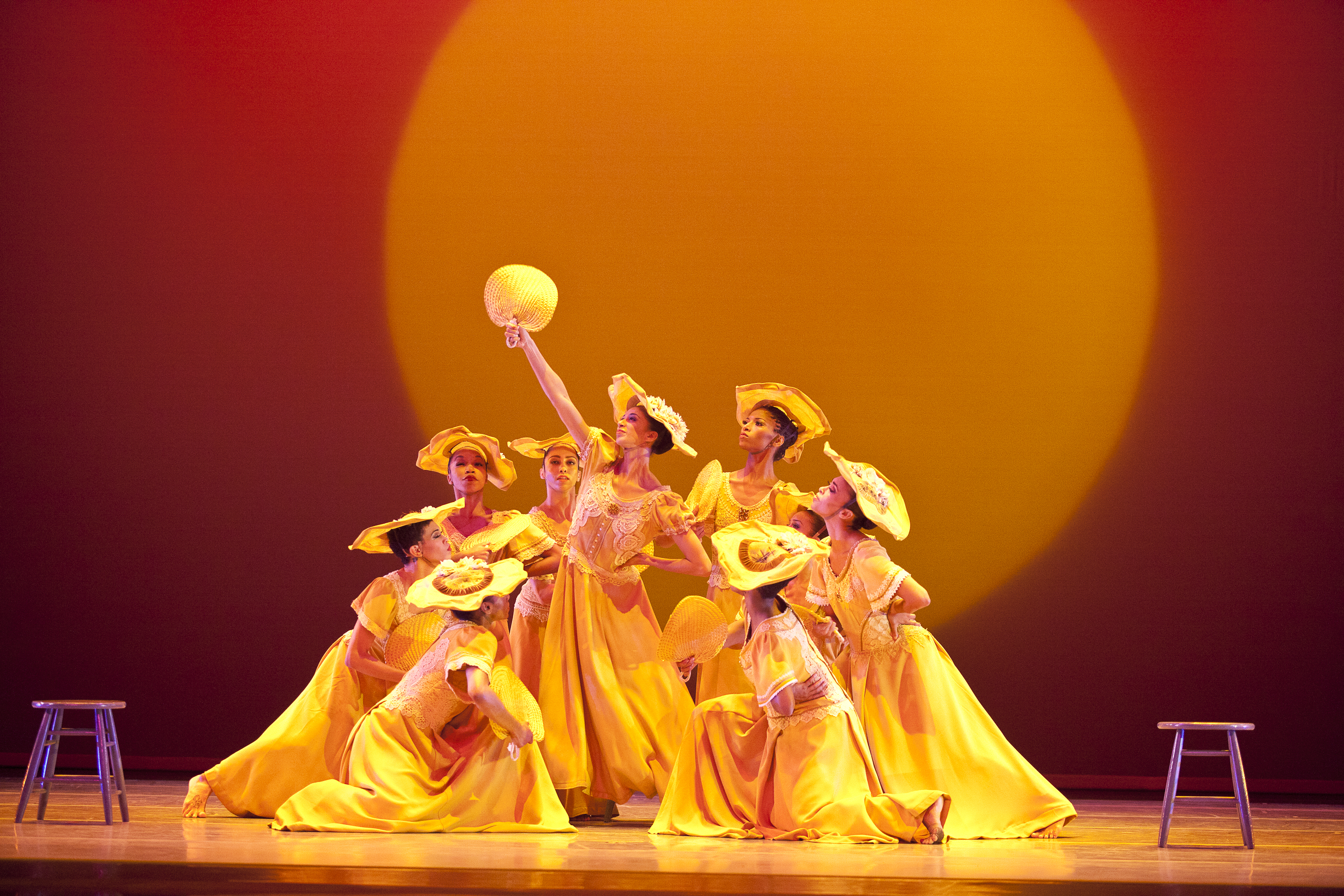
The finale, “Rocka My Soul in the Bosom of Abraham,” featured the full cast with the women dressed in antebellum-era yellow sundresses and matching hand fans, while their male counterparts were in matching yellow vests and dark pants. There was clapping, twirls and an overall feeling of jubilation and rebirth.

As the piece wound down there was a false ending where the company bows, followed by an encore. It was strengthening to end on a joyous note, even within the serious tone this particular performance was raising funds to train, teach and develop the next generation of Ailey dancers – some of whom may have been in the audience.

The Ailey company’s present, history and future are a strong reason to see this group perform year after year.

Red Velvet, the real life story of actor Ira Aldridge at Chesapeake Shakespeare

by Angela Carroll

This article was first published in DC Theatre Scene.

In the early 19th century, Ira Aldridge, an African American actor and playwright, was performing on European stages. A fraction of Aldridge’s miraculous story is portrayed in director Shirley Basfield Dunlap’s wonderful adaptation of Lolita Chakrabarti’s play, Red Velvet at the Chesapeake Shakespeare Company in Baltimore, MD. 

It is astounding to consider what Aldridge was able to accomplish thirty years before the Emancipation Proclamation. In 1833, Aldridge became the first non-white actor to play the leading role of Othello, the moor at the Theatre Royal Covent Garden in London.

We are introduced to Aldridge in 1867, backstage at a performance of King Lear in Lodz Poland; he is aged, hunch-backed, caned and in poor health. Christian R. Gibbs portrays the elderly Aldridge as a bitter, moody man whose movements are pained and burdened. “Macbeth weighs heavy on me”, he groans. Aldridge is agitated and jittery; he sits for short periods then frantically jumps up and paces around the small dressing room. His rants, often toward his assistant Bernard Warde (Dave Gamble) are intercut by violent coughing fits. Gibbs is unflinching in his portrayal of Aldridge, a man consumed and tortured by his memories.

Desperate for a real story, ambitious journalist Halina Wozniak, McLean Jesse, who speaks fluent Polish in the role, sneaks into Aldridge’s dressing room and attempts to interview him. It is obvious from their interactions that she is inexperienced and intimidated by the tenacious Aldridge. Their humorous banter eventually resolves when Aldridge reluctantly gives in to Wozniak’s incessant inquiries about his time as a performer with the Theatre Royal in London.

The lion’s share of the play unpacks Aldridge’s brief experience as a performer with the renowned London company.  Audiences are transported back to 1833 as the cast of Othello discusses the sudden illness of Edmund Kean. Kean, a white actor who played Othello in black face, collapsed on stage mid-performance. The unexpected event prompts the theatre manager, Pierre Laporte (Yury Lomakin) to replace Kean with Aldridge. Only one of the cast members, Henry Forrester (Seamus Miller) knows that Aldridge is African American. When he arrives, the cast is shocked.  This scene sets the stage for the subtle and overt aggressions Aldridge will face while working with the Theatre Royal. The scenes between Aldridge and Charles Kean, the son of Edmund Kean, are especially strained; Kean’s racist distaste for Aldridge is palpable. However, the cast soon recognizes Aldridge’s genius and passion for acting and warms to the idea of working with him. As the play unfolds, the play reveals many heart wrenching revelations that will torment Aldridge for the rest of his life.

Though the play is contained to two sets, both in the backstage of theaters, the beautiful set design and overall production of the Chesapeake Shakespeare Company makes you feel like you are sitting in the seats of the original playhouses, observing the rehearsal and performances of timeless works. 

Some of Red Velvet’s most memorable moments are in the ensemble’s performance of scenes from Othello.  The theatre is dimmed; the only light that remains is the warm flickering glow of small lanterns placed at the front of the stage. The actors perform as they would have on an English stage over one hundred years ago, expertly trained in the recitation of Shakespearean verse and anchored by thick red velvet curtains.

Red Velvet is haunting because it is based on some of the real traumas and victories Aldridge experienced. Gibbs’ performance as Aldridge is intoxicating and heartbreaking. The true success and power of the performance lies in the portrayal of Aldridge as an ardent dreamer who defies all odds, to remain passionately consumed by his ambitions to perfect and evolve the craft of acting. Red Velvet is a stunning work about power, prejudice and the transformative power of art.

Red Velvet by Lolita Chakrabarti. Directed by Shirley Basfield Dunlap. Production Manager, Kyle Rudgers. Production Stage Manager, Alexis E. Davis. Set Designer, Timothy J. Jones. Technical Director, Lighting Designer, Daniel O’Brien. Costume Designer, Kristina Lambdin. Cast: Christian R. Gibbs as Ira Aldridge, Seamus Miller as Casmir, a stagehand and  Henry Forrester, McLean Jesse as Halima Wozniak, a Polish Journalist, Betty Lovell, and Margaret Aldridge, his wife, Dave Gamble as Terence, Aldridge’s valet and dresser and Bernard Warde, Laura Rocklyn as Ellen Tree, actor, Ron Heneghan as Charles Kean, actor, son of actor Edmund Kean, Tracy Farrar as Connie, the theatre’s servant, Yury Lomakin as Pierre Laporte, theatre manager. Produced by Chesapeake Shakespeare Company.