On manhood and memory: In Search of My Father

by Angela Carroll

This article was first published in DC Theatre Scene

“Just what kind of man would abandon his son?” This is the central question writer/performer W. Allen Taylor has been asking in his twenty-year running play In Search of My Father … Walkin’ Talkin’ Bill Hawkins now at Atlas Performing Arts Center.  

In Search of My Father is a reflective and meandering musical drama about Taylor’s journey to learn more about his father Bill Hawkins, the first black disc jockey in Cleveland, Ohio. We learn about Hawkins through Taylor’s brief encounters with the people who knew him; friends, relatives, and intimates. Through their earnestly portrayed recollections, and Taylor’s wounded personal ruminations about his fathers’ absence, audiences explore mythologized and real narratives about Hawkins’ life.

Watching Taylor transform himself in Atlas’ intimate theater was a powerful experience. The actor stands alone on the stage in a simple shirt and slacks. Each time he addresses the audience we are introduced to a new character speaking from a distinct era within the 1950s into the mid-1970s. At times, Taylor is a small boy on a rocking horse, or a preteen who begs for his mother to tell him stories about his father. In other moments he is a young adult, an ambitious DJ for a college radio station, the aging matriarch of a Baptist church, or a cool jazzman.

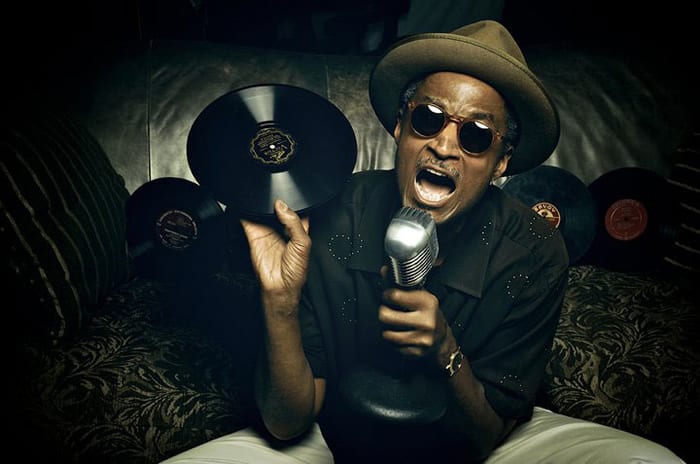
Relying on very few props; a scarf and pearl earrings, a gray fedora, a cigarette and pool cue stick, Taylor personifies a host of memorable characters. An impressive dancer, in one scene he leaps from popular dances like the Hustle to the Jerk and in another he lovingly sings the ballad “Body and Soul”. Taylor’s skill as a performer is catching and helps to create the feeling that our journey through his memories is an adventure.

His father, we learn, broke through a longstanding color line. Until his hiring by Cleveland radio stations in 1948, media outlets and industries at large in Cleveland and across the nation fervently enforced segregationist and exclusionary hiring policies.

Taylor tells us that Hawkins’ decision to showcase emerging and established black musicians expanded their mainstream appeal, and radically shifted the landscape of broadcast radio. The wit and charm of Hawkins quick-talkin’ broadcasts sealed his fame. In Search of My Father honors Hawkins’ legacy and celebrates the music that catapulted his career. Taylor uses music to underscore the tensions and triumphs of the play, from Al Green to Aretha Franklin, Thelonious Monk to Billie Holiday, Big Mama Thornton and Mahalia Jackson, among others.

Taylor’s obsessive quest to learn about his father through the people who knew and loved him is illuminated by a series of intimate conversations. The dialogs he has with his mother are particularly resonant. Their talks evolve gradually from the curt banter of an elusive mother and a curious child to emotional admissions that propel the story forward. It is only after Taylor becomes an adult that his mother feels comfortable enough to tell him the truth, a revelation that is years too late to be of any use to her son. I was moved by Taylor’s quiet portrayal of his mother, always in the throes of a mundane task, the washing and drying of dishes, the mending of worn garments. His mother speaks from familiar domestic interiors, at the sink of her kitchen or sitting in the rocking chair of her living room. It is in those subtle moments, that Taylors’ performance becomes transcendent.

The play oscillates between Taylor’s exuberant desire to uncover more clues, and the crippling anger he harbors about having an absentee father. The anxieties Tayler feels but rarely expresses about his father are evidenced in his portrayal of himself as a stylized version of Hawkins’ unique broadcast persona. Both comical and cutting, the DJ directly confronts the resentments Taylor maintains about their nonexistent relationship. Taylor holds a vintage chrome mic in his hand, and leans in deeply over the booth towards the audience as he speaks, “You want to know why I cut radio loose,” he retorts to the unseen Hawkins, “because I didn’t want to be anything like you, Daddy-o!”

In Search of My Father offers a unique perspective on the power of reconciliation and forgiveness.

——————

In Search of My Father: Walkin’ Talkin’ Bill Hawkins Written and Performed by W. Allen Taylor. Original Direction: Ellen Sebastian Chang. Set Design: David White. Production Manager: Klyph Stanford. Asst. Production Manager: Kristina Jackson. Lighting Design: Walter Holden andElliot Lanes. Sound Design: W.A.T. & Dustin Toshiyuki. Master Electrician: Aaron Waxman . Stage Manager: Elliot Lanes. Assistant State Manager: Norbert Thompson. Reviewed by Angela N. Carroll.
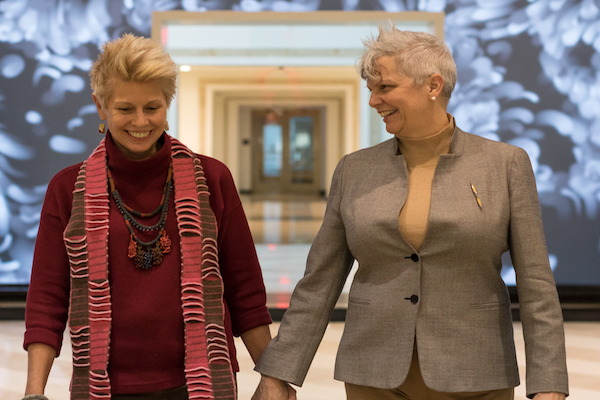
Janet Redman and Winifred Quinn: Leaders in Health, Partners in Life

This article was first published in TAGG and can be read on their site here.

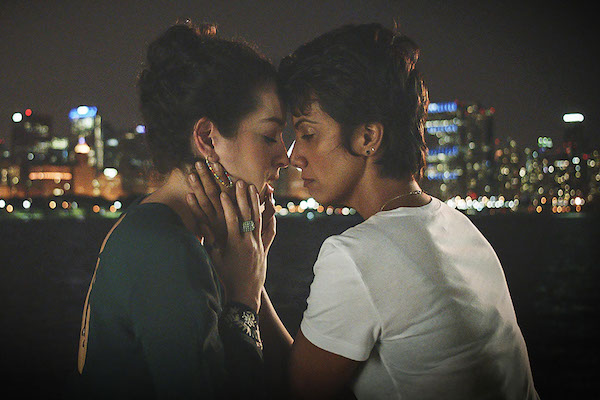
It’s a breath of fresh air to be able to find overlapping interests with someone, particularly with a romantic partner. Even luckier is being able to have a shared interest in serving communities and making a difference in those populations’ health and well-being.

For Janet Redman and Winifred Quinn, working in the health and wellness industry has become a staple part of their relationship. Redman works for Bell Rock Capital, LLC and Quinn works at AARP, additionally serving on the board of directors for Whitman-Walker Health (WWH). The pair share a passion and dedication for health and wellness, specifically focusing in women’s and LGBTQ health.

Their worlds collided at the 2013 Mautner Gala, where Redman was honored as their Volunteer of the Year. Quinn recalls being immediately charmed by Redman’s presence, a Facebook friend request later sealing the deal.

“It was one of the highlights of my life,” says Redman. “And that was before I realized I met the love of my life that night as well.” It wasn’t until 2015 that the two reconnected, with Redman reaching out to Quinn to ask if AARP had any programs that would aid in the caretaking of her parents.

Before meeting, each developed and established their own unique career path in the industry, though remain jointly dedicated to erasing stigmatization of LGBTQ health and wellness, aiming to provide care and programming that advances health care rights and accessibility.

Growing up in a family of nurses, Redman soon became involved in health and wellness within her own life. As a part of a committee at CAMP Rehoboth and a financial advisor, Redman helps the aging population, including the LGBTQ community, plan for healthy retirements while considering the cost of healthcare.

“Health and finances are tied so closely,” says Redman. “Healthcare remains a wild card for so many people, and having access to providers like WWH, who understand the unique needs of the community and offers care without judgment, is critical.”

Quinn shares a similar passion, with almost two decades of experience as a researcher and advocate in the health care sector. She sees herself as a “family caregiver” within the health care policy space, currently working on policies that “intersect consumer needs and nursing and leadership skills.”

Whitman-Walker Health has become a large part of that mission. Quinn began getting involved with WWH by an almost chance encounter; after spotting a rainbow flag above the Elizabeth Taylor Center at Whitman-Walker, she became a patient then became a board member.

“The goal is to provide much better prevention and primary care when people need it – especially at-risk, under-served people,” says Quinn. Quinn emphasizes the importance of nurses within the health industry and how crucial their role is to the quality of care that is provided, particularly those within the LGBTQ community.

Both Redman and Quinn discussed their dedication to advocating for more accessibility and transparency for the LGBTQ community. Quinn has seen WWH specifically expand its footprint in the Washington D.C. area to better serve communities and eliminate stigma and disparity in treatment and service.

“The LGBTQ communities have come a long way over the past 35 years,” says Quinn. “But many in our community are still being left behind. We need to change that and make sure we’re taking care of each other.”

Redman echoes Quinn’s words; being awarded Mautner’s Volunteer of the Year was the “catalyst” for her to continue standing up for those who weren’t always included in health care conversations.

“Win and I both spent many years helping our aging parents and navigating the health care system was challenging, eye-opening, and sometimes infuriating,” Redman explains. “We need to be our own best advocates for health care. We need to be better.”

Beyond a shared passion and dedication to health and wellness, the couple describes themselves as loving, supportive, and fun. Though they are currently based in two different locations (Quinn in Washington D.C. and Redman in Rehoboth Beach, DE) they try to see each other frequently, especially on weekends.

“When I go see Janet, I feel like I can let go of all of the stress from the week and just relax and have fun with her,” says Quinn. Redman agrees, adding that she loves the way they push one another to try new things while still being a strong support for the other. Though living apart isn’t the most ideal situation, the busy schedule of their individual lives allows them to appreciate their relationship and time together more.

The Freedom to Marry is 2017’s Best Reminder of Hope

This article was first published by TAGG and can be found on their site here.

The afterglow of the Supreme Court’s 2015 rule on marriage equality finally felt like something tangible had progressed into our lives and homes. The decision felt like a finally released sigh that marked an elevation of rights for LGBTQ people of the nation.

Although many collectively celebrated the long-awaited, landmark decision, the decades long campaign for the freedom to marry winded down to an end, a behind the scenes effort that takes center stage in Eddie Rosenstein’s exceptional documentary “The Freedom to Marry.”

The film follows Evan Wolfson, founder of the organization Freedom to Marry, his team, and those in the LGBTQ community the entire year leading up to the Supreme Court ruling. The film emphasizes that the fight for marriage equality’s increased visibility has been propelled by people like Wolfson, whose everyday work was dominated by finding new angles and approaches to outline the argument for marriage equality.

Interspersed between historical context of the fight for the rights for the LGBTQ community are countdown clips featuring Wolfson and his team. Wolfson has often been seen as the proprietor behind the movement to legalize same-sex marriage and started his fight for equal rights nearly thirty years ago.

After growing up in Pittsburgh (alongside director Rosenstein), Wolfson went to Harvard Law in 1983, where he wrote a thesis entitled “Same-sex Marriage and Morality: The Human Rights Vision of the Constitution” that outlined the argument for marriage equality for the community LGBTQ.

This was the thesis that led him to founding Freedom to Marry. Alongside National Campaign director Marc Solomon, the documentary shows the pair travelling to rallies across the entire nation before the Supreme Court decision came down. The film reveals the often-difficult terrain that comes with promoting equality for the LGBTQ community, including clips of homophobic protests and outright protests against the legalization of same-sex marriage.

Juxtaposing the opposing side of the argument are real stories of couples and families who want the same rights as anybody else. Part of promoting the legalization of marriage equality was introducing the universal notion of parental love; that LGBTQ families wanted the best for the children and their families, above all else, just like heterosexual couples. It was a touching collective truth that became exemplified through the stories of regular families and their stories.

By spotlighting ordinary people who were denied the legality of their families, the campaign for marriage equality became even more necessary and nuanced. April and Jane, a lesbian couple from Michigan, agreed to be the plaintiffs, a decision that required time and energy dedicated to a cause that was bigger than just their family.

“By denying marriage to same sex couples, we’re denying not only the protection to the adults, which is not only independently important,” said Mary Bonauto, a GLAAD lawyer who made one of the arguments in Obergefell v. Hodges. “We’re denying those protections and that security that would come from having married parents.”

Producer Jenni Olson highlighted the usage of these stories as one of the biggest successes of the documentary. “Regular people found a way to stand up,” said Olson. “It’s incredible that they had the courage and willingness to say that we want to make a difference, we want to make things better for our family, but also better for everyone. Now more than ever we need those stories.”

Marriage equality felt like the obvious, mandatory choice for some, and the ruling came with a feeling of “finally.” We forget that this decision, as overdue as it may have seemed, took decades to fight for. We forget the sacrifices and efforts made so that not only would no future generations have to fight for marriage equality, but that this decision does not end the fight for equality on every front for the LGBTQ community.

Olson talked about how almost everyday we wake up and feel overwhelmed and discouraged by the state of the world. It is films like these that remind you that there will always be regular people together and stepping up to make change. “I would like to think there’s another chapter coming,” Wolfson wistfully said at the end of film, signifying another generation will continue the fight for equality.

Reel Affirmations Film Festival Returns with More Queer and Transgender Representation

This article was first published on TAGG and can be read on their site here.

To be able to live your truth every day is a blessing. To be able to make art that can help others do the same is a blessing and opportunity that should not be taken lightly. Reel Affirmations Film Festival, Washington D.C.’s annual international LGBTQ film festival, aims to showcase media that not only promotes representation, but increases visibility for the entire community, no matter where they are on the spectrum. The four-day festival will feature director talk-backs, Q&A sessions, and a filmmaker reception.

The DC Center Director of Arts and Cultural Programs Kimberley Bush, who first joined the film festival as a volunteer, emphasized that the film festival has steadily become more inclusive since its 1991 inception. “[When I first joined], the organization was run by cisgender gay white men,” says Bush, whose love of film brought her to the festival. “A lot of the films we were screening did not affect people of color, women, and non-cis people.”

Bush and her programming team, comprised of individuals of diverse and varied backgrounds, sort through every submission they receive and sometimes solicit films for the festival. They find a common theme within the chosen submissions and then start to program a showcase for the short films. What is unique about the Reel Affirmations Film Festival is the division of film categories into women’s films, male-focused films, and transgender/gender non-conforming films, which help to hyper-focus on proper representation for audiences.

Bush emphasized the importance of having these categorical distinctions, particularly one for those who are not cisgender. “[The transgender/gender non-conforming category] is so necessary, especially with the multitude of gender expression that is out there,” says Bush. “It’s important for people to see themselves out there on the screen.” Within these categories are stories that represent intersecting facets and topics within the LGBTQ community.

The short film Right of Passage explores the stories of transgender refugees and the multitude of struggles they face as they leave their homes and into new foreign territory. Other films such as Will & Nicki and Finding Pride discuss the distinction between being transgender and gay, all the while emphasizing that transgender individuals are people who deserve the same rights as cisgender individuals. In Right of Passage, one refugee summed it up best: “I deserve to live in a place where I don’t have to worry about tomorrow.”

Attendees will also be able to see films such as Be Right Back, a short film whose playful and warm-toned aura features a vintage store shop owner who fantasizes about the customers that walk through her shop. Other short films like Giovanna Cheslar’s Java and Jessica Fuh’s Us touch upon topics of burgeoning sexuality, unrequited love, and acceptance in a 21st century backdrop. Bush stressed that the stories from these works are often directly from the filmmaker’s life and are not “just some frivolous storyline.”

Above all else, the film festival intends to be a place of comfort and affirmation for all those who attend, and especially for those who never see versions of themselves properly represented.

“I see firsthand individuals enter our film screenings questioning themselves and their place in this world and exit substantially impacted and with an uplifted and positive shift in their energy and outlook in their lives,” she says. Bush’s dedication to LGBTQ representation in film prompted her to start Reel Affirmations XTRA, a monthly LGBTQ film series that continues beyond the four-day festival.

The Reel Affirmations Film Festival will be occurring from October 19–22 at the Gala Hispanic Theater. You can find the full schedule for the Reel Affirmations Film Festival here.

Actress Shannon Dorsey Talks New Play, Representation, and the Depth of Love

This article was first published on TAGG and can be read on their site here.

From the time she started to form words, Shannon Dorsey was acting, shaping the theater into not only a home, but an eventual haven of self-expression and love. The space underneath the family dining table was her first stage, and she made anyone around her watch her early childhood shows.

“I’ve always enjoyed theater as a form,” said Dorsey. “I’ve danced since I was three years old, tap, Hip-Hop, but have been doing ballet the longest. I found [dance] satiated this thing of being on stage but it didn’t do everything I needed it to do.” As a student of both Wilson High School and Duke Ellington School of the Arts, Dorsey could take theater courses at the latter for half the day in her senior year of high school. Though she was not always exposed to roles in plays, she stayed on stage.

“Everyone knew I was going to be an actor,” said Dorsey, reminiscing on her early performances and community encouragement. “That’s something that has been so consistent from high school to college – acting was something that I was always going to do, regardless whether I had access to it.”

Growing up in Washington D.C., Dorsey’s childhood and education consistently emphasized the importance of arts and reinforced her identity as an African-American woman and actress. In her sophomore year of high school, Dorsey was cast as a Russian woman in a “white play with white characters” in a majority black high school, a humorous incident that allowed her to realize the extent of whiteness on stage, despite her teachers and community reinforcing an environment where her identity was not only validated, but celebrated on stage.

Dorsey continued to seek out theater as a safe space, attending Temple University where her pedigree grew and obtaining two degrees: one in communications in theater and another in African-American Studies. “[In college], I realized I am really, really a minority in this world and in my craft,” said Dorsey. “I was told about it, but it was different really experiencing it.”

Dorsey recalled an incident early on in her career where she and her cast were on a national tour for a play. The rest of the cast, who were all white, would make comments on the potential dangers of the neighborhoods they were in. The misplaced comments were discouraging to Dorsey, but led to a pertinent revelation. “I was the only black dot on this white bus,” said Dorsey. “Everyone else was white, only white, and all had perspectives that reflected each other, but not me.”

Dorsey continues to be “fascinated” by the way humans communicate effectively and began to seek out multi-faceted roles of characters that did not just represent her, but the complicated nature of the human spirit. Dorsey spoke on the difficulty on finding roles that sated her desire for diverse and complex representation, while avoiding roles that overly relied on shock value. Still, she continues to make conscious efforts to seek out roles that challenge stereotypes and societal norms, a steadfast motto that has led her to plays such as “Breath, Boom,” “In the Red and Brown Water,” and “Marcus; or the Secret of Sweet.”

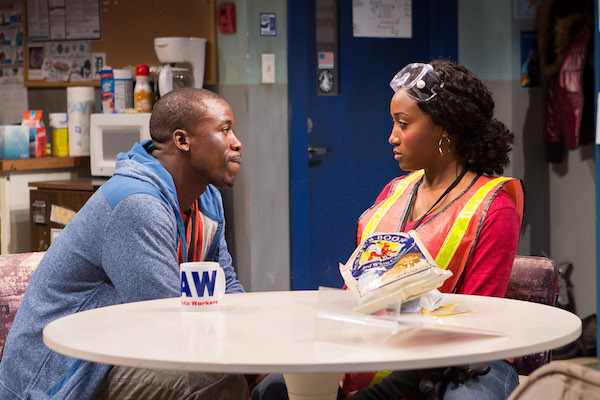
For the role of Shanita in “Skeleton Crew,” the Dominique Morisseau play that is currently playing in Washington D.C.’s Studio Theatre, the studio reached out to Dorsey to audition, which delighted her. “Shanita wasn’t a damsel in distress,” Dorsey said on what drew her to the role. “It wasn’t another story of a black pregnant woman and how things suck.”

Dorsey and director Patricia McGregor, as well as the rest of the cast, worked through character development from the first table work on, coming up with an intimate and stirring play with multifaceted characters. Dorsey stated that nobody’s words could “do the play justice,” urging everyone to see the play for its universal and touching themes.

Beyond representation, Dorsey consistently approaches all her roles with love. “Love is the ultimate complexity we haven’t figured out yet,” she said. “I want to take roles that touch my heartstrings. Love is everywhere, and I am made of love.”

Skeleton Crew is currently playing at Studio Theatre, 1501 14th St NW, Washington, D.C. and ends on October 15, 2017. For more information, click here.

Choral Arts Astounds with Washington’s First Performance of the Berlioz Requiem in 15 Years

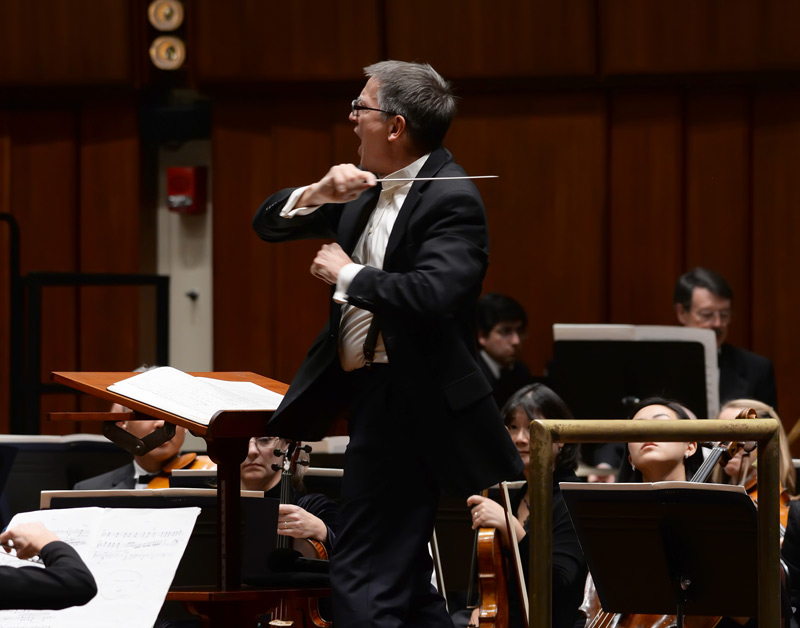
Choral Arts’ artistic director, Scott Tucker conducts the Berlioz Requiem.

Choral Arts’ artistic director, Scott Tucker conducts the Berlioz Requiem. Photo by Sharon Finney.


It was the first Washington, D.C. performance of the Berlioz Requiem in nearly 15 years and an expectant audience filled the Kennedy Center Concert Hall Sunday night to experience the Choral Arts Society’s version of Hector Berlioz’s gargantuan Op. 5, Grande Messe de Morts.

The Requiem is epic, 90 minutes long in 10 movements, featuring over 80 orchestra musicians and nearly 200 singers. Berlioz was commissioned to compose the work in honor of the 1830 French Revolution, and it was first performed at the memorial service for Charles Denys de Damremont and his fellow soldiers who died in the Battle of Constantine. Berlioz was influenced by the work of Beethoven and the Grande Messe de Morts is considered a prime example of musical Romanticism.

Berlioz’s Requiem was created for performance in spaces like large churches and cathedrals – which have a lot of echo and reverb. The Kennedy Center Concert Hall, like many modern performance spaces, is designed for optimum acoustic quality, and to contain reverb and echo. On Sunday evening the singers’ voices joined clearly, with nuances likely not apparent in 19th century performances.

The conductor, Choral Arts’ artistic director, Scott Tucker, is just the second director in the organization’s 51-year history, and his direction of the Berlioz was masterful. Concertmaster Nurit Bar-Josef and soloist tenor Dustin Lucas were equally impressive. Lucas’s sonorous tenor glowed, and the choice to stage him in the center upper balcony allowed his vibrato to ring out over the audience from behind, adding a special depth to the experience. The choice to split the brass section, with musicians on both the right and left upper balconies, also added a feeling of tremendous power, and a sense of being inside the belly of a musical beast.

Continue Reading

Dog and Pony DC Ask You to be a Citizen of Beertown

Natasha Gallop Acting in Beertown

I arrived at the Thurgood Marshall Center on a Wednesday evening, fighting a cold and feeling glum. That feeling would soon change. As soon as I entered the Center, a cheerful woman wearing a nametag greeted me. She turned out not only to be a ticket taker, but an actor as well.

“So glad you could make it for the quinquennial ceremony! We’ll be opening the meeting room shortly; you can fill out your nametag in the meantime. Would you like to nominate yourself for ombudsperson tonight?” I quickly discovered that Dog & Pony DC’s production of Beertown begins the minute you enter the building.

“No thank you,” I smiled as I filled out my nametag, nervous about the level of interaction this performance would require. I made my way to the room at the end of the hallway and entered into a quaint scene of Mid-Western civic assembly. Townspeople milled about the old gymnasium and poster boards displaying information about Beertown encircled the rows of folding chairs. A podium, whiteboard and an old piano sat at the front of the room. Instrumental music that wouldn’t sound out of place on an episode of “Prairie Home Companion” played quietly in the background, adding to the small-town ambiance.

A Beertonian immediately approached me and shook my hand. He introduced himself as Michael Soch, the Mayor of Beertown, “So good to see you! Glad you could make it to the quinquennial—how’s your family doing? You’re working at the Library now?” “Uh…yes. Yes I am!” I stammered, remembering that there is no saying “no” in improv.

All around me, Beertonians engaged in similarly upbeat conversations with other audience members. Some actors and audience members spoke to each other in American Sign Language. Interpreters also stood by to interpret between those signing and those speaking. A table of cookies – part of the advertised “dessert potluck” — sat on a table in front of the podium and a woman entreated everyone present to “please eat some cookies!” Near the refreshments sat a large metal beer barrel, the quinquennial time capsule. (Note: A quinquennial is an event that recurs every five years.)

dpdc-beertown_quinquennial

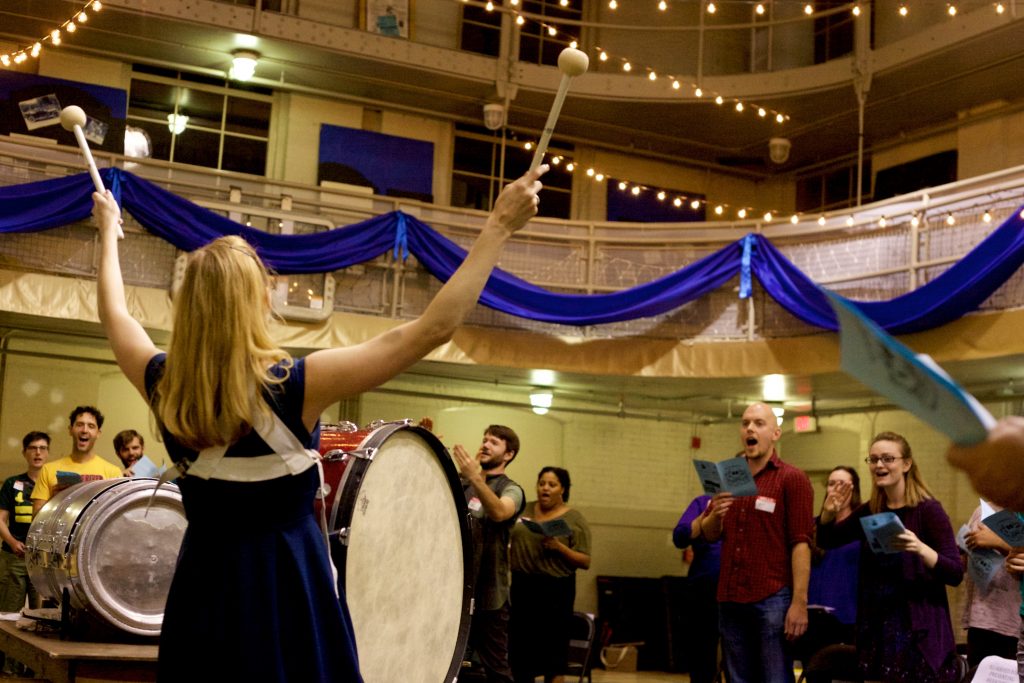
Dog & Pony DC lead the audience in singing the Beertown anthem. (Photo by Ryan Maxwell).


As I settled into a folding chair, a man in a suit approached me and began talking about the benefits of purchasing Beertown real estate. “Are you new in town? I’m Joseph Rodgers Davenport, but everyone calls me Rodgers! Just give me a call if you’re ever in the market for a house here in Beertown!” He handed me a business card, one of many small touches that made the performance feel hilariously authentic. Rodgers is played by actor DeJeanette Horne.

After I sat down, I looked around the room. It was becoming difficult to tell some of the audience members and the actors apart. I leaned toward the gentleman beside me, “I don’t know if this is the right way to put it, but are you a participant or an audience member?” I asked. “That’s a good question,” he chuckled. He explained to me that he was very excited to be attending the performance that night because had seen Beertown during its original run in autumn 2011, and also during the 2012 Capital Fringe Festival. “No two performances of Beertown are ever the same,” he smiled.

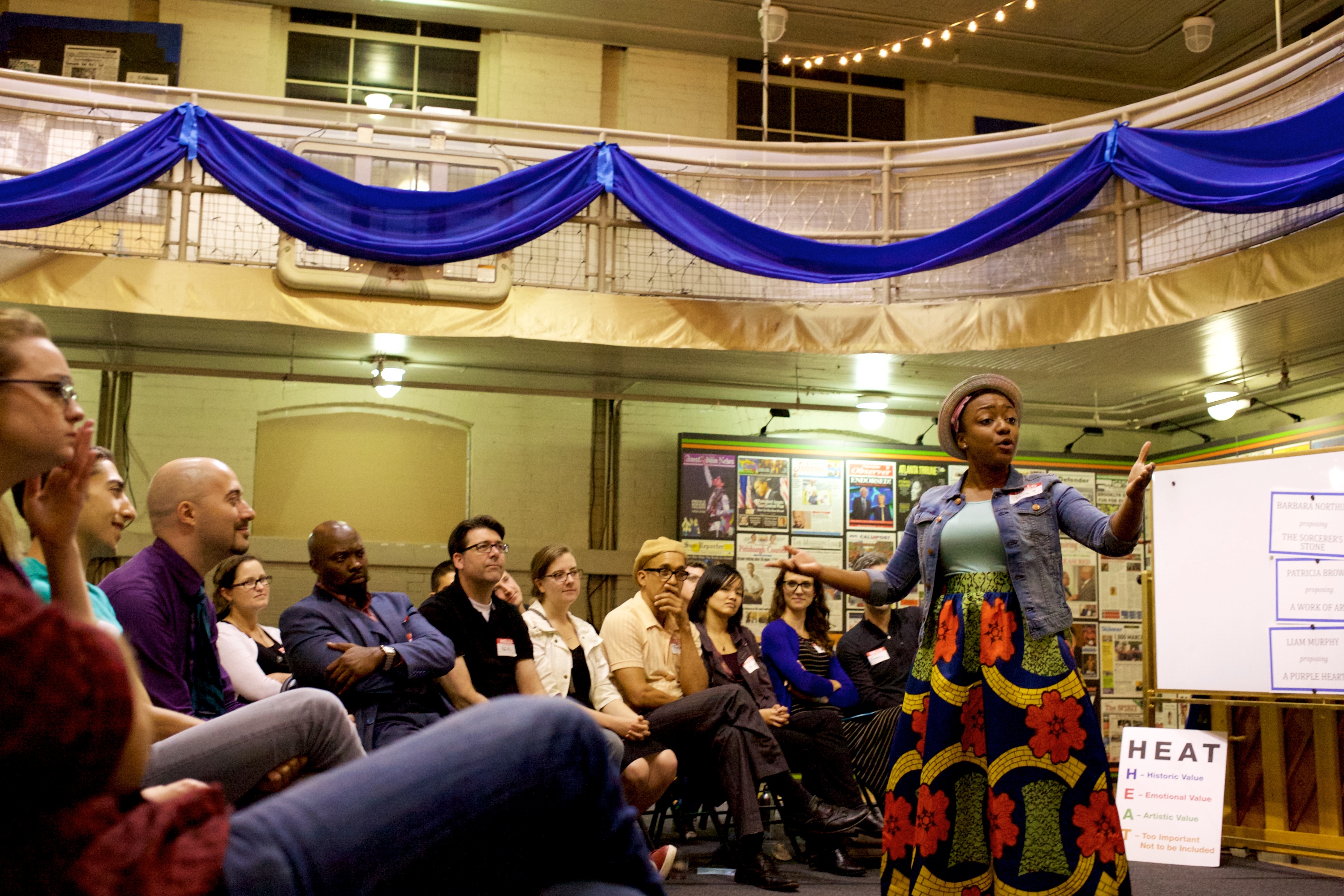
The room became quiet as the Mayor (Joshua Drew) began his welcome speech. “I am so thankful that you elected to be here to participate in Beertown’s 21st Quinquennial Time Capsule Day Ceremony! This process allows us to reflect on who we are today, in light of who we were five, ten, 15 years ago, and so on.” He introduced several other Beertonians: archivist Joann Sugarman (Eileen Earnest), artist Patricia Brown (Natasha Gallop), Fire Marshal Liam Murphy (Jon Reynolds), Warden Franklin Li (Jacon Yeh) and several other colorful characters also said their hellos to the room.

After a recitation of the Pledge of Allegiance and an invocation by the Daughters of the Ninkasi, the residents of Beertown led the room in a series of uproariously funny civic activities. We were asked to recite the Beertown oath of civic responsibility, we elected a citizen ombudsperson, and the townspeople led the audience in a raucous rendition of “The Beertown Hymn”, purportedly written in 1899.

At the heart of Beertown’s plot is the need for the room to arrive at a
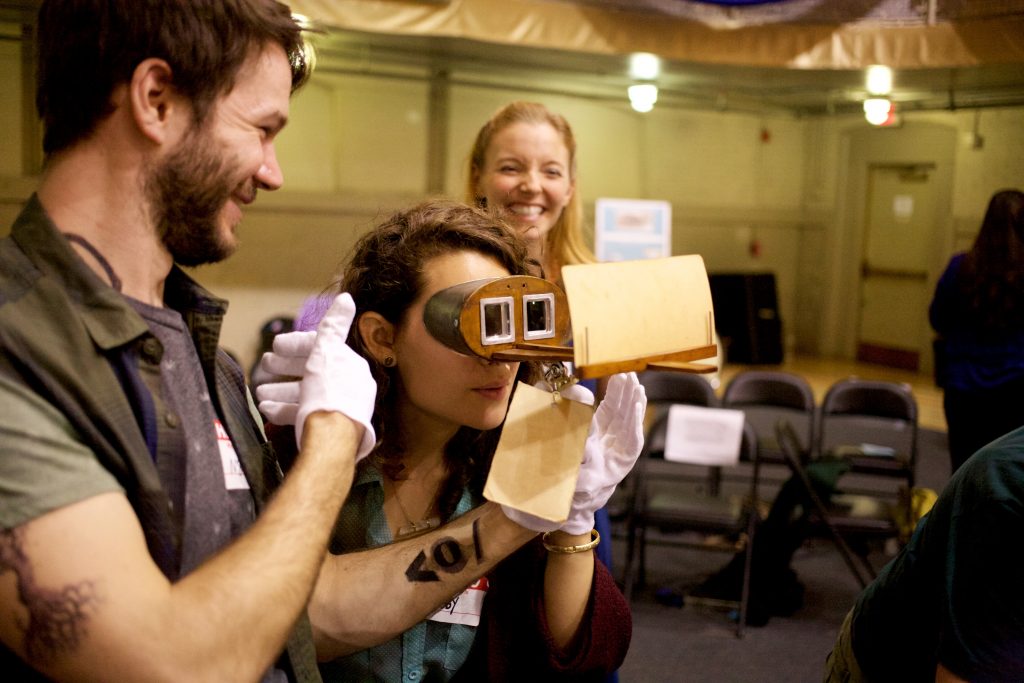
collective decision regarding the town’s time capsule. During each quinquennial ceremony, the audience is introduced to the contents of the capsule and asked to vote on which items to keep and which items to remove. Certain “eternal” items, artifacts representing the early history of the town, remain permanently interred in the capsule, while others are up for debate every five years. Only a certain number of items can fit inside the time capsule at any given time. Warden Li explained that everyone present should judge the artifacts on the basis of the acronym, H.E.A.T: Historic Value, Emotional Value, Artistic Value, and Too Important Not to be Included. If an object no longer seemed to have the same HEAT, it could be voted out and a modern artifact could take its place.

Beertown performance

Beertonians examine artifacts from the Beertown time capsule. (Photo by Ryan Maxwell.)


Within all of its silliness, Beertown digs into how our society elects our collective American history. “Do things become less accurate the more you remember it?” One of the actors asked during the ceremony. “Every time you remember something, you are recreating it,” stated another actor. Who’s history are we recreating? Who gets to decide what we preserve for public memory? During the voting and debating portions of Beertown, some audience members became very invested in the outcome of the vote. I was surprised in some of the votes I cast myself.

The deaf community plays an important role within the invented history of Beertown, and American Sign Language is critical to the show’s dialogue. Interpreters translated all spoken word for deaf audience members, and vice versa when deaf actors signed to the night’s predominantly hearing audience. Several skits incorporated projected captions and pantomime so that neither signing nor speaking was required.

A few days after the show I spoke with the theater company’s director, Rachel Grossman. She said that Dog & Pony DC has featured deaf actors and incorporated sign language in previous productions of other shows, but not to the same extent as Beertown. “There’s a large deaf population in DC and there’s a significant community of artists here that are underutilized and untapped. Once you make the decision to start changing your practices and becoming more accessible and inclusive, the doorways are open. It takes a lot but it can take very little to start making that change” in the theatre community.

Another way in which Dog & Pony makes Beertown and other productions more accessible is by offering pay-what-you-can showings. “It’s really about creating that environment in which accessibility and inclusion is of the highest priority,” Grossman said.

The world of Beertown is impressively detailed, down to the choice to stage it in the multipurpose room of the Thurgood Marshall Center, a space dedicated to providing educational programs that celebrate the richness of D.C.’s cultural history. Along with the live production, members of the company have created a website — VisitBeertown.com — and the hastag #ITooAmBeertown was even included as a time capsule artifact in a recent performance of the show.

Beertown performance

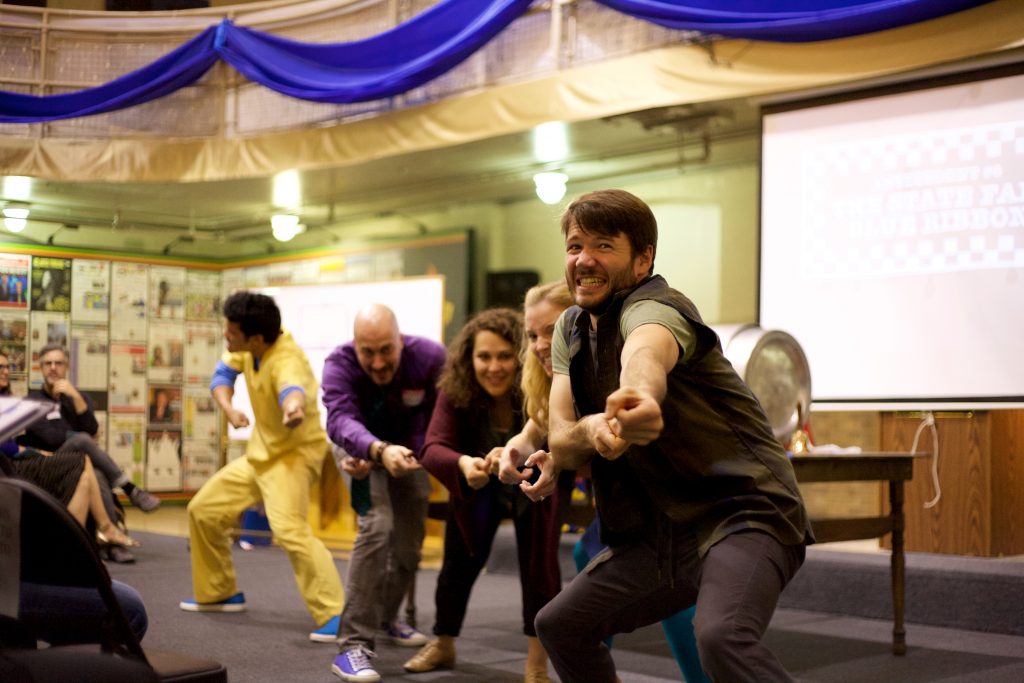
Photo by Ryan Maxwell.


According to Grossman, a critical element of each performance is figuring out the character of each audience. “Some audiences are more invested in observing and watching… sometimes it just takes awhile, like pushing a ball up a hill, and you just don’t know how high the hill is because you’re behind the ball pushing it! Sometimes you don’t even touch the ball and the ball just falls off the hill and then you run after the ball,” she laughed.

As a company, Dog & Pony DC is invested in the impact of audience-integrated work, and spreading that type of theater throughout D.C. and beyond. Beertown was a collective effort, originally created by a group of 17 members. Some members of the original group are currently working with another theatre company in San Diego to develop a performance called “Beachtown” that explores the identities of beach communities in southern California.

Beertown is unexpectedly immersive while offering critical commentary on the importance of civic duty. The show gets at the zeitgeist of American community politics in a way that’s completely refreshing, and needed. It’s a show likely to cause audiences to question their own involvement in local elections, and wonder about their personal impact on the histories of their communities.

Beertown runs through November 7 at the Thurgood Marshall Center. For tickets and more information visit Dog and Pony’s website here.

This article was originally posted on Tagg Magazine.