Browsing Category

Performing Arts

Ken Ludwig’s new play shares how his parents met during World War II

By Julian Oquendo

This article was first published in The DC Line here.

Once you know who wrote the play, there’s little doubt about whether Dear Jack, Dear Louise has a happy ending. The playwright — Ken Ludwig, one of DC’s most prolific and most produced comedic theater writers — is the younger son of the main characters, and the Arena Stage premiere wrapping up this weekend focuses on how his parents met.

The writer has over two dozen performed productions in his repertoire, with a quarter of them having premiered in DC-area theaters. Ludwig is widely recognized for the classics Lend Me a Tenor, Moon Over Buffalo and othersWith Dear Jack, Dear Louise, Ludwig — who’s best known for his parodies and farces — has taken a slightly different approach in writing the story of how his mother and father first met and fell in love in the early 1940s. 

Before they ever saw each other face-to-face, Army doctor Jack Ludwig and Broadway chorus actor Louise Rabinoe wrote letters to each other — at the suggestion of their parents — while Ludwig was stationed in Oregon and Rabinoe auditioned for roles in New York City.  

“When you’re a playwright, you think about, ‘What means most to me?’” Ludwig said in a recent interview. “I adored my parents. I knew they have lived through this very interesting past of meeting by letter and spending the first part of their relationship only knowing each other by letter. Because it was World War II and they were 3,000 miles apart, it’s always been on the back of my mind of writing a play [about my parents].”

What results is not just a story about Ludwig’s parents, but a snapshot of how members of the “Greatest Generation” found connections in a fractured world. 

When asked about casting choices, Ludwig says he wasn’t going for physical resemblance. 

“I didn’t base the choice on look-alikes at all,” he said. “A couple of people who knew my parents said that [the actors] both kind of look like my parents, with the wire-rim glasses for my dad and my mom as a brunette. I was looking for people who could capture the spirit of these characters.”

He explains that he wasn’t aiming just to tell the story of his own family — though their distinctive personalities help enliven the play while offering a look at the World War II era.

“I was trying to represent the spirit of the age,” Ludwig said. “Dad was a serious, shy, soft-spoken doctor who took doctoring very seriously, and mom was a much more flamboyant young woman who wanted to be in the theater.”

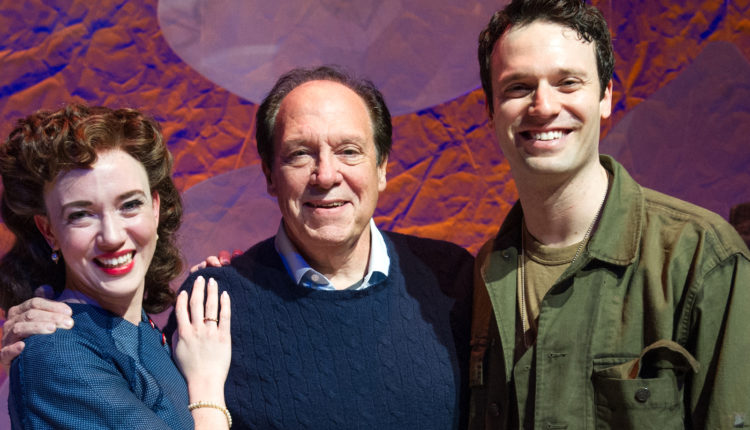
Expertly portrayed by actors Jake Epstein and Amelia Pedlow, the two have an inherent charm and chemistry on stage. They don’t read directly from the letters they’re sending out, but instead have a conversation with each other while facing out to the audience. 

Ludwig cited a reviewer who likened the postal courtship to online matchmaking today — a gratifying element in the play, he says, though it was entirely unintentional.

“[As the writer pointed out,] seen on stage, writing letters looking outwards is not dissimilar to people currently getting to know each other on social media. I didn’t think about that for one instant while I was writing the play,” Lugwig said. “The fact that it feels like that is great. It just shows that meeting and getting to know someone is a universal feeling that probably hasn’t changed in 2,000 years.” 

When writing the play, Ludwig knew that in order to tell the story in this format, he would have to build it from the memories of the letters, rather than from the letters themselves.

“Before my mother passed away, she destroyed the letters,” Ludwig said, explaining that his mother saw the letters as an intimate portrayal of their relationship. “I had to make the letters up from scratch. I knew the outlines of what happened. I knew that my mother met my father’s very large family all at one time. … I knew all the important points.”

In retrospect, Ludwig says not having access to the actual letters proved both pivotal and fortuitous.

“I was thinking recently, maybe having the letters would have been stifling and not produced the same kind of play,” he said. “Accuracy was not my goal: This is a play. I needed to dramatize it, make it enjoyable to watch — tragic and comic, and all the things we do with plays. I think it ended up being a very good reflection [of] them as how they must have been at that age.”

As a DC resident since the mid-’90s, Ludwig has seen the city and its theater scene evolve. He moved to the city to be close to his family; he and his brother have generally lived within three or four blocks of one another throughout their adult lives.

“I wouldn’t want to live anywhere else,” he said, highlighting his affinity for the National Mall and its museums and galleries. “It’s a great place to raise my family — a wonderful place to live.”

Ludwig ties those feelings to an “innate optimism” that also explains his affinity for comedy. He just wishes it were more widely shared.

“That’s why I write plays — to give us a sense of hope,” he said. “When people do Shakespeare classes, they teach HamletKing Lear, the Scottish play, all the tragedies. They don’t teach the comedies. There’s no reason for that. It’s crazy. The comedies tell us as much or more about life than the tragedies do. … I think what gives us hope for the future and makes us better people and makes us think about each other in a kindly way is comedies that give us a sense of hope. That’s what I try to write.”

Edgar Dobie, executive producer for Arena Stage and a longtime friend of Ludwig’s, finds that hope present throughout his body of work. Arena has produced a number of Ludwig’s plays, including Shakespeare in Hollywood and Baskerville: A Sherlock Holmes Mystery. “His biting wit and ability to find grace within farce have brought him international acclaim,” Doble notes in the program for Ludwig’s latest play.

As far as Ludwig is concerned, DC merits recognition as one of the great theater cities of the world.

“It’s a vibrant, vital, wonderful theater community — dozens of professional theater companies doing tremendously great work, and I love the theatre community. I wish we did more comedies — but maybe I don’t, maybe that’s the reason I can do my comedy,” said Ludwig, pivoting to an examination of the art form. “When I say comedies, I don’t mean frivolous comedies; I mean works that give us a sense of hope.”

In the production’s program, Arena Stage artistic director Molly Smith describes Dear Jack, Dear Louise as a standout from much of Ludwig’s work, a romance that swept Smith in each time she read the script: “Dear Jack, Dear Louise is a departure from Ken’s usual writing, and I think it’s his finest play yet. True, there are fewer hijinks, less door slamming, and only two actors; yet the play manages to capture all that we love about Ken’s voice — his ability to close the void between people with compassion and laughter.”

Having written prolifically for years, Ludwig is no stranger to changes and evolution in his craft. After focusing early on farces, he shifted toward more complex comedies and adaptations, drawing multiple awards, including two Olivier Awards, two Tony Awards and — locally — two Helen Hayes Awards. 

For DC’s Everyman Theatre, he created a new adaptation of Thorton Wilder’s version of the classic restoration comedy The Beaux’ Stratagem. For the Adventure Theatre in Glen Echo, Maryland, he has adapted multiple works, including Tiny Tim’s Christmas Carol and ’Twas the Night Before Christmas. 

His most produced work, Lend Me a Tenor, is widely renowned and performed across the nation, with two Broadway runs and more than 25 productions set for 2020. Described by publisher Samuel French as “a madcap, screwball comedy,” the play is not without the potential for controversy — set in 1934, the zippy show as recently as 2015 included a moment when a character, preparing to play Othello, donned blackface. 

Amid the political controversies surrounding politicians such as Virginia Gov. Ralph Northam and Canadian Prime Minister Justin Trudeau, Ludwig said he has reconsidered the original staging and removed this element from upcoming productions.

“The issue was never ever raised in the history of doing this play, but I just felt that, in terms of where our world is, and what is the right thing to do, I just changed the play,” he said. 

At least one company that had planned to mount Lend Me a Tenor raised objections to the revisions and canceled instead.

As far as the reaction to his most recent premiere, Ludwig looks forward with optimism — though he’s made no decision as to whether any future plays will resemble the scale of Dear Jack, Dear Louise.

“I’ve been thrilled that people are going and that people are loving [Dear Jack, Dear Louise],” Ludwig said. “I’m just happy people like it. Now, for the first time I’ve written a play that had just two people on stage and digging deeper into their lives. I don’t know if this will continue as a trend or not.

Might we see more productions that touch on an emotional and historical core?

“I don’t know,” he said. “Maybe, when I sit and think what my next play is gonna be. If the next idea is a comedy, I’ll do that. It truly goes play to play.”
Dancing into Yuletide: a Nutcracker with video projections, another with American historical figures

By Ilena Peng

This article was first published in The DC Line here.

Thanksgiving isn’t the only sign this week that the Christmas season is upon us, with the curtain rising on two incarnations of The Nutcracker ballet at DC theaters. An evergreen holiday tradition that originated in Russia in 1892, the traditional two-act ballet follows a young girl’s adventures through a fantastical land after her magical toy nutcracker comes to life. 

For those who haven’t seen The Nutcracker, imagine if someone were to cross the story of The Wizard of Oz with Dancing With the Stars. Even those who have never attended a dance performance are probably familiar with the music: Portions of Pyotr Ilyich Tchaikovsky’s Nutcracker suite are seemingly a ubiquitous soundtrack of the holiday season.

Locally, the Washington Ballet — which premiered its current version, with an American history twist, in 2004 — opened Nutcracker season with performances last weekend at Ward 8’s Town Hall Education Arts Recreation Campus (THEARC) in preparation for a monthlong run that starts Saturday at the Warner Theatre. For those looking for something less familiar, the Atlanta Ballet brings its new production of The Nutcracker to the Kennedy Center on Wednesday for a five-day visit.

The Washington Ballet at the Warner Theatre: Nov. 30 to Dec. 29

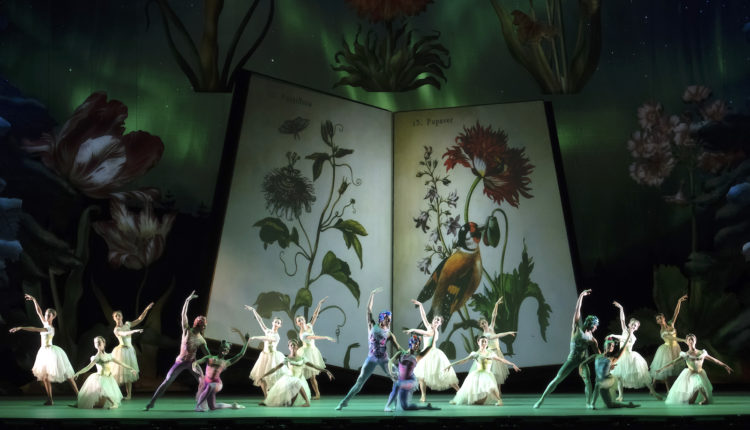
Now in its 16th year of performance, Septime Webre’s The Nutcracker takes place during an 1882 Christmas Eve celebration at a Georgetown mansion. George Washington is the Nutcracker here, and when he battles “the Rat King,” it’s King George III. Other historical figures including Harriet Tubman, Benjamin Franklin and Betsy Ross also appear, as does iconic DC scenery — the famous “Waltz of the Flowers,” for example, is renamed here the “Waltz of the Cherry Blossoms.”

“It’s become a family favorite, certainly a holiday tradition,” said Barbara Berti, public relations manager for the ballet company. “People come with their grandchildren and their parents, and it’s still very appealing to all ages. Everybody loves it.”

DC Theatre Scene wrote in 2017 that Webre’s DC-inspired Nutcracker is “like no other, but familiar enough not to be too jarring to traditionalists.” In a 2015 review, The Washington Post’s Sarah L. Kaufman noted that the production “at times feels too hectic for [the company’s members] to shine.” Instead, it rests upon “the cleverness and adorability of its least-experienced and littlest dancers.” 

Once again this year, the performance schedule began with several shows at THEARC, where the Washington School of Ballet opened its Southeast DC campus in 2005 — complete with a 400-seat theater that’s large enough to accommodate the annual Nutcracker performances.

The schedule at the Warner Theatre, 513 13th St. NW, continues almost through New Year’s Day, and that’s intentional. Berti said the post-Christmas shows allow family members visiting from out of town to see the production after the Christmas festivities are over. 

“Our version is just so beloved and enjoyed by so many — and it does kind of take up the whole month of December,” Berti said.

As for the November dates, the company added six extra performances last year — an effort to boost revenue in light of a $3 million debt, The Washington Post reported. The timing continues this year, although Berti declined to comment on revenue projections or needs.

Three performances will be accompanied by special events: Family Day (Dec. 1), Military Appreciation Night (Dec. 4) and the Nutcracker Tea Party (Dec. 8). 

Family Day features pre-performance activities for children, like coloring and ornament making, as well as opportunities to watch a rehearsal and take photos with dancers. On Military Appreciation Night, cast members and military dignitaries greet audience members prior to a rehearsal of The Nutcracker’s “Soldiers Marching” dance.

The Nutcracker Tea Party, which audiences can attend at the Willard InterContinental Hotel either before or after the day’s 1 p.m. performance, treats guests to refreshments like tea sandwiches and scones (plus mimosas for adults). Party guests can also take photos with the Sugar Plum Fairy and other dancers.

The Atlanta Ballet at The Kennedy Center: Nov. 27 to Dec. 1

The Atlanta Ballet’s first appearance in recent memory at the Kennedy Center features the company’s new production of The Nutcracker, which premiered last year. The production closely follows the traditional storyline from E.T.A. Hoffman’s 1816 tale The Nutcracker and the Mouse King — the predecessor to the 1892 ballet — but adds a modern spin with video projection technology.

The production’s choreographer is Yuri Possokhov, who after 12 years dancing with the San Francisco Ballet is now that company’s choreographer-in-residence. Possokhov first delved into integrating video projection and ballet when he choreographed Swimmerfor the Bay Area company in 2015. 

Possokhov’s works have been performed at companies nationwide such as Chicago’s Joffrey Ballet, as well as internationally at Moscow’s Bolshoi Ballet and the Georgia State Ballet.

The production’s video projections are designed by Finn Ross, who won a Tony Award for The Curious Incident of the Dog in the Night-Time, and the rest of the team is no less stellar — dance-world luminaries Tom Pye, Sandra Woodall and David Finn designed the production’s sets, costumes and lighting, respectively.

This Nutcracker is the Atlanta Ballet’s first major commissioned production by Gennadi Nedvigin, who became artistic director in 2016. Like choreographer Possokhov, Nedvigin is also a former San Francisco Ballet principal dancer. 

In an interview with The DC Line, Nedvigin said the holiday production simultaneously appeals to older generations with its traditional storyline and the younger “video gamer” generation with its digital projections.The latter, he said, “kind of serve as a glue between the real world and imaginary world, and it really fits this story perfectly.”

Possokhov’s Nutcracker’spremiere last year brought more ticket sales than any of the Atlanta Ballet’s prior productions of the holiday classic, and this Kennedy Center run marks the company’s first performances outside of Atlanta in some time. 

Nedvigin said he hopes the performance will spark audience members’ interest in the Atlanta Ballet’s work. He added that he is “super thrilled” to be in DC, having previously danced at the Kennedy Center on several occasions.

“Every time I’m coming back, it’s almost like I’m coming back home,” he said. “It brings a lot of memories from my performing days, and to be able to bring my own company to the same stage is meaning … a lot to me, and I just want to share it with everyone.”

Jean-Paul Sartre’s No Exit from Live Garra Theatre

Written by Mercedes Hesselroth

This article was first published in DC Theatre Scene here.

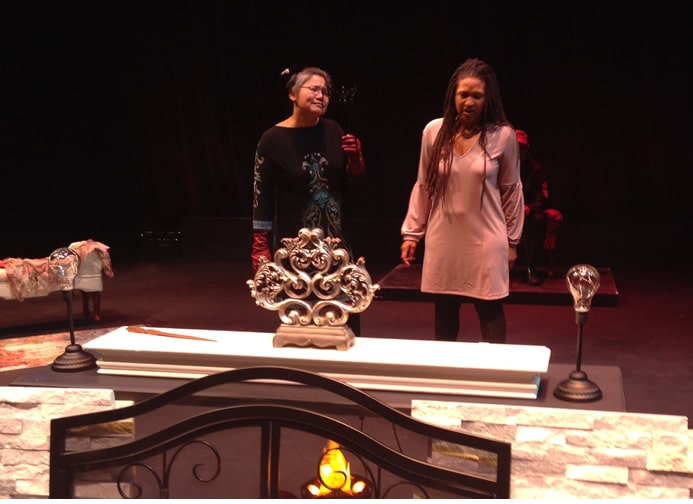
Though written over 75 years ago, Jean-Paul Sartre’s No Exit endures as a staple in Existentialist thought. Set in hell, the play focuses on three damned souls set to share the same room for all eternity: military deserter Joseph (Todd Leatherbury), upper-class trophy wife Estelle (Karen Lawrence), and lesbian postwoman Ines (Rosita Choy). Director Wanda Whiteside tries her hand at this French drama in Live Garra Theatre’s latest show.

The production purports to have moved the setting to the present day, though I noted no indications it took place anywhere but the timelessness of the afterlife. Even so, Sartre’s ideas of individualism and authenticity still loom large over the twenty-first century when issues of chosen and inherited identity have led to a rise in introspection.

In fact, No Exit is a direct inspiration for Mike Schur’s hit comedy series The Good Place. Viewers were so interested in the philosophical elements of the of the show, NBC decided to create a web series hosted by philosopher Dr. Todd May to teach the audience how to develop good morals. Even the rise of the astrology and tarot movements speaks to how willing people are to search externally for self-knowledge. If you’ve ever filled out a Meyers-Briggs personality assessment, dream journal, or BuzzFeed quiz, you too have taken part in the quest for meaning the characters in No Exit embark on. What if we don’t like the way others see us? What if we finally find out who we are and think that person is ugly? The ways technology continually pushes these questions to the forefront of our minds suggests that this eagerness to define selfhood is more than just a passing trend.

However, those of us on Earth have a better chance of benefiting from this process of self-discovery than the characters in the play. Once they begin policing each other’s behavior and revealing what they’ve done to warrant an eternal sentence, it becomes clear that the roommates are each other’s torture. Ines leaves chaos wherever possible; Estelle doesn’t like the way Joseph holds his mouth, but still wants to seduce him; Joseph tries to leave the room but can’t bring himself to do so until he convinces Ines to think better of him. And so on.

Just as the characters in the text are mismatched, the staging and intentions of this production are also at odds with one another. The title of No Exit refers to the legal term in camera, a judicial proceeding that takes place behind closed doors. But everything about this configuration of the Silver Spring Black Box Theatre feels wide open; the largely unmodified space doesn’t suit the fundamental tension of the play. With sweeping curtains and a ceiling two stories high, what is supposed to be a Second Empire drawing room instead seems like a full-size penthouse. Since Whiteside places much of the action against the back wall of the room, the actors’ voices are often swallowed by the vastness of the theater.

Most baffling is the situating of a fireplace front and center which blocks the characters who are almost always sitting behind it. The semi-arena seating arrangement also pushes the audience even further away from the infighting. There’s no feeling of constriction, no sense of the characters psychologically needling into each other and letting a spare word get under the skin. Consequently, it’s difficult to track the changes in the trio’s relationships. If there is any genuine string-pulling going on, the audience isn’t able see or hear all of it. It’s unfortunate that such a solvable issue was what kept this production from rising to its full potential.

The escape room option was not in service the night I attended, but if scavenger hunts and logic puzzles tickle your fancy, you can participate in the game for an additional fee this Sunday. Ultimately, No Exit is a reminder we’re all just trying to make sense of the world around us and how we fit into it. Whether it takes the prospect of eternal damnation or seeing a play to jumpstart these feelings, it’s best to improve our relationship with the self before time runs out.

DC Queer Theatre Festival Celebrates Local LGBTQ Playwrights

Written by Hannah Berk

This article was first published in Tagg Magazine here.

On November 23, the seventh annual D.C. Queer Theatre Festival will kick off with the first of three interactive table readings of brand new, unpublished plays by local LGBTQ artists. The festival guarantees that audiences will encounter work never before produced, and also offers a new way to engage with that work by providing pivotal feedback to the featured playwrights while their work is still in progress. “We like to change up the festival each year,” says Artistic Director and co-founder of the festival Matt Ripa, “to keep [it] fresh and to honor the different styles and work that queer artists are creating in the D.C. area. For this year’s festival, audiences can expect exciting new plays that are thought provoking and be the first to hear brand new scripts that might be on stages soon.”

This year’s plays were selected from among over 20 entries and represent a breadth of genre, from a comedy (R. Eric Thomas) to local history (Bob Bartlett) to a family drama (Esther Rodriguez). The winning playwrights have the opportunity to work with a professional director and dramaturg while they develop their scripts over the course of rehearsals. Finally, plays will be performed as staged table readings for the public.

Eric Thomas, “Crying on Television,” November 23, 2019 at 7 p.m.

Crying on Televisiondescribed as “a comedy about trying to make a connection through a screen,” centers themes of community, race, and our personal relationships with television. “I’m interested in having conversations about where people belong, where they don’t belong,” says playwright R. Eric Thomas. The theater is a well-suited venue for this kind of dialogue, and Thomas looks forward to the audience feedback element of the festival. “You learn so much when an audience watches a comedy,” he says. “It can be a communal experience. I’m hoping people walk away having conversations about community and the people they don’t normally think about much.”

Thomas wears many writer hats, including columnist at Elle.com, memoirist/essayist, and host of The Moth in Philadelphia and D.C. While his plays have been featured in several U.S. cities, including his hometown of Baltimore, Crying on Television marks his D.C. metro debut. “I’m excited to get more involved in the vibrant D.C. theater scene,” Thomas says. “Baltimore has a theater scene that doesn’t get enough credit, and D.C. is a place where a lot of really exciting, interesting things are happening.”

Bob Bartlett, “UNION,” December 7, 2019 at 7 p.m.

UNION will be Bob Bartlett’s second production with the DC Queer Theatre Festival, following his 2014 winning play about the export of violent homophobia from the U.S. to Uganda. Through UNION, Bartlett hopes to give audiences a fuller sense of Walt Whitman’s character and queerness. “My play considers his years living and loving in D.C. (and cruising Pennsylvania Avenue in a horse-drawn streetcar),” says Bartlett, “as well as his affinity for Lincoln and belief in the future of American democracy…I was most interested in exploring Whitman’s sexuality while he lived in our city and his attitudes about race, which were not unlike those of white men of the period.”

This play strikes a personal chord with Bartlett, who has long wanted to write about the poet’s D.C. years. “Like so many, I discovered Leaves of Grass in high school, and I’ve had a copy, multiple copies, with me since,” says Bartlett. “Expansive and audacious, to say the least, the book continues to inspire and even guide us…It was the first gay book I’d ever read.” For Bartlett, it’s meaningful to have this play debut at a festival that centers around the LGBTQ community. “While I believe UNION will resonate with all audiences, I hope that queer audiences experience the play on another level.”

Esther Rodriguez, “We All Fall Down,” February 22, 2020 at 7:00 pm

We All Fall Down centers a young woman navigating her family dynamics in the aftermath of a suicide attempt and the leadup to coming out. “Mental illness is something we don’t really talk about unless there’s a really visible suicide or attempt by a famous person,” Esther Rodriguez says. These stories are followed by a flurry of activity and information, but after the news cycle turns over, grief and trauma remain.

We All Fall Down is Rodriguez’s effort to keep the conversation going, and to bring it home for an intergenerational audience. A recent college graduate, she sees a shared understanding of mental health and a culture of support in her generation, while older generations seem to lack that level of comfort. “I wanted to give more of a voice to these kids who are reaching out and encountering resistance,” Rodriguez says, “not from a lack of desire to help” but from a culture of silence.

Matilda The Musical at NextStop Theatre

by Mercedes Hesselroth

This article was first published in DC Theatre Scene here.

Despite being one of the last books Roald Dahl ever wrote, Matilda has remained one of the British author’s highest-selling works. Even so, The Guardian notes a significant jump in Matilda’s global sales since 2016, the year of Brexit and the last U.S. presidential election. At its core, Matilda is a lesson in learning about the world around you and using that knowledge to make it a better place. Director Evan Hoffmann brings this lasting tale to the stage in NextStop Theatre Company’s production of Matilda The Musical.

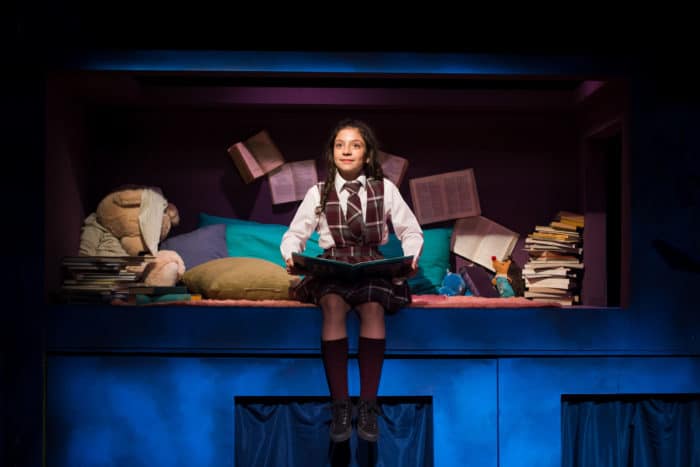
Like the 1996 film adaptation starring Mara Wilson, this production moves the action from Buckinghamshire to America. Kindergartner Matilda Wormwood (Katie Marsh) uses books to escape her unloving homelife and tries to avoid the cruel headmistress Miss Trunchbull (Brett Cassidy) at school. Only her teacher, Miss Honey (Meredith Eib), recognizes Matilda’s abilities – including the supernatural abilities that surface later on in the show.

Marsh, who alternates the role with Jane Keifer, brings a natural maturity to this classic heroine and cheekily carries out her small acts of resistance against overbearing authority figures. When she seems to rat out a fellow student to the whims of  Trunchbull’s wrath, it’s genuinely shocking until we find out that, as usual, Matilda is three steps ahead of us.

Emily Lotz’ scenic design incorporates a clever split-level formation in the tight space to accommodate the numerous locations of the show. A bright pink and blue palette for the set with popping neon accents highlights the Wormwood’s distaste for a daughter. Costume designer Paris Francesca displays a range of memorable outfits from Trunchbull’s gym uniform to the acrobats’ beautiful circus leotards.

By far the most compelling aspect of the show is how smoothly the child and adult ensembles work in tandem. The synergy between these two groups forms the glue of the production, and it’s a testament to Hoffmann’s direction that even with a rotating child roster, the cast blends together seamlessly. The adult ensemble works overtime to handle multiple characters apiece, most impressively when they form a gang of older students to haze the kindergartners in “School Song.” Their quick delight at terrorizing anyone lower on the ladder and the children’s palpable fear make it the standout number of the show. Choreographer Nicole Marie Maneffa uses the size difference between the ensembles to craft inventive dances, such as “Bruce” and “Revolting Children.”

Ask any theatre professional how they got their start and they’ll mention catching “the bug” after an impressionable childhood trip to the theater. It warms the heart to think of all the DMV children for whom NextStop’s Matilda will be that show. If there’s a little rebel in your life, make sure they see this story of kindness rising in the face of adversity.

Only Queen Latifah’s fabulosity kept ABC’s The Little Mermaid Live! afloat

by Mercedes Hesselroth

In 2013, NBC made a splash in event television by airing The Sound of Music Live!, attracting over 18 million viewers to a live telecast of the Rodgers and Hammerstein stage musical. Ever since, other productions and networks have tried to whip up a magic combination of nostalgia, stunt casting, holiday viewership, and integrated marketing to return these televised musicals to the juggernauts they were in the 1950s.

Last night’s The Little Mermaid Live! was the first such attempt from ABC, who only dipped their toes in the water by mixing live performances with footage of the classic 1989 film instead of committing to a fully live format. Ostensibly aired as a celebration of The Little Mermaid’s 30th anniversary, this production fell remarkably short as it understood neither animation nor musical theatre.

The hand-drawn animation of classic Disney films holds a certain charm unreplicable in other mediums. In the vast worlds of animation, anything seems possible, so audiences have a higher capacity to suspend their disbelief. In theatre, this surreality is traded for the spectacle of live performance. It is up to the audience to take the stage elements before them and collectively imagine them into being, like the masks and puppetry representing animals in Julie Taymor’s The Lion King or the lighting contraption that serves as the titular comet in Rachel Chavkin’s Natasha, Pierre, and the Great Comet of 1812.

By segmenting these two worlds instead of blending them together or letting each stand on its own, The Little Mermaid Live! simultaneously lost the magic of the original animation and shortchanged the human connection of its live performances.

Things, at first, got off swimmingly when Jodi Benson (the original voice of Ariel) introduced the telecast and an impressive ensemble delivered a spirited rendition of “Fathoms Below.” The curtains gave way to an enormous ship deck, flying aerial artists, a dreamy Prince Eric (Graham Phillips), and even a real dog to play Max (Bagel). It wasn’t until the disjointed movie clips overtook the telecast that things began to go underwater. Though Moana voice actress Auli’i Cravalho was supposedly the lead of the production, she didn’t even appear as Ariel until we had already gotten acclimated to Benson’s voice and the animated character design.

Since none of the animated characters looked or sounded quite like their live counterparts, the sudden cuts between them could be jarring. It’s difficult to stomach the sight of a fabric, unblinking Flounder after having just seen the emotive, bright-colored fish swirl around in the water. On top of that, audiences may have had trouble placing the characters and their motivations when they showed up in so many disparate forms. While Cravalho and Phillips pleasantly portrayed innocent teens falling in love, their reduced screen time hindered the ability of the performers to build effective emotional arcs. After the opening number, Phillips didn’t return to the stage for a full hour, and the couple’s most significant relationship developments were isolated to the film.

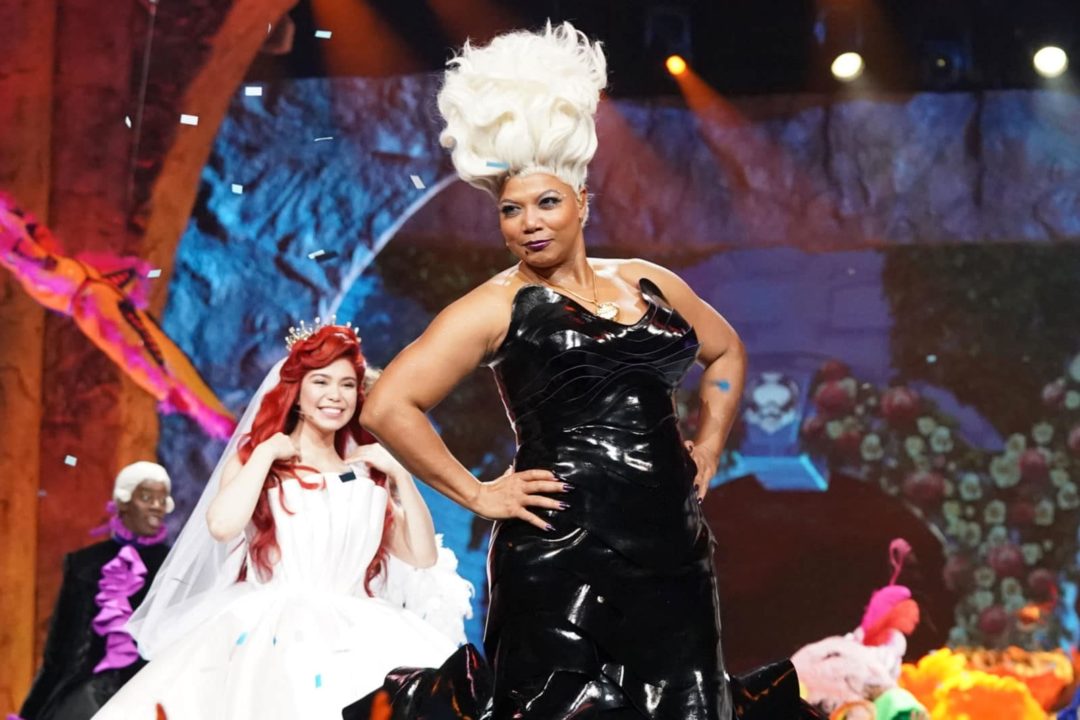
The highlight of the unsteady presentation was undoubtedly Queen Latifah, who had delicious fun as the villain Ursula and brought an original fabulosity to the role, making the case that she should have played the sea witch full-time. In comparison, other cast members seemed less than committed to their parts. Shaggy wore only a red jacket and pants to distinguish he was Sebastian, and gave the most concert-like performance, free from characterization. Even worse, at the end of his only number as Chef Louis, John Stamos openly announced he should have been cast as “Prince Albert” instead – confusing Prince Eric’s name and mistakenly thinking the show had already cut to commercial break.

What was most discouraging about watching The Little Mermaid Live! was it’s utter purposelessness – it’s not an homage to the 1989 film if you insert numbers from the Broadway version, and it’s not cultivating interest in theatre if you continuously cut away from the live sequences. Perhaps it’s no mistake Disney aired this special on Election Tuesday as people needed something light and mindless to switch to while waiting for voting results. But if you missed the telecast and have two hours of nautical apathy sitting in your DVR, you’re better off watching the original or taking the family for a night out supporting local theatre.

Mozart’s whimsical Magic Flute from Washington National Opera

By Daniella Ignacio

This article was first published in DC Theatre Scene here.

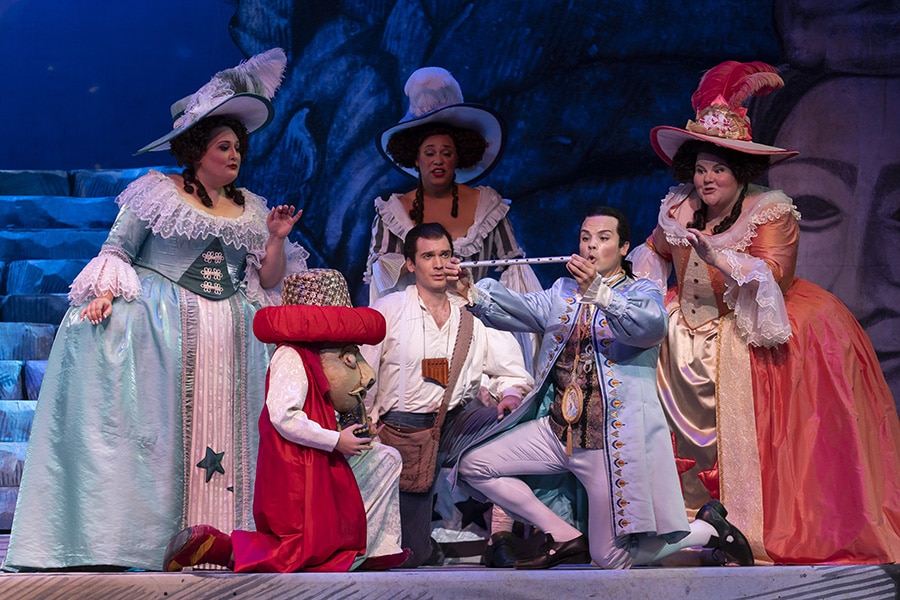
Wild things abound in this production of  Washington National Opera’s The Magic Flute, currently playing at the Kennedy Center. With Maurice Sendak’s artwork at its forefront, the opera’s elements of childlike whimsy makes it an entertaining night for audiences of all ages. Conventions of opera are adhered to, with all of the classical training obvious in each and every performer, from the principals to the chorus … yet there’s something more to it.

There’s whimsy and there’s a clear focus on the power of young people: something this opera always inherently does with its magical story about the journey of a prince, Tamino, and his sidekick Papageno, not to mention its accessible, tuneful Mozart score. This production highlights with no apologies in a language that children can understand: clear English (not the original German) and fun storytelling all-around.

Neil Peter Jampolis realizes the Maurice Sendak scenic design and artwork in a way that allows for wonderful theatrical moments, with lighting design (John Garofalo) that brings it to life even further. It’s clear from the moment the curtains open up and the audience’s first glance is a Maurice Sendak illustration highlighting the moon above the priest. There’s a beautiful connection between static image and dynamic, live theatre through this design. As the light on the scrim dims and the audience begins to see the physical set behind it, for a moment, one might think that the fantastic creatures in the illustration are also onstage.

And then the opera begins and the audience immediately sees the three ladies (Alexandria Shiner, Deborah Nansteel and Meredith Arwady – a fearsome trio who can also be flirtatious) attacking a serpent that is coming after Papageno. Said serpent, quite adorable with its big green eyes, waddles out almost unsuspectingly until it’s killed, smoke comes out of it and it creeps offstage. A wide array of creatures inhabit this production besides our friend the dragon: lions with golden manes and creatures right out of “Where The Wild Things Are” that resemble trolls.

Pamina and Tamino are the heart of the story. Sydney Mancasola’s Pamina brings a master class of a performance in “Ach ich fühl,” fully using the legato lines to demonstrate the character’s sadness and allowing her voice to travel up and down fully and freely, which is not easy to do in that aria. David Portillo’s lush tenor provided for a romantic feel for Tamino with just the right amount of vibrato, especially in his opening arias, and when Tamino decides to join Sarastro’s brotherhood, Portillo portrays that resolve with strength and fervor.

Michael Adams as Papageno is the standout in this production. His soaring tenor has a powerful speaking voice to match, with a slight twang that characterizes the chatterbox excellently. Adams finds moments to make the score his own and to create physical comedy with the role and allows the audience to laugh at him, all while making Papageno a person that you want to root for. Especially in his interactions with Papagena (a winning Alexandra Nowakowski), all culminating in the “Pa-pa-pa-Papageno” duet where they celebrate their love, he crafts a truly winning character. Nowakowski is a standout in her own right, as well. Her reveal from the cleaning lady to Papagena’s true form, with bucking “ahhh”s turning into a beautiful true-to-opera “ahhh,” was a comedic highlight of the show.

As the Queen of the Night, WNO veteran Kathryn Lewek (who played the same role in 2014) takes control of the stage and pulls off a stellar “Der Hölle Rache kocht in meinem Herzen” that was the crowd pleaser of the night. Although she seemed a little off (one could wish for her to get some of the notes from right on top of them, not by working up to them), she still remained in character and made the number a showstopper. Her rival in this story, Sarastro, played by Wei Wu, has a lyrical bass with low notes that are a joy to hear. It can be soft, and one could wish that he could allow it to boom out a bit more, but overall his voice matches the character well.

On a libretto note: I can appreciate the original choice of librettist Emanuel Schikaneder to ground the story with spoken moments; however, sometimes I wished that I could hear more singing, as some of the book scenes tended to drag out and contributed to a feeling of the opera starting to feel long. One full scene in the first act was entirely spoken and, to be quite frank, it was forgettable. The second act opened with the priests and followers talking, rather than a grandiose opening like that of the first act, and I wanted to just get to another magical, musical moment again. Although the performers played the straight acting scenes as best as they could (some rather excellently: at one point, Papageno conjured up two imaginary chickens to play with, much to the chagrin of Tamino and much to the enjoyment of the audience), musical moments in combination with powerful acting and design choices are what draw people to The Magic Flute; filler book scenes, not as much.

However, that doesn’t discount all of the incredible moments of this opera. Washington National Opera’s The Magic Flute takes you on a journey with unexpected moments.Take it all in with heart and joy, and try to remember the childlike wonder of seeing your first opera or musical.