Browsing Category

Performing Arts

In This Hope: A Pericles Project

by John Bavoso

This article was first published in DC Theatre Scene.

In fraught times, where do you go to find hope? Assuming the answer is not “within yourself,” might I suggest the basement of a church where, seated in a circle with a group of strangers, you recount personal stories and cherished memories? If it sounds like I’m pointing you in the direction of a support group, well, I am, sort of—in the form of Hannah Hessel Ratner’s In This Hope: A Pericles Project, being produced now by The Welders at Spooky Action Theater.

Using Shakespeare’s Pericles, Prince of Tyre as a starting point, an ensemble of four actors tell the tale of not only the Greek hero, but also their own personal and family histories, and coax the audience to do the same. In doing so, they transform the classic tale into something more modern and personal, updating some (generally the sexist) parts and finding relevance in contemporary life in the process. And in doing so, the cast of In This Hope stitches together an evening filled with memory, storytelling, and community.

Upon entering the Universalist National Memorial Church on 16th Street, audience members are led downstairs and through the kitchen to a big, open space filled with a circle of wooden chairs. On the walls surrounding this circle is a map of the ancient world with the cities of Tyre and Antioch and the like marked off. Above the space hangs several ropes or cords crisscrossed, like a tapestry waiting to be woven.

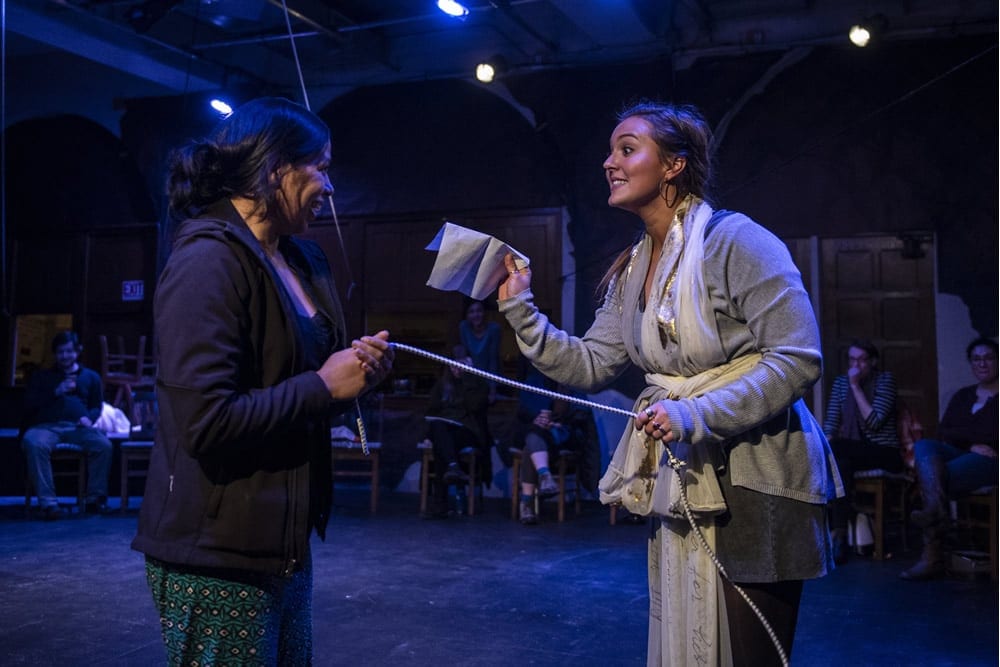
Our guides and our bridge between the ancient source text, the Jacobian retelling, and the present interpretation are four talented and versatile actors— Lida Maria Benson, Rocelyn Frisco, Raghad Makhlouf, and Lori Pitts. Under Anna Brenner’s deft direction and using little more than a few infinity scarves and a crown made of forks, these four assume a variety of roles from Pericles, but also play themselves, sharing bits of memory and personal anecdotes from the Ukraine (Benson), the Phillipines (Frisco), Lebanon (Makhlouf), and here in DC (Pitts).

In This Hope is billed as a ritual as well as a performance, and the audience is encouraged to not only participate, but help to create the piece from the ground up—this play literally could not exist on a proscenium behind a fourth wall. Given that Hessel Ratner’s primary vocation is that of a dramaturg rather than a playwright, it’s no surprise that deep excavation and group work are main features of the piece. From sharing a memory with a neighbor to inviting an audience member to play a role in the original tale, but with a choose-your-own-adventure twist, the audience is welcomed in and made to feel a part of the story in a genuine, non-threatening way.

The interwoven nature of the past and present, of myth and memory, is interesting and thought-provoking, but at times can lead to a somewhat muddled experience. For example, the death of Pericles’ wife, Thaisa, as she gives birth to the couple’s daughter, Marina, is used as a touchpoint for discussing how the maternal mortality rate in DC is more than twice the national average, especially among African American women.

While this aligns with the idea of blending the past and present, and literature and reality, it doesn’t seem to fit as neatly with either the world of the Pericles story or the personal lives of the actors—it’s important information, but it feels slightly out of place. Similarly, there are other moments when the drama of Pericles or the stories of the actors or the memories of the audience is reaching its height, only to be cut off by another narrative. When the intermingling of these different threads works seamlessly, it casts a spell; when it doesn’t, it can be jarring for the audience.

“What world is this?” This line, written by William Shakespeare and repeated several times by In This Hope’s cast, is not one that is easily or happily answered by many people these days. But the team behind In This Hope: A Pericles Project is creating its own world from scratch, in which strangers are vulnerable and open and stories are shared without judgement—and that’s a space I wouldn’t mind inhabiting for more than 2 hours at a time.


In This Hope: A Pericles Project by Hannah Hessel Ratner. Directed by Anna Brenner. Associate Director Jess Phillips . Featuring Lida Maria Benson, Rocelyn Frisco, Raghad Makhlouf, and Lori Pitts. Environmental designer: Colin K. Bills. Costume designer: Pei Lee. Sound designer: Roc Lee. Design assistant: Cody Whitfield. Artistic consultant: Isaiah Matthew Wooden. Stage manager: Emma Heck. Assistant stage manager: JJ Hersh. Production manager: KayCee Tucker. Produced by The Welders.

Sing to Me Now (Overworked muse seeks intern)

by John Bavoso

This article was first published in DC Theatre Scene.

In the promotional materials for their production of Iris Dauterman’s Sing To Me Now, Rorschach Theatre has been highlighting one particular quote from the script: “Every second you hesitate, every moment you’re not writing, furiously writing, or dancing, or singing, things are getting worse. So hurry. Up.”

While the creative types among us might hear a call to action (or a call to curl up into the fetal position and hide under our covers), in the context of the play, it’s more like an epithet hurled by a beleaguered muse at her Pollyanna human intern in order to intimidate and provoke her. And in the world that Dauterman’s skillfully crafted script and Rorschach’s team of theatrical sorcerers have created, that all makes perfect sense.

As director Jenny McConnell Frederick noted before the opening night performance, Rorschach fell in love with the script for Sing To Me Now as they helped to develop it through the company’s inaugural MAGIC IN ROUGH SPACES PLAY LAB earlier this year. Many of the actors from that initial workshop transferred to this full production, which is evident in the passion they bring to their roles and the lived-in, authentic performances that McConnell Frederick has elicited from them.

For Sing To Me Now, Rorschach has transformed the intimate Lab II black box at the Atlas Performing Arts Center into a land of dreams and myth. It is here that we meet Calliope (or Callie to her friends), nearly drowning in paperwork and angst. Chloe Mikala masterfully embodies the jaded muse of epic poetry, all hard edges gained from working too hard for too little recognition (no one looking for inspiration for their novel, or next song, or cheesecake recipe even addresses her by her real name!).

Callie’s workload is so overwhelming due to the fact that, owing to a set of circumstances that I will not spoil for you, she is the only one of the muses left to provide inspiration to the ungrateful humans below. Her best friend, Mo (short for Morpheus, and played with both snark and awkward vulnerability by Erik Harrison), the god of dreams, keeps her company and tries to convince her to sleep. But when she sleeps, she dreams of her sisters, and that’s something she’s definitely trying to avoid.

Her only other companions are her mother, Mnemosyne, goddess of memory (a warm and funny Cam Magee), who exhibits dementia-like symptoms caused by having, of all things, too many memories in her head, and Hades (played with the perfect combination of pomposity and self-pity by Ian Armstrong), who enters and exits via an old-timey elevator to the underworld. “He’s my sister’s asshole ex-boyfriend and also my asshole uncle…. because that’s how we roll,” Callie quips.

But Callie hasn’t resigned herself to wallowing—in fact, she’s put out a Help Wanted call to the universe; our muse, you see, is looking for an intern. And she gets one, much to her chagrin, in the form of Claire, who Callie insists on calling Yankee, a wide-eyed, naïve college graduate who’s having trouble finding a “real” job. Tori Boutin imbues Yankee with the right amount of self-awareness and chutzpah to keep her from being too cloying or irritating, but also with enough youthful optimism and exuberance to rub Callie the wrong way… at least at first. Soon enough, the two become what must be among the most unlikely work-friend pairings in history.

The cast is rounded out by Desiree Chappelle and Jonathan Del Palmer, who show great range as everything from aquatic ballet dancers to muses to Marcel Duchamp. Their cameos often serve to inject some levity into some otherwise fraught situations.

McConnell Frederick does an excellent job of using every inch of the small space and filling it with action in a way that feels purposeful and natural. Under her deft direction, the performances are rooted in realistic, relatable emotion, despite the fact that most of her actors are playing supernatural beings. In combination with Dauterman’s nuanced writing, she helps to bring mythic events down to a human scale in the best way possible—even when the stakes are the literal survival of the human race and art itself.

And it wouldn’t be a Rorschach show without some seriously nifty design work. A fair bit of the action involves the characters fishing ideas and dreams from a river, made possible thanks to Swedian Lei’s ingenious set design. Similarly, Rachael Knoblauch’s props design, Sarah Tundermann’s lighting design, and Gordon Nimmo-Smith’s sound design come together for an effect that transforms mundane objects into pure magic.

At its heart, Sing To Me Now grapples with a lot of weighty topics, including what the role of art is in a cruel, chaotic world; whether the human race is even worth fighting for; and how we cope with unimaginable grief. And like the best of art, what it offers is not so much clear answers as the hope we need to keep going, keep fighting, even after we leave the theater.


Sing To Me Now by Iris Dauterman. Directed by Jenny McConnell Frederick. Featuring: Ian Armstrong, Tori Boutin, Desiree Chappelle, Erik Harrison, Cam Magee, Chloe Mikala, and Jonathan Del Palmer. Costume designer: Debra Kim Sivigny. Set designer: Swedian Lie. Properties designer: Rachael Knoblauch. Sound designer: Gordon Nimmo-Smith. Lighting designer: Sarah Tundermann. Production manager: Gordon Nimmo-Smith. Stage manager: Rebecca Talisman. Produced by Randy Baker, Jenny McConnell Frederick, and Jonelle Walker.

The Fall Remembers A Student uprising in Cape Town

by John Bavoso

This article was first published in DC Theatre Scene.

Imagine a large group of college students, surrounded by the international media, anxiously awaiting the moment when a statue depicting a key figure from their country’s racist past is toppled and removed from its place of prominence on their campus. While this scenario has played out recently at the University of Virginia and the University of North Carolina, it also unfolded in 2015 at the University of Cape Town in South Africa—and you can see a vibrant and engrossing retelling of the events in some of the participants’ own words much closer to home in The Fall at Studio Theatre as part of the Studio X program.

When Studio’s Artistic Director, David Muse, saw a production of The Fall—an ensemble piece created and performed by students at UCT’s Baxter Theatre Center under the guidance of drama professor Clare Stopford—at the Edinburgh Fringe, he knew he wanted to bring it to DC. The Fall is deeply personal, rooted in the performers and country that created it, and universally recognizable to Americans of any age and political affiliation.

The inciting incident, as it were, for the events portrayed in The Fall is the moment on March 9, 2015, when UCT student Chumani Maxwele threw a bucket of human excrement onto a statue of Cecil Rhodes, the British Prime Minister of the Cape Colony in the late 1800s and early architect of South Africa’s apartheid system. The statue, despite years of petitions from black students, still stood more than 24 years after the end of apartheid, literally looking down on the UCT campus. Maxwele’s actions helped to inspire the birth of a movement, #RhodesMustFall, and transformed a group of otherwise unrelated students into activists determined to begin the work on decolonizing their campus.

Among those students were Ameera Conrad, Sihle Mnqwazana, Oarabile Ditsele, Sizwesandile Mnisi, Cleo Raatus, Tankiso Mamabolo, and Zandile-Izandi Madliwa, who fill the small stage at Studio with song, dance, spoken word poetry, and accounts of the kind of mistreatment and microaggressions they’ve endured as black students at their university. Driven by the earnestness of young revolutionaries, the ensemble powerfully—and often quite humorously—offers a behind-the-scenes look at the dawning of a movement.

Even united around the singular purpose of tearing down the statue of Rhodes, conflict and divisions within the movement begin to make themselves apparent. Once the statue does fall, the news is filled with images of the male students jumping on the plinth and whipping the statue—much to the chagrin of the radical black feminists in the group, who are sick of being pushed off camera by their hyper-masculine counterparts. And the group’s sole non-binary member has to constantly remind the rest of the characters about the erasure of contributions of queer and transgender individuals to the movement.

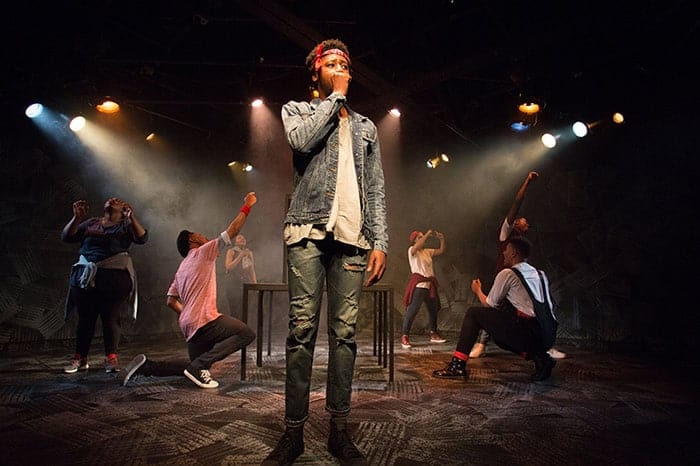
The internal debates and dynamics inherent in the early stages of the development of a group of activists is fascinating, but The Fallnever feels like a lecture or reading from a text book. The cast makes the most of the spare space and three plain desks, punctuating their discussions with choreography, beautiful vocals, and live footage from the protests. I began the show scribbling notes in a small notebook, and realized after I had the left the theater that I had quickly given up on my transcription, having become enthralled by a group of truly engaging storytellers.

For those of us past our early 20s, or who have just been paying too much attention to the daily news cycle leading up to the Midterm Elections, the cast’s sense of optimism and utter surety that they can change the world may seem laughably Pollyanna-esque. But if you are willing to really listen and pay attention to how much these young student-activists have already achieved—both personally and politically—you may instead find yourself reenergized and even a little more optimistic about the state of the world and its future after seeing The Fall.


The Fall co-created by Thando Mangcu, Kgomotos Khunoane, Clare Stopford, Ameera Conrad, Sihle Mnqwazana, Oarabile Ditsele, Sizwesandile Mnisi, Cleo Raatus, and Tankiso Mamabolo. Featuring Ameera Conrad, Sihle Mnqwazana, Oarabile Ditsele, Sizwesandile Mnisi, Cleo Raatus, Tankiso Mamabolo, and Zandile-Izandi Madliwa. Stage manager: Puleng B. Mabuya. AEA stage manager: Kelsey Sapp. Lighting designer: Michael Maxwell. Costume designer: Marisa Steenkamp. Scenic designer: Patrick Curtis. Produced by Studio Theatre.

Pamela Maria Chavez’s “Caracol Cruzando” Shines

This article was first published by TAGG and can be read on their site here.

When Pamela Maria Chavez set out to make her short film “Caracol Cruzando,” she wanted to tell a story that brimmed with universality but was still tied to her own personal experience as an immigrant. What she ended up with was a beautiful and heart wrenching film about a young Costa Rican girl leaving behind her homeland for the United States.

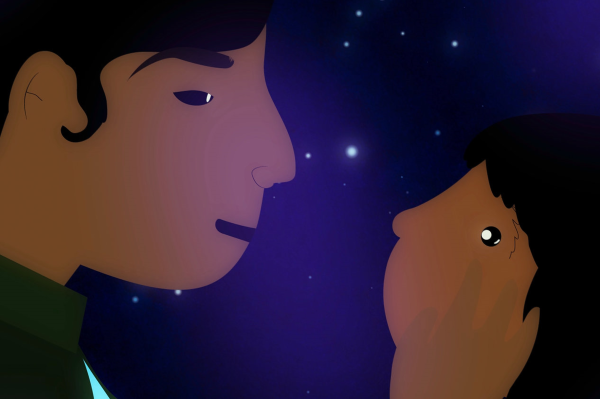
The film, funded by Latino Public Broadcasting, centers around a young girl, Anais, who is preparing to leave her home of Costa Rica. Her family decides to cross the border separately, splitting up one child with one parent. Anais’ beloved pet turtle, a symbol of her ties to her homeland, is taken at customs, allowing the audience to understand the full breadth and tragedy that comes with the immigration process.

Chavez ses animation as a sort of perfect medium to tell the story. “Kids love animation, but so do adults,” she says. “What a perfect sort of medium to be able to ask, ‘How can I tell this complicated, dense story in a way that’s accessible?’”

Her desire to reach young people and families alike drove her to tap into the heart of immigration, even allowing herself to heal during the process. Chavez cited the balance of creating a piece of art that not only creates dialogue around present day issues like immigration, but makes it universal for all those watching, sharing in that feeling.

“Activism is in the story I’m telling,” Chavez says. “I don’t know if I will ever steer away from content that doesn’t speak to my heart.”

As a filmmaker, illustrator, and animator, Chavez sees the importance in honest and genuine storytelling, specifically emphasizing how these narratives should be told by those experiencing it.

“We don’t want that narrative told by somebody else,” she says. “We want to be steering these conversations. We want to be at the helm.” As a queer woman of color in the film industry, Chavez can’t overstate enough the importance of funding other artists and filmmakers from marginalized communities.

“Who I am as an artist and activist is somebody genuinely concerned about the things that happen in our world,” she says. “I can’t be passive.”

To vote for “Caracol Cruzando” for PBS’s Online Film Festival, click here.

An Interview with Musician and Storyteller Holly Near

This article was first published on TAGG and can be read on their site here.

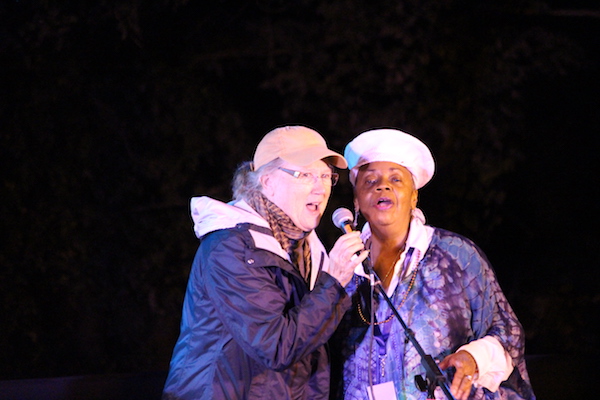
Musician Holly Near has dedicated her life and career to ensuring that her music allows activism, storytelling, and more to intersect. She has participated in the annual music festival SisterSpace in the past and continues to be a vital force in that event and the LGBTQ community. Below, she tells us a bit about her own career and the importance of festivals like SisterSpace.

How did you get involved with SisterSpace, and why is an event like this important to you?

I began participating in women’s music festivals in the early ’70s. I believe they have been a hugely important way for women and perhaps more specifically lesbians to gather. We all need songs no matter who we are, no matter where we come from. Lesbian and woman-identified songs were originally sung in the privacy of the home but fortunately, the music broke down the front door.

You’ve been involved in the music industry for some time now. How have you seen the industry shift and change, specifically in its inclusion of LGBTQ performers?

I’m not much of an expert on the music industry. I left it pretty quickly. I didn’t know how to be me in it. I was singing political lyrics, anti-war songs, songs about social change right from the start, and that just didn’t fit into the industry hit song mold. So I started my own record company. This was in 1972. That said, I think the work that lesbian feminists did to make a space for outspoken music laid the ground work so that women artists could then chose to go in to the music industry or work with the alternative feminist networks.

How has your experience as an out artist shifted your own life?

Before I came out I was already singing songs that had words like “genocide,” so my chances of a mainstream career were already unlikely. I knew that it would be difficult when I came out. Back then, the so-called white, male-dominated left and progressive movements were not user-friendly to feminists or lesbians and, for the most part, not receptive to people of color either. So by coming out, I would lose a good part of my audience in the peace movement. But they eventually went through their own changes. Now, at least in appearance, most social change groups are welcoming of diversity of all types. It is the next step that is hard. How do we change the racism and sexism that still hangs on in organizations, institutions, and individuals? I think that songwriters can continue to be of use in this regard. It is important for people who think of themselves as progressive to look long and hard on what work still needs to be done. In this case, for example, lesbians have an opportunity to really undo the racism and class discrimination that lurks in our communities, our structures, our culture. Music festivals can be part of this work.

What does SisterSpace mean to you, especially in the context of today’s social and political climate?

SisterSpace has made a commitment to challenging racism and other forms of discrimination. It is in their mission statement; it is reflected on their board and in their leadership. It gives us all a place to practice and we can take that knowledge out into the larger community.

Is there anything else you would want to add, either about yourself or to burgeoning LGBTQ musicians?

Young artists will make up a path that I cannot even imagine. That is how it goes and I look forward to seeing where it goes. However, no matter when we come in to this work, it is a challenge to really commit to being socially relevant and conscientious artists. It takes practice and can be painful and it can be glorious. As hard as it has been over the last 50 years, I do not regret for one moment working outside of the mainstream.

SisterSpace Continues to Pave Way for Fun and Inclusion

This article was first published on TAGG and can be read on their site here.

SisterSpace, the annual camping festival for women’s music, culture, and—most importantly— community, is gearing up for another year of femme-oriented fun with a social impact that is unparalleled.

With comedy, spoken word, jazz, pop, folk, rock, world music and more, the festival is spread out over five stages indoors and outdoors and lasts three days. This year’s theme, “Her(Story),” builds upon last year’s theme,“ReSisterSpace,” where workshops were focused on empowerment, activism, and self-care.

“We have several workshops about empowerment, but also about coming together,” says Jo-Ann McIntyre, an organizer of SisterSpace. “It’s about coming together, learning how to talk and listen to each other and hearing and celebrating each other’s stories.”

The festival, which has been held since 1977, has long ensured that the event is packed with opportunities and activities to connect queer individuals with each other and allow for intergenerational queer bonding and solidarity.

This year, the festival will celebrate the creation of the Virginia Giordano Memorial Fund. Virginia Giordano was a prominent and celebrated producer of women’s music in the 1970s who helped to promote LGBTQ musicians, including SisterSpace performers Holly Near and Cris Williamson, until her death in 2014. The fund is aimed at helping up-and-coming musicians and other individuals gain more recognition and visibility.

Near, who is on the advisory board for the Virginia Giordano Memorial Fund, has participated in women’s music festivals since the early ’70s and emphasizes the importance of these spaces in celebrating and advocating for one another.

“How do we change the racism and sexism that still hangs on in organizations, institutions, and individuals?” Near asks. “I think songwriters can continue to be of use in this regard. It is important for people who think of themselves as progressive to look long and hard on what work still needs to be done.” Music festivals like SisterSpace can be an avenue of change that can help in this dismantling.

“We all need songs no matter who we are, no matter where we come from,” Near says. With a line-up of musicians that span multiple generations and backgrounds (including Be Steadwell, Crys Matthews, Indigie Femme, and KIN4LIFE) and plenty more workshops and events, SisterSpace is gearing up for a successful year.

SisterSpace takes place September 7–9 in Darlington, Maryland. To register for the festival or to learn more about the SisterSpace community, visit sisterspace.org.

Happy Wife Happy Life: Bridget McManus Talks Being Happily Ever Married

This article was first published on TAGG and can be read on their site here.

Bridget McManus can be considered a lot of things (and rightfully so): a host, director, screenwriter, comedian, creator. But there’s one position that she’s managed to transform into a web series that is equal parts funny, endearing, and honest – wife.

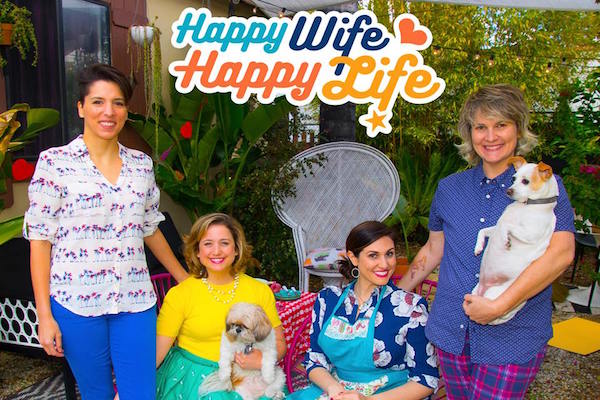
McManus’ web series “Happy Wife Happy Life” features two married lesbian couples, including McManus and her wife of a decade, Karman Kregloe, discussing, debating, and dissecting the ins and outs of relationships.

“I always hear marriage is difficult, even challenging,” says McManus in a phone interview. “We love the idea of couples talking about how great it is to get married. Marriage is fucking awesome.” McManus and long-time friend Cat Davis conceived the idea, later asking their respective wives to be a part of the self-produced show.

McManus hadn’t even thought about marriage before meeting her now wife, but “love at first sight” became a reality when she met Kregloe. They married in 2008 and were among the 18,000 same-sex couples who were able to get married before Prop 8 was passed. They were grandfathered in, but that allowed McManus to see the immense privilege in being a married lesbian couple.

“Marriage is two people coming together to make each other’s lives better,” says McManus. “It’s letting the person you’re with flourish and allowing yourself to evolve, too.” It’s this sentiment that drives the show’s core; being a partner in all senses of the word and allowing for mutual respect and growth. The four women offer an insight into how to make the most out of married life and allows for a very literal glance into what married lesbian couples look like for younger queer people.

The show has unconsciously begun to recode the heteronormative marriage therapy trope into something more queer-centered and humorous, qualities that has led to the production of two seasons (and counting) of the web series. McManus is delighted with the response to the web series, but stresses that there is still a distinct lack of LGBTQ content in the mainstream media, but urges young queer people to seek out and even create their own representation.

“Everyone can put their stuff out there on the internet,” says McManus on finding more LGBTQ media. “[The internet] levels the playing field; of course, it’s not 100 percent leveled, but that doesn’t mean the minority can’t flourish and thrive too. I just want to see more queer content. I want to see more points of views and perspectives.”

McManus has seen the “nonstop growing and thriving” in the queer community but acknowledges it may not be accessible to everyone. Web series like “Happy Wife Happy Life” have gained mainstream traction for the LGBTQ community and become an important and central platform for new queer creation.

“Happy Wife Happy Life” season 3 premieres on June 3 on tello Films and was recently submitted for an Emmy Award in the “Outstanding Short Form Variety Series” category. McManus is working on multiple other projects as well, with no signs of slowing down in sight.