Browsing Category

Performing Arts

The Washington Ballet Presents Three World Premieres

by Jason Williams

This article was first published in The Northwest Current.

In the armed services how you identify yourself (rank, branch, tours of duties) reveals critical information about the length and depth of your military career. In the world of dance, particularly in ballet, there is similar identification shorthand that gives insight into a dancer’s proficiencies. What can never be quantified is the human element, the fact that no two people–even those who have the same experiences–will experience them the same way. That human element was on full display as The Washington Ballet, under the artistic direction of Julie Kent, presented Three World Premieres March 14-18 at the Harman Center.

Three World Premieres was a showcase of three veteran dancers Clifton Brown, Gemma Bond, and Marcelo Gomes, as they pivot from their work as performers to creators as choreographers. The two-hour performance had intermissions after each act. Clifton Brown’s Menagerie opened the show.

Brown, who started his professional dancing career in 1999 as a member of the Alvin Ailey American Dance Theater (AAADT) is a Bessie Award winner, a founding member and rehearsal director for Jessica Lang Dance.  Additionally Brown has performed on So You Think You Can Dance and Dancing With the Stars. Menagerie features 10 dancers and was set to Gioachino Rossini’s Duet for Cello and Double Bass in D Major. Cellist Suzanne Orban and Bassist Marta Bradley brought the piece of music to life; their playing added another rich layer to the performance.

Menagerie, as its name suggests, was free-flowing and light. Comprised of three dances, each had corresponding openings and endings. The start of the piece has two male dancers with their backs turned to the audience, heads high as if looking at a horizon. The lighting designed by Robert Fabrizio was subtle throughout, starting in a pale blue that shifted to deep copper before returning back to blue. The two male dancers were soon joined by two female dancers, with a slow rhythmic interplay prior to a pairing off.

Menagerie seems very aware of the audience. Commonly with four dancers two men and two women, the pairing would be gender balanced, but often that convention was brushed to the side. And there were at several turns facial expressions just as important as the body moments in regarding to the feelings of the dancer. As all ten dancers arrived on stage there were still moments where groups clustered, but more of the movements were in long clean lines facing the audience. The syncopation of the dueling cello and bass added drama, and even the moments when the music was less intense the natural rhythm of the dancer’s steps filled the sound void. As Menagerie draws to a close all ten dancers are on stage against a golden orange backdrop, creating a flower-shaped silhouette. It reminded one of a formation we’ve seen performed by the Ailey Company, but the transition out was joyful movement filled with laughter, encapsulating Brown’s genius and station as a creative.

Gemma Bond hails from Bedfordshire, England, and she is currently a corps member of the American Ballet Theatre (ABT). Bond’s choreographic career goes back just as far as her dance training; her first piece was staged at the age of 13. The 2017-2018 Princess Grace Foundation- USA Choreography Fellow has created three ballets for ABT’s Choreographic Institute and her next commissioned work with a premiere at the Ballet Sun Valley. Performed this evening was Myriad, set to the music of Henry Purcell. The dance features six female dancers and one male counterpart. Whereas Menagerie did not reduce to a linear narrative, Myriad is presented as a story, with a clearly defined being, middle, and end.

As the curtain rises a white-hot backdrop stings your eyes. Thankfully it softens as six women dancers in long flowing pastel-colored dresses move to center stage. Through the opening, the dancers are commonly interlocked, each taking turn coming to the forefront. One after the next, each establishes her own tempo while the rest sway in the rear. Seeing these performers, and knowing there will be a seventh, it was hard not to think of themes like creation and completion. As the male dancer arrived–on this evening Brooklyn Mack–those earlier thoughts are solidified as he dances with each woman individually. Each dance had some overlap, but was distinct. And as Mack and Ashley Murphy dance you begin to see a more pronounced contrast in the styles of the women dancers. As Mack leaves the stage the lights are lowered to the point that you cannot tell the remaining women dancers apart. Their long elegant outlines become elongated as their movement slows, and the bright light that opened the dance is long gone as dusk and darkness settle over the stage.

The final premiere of the evening was choreographed by Marcelo Gomes, from 2002 until 2017 a Principal Dancer with American Ballet Theatre. Gomes started his training at age 5 in his native Brazil, and in 1993 was awarded the Revelation Prize that sponsors his travel to the states to continue his dance education. The Outset, which is set to the music of Antonin Dovrak, was played this evening by a quartet including violinists Sally McClain and Mayumi Pawel, Jennifer Ries on viola, and Suzanne Orban on the cello. The Outset is the most story rich of the three premieres, and not just because the dancers have character names in the program. Created by eleven dancers, The Outset tells a very particular story and does it really well. The dance segments are episodic and easily flow into each other. Penny and Martin are a young soon-to-be-married couple who live in a small town. While they are excited about the prospect of starting a new life together, Martin yearns to explore life beyond his small town limits. The struggle of loving and leaving is the central tension of this work.

The costume design (by Judy Hansen) accentuates the authenticity of The Outset. The women dancers wear long prairie dresses while male counterparts are in dark colored pants and button-down shirts. As the dance moves to a more formal setting, accents like ribbons and bolo ties are added. The dancing in The Outset generally was in one of three varieties: celebratory but controlled line dances, multi-tiered formations, and couple paring. The line dances were joyous and well executed as they used showcased the company’s well-practiced coordination. The multi-layered formation that often included all eleven dancers drew your eyes all over the stage, giving the impression of organized chaos. From a story-telling perspective, it allowed the protagonists to appear out of the center of the action, which played well into the overall theme of questioning ones place at home. Much of the couple dancing was performed this evening by Maki Onuki, and the aforementioned Brooklyn Mack. The two performed wonderfully together, taking advantage of Mack’s dexterity and Onuki’s powerful grace. It was a pleasure to see Mack’s skill showcased in two of the three premieres.

As the final curtain fell there were two obvious takeaways. Brown, Bond, and Gomes’ years of dedication to the craft of dance have translated into three unique works of choreography. Menagerie, Myriad, and The Outset were each distinct, yet very much in the evolving tradition of modern ballet. The gifted dancers of The Washington Ballet and the artistic supportive environment that director Julie Kent is prioritizing there will be an opportunity for more dancer-turned-chorographer works in the future.  

Washington Jewish Film Festival Brings New Intersections To The Screen

by Anying Guo

This article was first published in Tagg Magazine.

As the Washington Jewish Film Festival enters its 28th year, director Ilya Tovbis reminds us of the full diaspora of the Jewish experience that is equal parts universal and intersecting. Coming into his sixth year as the director of the annual film festival, Tovbis has seen growth not only in quantity, but in the kinds of films that are showcased at the festival. Though the jump in numbers (from 5,000 attendees to about 15,000) is impressive, the care and thought of selecting the films that are shown has become a major part of why the festival has found success with a diverse audience.

“We’re a festival of the Jewish community, but not [exclusively] for the Jewish community,” said Tovbis. “The root of our mission is not to discover the dominant narratives around the Jewish experience; we are really interested in the full diaspora of the Jewish experience.”

Tovbis has seen a steady increase in the amount of representation for marginalized communities in film festivals, and views the Washington Jewish Film Festival as one outlet that not only welcomes but embraces these intersections. As someone who has worked at major museums and festivals in cities such as San Francisco and New York City, Tovbis finds D.C. a city to be one filled with rich cultural knowledge and expertise after talking with patrons deeply about niche and specific aspects of films.

His focus is on finding films that represent not only the Jewish experience, but intersecting identities as well. Specifically, the “Rated LGBTQ” section of the film section is a reminder that the Jewish experience and the queer experience is and has always been intertwined. A spotlight film of this year’s festival is The Cakemaker, a film that bears a universal sense of grief and loss while also navigating queer identity and loneliness against the backdrop of cultural clashes.

“What’s exciting is that we as humans have these sort of layered identities,” said Tovbis. “I think when we delve deeper into the film that are a part of the LGBTQ sidebar that becomes really clear – it’s all about how those identities reflect and press on one another.”

With roughly a thousand films submitted for eighty slots, Tovbis admits the difficulty in curation, because not every patron or even selector will understand why a film was chosen. Tovbis stresses that they try to select films that represents facets of the festival, even if that means passing on films he or others personally loved.

“We are seeing more films grappling with the fluidity of our modern world,” said Tovbis, who brought up the film The Strangest Stranger as one of the most thought-provoking pieces about the nuance and complexity of identities. “It mirrors society, as fluidity and identity is finding its way into media and public discourse. Art really does reflect life, and if it doesn’t, it’s essentially life-less.”

The Washington Jewish Film Festival will run from May 2-13. For tickets and information, visit wjfff.orgor call at 202-777-3210.

Between The World and Me

by Jason Williams

This article was first published in The Northwest Current

Witnessing the meteoric rise of Ta-Nehisi Coates from a relatively unknown journeyman journalist to a multiple New York Times list best selling author, the easier narrative to follow was Coates.

It did not matter that Coates eschewed the spotlight at first, then tried his best to redirect his newfound celebrity to the issues and the people that needed the attention. There was a segment of his readership that wanted from Coates what we typically request from all brave, new, voices that challenge the status quo – more.

With the presentation of his “Between the World and Me,” adapted for the stage by Lauren A. Whitehead under the direction of Kamilah Forbes and scored by Jason Moran, the places, people and experiences Coates so incredibly illuminates through this work are drawn to the forefront again.

The audience filed into the Eisenhower Theater at the John F. Kennedy Center for the Performing Arts to a musical mix of Stevie Wonder and Nina Simone among others. Promptly at 2:15 p.m. the music was lowered, as were the house lights. The dark curtains were pulled back and the stage revealed.

In the foreground were three clear podiums, stage right, with nine chairs and accompanying music stands. Behind them stood a tall, rectangular media screen. On top of the screen sat Jason Moran at his piano, as he was joined by Mimi Jones on bass guitar and Nate Smith on drums. The trio played softly as the cast entered on both sides of the stage.

Behind the band was a similar media scene that was synced with a larger one under it. The first image shown was cracked pavement similar to the one displayed on Coates’ 2008 debut novel, “A Beautiful Struggle.” As the actors found their seats, the music came to close when Joe Morton came out to open the production.

The book version of “Between the World and Me” is a tightly-written 152 pages without a table of contents. At its heart, the book is a letter to Coates’ then-teenage son, Samori. The power of the story is how Coates expresses his understanding of how his physical body, like the one of his son and all people of African decent, fit in the larger context of American history.

Morton opens as the book does, with setting primes for this discussion. It was a response to an interviewer’s question about what it meant to lose his body. What is clear from the outset is the pairing of the actors with the parts of the text they presented was intentional, not just for tone and annunciation, but for the history each actor brought to this work.

For example, Tariq Trotter, who is professionally know as Black Thought of The Roots, was called upon to express the difficulty of navigating urban America, being it the Baltimore of Coates’ youth or his first venture into Brooklyn after college. Trotter, only four years older than Coates, has often written about the difficulties he faced growing up in Philadelphia.

The production began to pick up steam as it entered what would be the second part of the book. At this phase, Coates is questioning, discovering and re-questioning the vast amount of history he is consuming during his studies at Howard University. This is also the time when Coates is laying claim to one of his first heroes, Malcolm X. In a beautiful convalescing of words, music, lighting and the media screens, Greg Reid and Michelle Wilson duel in rhythm and tell how Coates came to appreciate and adore Malcolm X. As they tell the story, the jazz trio played forcefully in the background. As two spotlights beamed down on Reid and Wilson, the iconic photo taken by Don Hogan Charles of Malcolm X with a rifle in his hand came into focus on the lower screen, while a picture of him smiling appeared on the upper screen.

Next, Susan Kelechi Watson, who is an alumna of Howard University, told of the cultural education Coates received at The Mecca. Dressed in black, Watson expressed with incredible joy and energy what Coates saw, heard and felt while walking the yard of D.C.’s oldest Historically Black College. There was moment when Watson beat on the podium, recreating the beat of hip-hop cyphers that happened on campus. It is then you realize that despite the seriousness of what Coates is expressing to his son and to us, this is not a tale of sorrow or fear, but rather a complicated reconciliation of the reality of being black in the country.

The moments when the actors read as an assemble where carefully used and punctuated important passages. Marc Bamuthi Joseph channeled the anger and pain of Coates as he tried to make sense of an officer-related killing of his dear friend Prince Jones. Balanced against that rage was Dr. Mable Jones, Prince’s mother voiced by Pauletta Washington. As Washington and Reid recreated this heartbreaking conversation, the audience was forced to understand why this entire venture had to happen. If not for anything else but to acknowledge the countless Prince Joneses this country creates and the mothers who are left behind.

As the performance came to an end, Morton returned to close the circle he had started with words of wisdom for Samori. They were neither overtly hopeful nor dismal, for the times we live in are far too nuance for extremes.

As Morton ended, the rest of the cast joined him at the front of the stage to a loud wave of applause. After a quick turn to thank Moran, Jones and Smith, the cast exited.

Then, a scroll of names of people lost to state-sanctioned violence rolled across both screens. The applause turned to silence while some in the audience recorded on their phones. Virtually no one left his or her seat until the last name left the screen – that of Saheed Vassell.

RS/24 at Anacostia Playhouse

by Angela Carroll

This article was first published in DC Theatre Scene

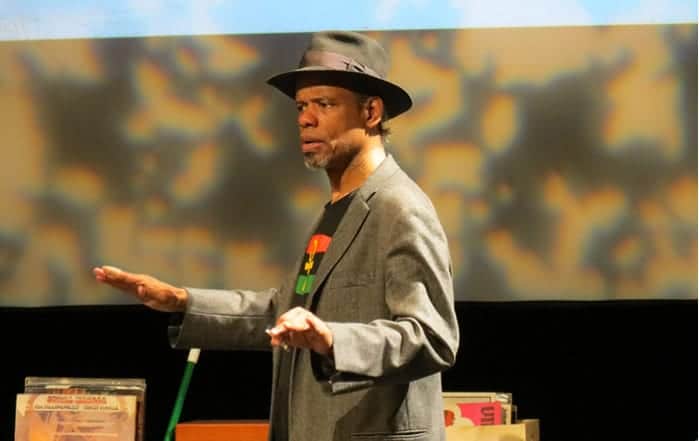
RS/24 is an ethereal drama about one long night in the life of Herbie, a record store owner (writer and director Clayton LeBouef, the veteran actor is best known for his performances in “Law and Order: Criminal Intent” and “HBO’s The Wire.”)

Audience members, drawn into the small black box theater of the Anacostia Playhouse by a soulful soundtrack, see the space transformed into a vinyl stocked vintage record store with a huge golden record centerstage.

At the start, the play jumps between the present, character memories and excerpts from epic dreams. Memories are presented in disjointed and transient ways that mirror the nonlinear happenings in dreamtime. The dream sequences provide some of the most beautiful and surreal scenes in the play.  Short video projections (Tewodross Melchishua Williams) and stylized choreography elicit an interesting illusory aesthetic. Red lights and the crisp sound of an mbira announce the presence of avant-garde jazz musician Sun Ra (Maurice McKinney) and two Arkestra angels (Vaunita Goodman/Larry E. Hull). The three beings are dressed in white. They pose in yogic postures, bow to each other and then address the audience, arms stretched outwards towards us as if welcoming us into the dream. “Words are like birds.” Sun Ra calls. “Words are like birds,” the angels reply. “Songs are like birds. They soar to higher heights” Sun Ra calls.

When John Coltrane’s beloved devotional “A Love Supreme” begins, Sun Ra and the angels disappear, replaced by projected video portraits of legendary deceased Black musicians, superimposed against a bright galaxy filled with a universe of stars. It becomes clear that LeBouef is drawing a connection between ancestral reverence traditions from the African Diaspora and his sacred appreciation for music.

Herbie, now alone in the record store, is unnerved by a dream he had a few hours earlier in which his store was visited by a celestial gathering of venerated musical ancestors including Sun Ra and members from his Arkestra. The musicians issue a directive that Herbie unearth a small box buried under a rose bush in his garden, bring it to his record store and keep the store open for 24 hours. Which is why Herbie is thereat 2am when he hears the loud bang of a gunshot from the alley.  

Shortly after, Melody (Kazi Jones) a lady of the night, walks in. At first she focuses on turning Herbie into her latest john, but eventually, and after being paid for her time, warms to Herbie’s company and the temporary haven from the streets he provides her. The lion’s share of the play focuses on their conversations that become more intimate throughout the night – shared recollections about music, Herbie’s dream and the mysterious contents in the box, and Melody’s disclosures about her life and profession. Jones and LeBouf are touching and relatable. The play gives them memorable one-liners from famous song lyrics. At times this inclusion is an endearing nod to great musicians, and in other moments it feels more like a forced cliché, but still largely engaging. On opening night, performers persevered through a few awkward missed sound and performance cues, but overall offered an entertaining work.

Nostalgic and magical, RS24 is a worthwhile play that explores the power of dreams, the wonder of great music and messages that transcend death.

————–

RS/24. Writer, director, actor Clayton LeBouef. Featuring Kazi Jones, Vaunita Goodman, Maurice McKinney, Larry E. Hull. Projection and Sound Design: Tewodross Melchishua Williams. Lighting Designer: John D. Alexander. Stage Manager: Kristina Jackson. Producer/co-director: Ella Davis and Cheryl Lewis Hawkins, All About the Drama Theatre Group, Prosperity Media Enterprise and The Zhanra Group . 

Breathe – a New Transformative Musical

by Angela Carroll

This article was first published in DC Theatre Scene

Breathe is a transformative work written and directed by Cleavon Meabon IV about the resilience of an African-American family trying to establish balance in the face of white violence. An announcer from TheARC stood before the sold out opening night crowd to offer a word of warning. “You will go through a range of emotions” he stated encouragingly. His warning was warranted. Expect to be uncomfortable. You may feel deep sadness. Rage. Joy. You may feel moved to clap along with classical spirituals and timeless blues.  You will not leave the theater the way you came in.  

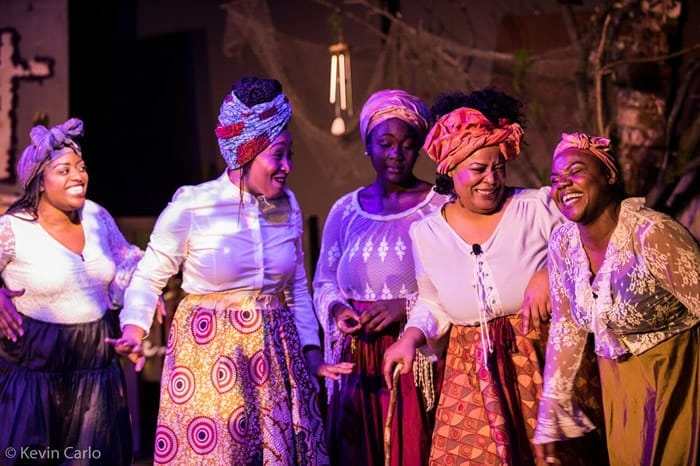
Original musical arrangements (Meabon/Jarrett Roseborough), dynamic choreography (Ebony Ingram), beautiful costuming (Tyson Evans/Belinda Ligon/Luqman Salim/Sankara Xasha Ture/Solfistafunk) and a stellar collective of vocalists illuminate narratives about the lives of the Jones’, a family of sharecroppers and their community; The Midwives, The Blues People, The Revival and The Dancers.  The Fruit, the tortured spirits of lynched men and women also share their stories and mark the transition of others who have been or will also be murdered.  Each group contributes troubling and transcendent choreo-poems, scenes and songs about living in a free Black settlement in the 19th century south.

The sound of syncopated breathing and the hum of a fog machine echo in the dark theater. The lights rise on a modest setting — wooden fences, baskets filled with flowers and tree branches draped with limp nooses. A chorus of melodic singing ascends from the exits and grows louder as the full cast moves through the audience toward the stage. The cast exits and Myra “Jean” Jones (Kayla Dixon) and the Midwives—Selma (Alexis Smith), Gertie (Brittany Turner), Erma (Lady Davonne), Cissy (Catrina Brenae) and Devorah (Corisa Myers), are left singing. Myra, shrouded in a long white dress that clings to her full pregnant belly, walks to the center of the stage and recites a powerful monologue.

The monologue imagines a confrontation she would have with her rapist slave owner, who she images may be the father of her unborn child.. “My foundations lie in them fields. Centuries of royalty raped out of my DNA” Myra laments.  Labor pains bring her out of the dream and into a birth room with the Midwives who sing for her to “Breathe.” Myra screams, “You invaded me…fix it! Fix me! I don’t belong to you.” Her husband Wilbur R. Jones, Sr. (Kofi) shocked and pained by the traumas his wife has suffered sits rocking in a corner with his knees clutched tightly to his chest. The performances of the cast in these scenes are exceptional and haunting.

The word “breathe” is repeatedly invoked by individuals and in chorus as a mantra, prayer and rally cry throughout the play. One immediately recalls Eric Garner’s last words—he uttered “I can’t breathe” eleven times through an illegal chokehold before he eventually died from the lack of oxygen to his brain. Meabon situates contemporary violence in relation to histories of violence that have literally and systemically suffocated black lives and livelihoods.

Breathe does not adhere to a strict linear storytelling style. Rather, the stories follow in the tradition of other notable nonlinear post-slavery chronicles like Toni Morrison’s Beloved, Julie Dash’s Daughters of the Dust, or Alvin Ailey’s Revelations that fluctuate between the contemporary world its protagonists inhabit and ethereal flashbacks.

The scene transitions from disturbing recollections by the Midwives and Myra about the days they were purchased on the auction block to an epic full cast church revival that overwhelms the stage with ecstatic dance and song. Meabon is strategic in his arrangement of narrative — every iteration of trauma is countered with exuberant examples of Black joy. The juxtaposition of innovative performance traditions with violent acts illustrates some of the brilliant mechanisms African-Americans have engaged to survive the recurrence of abhorrent violations.

The story eventually settles years later at the home of free Myra and Wilbur and their four children, Rayford Jones (Bryan Archibald), Marlyn “Jean” Jones (Nzingha Ashford), Rona “Jean” Jones (Courtney Harris), and Harold “Bud” Jones (CJ Harris). Rayford, the oldest son, puts on his best clothes to head out for a night on the town with his friends. He tells his family that he is headed to a juke joint to listen to blues, but he really intends to visit Madame Lovely’s, a speakeasy and whorehouse on the other side of town. The music transitions from spirituals to blues and wonderful dance sequences by The Blues People, Rayford and his friends, Madame Lovely (Dana Coleman), and her lingered girls. In the end, the narrative takes a tragic but expected turn.

Breathe is a poignant work that is heavy laden with outrageous cruelty, but if you can sit through the terrors, you will be greatly rewarded with a captivating production.

——————————

Breathe The Musical. Written & Directed by Cleavon Meabon, IV. Featuring: Kayla Dixon, Kofi, Bryan Archibald, Nzingha Ashford, Courtney Harris, CJ Harris, Alexis Smith, Brittany Turner, Lady Davonne, Brittany Caldwell, Catrina Brenae, Corisa Myers, Tiana Thomas, Harrison Walker, Thomas Shipp, Anthony Powell, Abram Smith, Latoya Lewis, Emilie Antonie, Shawnee Owens, Laura Nelson, Niko Gibbs, Lige Daniels, Tatyana Glannigan, Unknown, Dana Coleman, Jaleesa Sharp, Niko Gibbs, Harrison Walker, Anthony Powell, Barry Moton, Da’neisha Ligon, Tyra Jackson, Naila Brown, Carla Camargo, Lailah Horseford.  Assistant Director: Nathaniel Shelton. Musical Director: Cleavon Meabon, IV. Music Composer: Cleavon Meabon, IV. Music Arranger: Cleavon Meabon, IV, Jarrett Roseborough.  Music Producer: Robert Dixon, Jr. Choreographer: Ebony Ingram. Dane Captains: Jaleesa Sharp, Da’Neisha Ligon. Costuming: Tyson Evans, Belinda Ligon, Sankara Xasha Ture, Solfistafunk. Set Design: Tyson Evans, Darius Ligon.  Prod. Manager: Demetrius Cole. Sound Design: Demonte Cross. Light Design: Jourdan Holden. Marketing/Graphic Design: SoulFree Enterprises. Photography: Cleavisions. Creative Direction: Cleavon Meabon, IV. Support Staff: Kevin Thorne, II.  Associate Producers: Belinda Ligon, Chandra Gore, Alexis Smith, Shantelle Mosby. Produced by SoulFree Enterprises . Executive Producer: Tyson Evans .


Disgraced from Compass Rose Theater

by Angela Carroll

This article was first published in DC Theatre Scene

Ayad Akhtar’s Pulitzer Prize winning Disgraced is a thoughtful character study about American Muslim identity. Driven by casual conversations, the play reveals earnest and unsettling disclosures about the perceptions and misconceptions we all maintain and project about those with differing world views. Compass Rose Theater offers a fresh production with direction from James Bunzli at a temporary location in Annapolis, Maryland. 

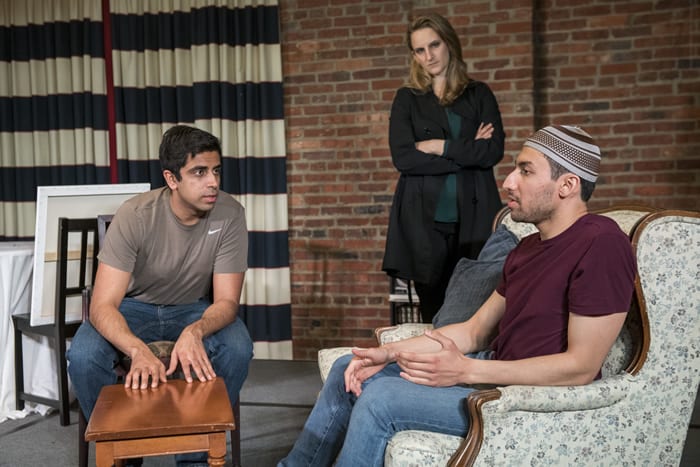
Disgraced takes place in the Upper East Side Manhattan apartment of married couple Amir, a successful Pakistani lawyer (Park Juneja) and Emily, white visual artist (Katie Wicklund). Audiences are immediately made aware of their divergent political and philosophical beliefs. Emily is deeply inspired by classical Islamic visual culture. “It’s time we stopped paying lip service to Islam and Islamic art. We draw on the Greeks and the Romans, but Islam is part of who we are too!” she explains. She appropriates Islamic art aesthetics to bolster her career as a contemporary artist. In contrast Amir, who allows people to think he is from India rather than Pakistan, is vehemently critical of anything associated with Islam, a religion he considers “backwards”.

Amir struggles to come to terms with his relationship to Islam and fears that it could destroy his American dream to assimilate, attain wealth and not be viewed as a terrorist. His nephew Abe (Joe Mucciolo) counters Amir’s perspective with a keen pride in Islamic culture and religion, but ironically prefers his newly adopted western name over the Pakistani one he was born with. Abe begs Amir to provide legal counsel to a local imam who is accused of aiding terrorists. Initially Amir adamantly refuses, but eventually agrees to attend the trial as a neutral observer. That decision proves disastrous for Amir’s professional and personal life.

Still reeling and dazed from events following the trial, Amir wearily agrees to cohost a dinner party Emily is throwing. In the hopes of solidifying the acquisition of her paintings, Emily invites mutual friends over for dinner: Isaac, a respected Jewish art dealer (Sam Midwood) and his wife Jory (Aunye’ Boone), an African American lawyer and colleague of Amir. The dialogue between Isaac and Amir is especially revealing– both men maintain problematic and inconsistent conceptions about the religion, culture and traditions of the other.

In that scene, one of the highlights of the production, Juneja and Milwood deliver passionate performances. Isaac asks Amir if he was happy about the September 11 attacks.  “Are you telling me you’ve never felt anything like that? An unexpected blush of pride?”, Amir asks. “Blush? No! I don’t feel anything like a blush.” Isaac retorts. “When you hear about Israel throwing its military weight around?” Amir comes back. Isaac, “I am critical of Israel. A lot of Jews are.” Amir, “And when you hear about Ahmadinejad going to the Mediterranean? How do you feel about that?” Isaac, “Outraged like anybody else.” Amir “Not everyone feels outraged.”

Compass Rose Theater presents a satisfying production of a timely work about America’s tenuous relationship to Islam. While the company transitions to a new venue, they are preforming in a space tucked inside the Power House Building adjacent to the Loews Hotel. It’s a little tricky to find. Arrive early to ensure a good seat.

—————

Disgraced by Ayad Akhtar. Director: James Bunzli. Featuring: Par Juneja, Katie Wicklund, Sam Midwood, Aunye’ Boone, Joe Mucciolo. Stage Manager: Caitlin Weller. Lighting Designer: Caitlin Weller. Production Supervisor/Properties: Mary Ruth Cowgill. Costume Designer: Katie Boothroyd. Produced by  Compass Rose Theater. 

The Intruders Takes on Gentrification in DC

by Angela Carroll

This article was first published on DC Theatre Scene

Hope Lynne Price-Lindsay’s The Intruders  is an entertaining satire about the contemporary wave of gentrification in DC that packs lots of laughs, but fails to do more than scratch the surface of a pressing issue. Directed by Vera J. Katz, and produced by The New Millennium Howard Players, The Intruders is one of over one hundred performances included in the 9th Annual INTERSECTIONS Festival. 

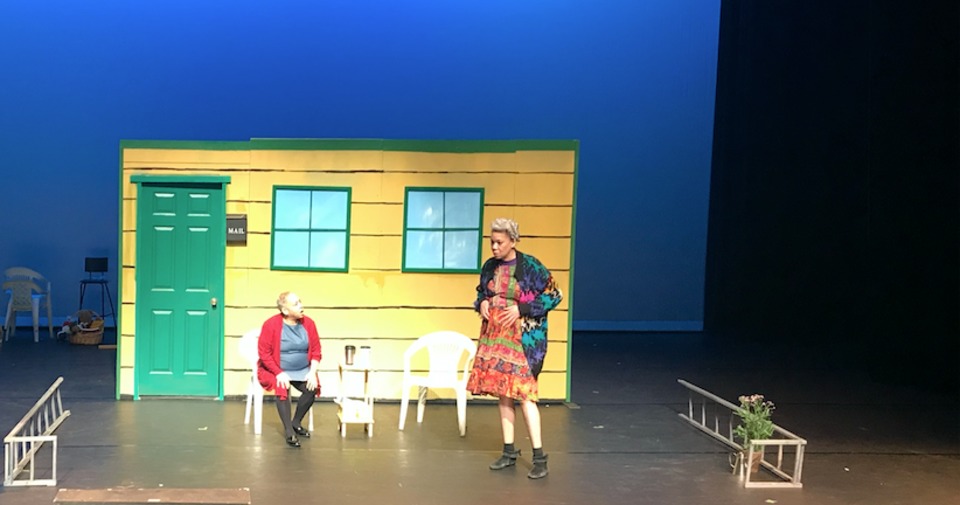
The Intruders centers on the observations of longtime DC residents, friends and Ella (Judy E. Leak), Avis (E. Dawn Samuel) and Ella’s professional adult children Jennifer (Farah Benkahla) and Elliot (Neko Ramos) about the influx of white wealthy couples purchasing homes in their community– who Avis calls “urban pioneers”. Their conversations occur on the front porch of Ella’s modest home — a yellow façade, gate, two patio chairs, and a small table.  “I used to know everybody on this block” Ella sighs, “now I’m a stranger in my own neighborhood.”

The family is skeptical about the changes the neighborhood is undergoing and angered by the emergence of a newsletter that details a long list of mandates issued by their new Block Association. One of their new neighbors, Zylinksi (Jim Epstein), leads the charge of the Block Association to prevent activities that he believes will depreciate the property values of their homes. He spends much of his time patrolling the community, looking into the windows of his neighbors, and making notes about the violations he finds.  Zylinksi is portrayed as well-meaning and annoyingly aloof about why Ella and other residents would be offended by the amenities that their new neighbors bring to the community.  “In colonial times they sent missionaries, but in contemporary America they build a Starbucks.” Elliot laments. This is especially amusing for anyone living in DC who has witnessed the influx of corporations that previously avoided predominant POC neighborhoods like the plague. Starbucks has functioned as a kind of white-flag, a sign that higher earning inhabitants are in the region. Who else would pay $6 for a cup of coffee?

The family is perplexed and amused by what they consider to be warning signs of gentrification; adults riding bicycles, white people with toy size dogs, and claw foot tubs among others. Elliot is especially critical of the changes.  His monologues in the play provide the primary historical context about gentrification– the disenfranchisement, inequitable housing, and racialized zoning policies minority populations living in D.C. have experienced. Unfortunately, Elliot’s assessments are presented as embittered rhetoric, rather than important examinations about the real-time effects of gentrification.

After a strong first act, the play meanders through a series of catch-phrase, knee jerk perspectives about gentrification that rarely go beyond surface assessments. The dialogues which occur between Zylinkski and Elliot are at times revelatory, but often fall into simplified polarizations– an angsty white liberal pit against an aggressive black man. In one tense exchange, Eliot confronts Zylinksi about the newsletter and the encroachment of urban pioneers into the neighborhood he has lived in his entire life. Though Eliot makes strong points, his volume and assertiveness frighten Zylinksi, who threatens to call the police. Other tensions between Zylinksi and members of Ella’s family are quickly, and too easily resolved.

The play concludes with a significant but expected tragedy that catalyzes an odd, unbelievable kumbaya sentimentality between Zylinksi on behalf of the Block Association, and Ella’s family. In many ways, the tragedy felt like a stand-in for a difficult dialogue. While these missteps do not take away from the overall great performances by cast members, especially Judy E. Leak and E. Dawn Samuel, it did seem like a missed opportunity to more thoroughly and creatively explore the phenomenon of gentrification in the District.

The Intruders had two performances, March 3 and 4, 2018 at the Atlas Performing Arts Center.

——————–

The Intruders by Hope Lynne Price-Lindsay. Director: Vera J. Katz. Featuring: Judy E. Leak, E. Dawn Samuel, Jim Epstein, Neko Ramos, Martece Caudle, Todd Leatherbury, Farah Benkahla. Understudy: James Curtis Bowers. Set Designer: Greg Jackson. Stage Manager: Antoinette Fisher-Green. Technical Director: India Soodoo.  Produced by The New Millennium Howard Players.