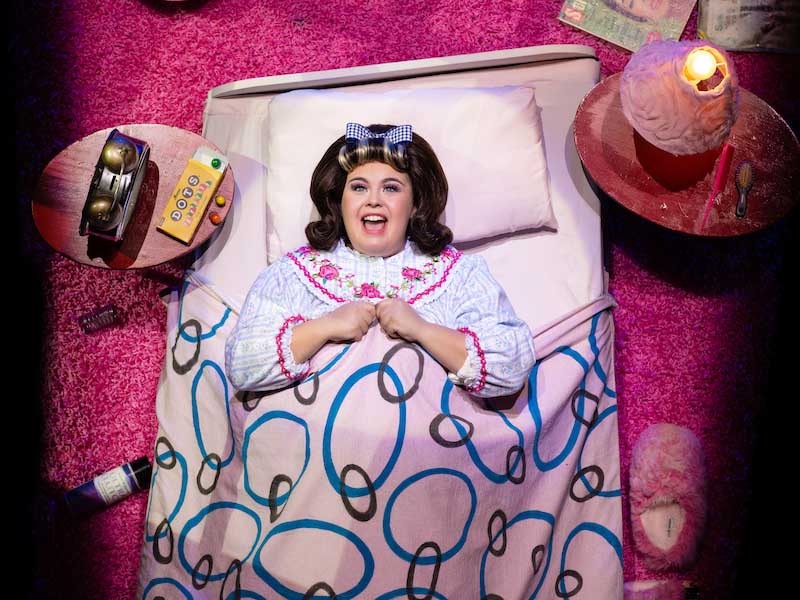
A stellar ‘Hairspray’ on tour at the National can’t stop the beat

by Michael Sainte-Andress

This article was first published in DC Theater Arts here.

This Hairspray was the third go-around for me! I saw the show first on Broadway, with R&B star Tevin Campbell as Seaweed, then at Kennedy Center, and last night at the National.

Each time I was thoroughly entertained, and each time it felt fresh and inspiring. So I was trying to come up with a word that truly expresses my affection for this show and it is rousing!

Because of technical difficulties, there was a 30-minute delay before the curtain, which seemed like an eternity. But the wait was well worth it. The energy and exuberance were front and center and remained throughout the show. You would think my familiarity with the show would render it without the surprises one hopes for in musical theater. However, this performance gave tremendous witness to what talent, expertise, imagination, and highly skilled technical production values can do to “an old chestnut.”

Let’s start with the casting: the lead role of Tracy Turnblad, the plump and cruelly maligned teenager who just wants to be on a local TV dance show was portrayed by Faith Northcutt, the understudy. Seeing her it was hard to imagine how much better the original lead, Niki Metcalf, could possibly be. From Northcutt’s initial appearance getting out of bed and singing “Good Morning Baltimore,” she draws you in with her vocal clarity and melodic playfulness (much like you would expect of a 16-year-old). In the script, Tracy’s physicality brings her scorn and criticism from her peers, showing how senseless and cruel body shaming can be. But the vulnerability Northcutt conveys really underlies her true strength of character. Brava!

The second standout performance is the role of Tracy’s mother, Edna, a more mature version of her daughter. This role was originated by the inimitable Harvey Fierstein, and his brilliance designated drag casting for all future productions. Edna is portrayed by Andrew Levitt, a standout of Season 11 of RuPaul’s Drag Race. His comic sensibility and physical adroitness (for a 6-foot-4-inch man in women’s clothes) are a joy to behold, and the interplay between him and Tracy as well as with Edna’s husband, Wilbur (Christopher Swan), is a touching portrait of familial love, support, and understanding. Wow!

Then there is Motormouth Maybelle (Sandie Lee), a proud, middle-aged Black mother who hosts a dance show for Black teenagers but who is also a proud and stalwart crusader for racial equality in her community. She is authoritative, without being domineering, and is a woman who has learned the hard lessons of racial discrimination. She brings it out forcefully in her beautifully rendered “I Know Where I’ve Been,” a song that gives the show a stirring moment of insight and poignance not generally expected in musicals. Kudos!

Finally, this company of performers is all accomplished as singers, dancers, and definitely actors, and their ensemble enactments are a director’s satisfaction and an audience’s joy. The technical support is equally outstanding. The direction of Matt Lenz, the choreography of Michelle Lynch, the costumes by William Ivey Long, the scenic design by David Rockwell, the wigs and hair design by Paul Huntley and Richard Mawbey, the lighting design by Paul Miller, and the sound design by Shannon Slaton are all top-notch and make the telling of this timeless story all the more believable and meaningful.

It all ends with a celebratory, spirited, and jubilant rendition of “You Can’t Stop the Beat!” Yeah, rousing is just the right word for this stellar production.

Running Time: Approximately two hours 30 minutes, including one intermission.

Hairspray plays through May 15, 2022, on tour at the National Theatre, 1321 Pennsylvania Avenue NW, Washington DC. Evening performances each day are at 7:30 pm. Matinee performances on Saturday and Sunday, May 14 and 15, are at 2 pm. Tickets (starting at $50) are available online.
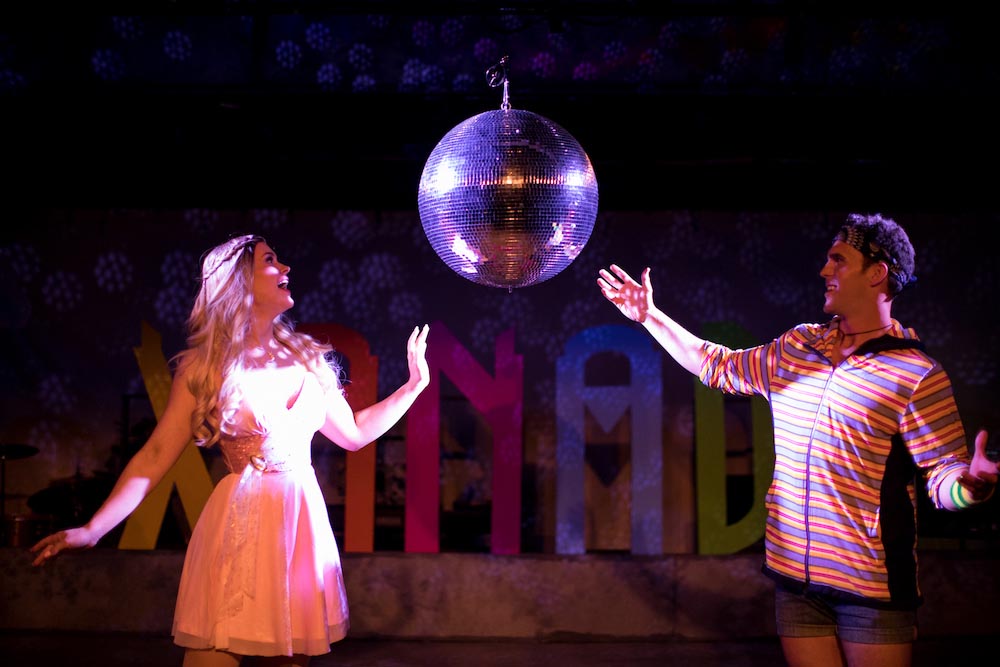
Campy and heartwarming ‘Xanadu’ sparkles at Workhouse Arts Center

By Ajani Jones

This article was first published in DC Theater Arts here.

Campy in the best way possible, Xanadu is a goofy and lighthearted yet strangely heartwarming tale that pushes the boundaries of how much an audience is willing to suspend disbelief amidst bursts of laughter.

Xanadu, a Tony-nominated musical based on the 1980 film of the same name, delivers an inspiring story wrapped in a fantasy romance adventure. Workhouse Arts Center’s take on the show, directed and choreographed by Stefan Sittig, captures its whimsy and gut-busting comedy.

Xanadu follows the Greek muse Clio (Jessica Barraclough) as she travels to Earth disguised as the Australian Kira to help struggling artist Sonny (Pat Mahoney) overcome his creative block and achieve his dreams. Hijinks, both mortal and divine, ensue as the pair grow closer, ultimately learning the value of chasing one’s dreams despite potential obstacles.

The cast delivered magnetic performances. Each of the nine muses was bursting with personality. While Barraclough definitely embraced her role as head-muse–turned–girl–from–“down-under,” moving with grace and charming with her sweet and melodic voice, her sisters were equally up to the task of portraying their divine characters, filling the stage with near godly charisma every time they entered a scene.

Melpomene (Jolene Vettese) and Calliope (Audrey Baker), Kira’s scheming muse sisters, stood out throughout. Calling back to the Greek myths their characters are drawn from, Vettese and Baker portrayed the wicked muses with an air of villainous grandiosity. As they pranced and sashayed across the stage, cackling and delivering every line with charisma and malice, the two worked together to sell the entertaining over-the-top villainy of their characters, enhancing the overall humor of the show.

Every minute of Xanadu was a pleasure to watch, delivering the show’s heartwarming story and inspirational themes with welcome humor and cheer. From visual gags and clever puns to eccentric mannerisms and fourth-wall breaks, almost every scene leaves the audience nearly doubled over in laughter.

Through its hilarity, Xanadu maintained a surprisingly heartwarming tone, a welcome element attributable to its wonderful cast and the sheer chemistry they had with one another. From Melpomene and Calliope’s delightfully villainous antics to the budding relationship between Kira and Sonny, the cast painted each scene with believable charm and cheer.

The songs of Xanadu also worked perfectly as the cast delivered vocally captivating performances. The musical elements of the show, directed by Merissa Martignoni Driscoll, were thematic, enhancing each scene with lively riffs and melodic chords while supplementing the characterization of the show’s star players.

“Evil Woman,” Melpomene and Calliope’s primary villain song, showed off the cast’s vocal prowess as Vettese hit impressive notes amidst Baker’s hilarious (yet just as impressive) adlibs and riffs. “Suddenly” was equally captivating as Barraclough and Mahoney wowed the audience with their sweet harmonies and conveyed their characters’ growing connection to one another.

The choreography in Xanadu was energetic and thrilling, pairing perfectly with the music. Sittig’s choreography was especially mesmerizing when the muses danced in unison, all while managing to maintain their individual quirks in every movement. The cast gracefully glided across the stage, often literally as Barraclough and Mahoney spent much of the show in rollerskates.

Tying the choreography, vocals, and portrayals together were the show’s wonderful costumes. Almost the entire cast acted as background dancers and scene fillers whenever their primary character was not needed, each time sporting sparkly and timely costumes. The dresses the muses wore were especially captivating as each muse wore a Grecian gown in a different color and cut to match her personality.

Overall, Xanadu was incredibly entertaining and a worthwhile watch. Filled to the brim with charisma and humor, the show boasts a well of creativity and charm that is sure to impress its audience, leaving them nostalgic for the ’80s and hoping for their own divine strange magic.

Running Time: 90 minutes with no intermission.

Xanadu runs through June 11, 2022, at Workhouse Arts Center—W-3 Theater 9518 Workhouse Way, Lorton, VA, 22079. Tickets ($20–$30) can be purchased online.

The Xanadu program is online here.

GenOUT ‘Youth Invasion’ concert raised up LGBTQI+ teens

By Michael Sainte-Andress

This article was first published in DC Theater Arts here.

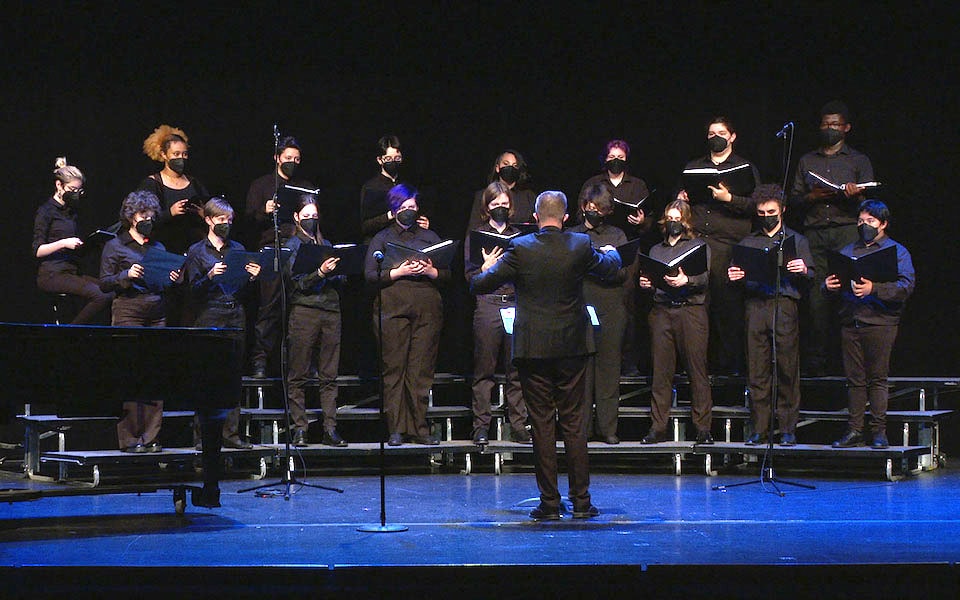
When I reviewed the Gay Men’s Chorus of Washington’s concert Brand New Day in mid-March at the Lincoln Theatre, I extolled its virtue of showcasing inclusivity and equality with its wonderful renditions of songs on the subject. In that concert, each of GMCW’s five components performed, and I was introduced to GenOUT Youth Chorus, its outreach ensemble of LGBTQI+ and allied 13- to 18-year-olds.

Well, this time around the spotlight was squarely on GenOUT’s concert Youth Invasion, which I attended at THEARC. The program also featured the Mosaic Harmony community choir, a seniors group committed to “empower choirs to fully entertain, inspire and engage audiences by both moving music and uplifting messages.”

The concept of supporting youth — who are coping with not just being young but also the pressure of understanding their sexual orientation and coming to grips with self-acceptance — is a powerful mission of the GMCW. Achieving that goal through music is liberating and inspirational and lends itself to providing these young people with a means to gird themselves with pride, self-understanding, and a profound sense of worth..

C. Paul Heins, GenOUT’s director, provides the training and artistic inspiration for these young people to flourish and, through artistic expression, develop confidence and self-affirmation that will enable them to better face the challenges that will come before them.

With this in mind, I imagined a repertoire that would be evocative, celebratory, and, yes, rousing. The program selections were certainly appropriate and hit the mark in terms of intent and appropriateness but tended to be more somber and reflective. All of the songs — “Build Me a World,” “Reflection” (from the animated film Mulan), “Imagine” (based on the poem by long-time LGBTQI+ activist Donna Red Wing), “Write My Own ‘Story,” “The Human Heart” (from the musical Once on This Island), “How Could Anyone?,” “I Was Here (Beyonce), and “You Are the New “Day” — beautifully conveyed the hopes, dreams, aspirations, and reflections of these young people. The one song that could have surely been a showstopper, “Corner of the Sky” (from the musical Pippin), was only quietly delivered. Near the end, GenOUT performed with Mosaic Harmony in a straightforward rendition of “Lift Every Voice and Sing” (the Negro national anthem).

Ironically, it was the guest group, Mosaic Harmony, that got things shaking. Under the foot-stomping, hand-clapping, roof-raising direction of Rev. David North, Mosaic Harmony’s performance became a glorious celebration with spirited versions of the gospel songs “Love in Any Language,” Hezekiah Walker’s “Better,” and “One World.” Rev. North said that he wanted to bring a “new flavor” to the gospel staple “Soon I Will Be Done,” made popular in the 1959 movie Imitation of Life sung by the great Mahalia Jackson. Man, did he deliver! He infused this deeply spiritual anthem with jazzy inflections and uptempo flourishes that had the audience clapping and rejoicing with abandon. (Mahalia wouldn’t want to hear it anymore!) This closing number was just the right touch that the whole affair should have reflected.

That it was shared with this wonderful, young, and talented group I am sure will make it an experience and lesson learned that they will never forget. This was a great example of how reaching across needless barriers and constrictions can bring about tremendous connection and mutual appreciation. It was an afternoon I would gladly spend over again.Youth Invasion was performed by the GenOUT Youth Chorus with special guest Mosaic Harmony on April 23, 2022, at THEARC Theater, 1901 Mississippi Avenue SE, Washington, DC, and on April 24, 2022, in the Auditorium at MLK Library, 901 G Street NW, Washington, DC.

Plain(tive) Text

By Mercedes Hesselroth

This article was first published in Washington Independent Review of Books here. This article was produced within the New Book Critics project, a part of Day Eight’s 2022 Crisis in Book Review conference.

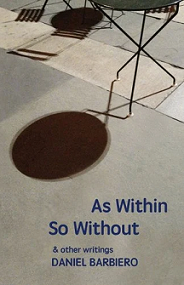
Double bassist Daniel Barbiero has spent decades thinking and writing about the interaction between music and other artforms and the places in which these cross-sections of time, space, and sound collide. His recently published essay collection, As Within So Without: & Other Writings, covers a wide-ranging slate of art-related topics, including Surrealism, poetry, dance, the nature of musical improvisation, and the meaning of meaning itself (or lack thereof).

The majority of these 20 essays first appeared in the art and literary journal Arteidolia, which also owns the press that published As Within So Without. Consequently, Barbiero’s book is not for the uninitiated. Art-history novices, for instance, shouldn’t expect much orientation in the chapter “Is Silence Golden?” when Barbiero weighs in on a century-old debate between Surrealists and musicians surrounding the limits of musical expression compared to other artforms.

Readers meeting key players like Andre Breton and Giorgio de Chirico for the first time might be lost for most of this chapter — and the rest of the book. And if you’d never seen an asemic text prior to picking up As Within So Without, the chapter “Writing Pushed Beyond Writing” won’t necessarily give you the tools to envision one of these written images.

Part of the problem lies in the form in which this essay appears in print. The original online version of “Writing Pushed Beyond Writing” begins with artist Cy Twombly’s asemic piece Cold Stream (1966). For a highly intertextual book so focused on comparative art, visual systems of writing and notation, and spatial division, the exclusion of the pieces discussed from As Within So Without results in most of these unrevised essays appearing without full context.

In the chapter “Dancing with the Hands,” Barbiero implores readers to “look again at the dancer’s hands as they pick up an object,” but the photograph of two dancers frozen in motion as they lean over an array of fossils featured in the Arteidolia version of the piece is nowhere to be found. Neither are there any additional written descriptions to make up for the missing visual reference.

The lack of visual material also leaves readers at the mercy of Barbiero’s interpretations of the works with no room for additional input or disagreement. To wit: In “The Angel of Contingency,” he describes the creature of Angelus Novus (1920) by Paul Klee as “a blocky physique facing us with a bland expression.” To me, the angel’s bared teeth and lowered eyes appear anything but bland, and I’m reminded of a crude version of Leonardo da Vinci’s Vitruvian Man (1490).

Such is the varying and unique experience of art Barbiero himself talks about in several observations on “idiolectic” theory — the idea that language holds different associations and references for everyone — throughout the book. But readers without access to the central pieces referenced in his essays miss the opportunity to apply the theories while reading. The book also contains numerous typos, awkward spacings, and misspelled words that, oddly, don’t always appear in the original online essays.

Further, there are multiple points where Barbiero’s writing extends too far into the abstract. In the titular essay of the collection, “As Within So Without: The Painter as Clairvoyant,” he writes that “the occasions and locations associated with travel — by train or any other means — naturally continue to elicit powerful emotions,” but neglects to define what these emotions are, ambiguously stating that they are “scenes of deep emotional meaning” with “specific emotional meanings” cast “in a certain emotional light.”

In “On Russell Atkins’ Poetics of Objectified Mind,” Barbiero discusses “Atkins’ signature gesture of substituting an apostrophe for the omitted ‘e’ before the ‘d’ at the end of a past-tense verb [in] order to conflate its functions as an adjective and verb,” but this passage never showcases a sentence from Atkins that would demonstrate his intended grammatical effect.

The strongest parts of As Within So Without are the essays about music and dance, especially the artistry and experience of improvising music live. One can imagine these essays fitting neatly into an undergraduate conservatory curriculum, young musicians ruminating on the sonic landscapes they shape and the temporal spaces they occupy while performing.

But for the layman who wants to dive into one of Barbiero’s many areas of artistic expertise, these writings are best enjoyed in their original multimedia home on the Internet and not as the plain, unadapted text in this book.

Between loneliness, capitalism and immigration, ‘Against the Wall’ has a lot to say about life

By Clare Mulroy

 This article was first published in The DC Line here.

“Whoever says you can’t live in two places at the same time is dead wrong” is my favorite line in Alberto Roblest’s recently published book of short stories, Against the Wall. Capitalizing on themes of loneliness, power and self-discovery, Roblest delivers a collection that masterfully comments on the human condition.

Translated from Spanish, Roblest’s prose brings readers through a variety of first-person and third-person accounts of human life. While many of the characters in Against the Wall are not tasked with anything particularly remarkable, even a journey like moving a mattress to a new home or going to a casino provides a vehicle for social commentary.

Roblest, a local author and founder of Hola Cultura, has a lot to say about the crumbling myth of the American dream and the overwhelming disappointment of mainstream politics. In one notable story, “Blackened Obelisk,” the Washington Monument becomes encased in roaches. The nation panics. White House officials and strategists propose blowing up the monument and rebuilding it to profit off of the tourism and sponsorship it’ll attract. You would’ve thought filmmaker Adam McKay himself took inspiration from this short story for his December release Don’t Look Up. 

But there are more subtle conversations about national identity and capitalism throughout the book. Immigration is an undercurrent in almost all of Roblest’s short stories, showing how natural-born citizens often treat immigrants as if they’re disposable, even though they are the backbone of this country’s labor and production. Even when immigration doesn’t seem at the forefront of a particular story, there is a throughline of expedition and feeling lost in all of his work. 

The magic of Against the Wall is that each story builds on the previous one to create a sort of time-capsule memory — by the time you get to the latter half of the collection, each new story with new characters feels charmingly familiar. Sometimes it feels like we already know the character after just a few paragraphs, and often it’s painful to leave a character and move onto the next story so soon.

The book’s weakness is the jarring way it sometimes toggles between realistic fiction and mystical storytelling. In one story a man moving with his family reflects on political scandal and class differences, and in the next a female monster chases a man through a maze of garbage and starving children. Just as you feel you’ve grasped the essence of Roblest’s writing style, he pivots, sometimes leaving you puzzled.

Still, it’s captivating enough to slip into these stories. “Lost and Found” sees a man waking up trapped in a bus terminal, unsure how he got there. As he searches for his luggage, the tale becomes more intense with each step. Reading the story felt like waking up from a puzzling dream, sitting in bed trying to interpret what it is my brain is telling me. “Cat Life” features a character who is led to out-of-body experiences through the felines that live in the house where he rents a room. Stories like this are sometimes so abstract it’s hard to pull yourself back down to earth, but at least spending so much time in the clouds makes you think.

Roblest’s storytelling gives the feeling of gathering bits and pieces of a puzzle until, in the last paragraph of each story, you are finally able to push back your chair and see the entire masterpiece. Roblest skillfully buries messages just below the surface; lessons about immigration, capitalism and the passage of time masquerade as everyday human interactions.

In the collection’s last story, “The Apparently Abandoned God-Forsaken City,” the narrator speaks candidly to the reader: “Whenever I get scared, I grab my balls.” While the detail is a slightly graphic one, the paragraph ends with a beautiful tribute to the human body and the connection between our soul and physical being. 

“Holding onto myself, I face the world and proceed.”

This last story rounds out the entire book, which is filled with people setting out on journeys — either metaphorical or real. In these varied stories, Roblest comments on living in the present while looking toward the future, on being in New York City and on the contributions of immigrants to this country. And though the stories’ connections aren’t always obvious, readers can see humanity of all shapes, sizes and colors at the forefront of the book’s most important themes — destruction, growth, change and time. I am not an immigrant and have not experienced the attendant discrimination and xenophobia, but the skill of their portrayal nonetheless allows me to feel a personal connection to the characters. Roblest marries narratives that might not be recognizable to every reader with human experiences that all of us share.

In the last section of the final short story, Roblest seems to break the fourth wall, telling us, “So I’m finally here … telling you my life story.” And while it may just be the voice of another character, I can’t help but think that maybe Roblest has lived a thousand other lives before.

Against the Wall: Stories by Alberto Roblest and translated by Nicolás Kanellos (134 pages, $18.95) was published in September 2021 by Arte Público Press.

This article was produced in conjunction with Day Eight’s February 2022 conference on “The Crisis in Book Review.” The DC Line worked with conference organizers on the New Book Reviewer Project, an initiative to grow the cohort of qualified local book reviewers. Clare Mulroy is one of eight writers assigned as part of the conference to write a review for The DC Line or the Washington Independent Review of Books.

An Ode to Joy (and Pain)

By Edgar Farr Russell III

This article was first published in Washington Independent Review of Books here. This article was created within a New Book Critics project and within Day Eight’s 2022 “The Crisis in Book Review” conference.

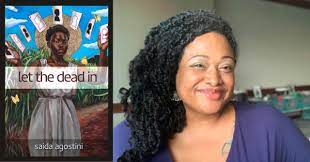
For those compelled to ponder how the past molds the experiences of the present, the powerful language of Saida Agostini’s first full-length collection of poetry, let the dead in, not only offers the opportunity to see and hear people’s interactions in her world, but to smell, taste, and feel their joy and pain. Readers unfamiliar with this sphere will likely find Agostini’s words and imagery resonating within themselves — recalling their own experiences and emotions.

The collection, a finalist for the 2020 New Issues Poetry Prize and the Center for African American Arts & Poetics Poetry Prize, is divided into three parts: “notes on archiving erasure,” “we find the fantastic,” and “american love.” The first begins the story in Guyana, where past generations tell their stories of young love at first sight, of brutal treatment of women at the hands of men — whether husbands or lovers — and of children hungry and wailing for their absent daddies.

We also experience the environment where these people live and work and suffer — such as the sugarcane fields where they toil, the rivers of “dark cool moving waters,” and the homes where the families exist — with or without love.

But, most of all, this section introduces us to the power of women — full of passionate love or jealousy; suffering but surviving — role models to be emulated or not. The author also affords us an initial look at the fantastical world of spirits and demons, such as the Jumbees. The general belief is that a person who has been evil in life will remain evil in death and continue to exert his or her power over the living.

The second part further introduces readers to the creatures of this world, including the ole higue, a myth created by Dutch enslavers in Guyana of a hunchbacked old woman “said to depart her skin at night and beguile young women into killing their families.” Ironically, such spirits provide an emotional outlet for women betrayed or abandoned by their men. Others, such as the moongazer — a bloodthirsty monster created to stop slaves from stealing sugarcane from the fields after dark — inspired Agostini to transform this horrific mythology into a glorious dream of being reunited with a deceased lover:

“…what I have done

to find my darling; look at her

crowned by nothing but the stars

in this bowl of sky. Her dark hands lifted

soft and warm, my gaze

a patient delight. Look at her

there beyond the moon…”

Also in this section is a sequence of six poems introducing us to a man who may serve as a symbol for many men in this culture. He is known as chickenfoot, “all sinew and black amble.” He offers romantic passion to women but will cause them great heartbreak. Chickenfoot also loves his granny and weeps for a man he adores and can never touch. In his macho environment, such feelings cannot be tolerated. Here, Agostini demonstrates that pain is often a universal constant for children, women, and men.

The third part of the collection features the ironic title “american love,” for here we are reminded of past and present examples of Black men and women who have been killed by police, used or abused by those with greater power, or convicted of killing their abusers. Agostini’s poems in this section cover multiple locations and span decades, even centuries.

Some of the names — Freddie Gray or Eric Garner — may be familiar. Others, such as Recy Taylor, hark back to 1944. In “Bresha Meadows Speaks on Divinity,” Agostini offers these words on the resilience of children beaten by their parents: “god is a black girl in love with living, a sacrament on how to be disbelieved, forgotten and rise a thousand times over.”

While her poems appear to be about one subject, Agostini often uses them to express an entirely different emotion. She writes “whoever died from a rough ride” as a gentle meditation for her love of Baltimore in all its complexities — her memory of the feel of her mother parting her hair on Sunday with a purple fine-toothed comb; to a stranger seeing Agostini weeping and placing his hand on her shoulder to express concern for her welfare; to viewing the falling houses behind her, whose bones chant, “we won’t leave we won’t leave.” 

At the same time, some of the brutal experiences she has endured recur in multiple poems. Agostini finds grace, however, in the collection’s penultimate poem, “who we are human to,” as demonstrated by her closing words:

“we are nothing if not houses to each other that can hold

all sorts of brutal tender memory, make rooms of flesh

and light where we bear witness to the most horrible

rock each other in our arms and whisper yes yes 

I know”

Readers willing to journey with Saida Agostini will find their path full of conflicting emotions and painful choices which must be made. In return, the reward offered is one of richer insight and greater empathy for those whose lives she has illuminated.

Edgar Farr Russell III is a fine artist, writer, director, and performer. His art was selected for the Joslyn Art Museum’s Biennial XX. His plays have been produced for NPR, the stage, and television. Russell produced and reconstructed the lost 1938 Orson Welles’ Mercury Theatre On the Air production of Julius Caesar. This new presentation featured members of Welles’ original Broadway cast. Russell has performed at the Library of Congress and the Kennedy Center. A lifelong enthusiast of Abraham Lincoln, he served as president of the Lincoln Group of DC, as well as president of the Washington, DC, chapter of the National Society of Arts and Letters. His most recent poem was published in November as part of the anthology We Were Not Alone, which features a foreword by singer/songwriter Jewel.

GMCW’s inspirational ‘Brand New Day’ sings of equality and inclusivity

By Michael Sainte-Andress

This article was first published in DC Theater Arts here.

What to do on a cold, overcast, snowy Saturday afternoon? Well, I had the good fortune of having a ticket to the Gay Men’s Chorus of Washington Brand New Day concert at the Lincoln Theatre.

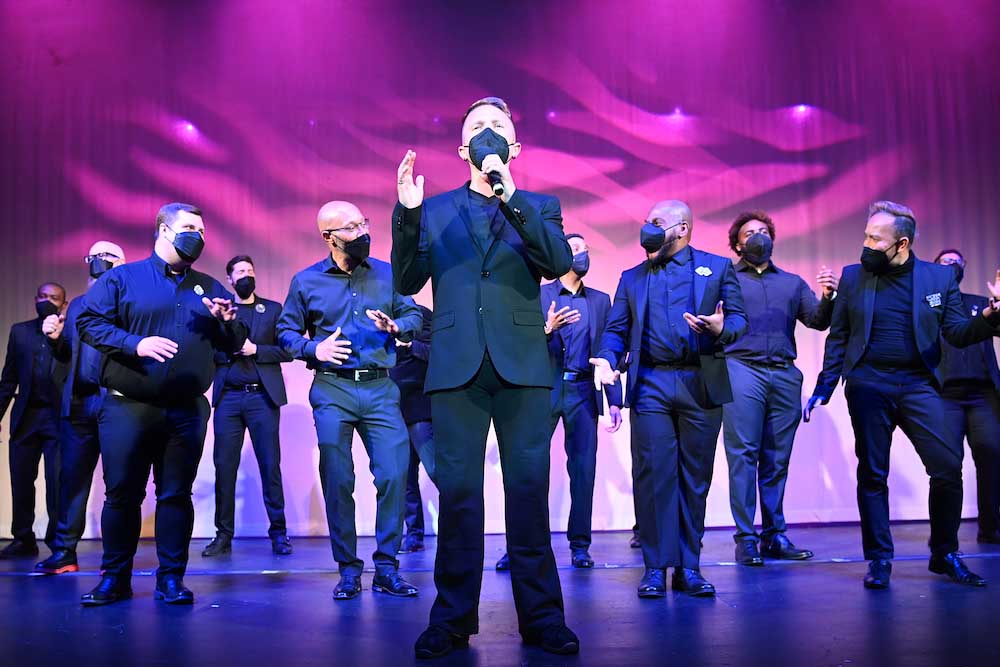
GMCW has been a cultural fixture in Washington, DC, for over 40 years and is one of the oldest and largest LGBT choral organizations in the United States, with over 300 members. It has a history of entertaining performances and has a large multidimensional following. I have enjoyed many of those past shows.

Brand New Day has moved the group a step up the ladder of socially conscious, inspirational, and diversity-focused quality entertainment. The GMCW ensembles (Potomac Fever, Rock Creek Singers, Seasons of Love, 17th Street Dance, and the GenOUT Youth Chorus) delivered a program that from beginning to end was razor-focused on the issue of inclusivity, equality, and the basic idea of recognizing the worth of all human beings in their infinite variety.

The songs and musical numbers were a delightful potpourri from different genres: Paul Negron singing “Human Heart,” the theme song from the Caribbean musical Once on This Island, about enduring and persevering life’s hardships; “We Are,” lushly underscoring the text of Maya Angelou’s poem “Human Family” (“We are more alike, my friends, than we are unalike”); soloists Matt Holland and Cooper Westbrook’ rendition of, “Perfect/Just the Way You Are”; Native American Linthicum Blackhorse’s arrangement of a traditional Lakota Sioux American Indian spiritual; the rendering of a Korean folk song, “Arirang,” about finding one’s way; and the Spanish folk song “Luz y Sombra,” about appreciating the simple things in life. Arresting arrangements of classics like “Through the Fire,” ” Bridge Over Troubled Water,” and “Purple Rain” were newly imagined and invigorating.

The finale was a rip-roaring, Las Vegas–style choreographic sequence from the movie The Wiz, after which the concert was named: “A Brand New Day (Everybody Rejoice).” Magical and thoroughly entertaining, it was a great way to convey the idea of living in a world free of bigotry, hatred, and lack of understanding.

This was an afternoon well spent, and the joy of it swept the dreary day away.

Running Time: Approximately 75 minutes with no intermission.

Brand New Day was presented by the Gay Men’s Chorus of Washington, DC, on Saturday, March 12, 2022, at the Lincoln Theatre – 1215 U Street, in Washington, DC. For future GMCW concerts and events go to their website.

The program for Brand New Day is available online here.