Poly-Theist at Charm City Fringe

By Mercedes Hesselroth

This article was first published in DC Theatre Scene here.

Theatre and religion have been intertwined since the beginning – the very, very beginning. One of the earliest forms of theatre developed in Ancient Athens with public festivals of music, poetry, and dance held to honor the Greek god Dionysus. Religion has also long served as inspiration for artists’ expression, from Leonardo da Vinci’s painting The Last Supper to Kanye West’s recent Sunday Service concert series. Faith makes for a rich topic of artistic inquiry as it is both highly individual and dependent on communities in order to survive. The tension between personal systems of belief and the public presentation of these beliefs can cycle from pushing faith forward to holding it back.

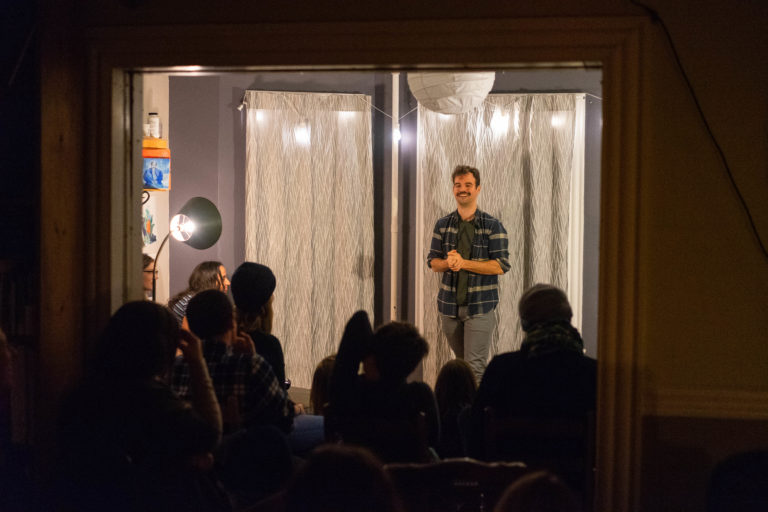
Boston-based comedian Brett Johnson adds his own contribution to this swirling dichotomy with Poly-Theist, a reverse testimony of sorts sharing the cascading series of events that led him to walk away from his faith, his monogamy, and his marriage. Johnson joins a roster of other writer-performers exploring their religious backgrounds through humor, such as Kevin James Doyle with his live show 30-Year-Old Virgin, Pete Holmes’ with his TV series Crashing, or Kumail Nanjiani with his film The Big Sick, which struck enough of a chord with Oscar voters to land a nomination for Best Original Screenplay. Not quite a stand-up special or one-man-show, Poly-Theist hovers closer to the kind of oral storytelling you might hear at a Moth open mic.

Johnson’s story starts like any standard rom-com. He meets his college sweetheart, Audrey, on campus and their relationship progresses quickly. At 21 years old, Johnson and Audrey marry within a month of his college graduation, not at all an uncommon experience at “ring by spring” schools – religious colleges where couples often get engaged before the end of their senior year. After a few years of marriage, they decide to open their relationship after agreeing they both want to see other people but not break up.

Relationships can be complicated enough between two people, so it stands to reason that the potential difficulty compounds with every new person added to the web of romantic attachments. The tale requires a massive amount of vulnerability to impart, which Johnson pairs with a heavy dose of self-deprecation. Bringing a nervous energy to the stage, he jokes he could pass as a “bisexual Luigi,” referring to the Nintendo character often overshadowed by his more famous brother, Mario. Johnson doesn’t lecture or judge the audience for its beliefs or choices, opting to judge himself instead. He recalls how he was unable to turn Audrey down when she wanted her boyfriend to spend the night at their house, making a joke rather than voicing how he really felt.

The show itself mirrors that impulse by tagging each tough moment or observation with another one-liner. While the balance of levity and gravity is a tricky line to walk, the piece succeeds most when it leans away from the mask of comedy and honors the inherent magnitude of the situation. Poly-Theist benefits from the moments when Johnson allows the story to breathe by giving the audience a broader context to latch onto. As shown by the inspirational figures in many a religious parable, sometimes you have to go through trials to come out stronger on the other side.
My Barking Dog: What happens when a coyote shows up with a message

By Mercedes Hesselroth

This article was first published in DC Theatre Scene here.

In 2017, the American Psychological Association acknowledged the existence of a new psychological disorder: eco-anxiety. The disease can cause a spectrum of despair in response to the effects of climate change, including substance abuse, anxiety, depression, and chronic stress and fear. However, some psychologists do not classify eco-anxiety as a mental illness, despite many overlapping symptoms, because they believe the underlying cause is “rational.” As Swedish teenager and environmental activist Greta Thunberg said at the 2018 United Nations Climate Change Conference: “Until you start focusing on what needs to be done rather than what is politically possible, there is no hope. We cannot solve the crisis without treating it as a crisis.”

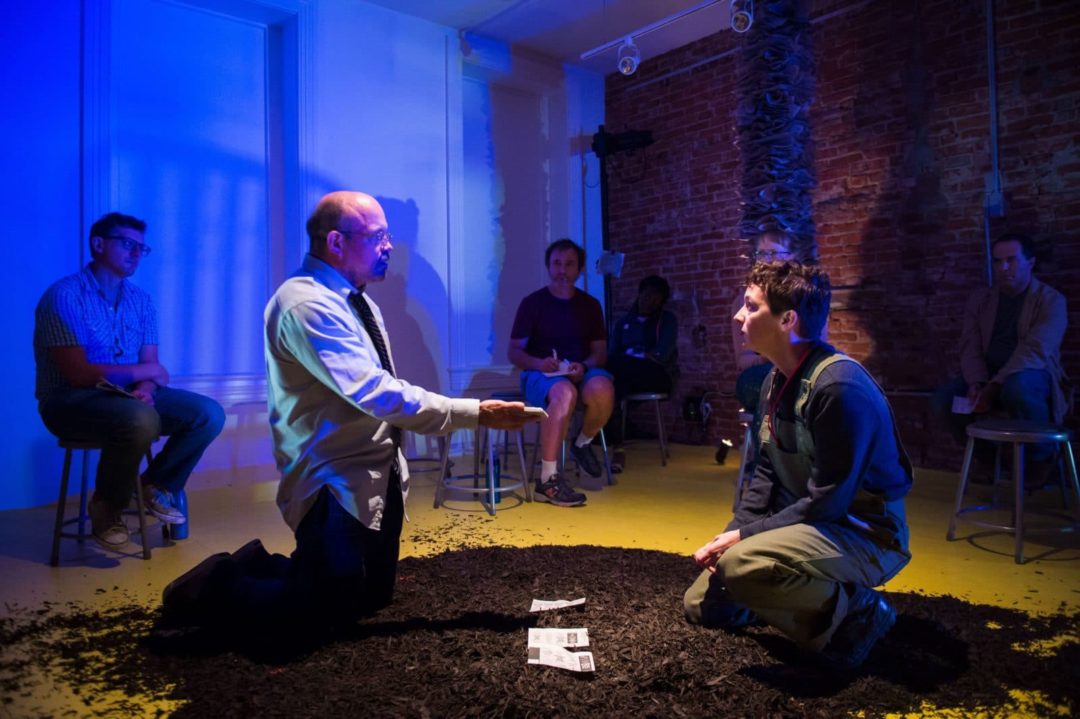
The variance of individual responses to communal concerns is one of many ideas confronted in The Edge of the Universe Players 2’s current production of My Barking Dog by Eric Coble. Staged in the round by director Michael Chamberlin, the play centers on two neighbors who don’t even acknowledge each other for a large chunk of the play until the mysterious appearance of a city-dwelling coyote outside their home. Most of the tale is imparted to us through interlocking monologues from the earnest Melinda (Tia Shearer), who works the graveyard shift at a printing plant, and the recently unemployed Toby (Christopher Crutchfield Walker), who lives near the largest cell tower in the world but can’t manage to get a connection on his hand-me-down phone.

Like his visitees, the coyote is a nocturnal creature who travels alone. Melinda and Toby both find a renewed purpose in their interactions with the unnamed and untamed animal. Melinda starts out by leaving meat for him to take while Toby begins a nonstop research quest to learn as much as he can about the canis latrans. Both Shearer and Walker excel in maintaining intimacy with the audience and choosing when to make critical eye contact. Leaning on her experience in children’s theatre, Shearer brings a wistful sincerity to Melinda’s direct address and guides us through what might otherwise be an abrupt heel-face-turn for her character later in the play. Walker serves up a balance of gallows humor and exasperation as the downtrodden Toby, whose resilience has been knocked down a few pegs since losing his job. Multiple audience members nodded in agreement to his miserable adages about unemployment, insomnia, and technology.

If it’s possible to have a scene-stealer in a show with only two characters, that designation goes to the impeccable scenic design by Giorgos Tappas. Though the floor is painted bright yellow, the set gives the feeling of a bunker or post-apocalyptic landscape. Columns of recycled newspapers stretch to the ceiling, framing the static-filled box televisions in opposite corners of the room and an unsuspecting pile of mulch arranged in a perfect circle. The seating arrangement of stools strategically placed around the edge of the gallery space also contributes to the initial sense of desolation.

If, as Toby observes, “the two hardest things about being unemployed are looking for work and not looking for work,” then perhaps the two hardest things about knowing of global catastrophes are trying to solve them and knowing you cannot. Luckily, we don’t have to do it alone. As the pre-show track “Road to Nowhere” by the Talking Heads invites us to do for the next 95 minutes, “come on inside/taking that ride to nowhere/we’ll take that ride.”

Unsettled: The Journey of Cheyenne and Mari

Written by Hannah Berk

This article was first published in Tagg Magazine here.

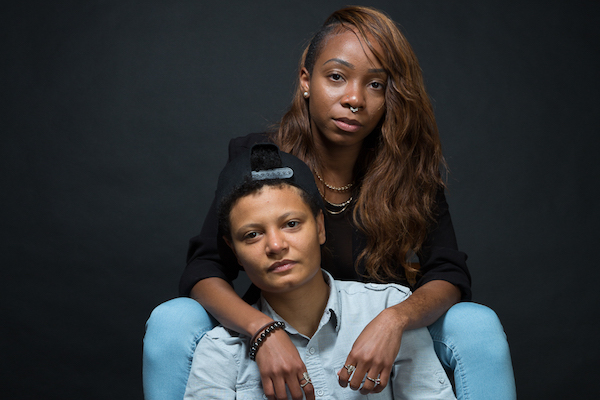
Cheyenne Adriano and Mari N’Timansieme were looking for a place where they could be themselves, and still be safe. That simple demand has led them on a journey that has bounced them back and forth across borders and entangled them in immigration bureaucracy for seven years and counting.

Gender-nonconforming from a young age, Mari grew up facing a barrage of abuse in Luanda, Angola. “I’m a target right away,” she says. “I don’t even have to open my mouth, they can just look at me…I couldn’t even leave my house without knowing I could be attacked.” In their time living together, Cheyenne and Mari never felt safe in their home. Neighbors cut their power and killed their dog; police joined in the swarm of street harassment that rose to meet them. The final straw came when one neighbor devoted himself to stalking the couple at all hours, threatening to burn their house down in the night. After years of dodging and withstanding attacks, they knew better than to disregard a threat against their lives.

When the couple first decided to leave Luanda in 2012, homosexual conduct was still criminalized under the country’s colonial penal code. Legal discrimination meant that Cheyenne and Mari bore abuse from family, neighbors, and strangers alike with no institutional support to turn to.

Cheyenne and Mari planned to build a life together in Cape Town. The only country on the continent to legalize same-sex marriage and home to significant anti-discrimination legislation, South Africa is a common destination for African LGBTQ asylum seekers. However, Cheyenne and Mari didn’t find the support they anticipated. The government had shut down Cape Town’s Refugee Reception Office shortly before their arrival, leaving asylum seekers to travel long distances to submit their applications. Unauthorized to work, living in a shelter, and with no discernible progress toward legal status, the couple returned to Luanda after two years and began planning their journey toward a new destination: the United States.

Arriving on student visas, the couple began a long immigration process they are still undergoing. It took them about six months just to get a hearing, another six months to get a work permit. While they waited, they struggled to stay afloat in San Francisco, consistently ranked the most expensive city to live in the U.S., and the one with the country’s widest wealth gap. But navigating the legal system took more than a financial toll. “The bureaucracy of seeking asylum is psychologically challenging,” Mari says. “You go to bed thinking, what if I have to go back? What’s my plan B?”

While heralded as a progressive hub and LGBTQ haven, San Francisco had its ups and downs for Cheyenne and Mari. They found that community didn’t come easy. “In our culture,” Mari explains, “it’s so easy to make friends. In the U.S., it’s different. People are so into that routine of exchange. They will network with you because they want something from you.” They’ve faced extra challenges as a result of their intersecting identities. “In our LGBT community,” Mari says, “there’s still racism, and there’s still xenophobia. We have been discriminated against for being Black, a foreigner. You’ll go to a job interview and when they realize you have an accent, they’ll find a reason not to hire you.” But there have been bright spots, too. In 2015, the couple married, after years of waiting for the chance. They have relocated to Las Vegas, where they work in the tech industry and are recording new songs; Cheyenne writes and sings under her artist name, KingCyborg, while Mari produces the music. And while they still hear comments in the streets, they felt more comfortable being themselves in public. “Whatever else,” says Mari, “that’s freedom.”

Cheyenne and Mari’s story, alongside those of Subhi Nahas from Syria and Junior Mayema from the Democratic Republic of Congo, is featured in the new documentary “Unsettled” from director Tom Shepard. The film follows the four asylum seekers and refugees as they arrive in San Francisco and work to build new lives. Cheyenne hopes the documentary will help audiences understand why people come to the U.S. to seek refuge, the great contributions they bring with them, and what they have to go through once they get here. “We want people to see what the immigration, the asylum process is really like,” she says. Screenings are scheduled across the country and internationally.

In January, the Angolan parliament voted to adopt a new penal code for the first time since the country gained independence in 1975. This code abandons the anti-LGBT provision, and bans discrimation based on sexual orientation. Carlos Fernandes, director of Iris Angola Association (Associação Íris Angola), says that it remains to be seen how it will be put into practice.

The first and only LGBTQ rights organization to be officially registered with the Angolan government, Iris Angola works in the areas of health, LGBTQ support and empowerment, and community education. Part of the problem, Fernandes says, is that “many people in this area don’t know what it is to be LGBT.” Even when knowledge is higher, people may be more tolerant in public, but “everything changes when you are at home. We face various problems as a result of the family. They are the first to discriminate against LGBT people in Angola.”

Mari describes the legislation as “definite progress.” “Right now,” she says, “LGBT people know there is a community where they can go for guidance and support…but it’s still not going to change society’s mindset. It takes decades—maybe centuries—to do that.”

The Wheel Theatre Company exits with The Winter’s Tale

By Mercedes Hesselroth

This article was first published in DC Theatre Scene here.

With the holiday season quickly approaching, so do the stresses that accompany the tricky social etiquette around visiting and hosting loved ones. You might do your best planning and preparation – altering seating arrangements to keep divergent personalities away from each other, creating three different menus to appease everyone’s dietary preferences, diffusing every conversational time bomb – and still not foresee a yuletide crisis. But even if there is drama at your dinner table this year, take comfort in the fact that it certainly can’t be worse than the conflict that befalls the guests and hosts of The Wheel Theatre Company’s The Winter’s Tale by William Shakespeare.

King Leontes of Sicily (Lee Havlicek) and his heavily pregnant wife Hermione (Elizabeth Ung) have welcomed King Polixenes of Bohemia (Colton Needles) into their home for nine months. Leontes is happy to extend his childhood friend’s stay, until he baselessly concludes Hermione and Polixenes have conspired to steal his crown by producing an heir of their own behind his back. Too deep in his own conviction to realize his accusations of adultery are unfounded, Leontes unsuccessfully plots the murder of his friend and forces Hermione to give birth in prison before subjecting her to a trial.

Needles’ performance as Polixenes stands out for his balance of steadfast rationality and sincere concern in the wake of Leontes’ jealousy. Highlighted in this production is the urgency with which Sicily’s court of advisors must act against a paranoid king’s rages. Yet, even when they present Leontes with his newborn, he still cannot bring himself to admit the child is proof of Hermione’s love.

We live in the era of the double-down. When those in the limelight make a mistake, be they lawmakers, comedians, or CEOs, rather than save face with a genuine apology it has become standard practice to shirk accountability and insist no error was made at all. Therefore, no effort is necessary to correct any harm or become a better person. This is the trouble that overtakes the prideful Leontes, but unlike the disappointing scenarios we see unravel in the public eye, Leontes eventually recognizes the gravity of his missteps and promises to reform, ushering a time jump of sixteen years to the lighter second half of the play.

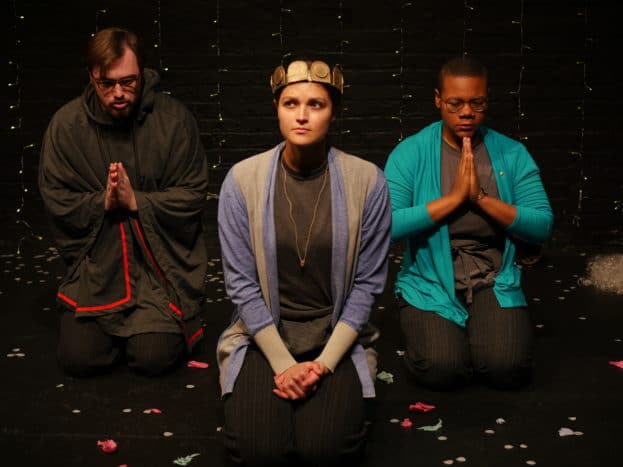
Director Jack Read wisely lets the small size of the DC Arts Center theater guide a “less is more” approach to the production’s aesthetic. Paper snow and the soft haze of twinkle lights are enough to establish a cozy winter setting. The minimalistic design allows the Bard’s language to shine through, especially in the hands of such a capable ensemble. Since each player pulls at least triple duty to bring both timelines of characters to life, bright layers over loose, gray clothing help to distinguish their various ages and classes (costumes designed by Read, Grace Eda Baker, and Elizabeth Floyd). Of note are Mackenzie Larsen’s seamless shift from five-year-old prince Mamillius to lost princess Perdita and Moira Todd’s cheeky interpretation of the scammer Autolycus, who provides much of the comic relief and musical additions in the show.

The Winter’s Tale will be Wheel Theatre Company’s last local production before they head west to their new home in Nashville. It seems fitting they’ve selected one of Shakespeare’s more reflective works, and one of his final pieces, as their goodbye. Wherever your destination this holiday season, a trip to the DC Arts Center for this twisting tale of forgiveness and new beginnings is worth the visit.

With ‘Bridges and Alleys,’ local artist offers intimate, sometimes moody look at DC beyond the monuments

by Athena Naylor

This article was first published on The DC Line and can be read on their website here.

Artistic portrayals of Washington frequently draw from one or more of the city’s distinguishing landmarks to convey a sense of place, whether that involves highlighting skylines sculpted by the Washington Monument and the Capitol Dome or illustrating vistas of the National Mall and Lincoln Memorial that evoke the nation’s popular imagination. At Artist’s Proof Gallery in Georgetown, however, an ongoing exhibition of drawings and paintings titled Bridges and Alleys: A Collection of Works by DC-based artist Scott Ivey offers an alternative vision of DC removed from nationally recognizable landmarks. The exhibit provides a more intimate, quotidian portrait of the city — one that’s frankly relatable to local residents.

The strength of the 14 paintings and drawings on display in Bridges and Alleys derives from Ivey’s personal connection to DC. Ivey was born in North Carolina and first came to Washington as a student, receiving training from Montgomery College in Takoma Park and the Corcoran School of Art in DC before eventually getting his Bachelor of Fine Arts degree from the Maryland Institute College of Art (MICA) in 1987. Since that time, Ivey has lived in DC and focused his practice on painterly urban landscapes. Currently residing in Georgetown, Ivey pays homage through his works to DC neighborhoods such as Shaw, Dupont Circle, Adams Morgan, Southwest and downtown.

Ivey’s views of DC seem simultaneously immediate and meditative, specific and dreamlike. Rather than searching for scenes to illustrate, Ivey allows images to find him, often finding inspiration while running errands and or taking neighborhood strolls. His charcoal drawings achieve a ghostly effect reminiscent of old photographs, composed of faint lines and overexposed expanses of white contrasted with indistinct swaths of shadow. His 1988 drawing Rainy Scene is particularly enigmatic, with houses on an unnamed street depicted through abstract, atmospheric shapes. 

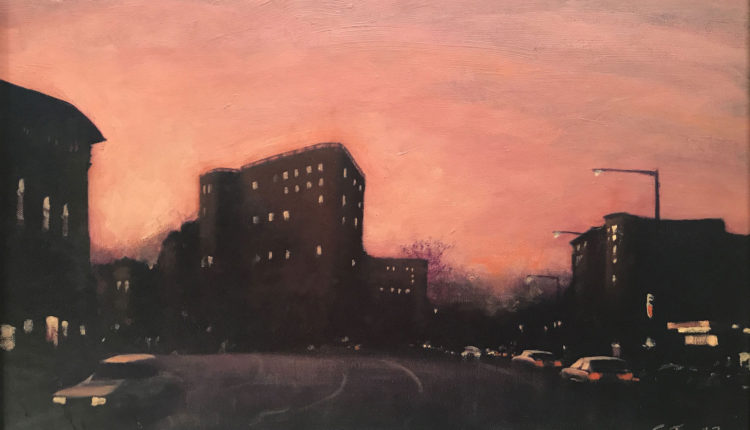
Ivey’s oil paintings appear preoccupied by light and often highlight a less obvious characteristic specific to DC’s urban landscape: the sweeping views of sky afforded by the city’s building-height restrictions. The paintings 19th Street (2000) and Rosslyn (2003) particularly focus on this aspect of the urban landscape: The former shows the hazy atmosphere above a cloudy day in DC, the latter illustrates the Northern Virginia skyline from a great distance, dwarfed by a morning sky striped with sun-kissed clouds. 

The seeming specificity of light in Ivey’s works stems from his practice of drafting on-site studies of scenes. These preliminary sketches are translated into final pieces through years of gradual, meditative work. Rather than portraying distinct moments in time, Ivey’s landscapes transform into portraits of feeling and memory encapsulated by place. “I intentionally start with a dark background, slowly introducing light into the painting; the scenes slowly reveal themselves in the emerging light,” Ivey says in a bio on his website. 

The often moody and melancholic nature of Ivey’s work also points to his artistic influences, including American realist Edward Hopper. In a manner similar to Hopper’s paintings, Ivey’s depictions of DC are of a strangely deserted city, devoid of pedestrians. Often, the only signs of life come from shadowy cars or blurred headlights on streets and bridges. Hopper’s influence is clear from Ivey’s online bio, which ends with the famous Hopper quote, “If you could say it in words there would be no reason to paint.”

Ivey will be speaking about his process and practice on Wednesday, Aug. 14, during an evening workshop at Artist’s Proof Gallery. Bridges and Alleys will remain open to the public through Aug. 24, providing time for visitors to stop by and consider how the artist’s depictions of DC coincide or diverge from their own personal experiences of the city.

“Bridges and Alleys: A Collection of Works by Washington DC Artist Scott Ivey” opened at Artist’s Proof Gallery and Art Consultancy on July 17 and will close on Aug. 24. Located at 1533 Wisconsin Ave. NW, Artist’s Proof is open Tuesday through Saturday from 10 a.m. to 6 p.m.

Redefining Soft: Making Space for Masculine of Center Community Healing

by Hannah Berk

This article was first published by TAGG Magazine and can be read on that site here.

What happens when a community comes together to reclaim a word that has been weaponized against them? The two-day event Redefining Soft aims to offer an example that emphasizes healing and affirmation. Participants will challenge one another’s concept of softness and explore their own relationships to the word as masculine of center women (MOC), trans masculine, and gender non-conforming individuals.

Robin Williams created Redefining Soft in response to a series of conversations she found herself having MOC friends, acquaintances, and former partners who expressed a need for emotional support that was rarely afforded to them. “They felt targeted a lot when it came to being vulnerable or emotional as they weren’t given the space to express that with their femme-identifying partners,” Williams explains.

Realizing this kind of space was lacking even in her own relationships, she wanted to create one that would be openly accessible and would kickstart conversations that participants could carry forward with one another and with the people in their lives. Femme-identifying herself, she partnered with additional individuals and organizations such as BlackGirlMasculine and bklyn boihood to shape and facilitate the event in close partnership with members of the community Redefining Soft serves.

Now in its second annual iteration, the event is making its Washington, D.C. debut August 17-18. Participants will be offered an array of avenues for reflection and self-expression. The agenda includes creative writing and journaling exercises, guided meditation, Reiki healing, a visual art workshop, and a panel discussion on sex and relationships. Throughout, participants will have the chance to process in pairs, small groups, and large gatherings, as well as individually. A meet and greet happy hour is also included on August 17 at XX+ Crostino.

Building community, says Williams, is a central purpose of Redefining Soft. “One thing that I love about the events so far is that people have left with new friendships and new bonds and things said out loud that they’ve never said before.

The event has grown in numbers and in sponsorship since its inaugural convening in New York last year, and Williams has big plans for the future. She is partnering with LGBTQ financial literacy specialist Kenneth Davis to establish a non-profit, a step that would allow greater expansion and sustainability.

Whatever its scale, the goals of Redefining Soft remain the same: reclaiming the power of softness, building community among MOC folks, and sparking conversations that will open up new depths of interpersonal understanding beyond the weekend.

“It’s my goal that, if nothing else, people walk away from the event asking themselves and the people in their relationships tougher questions, and actually holding space for the answers,” Williams explains. The reflective weekend is designed to support participants in discovering and defining for themselves the power that lies in vulnerability.

Anthony Bowen YMCA gallery enters its second year with vibrant mixed-media exhibit evoking the Caribbean islands

by Athena Naylor

This article was first published on The DC Line and can be read on their website here.

The Shaw neighborhood’s Anthony Bowen YMCA, the organization’s first African American branch in the world, has an extensive track record of social engagement spanning its 166-year history. With Gallery Y, an exhibition space that debuted last year, the Anthony Bowen YMCA aims to further its mission to foster diverse local voices within the creative community.

Gallery Y, which acts as an open community space accessible both through the lobby of the YMCA and the adjacent Sweetgreen restaurant, currently displays 28 pieces by artist-in-residence Tracy Monsanto. Her show A Journey in Mixed Media opened June 7 in conjunction with National Caribbean Heritage Month, a celebration dedicated to honoring the history and diversity of the Caribbean islands and the numerous cultural contributions of Caribbean Americans.

Monsanto — a Caribbean American artist who grew up in Trinidad and now lives and works in Tampa, Florida — specializes in vibrant mixed-media pieces. While A Journey in Mixed Media features some stylized figurative work, Monsanto’s creative process shines most in her non-figural abstract pieces, which illustrate the artist’s interest in intuitively exploring relationships among color, texture and material. 

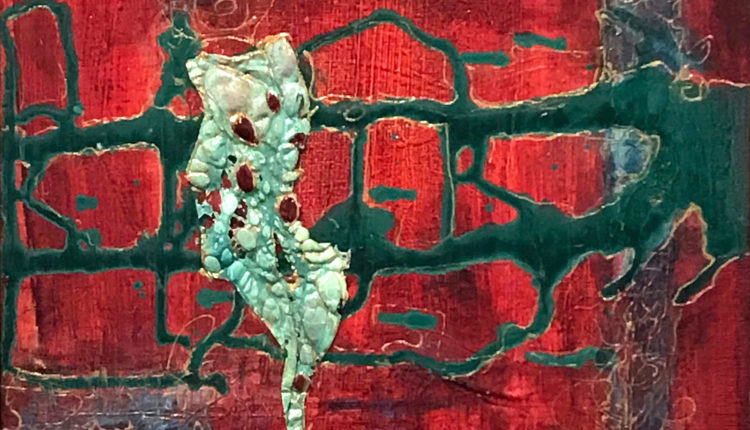
Monsanto’s larger works, like her 2019 “Time to Refresh,” highlight collaged materials of hand-painted papers and found objects, while smaller pieces like her 2016 composition “Night Dreams” feature mark-making suggestive of personal artistic motifs. Monsanto’s “Love Holds Us Together II,” completed in 2019, features the artist’s use of thick paint with glaze, a process that results in an almost enamel-like effect. In this piece, the technique results in an organic green form on the canvas that feels almost geographic, a fitting association since Monsanto derives much of her inspiration from nature.

The exhibit’s opening marked the one-year anniversary of Gallery Y. Diane Taitt, executive director of the Anthony Bowen YMCA, developed the gallery space and artist residency in order to foster community engagement and collaboration in the Shaw neighborhood and beyond. 

In its first year, Gallery Y launched three shows, starting with its inaugural artist-in-residence, Marielle Barrow. Barrow, a Caribbean-born visual artist, social entrepreneur and arts management consultant, earned her doctorate in cultural studies at George Mason University. Her show also coincided with Caribbean Heritage Month and examined cultural associations among place, space and belonging. The gallery hosted the launch of Barrow’s book Sacred Spaces: A Sense of Place, co-written with Antonius Roberts, and her residency included a Caribbean American Heritage event. Barrow continues to engage with her Caribbean heritage through the arts journal she founded, Caribbean Intransit.

Last September, Gallery Y presented its second exhibit — Seven Centuries, which featured Leslie Anne Hansley’s paintings inspired by African masks along with the photography of Maryland-based photojournalist Donovan Marks. More recently, the Rev. Sandra Butler-Truesdale, another Gallery Y artist-in-residence and the president and founder of DC Legendary Musicians, organized an “Art Meets Music” event in May that celebrated the DC jazz scene. 

With Tracy Monsanto’s A Journey in Mixed Media, Gallery Y is kicking off its second year of exhibitions. 

Through Gallery Y, the Anthony Bowen YMCA is building on a history of cultivating creativity in the community. Established by religious leader and educator Anthony Bowen in 1853, the organization found its first permanent home at 1816 12th St. NW in 1912, seven years after it was officially recognized as a branch of the YMCA of Washington. It was there that Langston Hughes wrote poetry when he was working as a busboy, Thurgood Marshall devised legal strategies, and legendary Georgetown University basketball coach John Thompson Jr. practiced his game. The YMCA branch was formally named after Bowen in 1972, and in 1988 it moved to its new location on W Street NW, which was renovated in 2013. 

Gallery Y looks toward a future of continued community engagement with new projects, including its first National Endowment for the Arts grant and a partnership with local curator Beth Ferraro of the creative consulting project The Art Island.

The YMCA’s Taitt expressed excitement for Gallery Y’s role as a “vibrant cultural community node.” She says the gallery is always on the lookout for new partnerships, funding and volunteers to sustain its mission. Details on the space’s programming and opportunities are available on its website

Located in the Anthony Bowen YMCA at 1325 W St. NW, Gallery Y is open daily from 9 a.m. to 6 p.m. A Journey in Mixed Media opened June 7 and will be on display through Aug. 2. All exhibited artworks are for sale.