
Intimate Moments: A Look At Sydney Vernon’s Interior Lives At Philips@THEARC

 By Oluseyi Akinyode

This article was originally published in DCTrending here.

Our lives are an amalgam of ordinary moments and significant events. Interior Lives, an exhibition featuring works by up-and-coming local artist Sydney Vernon at Philips@THEARC captures the subtleties and complexities of these experiences. Vernon was invited by Philips@THEARC to showcase her works in dialogue with Bonnard’s World, a retrospective of Pierre Bonnard’s body of work at the Phillips Collection. 

This collaboration with Vernon is particularly fitting given her exposure to Bonnard’s work during her formative years and her ties to the area. The exhibition at Philips@THEARC is part of a wider initiative between The Phillips Collection and its partners to extend programs to communities and foster collaboration with local artists.

Interior Lives features six of Vernon’s drawings on paper, two in black and white and the rest in color. The artwork that drew me right in is Prinita in Park Slope Apt. It depicts a woman enjoying a cigarette by the window, her eyes closed in bliss. A loosely drawn curtain hangs over the window sill, framed by leaves from a nearby potted plant. 

Although it’s a simple pencil sketch, it deftly conveys the essence of the fleeting moment, making it a striking piece. There is a sense we are privy to a glimpse because Vernon has captured it on paper. The paper’s serrated edge accentuates the moment’s brevity, almost as if the scene has been ripped from a snapshot of someone else’s life. The loose and fluid style of the drawing is ideally suited to the paper medium.

As a newcomer to Vernon’s work, I was curious about her choice of drawing as her primary medium over more traditional ones like paint. Vernon explained that paper is more accessible and conducive to jotting down ideas. She noted, “I can be on the train with my sketchbook and quickly sketch out an idea.” The immediacy of paper aligns well with her rapid and spontaneous creative process; she tends not to plan or overthink how a piece will unfold once she starts working on it.

It would be remiss to assume Vernon’s artistry revolves solely around elevating mundane moments to studies of contemplation. A native of Prince George’s County, Sydney Vernon studied Fine Arts at The Cooper Union in New York City. Vernon’s artistic practice involves overlaying family photographs with imagined histories and futures to create forms with new meanings.

This fusion of history and memory holds deep significance when viewed through the lived experience of Black people in America. This shared history is characterized by resilience and the triumph of the human spirit. Vernon desires for her art to reflect this spirit. She observed that each generation of her family was marking new milestones, surpassing the dreams of their predecessors, who often contended with a limiting socio-economic environment. Vernon’s approach to overlaying her images goes beyond a mere poetic reconstruction of her ancestors’ imagined lives. It becomes a powerful tool for consciously framing her world, transforming her art into a medium for personal and cultural expression.

Coastal Ride, a charcoal drawing on paper, features the artist’s aunt on a motorcycle, her smile visible beneath her sunglasses. The charcoal medium adds texture to the work. The composition, with the aunt against a vast landscape, evokes a sense of freedom and possibility. This piece is not just about the joy of engaging in a hobby but also a testament to the private moments of human life. Like Vernon’s other works, Coastal Ride exalts the beauty of everyday Black lives, in stark contrast to the tragic depictions and stereotypes often perpetuated in the media. 

Continuing the theme of intimate moments is the artwork Vacation, created with pastel and silkscreen on paper. Using a family vacation photograph as source material, the artist overlays an urban landscape with an imagined bridge. Her mother, wearing a sky-blue swimsuit, stands waist-deep in swirling waters of turquoise and blue. Her eyes are half closed as she enjoys the moment. Against a backdrop of vivid green mountains is a sky bursting with bold red, white, and yellow patches. The artist takes a similar approach in Hide and Seek, another drawing portraying the artist’s mother in the family living room against a purple, yellow, and blue background, framed to the right by green foliage. 

Both artworks, Vacation and Hide and Seek, stand out not only for their bright colors but also because of their familiar portrayals of objects in unfamiliar tones, equipping the viewer with new ways to see. More importantly, color also serves as a channel for expressing human emotions, reminiscent of the intense feelings conveyed in Mark Rothko’s 1950s paintings, with their horizontal bands of color. Vernon’s artworks are influenced by the post-impressionist French artist Pierre Bonnard. There are the brightly saturated colors, how Vernon frames her scenes with plants, and the portrayal of intimate moments.

Vernon takes Bonnard’s technique of using color to obscure his subject matter and takes it in a new direction by revealing their facial expressions, making a powerful statement about her subjects’ inner worlds. Often, societal perceptions overshadow the true essence of black individuals, treating their bodies as a filter through which to view them. Vernon’s artworks envision a world where Black individuals’ full expressions and inner emotions take prominence.

Finally, we come to the pivotal events of life in The Real Strange Thing, rendered with pastel on paper. The artwork depicts the artist’s parents in a slow dance on their wedding day, dressed in white attire. The chief bridesmaid and best man are positioned to the right, clothed in shades of magenta and gray, respectively. A crowd of onlookers, faces devoid of expression, fill the wedding hall in hues of reddish-pink and bluish-gray. The artist’s mother, gazing at the viewer, holds our attention. 

Conversations with Vernon and her mother revealed that the bride’s face in the drawing is that of her mother in the present. In The Real Strange Thing, the artist tackles themes of past regrets and the enduring consequences of choices. The artwork recalls past events and meditates on the textures of memories and their varying interpretations by individuals. In this piece, the artist journeys across time and space to her parent’s wedding, bearing witness to that day’s hopes and possible fears.

A central message for visitors to the exhibition is the reminder that there is beauty in celebrating both the simple and the momentous. To truly see others, we must peel back the layers that obscure our perceptions to appreciate the richness beneath their lives.

‘Raisin in the Sun’ at Port Tobacco Players brightens Black family story

By Isaac Welch

This article was originally published in DC Theater Arts here.

The Port Tobacco Players’ production of Lorraine Hansberry’s classic A Raisin in the Sun brings to life the tale of the mid-century Black American household in an endearing display, highlighting the jovial narratives that often otherwise are overshadowed by plight and dismay. The volunteer organization brings together a cast of naturally gifted actors and actresses who at all times live at home in their roles and complement each other’s energy with willing chemistry. Paired with an ornately set stage, this production far exceeds the expectations one may hold of volunteer-based theater, yet at the same time, it maintains the wholesome reverberations of a tightly knit community.

In his director’s note, Jeremy Keith Hunter declares that “A Raisin in the Sun is not about hardship. It’s not a play about depression or loss. [It’s] a story about family, and about love… The people in this play are proud. They are energetic, funny and smart…  They are every bit as loving, joyful and passionate as they are worn, disheartened and exhausted. It was my intention,” he states, “to highlight the former of these traits — to present a family that modern audiences could relate to and understand.” In service to his community, Hunter accomplishes the task of telling the truth and brightening the narratives of the Black family that are often masked and told sullenly when recounted in America’s history. In this tale, underscored by the pursuit of financial liberation, the dynamics of the Southside Chicago-based Younger family are examined in contrast to the desires of each individual, as the family quarrels over how to best spend insurance money awarded to them after their father’s death. Dreams of business enterprise, medical school, and improved housing are lobbied for, and battled against by the discrimination and racial barriers that characterized those times, but are ultimately left to the decision of the inheritor, Lena “Mama” Younger.

In a recent showing on Mother’s Day, the Port Tobacco Players theater swelled with an atmosphere of love in community, where the play’s central themes, exploring the preservation of the matriarch and her weathered spirit, were duly understood. Maintaining the heartbeat of her household, Mama Younger, played by Dionne Belk, lives undeterred by her age, bringing unity to her household and establishing the grounds they must abide by. Belk’s confidence as she asserts her role solidifies Mama Younger as the pillar that holds her family together and brings them to well-being. Raising her voice, shaping her face to a smile, or narrowing to a stare, her act as the Grandmother undoubtedly arises from familiarity, harkening to a generation that has so dearly cared, as seen in the proliferation of America’s Black community.

While this rendition presented itself in a brighter tint, Hunter and his cast did not withhold the gut-wrenching performances that for 75 years have struck a nerve in the hearts of audiences across America and earned the play’s reputation as a classic. Most notable is Gershawn A. Mason’s portrayal of Walter Younger. Rising on drunken mania and crashing on robbery and disenfranchisement, Mason’s expressions range from heightened jubilee dancing to guttural bellows roaring on sunken knees. In his character, Mason lives the story of the Black man-of-the-house, burdened and misunderstood by the society around him, at all times exuding his passion for the art of theater. In partnership with his wife Ruth Younger, played by Marleigh Ferguson, the two endure their love tested by the hardships a white society has cast upon them, but at no point fall out of synchronicity in their act together on stage. Warm, receptive, and sternly spoken, Ferguson gracefully adapts in each scene as she navigates her role as a wife, mother, sister, and daughter-in-law. Her relationship with her child Travis Younger (Ethan Thomas) is warmly established in the play’s opening scene as she picks his hair and smothers him in a hug before he leaves for school. She holds her own in contentious meetings with her in-laws, persevering under the wing of Mama Younger and standing up for her husband against the degradation of sister Beneatha Younger (Angela Alexander).

Somewhat of an antagonist to her family’s ways, Beneatha Younger spends most of her time in the play acting on her right to independence, exploring passions, and pursuing a doctorate degree. In her act, Alexander seldom deviates from her tone, counter-culture and full of angst, which is best utilized in conversations with elders and lovers, as she looks to stave off the antiquated expectations of a patriarchal society. As she explores avenues closer to her origins, audience members are reminded of the cultural juxtapositions that complicate the lives of African Americans still today.

As the play meets its climatic moments, the audience is rewarded with a sense of triumph, and though it is a small victory in a large and ongoing battle, Hunter’s direction and the cast’s exploration of the play’s themes work well to celebrate the Younger family’s success. In this light, the production of this famed play serves as a ceremony, praising the perseverance of the Black American household, in such a way that allows viewers to review their journey with the hope necessary to continue the push toward liberation. Should it be that the stories of Black Americans and their histories are told with intention as Hunter saw it — not as depression and a struggle against a system, but as the love and passion that binds a family — a better future may result for all.

Artomatic transforms abandoned building into a free artistic oasis

 By Abby Stuckrath

This article was originally published in The DC Line, here.

In its latest incarnation, Artomatic once again serves as a beacon of creativity, transforming a vacant building into an artistic hub. From sculptures fashioned from trash in the Potomac to a time-lapse video capturing the Rosslyn skyline, Artomatic demonstrates dynamic, empowering and utterly captivating art that defies traditional form. Running through April 28, Artomatic covers eight floors in a Golden Triangle office building, with the exhibition showcasing the works of over 1,000 artists and performers, ranging from live musical acts to tarot card readings — ensuring there is something to enchant every visitor.

Twenty-five years ago, Artomatic emerged as a liberated space for artists in an abandoned office building at 14th Street and Florida Avenue NW. It was a free-flowing exhibition devoid of a formal curator, where artists wielded the space for their creative voices. The mission of the entirely volunteer-run show remains to “create community, build an audience, and expand economic development by transforming available space into a playground for artistic expression.” After a seven-year hiatus, this groundbreaking art extravaganza has returned to DC, this time hijacking an unoccupied office building on M Street NW.

In this transformative ecosystem of artistic expression, the bounds between creator and audience blur, fostering a sense of community and connection that transcends most traditional gallery experiences. The events at Artomatic range from paint-off competitions to self-exploration workshops, making it not a venue for passive observation but instead a place where individuals become active participants in the Artomatic community.

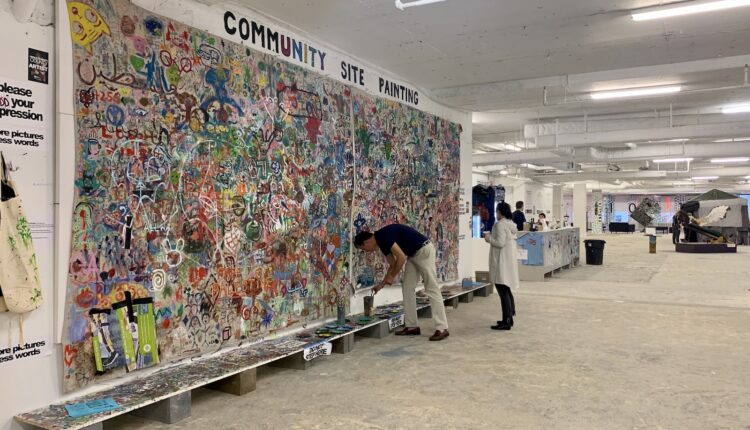
Stepping off the elevator onto the eighth floor — a logical place to start — you’re greeted by a stripped-down building, its structure bare against rugged cement floors. On the northeast side, visitors can unleash their creativity on a community canvas wall with paint and brushes supplied nearby. With the end of Artomatic’s seven-week run fast approaching, the once-blank canvas brims with a kaleidoscope of random squiggles and smiley faces, serving as a testament to the thousands of Artomatic visitors who’ve left their mark.

Turn the corner, and you’ll find art covering every surface. Karen La Du and Jeffrey Blender’s “Adventures in COOKIELand” installation offers an immersive journey saturated with vivid pinks and blues. Their whimsical and abstract sketches evoke a sense of nostalgia reminiscent of the classic style of Keith Haring. 

After walking down the stairs or riding the elevator to the seventh floor, audiences are met with a labyrinth of office spaces, each room dedicated to the work of an individual artist. Natalia Febo’s vibrant neon room, adorned with watercolor depictions of vegetables, fruits and empanadas, stands out as a refreshing oasis amid the darker, gloomier artwork scattered throughout the floor.

On the seventh floor, you’ll also find a room with a continuous stream of films, predominantly in short form. Unfortunately, the quality of these films does not meet the standards set by other art installations. One example is Heritage Film Festival’s short “Birds of the Air,” which feels stiff and lacks the emotional intimacy necessary to effectively portray the story of a transgender woman’s first day presenting as herself.

A standout installation is on the third floor, where Syahidah Osman is showcasing more than a hundred small photo collages adorned with maps and portraits of missing people from East Turkestan who are detained in Chinese Uyghur internment camps. Many victims have had their passports confiscated; they’ve also been assigned to forced labor. Moreover, a large number have vanished altogether. Osman’s artwork is just one of the many pieces across Artomatic’s eight floors that leave a lasting impression.

With each visit to Artomatic, audiences are enveloped in unique art installations that celebrate freedom of expression. Unlike traditional art showrooms, Artomatic is able to provide a platform that empowers artists who might otherwise need more time or financial means to showcase their work. 

By repurposing a demolition site into a place of creativity and freedom, Artomatic uplifts the voices of artists in ways that more conventional museums and galleries cannot achieve. By fostering this collaborative environment, Artomatic encourages audiences and artists to experiment, innovate and push boundaries without the pressure or expectations of a mainstream art institution. Artomatic democratizes access to the arts while making it accessible and relevant to a mass audience. 

This is more than just an exhibition space; it’s a living testament to the boundless nature of human creativity. It’s a place where inspiration is limitless, and the possibilities — for visitors and the featured artists alike — are as endless as the imagination itself. 

Alexandre Diop: Jooba, Jubba, L’art Du Defi, The Art Of Challenge At The Rubell Museum In Washington, DC

By Oluseyi Akinyode

This article was originally published in DCTrending here.

The Rubell Museum is a must-see in DC’s Southwest waterfront neighborhood for those eager to dip their toes into contemporary art. Located in the former Randall Junior High School, the museum offers a unique opportunity to sample the private collection of Mera and Don Rubell. Founded two years ago, the museum reflects the Rubells’ commitment to making art accessible and creating dialogue within the community. 

The Art of the Challenge part of the Alexandre Diop: Jooba, Jubba, L’Art du Defi, the Art of Challenge  exhibit at the museum, showcases five potent works by the French-Senegalese artist. Diop tackles complex themes such as colonialism’s lingering effects, violence, and suffering. While the themes he explores are timeless, his choice of found materials adds a fresh perspective, transforming them into a powerful commentary on the contemporary issues he grapples with.

In Le Mensonge d’État (The Lie of The State), Diop repurposes text, wood, door hinges, and plastic to create a compelling reinterpretation of Olympia, Edouard Manet’s once-controversial masterpiece. Diop engages in dialogue with viewers by incorporating a ripped cover of Civilisation Ou Babarie, a seminal work by African historian and anthropologist Cheikh Anta Diop.

On the left side of the exhibit wall, Honi soit qui mal y pense (Shame be (to him) who thinks evil of it) riffs on Jean-Auguste-Dominique Ingres’s 1812 painting, La Grande Odalisqueanot, echoing similar themes to Olympia. Alongside a series of zig-zag lines, fabrics feature prominently in this composition, with three pieces of velvet-like material in yellow, deep blue, and blueish green serving as the artwork’s background. The fabrics extend slightly off the canvas, creating a sense the viewer has wandered into the subject’s interior world.

Like many early career artists who reference established works, such as Manet’s reimagining of Titian’s Venus of Urbino, the French-Senegalese artist draws inspiration from the art history canon. Taking a subversive turn, Diop asserts his unique perspective by prompting viewers to question prevailing narratives on identity, self, and agency, which is particularly meaningful in Africa’s social and political history. Diop stakes his place in the art world through these references as if to say, “Here I am, too.”

The most striking piece in the exhibition is titled Mondo Carne. It was inspired by the 1962 Mondo documentary, which depicts humans in bizarre situations. Mondo Carne’s scale demands attention, requiring viewers to step back and appreciate its grandeur. Yet, details like a notebook page, hockey stick, and gnashed teeth draw one close to discern the ferocity of its message. 

Strewn across the canvas in disarray are dismembered body parts (skulls, teeth, limbs, ankles, and arms) amidst rich hues of deep reddish-brown, yellow, and purple. Pulsating across the canvas are gestural lines, marks, and frantic scribbles loosely framing the unfolding mayhem, conveying a sense of urgency and despair. With no space for the eye to rest, the painting can feel overwhelming and disorienting, evoking the chaos and disorder that violence leaves in its wake. In light of ongoing wars in Ukraine, Gaza, Yemen, and recently Haiti, Mondo Carne is a timely commentary on today’s realities, inviting viewers to reflect on the enduring power of art to speak to the human condition.

If you’re looking to give your eyes a rest, consider the triptych, L’ Incroyable Traversée d’Abdoulaye Le Grand, Troisième de la Lignée (The Incredible Crossing of Abdoulaye the Great, Third in Line to the Throne). Despite its innocuous title, the subject matter is anything but tame. Diop addresses the post-independence struggles of many African nations, notably Senegal, whose third president, Abdoulaye Wade, held office for just over twelve years, a tenure marked by allegations of corruption, nepotism, and human rights violations. 

This artwork consists of three panels, each featuring figures that blend human and monkey forms in profiles reminiscent of ancient Egyptian art. On closer examination, these figures, created from collages of consumer goods, reveal a coded message discernible to those who have spent time in African countries. The hidden message critiques colonialism. The materials bear the names of various European brands consumed in Africa and produced from raw materials extracted from countries under colonial rule. The irony is highlighted by an ankle constructed from a gift wrapper adorned with the words “Home Sweet Home”, underscoring the exploitation that enriched European nations at Africa’s expense. 

The final artwork in the exhibition, another triptych titled L’ Histoire du Monde – Le Temps et L’ Espace (The History of the World – Time and Space), stands in contrast to the crowded energy of Mondo Carne and the multiple figures in The Incredible Crossing of Abdoulaye The Great. Wood provides a prominent background, its surface colored with deep red hues in certain areas and interspersed with textures of mattress foam, a ruler, burnt plastic, and scraps of metal. A few scattered English letters and words hint at a broader narrative.

Two female figures, one adorned with African braids on her head, feature prominently on the first and third panels. The artist emphasizes their femininity with forms crafted from gold-colored metals and pinkish hues. Based on public interviews with the artist, the figure on the right holds an apple. This inclusion references the biblical tale of Adam and Eve, another recurring motif in works by old masters that signify humanity’s downfall. 

Examining The History of The World – Time & Space as an origin story allows us to dig deep into the exhibition’s themes of lust, violence, greed, corruption, and power. This interpretation provides a powerful thread connecting the five artworks. If the challenge is to tell the story of humanity through art, Diop has woven a masterful tale of its shortcomings. The discarded materials used in the artworks become testaments to how human behavior impacts our fellow humans and the environment. Diops’s use of these materials reinforces the message that humanity’s history is not just one of achievements but also one inextricably linked to its flaws.

The Art of the Challenge exhibition at the Rubell Museum in Washington, DC, runs through October 2024. Admission is free for DC residents with a valid ID card. 

Poet Layla Said Embodies the Unyielding Power of Art

By Abby Stuckrath

This article was originally published in Tagg Magazine here.

Writing comes naturally to Layla Said, creator of Said Nothing. Media. She told Tagg that sharing her life through art was something she “always felt really compelled to do.” 

Said’s poetic and written talents will officially culminate in her first poetry book, “Don’t You Cry, I’m on Venus.” Releasing this summer, this 7-year project reflects her life journey in navigating the world as a queer BIPOC woman.

A Life of Poetry

Said’s book took its first breath during her junior year of college when her professor, Sarah McCallum, encouraged her to become a poet. “She was the first person to ever call me a poet. She’s brilliant, she made me realize I was more than good enough,” says Said. 

But Said didn’t begin writing poetry in college; she wrote her first poem at age 7. Poetry even runs in her blood. 

Said shares that her grandmother used to be a political poet who was once imprisoned by the communist Romanian government. At nine months pregnant, she sat in jail reciting poems to the guards. Like a siren who lured pirates into dangerous waters, her poetry moved the guards to tears, and they let her go. This miraculous tale within Said’s ancestral past inspires her work today. “Her first name is my middle name, so I’ve always felt really connected to her,” she says. 

Said’s book is divided into three parts: “Enter the War Zone,” “Leave the War Zone,” and “Enter Self.” The proclaimed “war zone” began in high school, where Said, a Romanian Afghan woman, was surrounded by predominantly white peers. “I was very other in their eyes there,” says Said. “Everyone was super white, and they really made it a point that I was not.” 

The Beat of Her Own Drum

Said’s poetry doesn’t simply stay on the page. It finds life musically as well. Said has produced two EPs, “Poetry is Not a Luxury” and “Portrait of a Young Woman,” and she is adding a new song, “She Who Laughs Lasts,” to her discography on May 24th. The song was produced entirely virtually through voice memo recordings and Zoom calls with her producer. 

Her book and song are vulnerable expressions of her familial trauma and battle with bipolar disorder. While it can be difficult to share her experiences publicly, she says that it’s a vital part of how she heals. “I just feel like processing that in my art is really the only way I’ve been able to get through it to move on to have better relationships with my family,” Said says.

Uplifting Others

Discussing her past isn’t the only way that Said is healing and reclaiming her power. To challenge capitalism’s dominance over artistic expression, she created Said Nothing. Media is a company dedicated to amplifying poetry in all forms, specifically by women and minority artists. “There are so many ways to sell your soul and I really think that there’s such a power in being your own boss, and having your own voice and not having anyone dictate that,” says Said. 

But her passion for uplifting unheard voices doesn’t stop there. Said is also a fierce advocate dedicated to helping end homelessness in Denver, Colorado. She says, “My art is an extension of my public service, which is core to my identity and human experience.” This past year, she helped secure $2.58 million in recurring city funding to support homeless youth. 

Said says she doesn’t need recognition or fame to feel that her art and advocacy have made a difference: “The important thing is to just create, and to kind of just let the risk be and not try to force the outcome so much. Do I hope people consume it? Sure. But is that the end-all-be-all? No.” 

The scent and feel of an Irish bog in ‘Distillation’ from Solas Nua

By Whit Davis

This article was originally published in DC Theater Arts here.

Distillation is an experiential, interactive production presented by Solas Nua and Abbey Theatre at Eaton DC, brought to life by creator and performer Luke Casserly. It’s a unique blend of performance art and theater, with Casserly serving as the bridge between them. At the heart of this bridge is the star performer, the Irish bog, symbolized by a circular custom-made table by sculptor Ger Clancy and miniature bottled fragrances to be discovered by the audience. Casserly, in his supporting role, beautifully honors the story of the Irish bogs and his deeply personal relationship with them. In this intimate performance, Ireland’s landscape and history are brought to life, allowing the audience to connect with them through scent and touch.

The recent cessation of the peat harvesting industry in Ireland inspired this multidisciplinary performance, which features Casserly providing oral history, video, sound, and costume design.

Every element of the production is essential. The performance starts with smelling coffee beans to cleanse the scent palate and bring the audience to a place of presence. The organic materials of peat and moss pass from person to person for us to touch and smell. The stage is where the audience sits around the table, and the exchanges occur between stranger and artist and stranger.

Irish bogs, once a vital fuel source that created a significant need for jobs, now serve as a central reminder of our environmental impact. The peat-harvesting company Bord na Móna played a key role in this narrative. Peat harvesting, while contributing to carbon dioxide emissions, also had the potential to hold carbon dioxide within the bogs. However, when extracted, they can emit into the atmosphere, leading to the destruction of the ecosystem. Casserly and his family, living with the aftermath of the decision to start and stop peat harvesting, embody the complex and often devastating consequences of our actions on the environment.

Casserly plays the Irish bog. He gives voice to the material, allowing it to speak for itself. Casserly also uses dialogue from a real-life conversation he had with his father. A random audience member plays the father. The interactiveness of the play is a unique touch. How might the work have benefited from more dialogue and less lecture? What if the bog spoke more? What if the eerie weirdness was a much larger theme? The performance is detailed, calculated, delicate, compelling, and weird. The small moments of strangeness have a way of elevating the work.

Distillation reminds us that storytelling can take many forms and shapes, blending mediums and genres. Theater is still alive and well with experimental creativity.

Robots give humanity one last hurrah in Rorschach Theatre’s ‘Human Museum’

By Haley Huchler

This article was originally published in DC Theater Arts here.

No one likes to think about their own death. Certainly no one likes to think about the death of the entire human race. To do so is frightening, depressing, and just plain uncomfortable. Rorschach Theatre’s Human Museum throws comfort to the wind by confronting the demise of the human race head-on, with heart, humor, and Twinkies.

Welcome to the not-so-distant future, in which humans have gone extinct due to a series of natural disasters brought on by their own environmental destruction. Playwright Miyoko Conley’s eccentric story takes place at the titular Human Museum, an institute dedicated to remembering humans. The team of robots who run the museum are preparing to unveil a new exhibit about the final days of the human species, detailing how humans failed to save the planet and themselves.

Human Museum is a uniquely immersive play. The production is housed in a converted retail space, the entirety of which is staged as the setting of the play — the Human Museum. Before the performance, audience members are encouraged to walk around and view the different exhibits on human life. Some of these exhibits feature real “artifacts” of the human world, such as a display of a melted clock (“While humans generally perceived time through memory, they frequently used devices such as this to divide their days and plan their many activities”), while others are imaginings of a future where humans succumbed to a dying planet, such as an arrangement of plants labeled “Eco Experiments, failed” (“These are samples of humans’ many failed attempts to regrow the destroyed environment”). One tongue-in-cheek exhibit recalls the human love of snack foods, especially Twinkies, which come to be a mascot food of the apocalypse in this fictional world.

The production itself plays out in a corridor between two parallel rows of seating, more like the setup for a basketball game than a play. This intimate setting allows audience members to be wholly immersed in the story; however, some of the seats have lower visibility, making viewing every piece of the action slightly difficult.

Screens on either end of the playing area are used to display video. The integration of video, including home movies and museum commercials, adds an entertaining multimedia element to the production. The story is told through artifacts and video as much as it is told through the characters’ words and actions, providing a fascinating theatergoing experience.

In Human Museum, the plot occurs across space, time, and data streams. The play is told through a seamlessly woven tapestry of moments from the present and past. While the robots prepare the latest exhibit of the Human Museum, the museum director, played by Ixchel, finds herself thrown back into memories of the human scientist who created her. A spunky and sweet museum curator named 237, played by Rebecca Husk, relishes in the ability to remember human life, while her coworker 65, played by Aron Spellane, struggles with the burden of holding onto all the knowledge of a dead species. A shocking discovery made by 237 adds another twisted layer to the story, forcing each robot to reexamine their mission.

The performances from the cast are all warm, tender, and, well, human. Rebecca Husk radiates authenticity and warmth as 237, a robot with a heightened sense of sensitivity, while Aron Spellane contrasts her perfectly as 65, a grumpy and sarcastic robot who is more interested in data and logic. Jennifer Knight is wonderfully vivacious as the kind scientist fighting to save her dying species, and Ixchel is powerful as the museum director who holds the legacy of humankind on her shoulders. Ayanna Fowler gives a marvelous performance as a goofy delivery bot, providing comic relief that balances out the somewhat dark story. Bri Houtman’s astonishingly genuine performance as Avery, a human whose story becomes important to the museum team, is the emotional core of this work, with her powerful delivery of monologues that are intense, moving, and unforgettable.

The premise of Human Museum is incredibly original, fascinating, and prescient. At times, the script veers toward sentimentality, but generally, it remains grounded in the gripping reality of an all-too-possible “What if?” scenario. Despite the morbid premise, Human Museum manages to infuse fun and delight into this imagined future, with the heart of the story being a loveable crew of robots who are more human than they think.