Big laughs and bawdy fun in ‘The Book of Mormon’ on tour at the National

By Haley Huchler

This article was originally published in DC Theater Arts here.

One of the most successful Broadway musicals of all time has landed at The National Theatre with an outstanding opening night. The Book of Mormon’s positive critical response over the years has garnered many subsequent national tours, and this uproarious production, directed by Jennifer Werner, continues that stellar reputation.

The Book of Mormon is a uniquely American musical about a uniquely American phenomenon: Mormonism. The fresh, original, and wickedly funny story of two Mormon missionaries who wind up in a remote village in Uganda is rife with raunchy comedy and farcical performances that make for an evening of hysterical fun. The beloved satire follows Elder Price and Elder Cunningham as they preach about Joseph Smith to African villagers who are more preoccupied with poverty, disease, and violent warlords than the possibility of eternal life as a Latter-day Saint. When the villagers finally begin to be swayed by the missionaries’ promises, things start to get even more wackier.

Elder Price and Elder Cunningham, played by Sam McLellan and Sam Nackman, are a riotous duo. McLellan is delightful as the overconfident, egotistical Elder Price, who is disappointed that he’s been sent to Uganda for his mission instead of his favorite place on Earth (Orlando, Florida) but still determined to succeed in his quest for conversion. Nackman is a talented comedic actor and perfectly cast for the overzealous Elder Cunningham, who just wants to make his dad proud — and maybe become BFFs with Elder Price along the way.

The rest of the cast is equally as charming as the two leads. Keke Nesbitt plays Nabulungi, the first villager to become interested in the missionaries, with an earnest glee and dazzling enthusiasm. Jarret Martin hilariously plays a doctor who has “maggots in his scrotum” and isn’t afraid to sing it loud and proud. Some cast members, such as Trevor Dorner and Sean Casey Flanagan, swing between multiple roles with practiced ease, creating a sense of continuity and synchronicity in the story.

The set design by Scott Pask is a vital piece of this show, and each scene is crafted with immense care and detail. The stage is outlined by a white, gleaming Mormon temple that really does feel like it’s reaching up to the heavens. On stage, the cast and crew do an amazing job of changing scenes with what seems like the touch of a fairy godmother’s wand, effortlessly gliding the story between a suburban Salt Lake City, a tattered and dusty Ugandan village, a sunny, false Florida, and even the depths of hell. The versatility of the design is remarkable, with pieces that swivel quickly to transform the stage in mere seconds.

The joy of the costume design is all in the details, such as Jesus’ curly blond hair, reminiscent of a teenage girl before a school dance, and Elder McKinley’s little pink-flowered suitcase. These comical visual touches remind us of the absolute absurdity of this world and its spunky characters.

Each musical number is more intensely hilarious than the last, not to mention filled with powerful vocals from the cast. Some of the most notable songs include “Spooky Mormon Hell Dream,” where Elder Price dances with a group of unsavory characters from history who have ended up in this spooky, sparkly underworld, and “Turn It Off,” in which the more experienced missionaries try to teach Elder Price and Elder Cunningham about the little Mormon trick of just “turning off” unsavory thoughts, of course in a flashy dance complete with sequined vests.

Running gags in the show provide harmonious fluidity from one scene to the next, although the raunchy nature of most means this show is definitely not for the kids — or for anyone easily offended. But every crude line or lewd joke is delivered with radiant joy and faux innocence that guarantees a gaggle of laughs. This production reminds us of the power of theater to bring us to tears — that is, tears of laughter. The Book of Mormon at The National Theatre is a complete joy that no one should miss.

New musical ‘Sonnets and Soul’ resonates deeply at Howard University

 By Isaac Welch

This article was originally published in DC Theater Arts here.

Throughout the world, the folklore of Black Americans serves as a foundation of the popular culture we know and enjoy today, bringing context and inspiration to the creative minds that now decorate our history. Folklore as a historical record is pivotal in this aspect. As the world around us continues to change in ways unforeseen by our generation’s forerunners, the necessity becomes ever-present to inscribe new stories and bring light to the narratives that had once lived befogged by ignorance and neglect.

Taking on this responsibility are director and choreographer Dell Howlett and composer Michael McElroy with their new musical Sonnets and Soul. Conceived during the COVID-19 quarantine in 2020, the work addresses the lack of stories akin to their experiences as queer Black men in theater and adjacent arts. Moving away from the Shakespearean motifs that once inspired their collaboration’s title, Howlett and McElroy embark on a journey of healing, begging the question “What if we could go back?”

Sonnets and Soul follows the young Seer, a queer boy played by Kenneth Carter Jr. coming of age in the late 1970s. Son to his mother, Faith (Gabrielle N. Rice), and his father, the Reverend (Jaden Madget), the college-bound high-schooler is set on a path of self-discovery as he finds his heart in conflict between the merits of his future decisions, the fervor compelling him in his sexuality, and the responsibilities ingrained in him as his father’s successor. The jovial yet expectant Reverend has high hopes that his son will follow in his footsteps toward his alma mater and his ministry, leaving Seer guarded against his true desires. As the story unfolds, Seer is emboldened by the support of his mother, who helps both the men in her family come to terms with the fact that Seer’s fate rests in his own hands. Upheld by his acquaintances Romeo (Ethan Hart) and Juliette (Atara F. Romero-Wilson), Seer embraces the challenge of honoring his heart, and through his matriculation begins to explore possibilities for his life outside the realm of his father’s wishes.

This story is told in this musical through the perspective of Seer in the present as a Narrator (Kendrick Jackson) reads on the day of his future wedding pages from an old journal that bore witness to Seer’s past struggle and provenance in his youth. Recounting these storied days, the Narrator — floating above his former self and through scenes as a third party — interjects testimony that brings the significance of each moment to the audience. Through this dichotomy, the audience is given a deeper insight into an already complex character. As Carter acts out Jackson’s reminiscent storytelling, the pair offer a performance devoid of fear. In scenes where Carter skillfully emits Seer’s hesitance and naivety, Jackson reaffirms with grace the wisdom gained. In moments of Carter’s courage, Jackson returns to applaud where he stood ground or laugh at the hardheaded ways he has since matured from. Though the plot covers ground quickly, the audience is anchored by narratives encased in 18 musical numbers.

The play opens with the “Narrator’s Song” then a chronological jump to the first scene, in which the audience is transported from the soft calls of a diary’s opening pages to the pews of a Sunday service. At once, as the second number, “God’s Favor,” reigns, the inimitable reverence that imbues the Black church is comfortably at home on a Saturday afternoon in Howard University’s Ira Aldridge Theatre. This devoted gospel sets the bar to heights that the cast of students from the Chadwick Boseman College of Fine Arts dutifully maintain. The next stand-out number comes during a school talent show when Seer, Romeo, and Juliette perform “Hot Chocolate Love,” an exuberant ode to the era of Funk. With pinpointed dance moves and provocative songwriting, the trio of cronies brings to the present the free-spirited and fully embodied aura of the 1970s Black teenager.  Accentuated by Brandee Matthies’ costuming, this character-defining act earns Hart and Romero-Wilson their praises and gives Seer his trusted allies for the rest of the musical.

Forgoing parental approval, this number blossoms as a seedling spelling out the conflict that is to unfold between Seer and his father. The loving yet stubborn and domineering Rev is a familiar portrayal of Black fatherhood, illustrating the generational discrepancies often endured by those with stories similar to Seer’s. Jaden Madget’s courageous embodiment of this character brings the necessary thematic tension that is created with Rev’s role in the musical. He allows his individual talents to shine during the number “Don’t Mourn for Me,” opening a window to Rev’s fervent heart and encouraging the healing of broken bonds.

Written by McElroy — who has performed in Sunday in the Park with George and Next to Normal and composed for Disaster! The Musical and Street Corner Symphony — these numbers beg the same level of greatness as the Broadway stages he’s set foot upon. Heartfelt and pouring from the souls of these young and extremely talented collegiate actors, the vocal performances throughout the show reach a level of such professionalism that could cause viewers to forget that these numbers were rehearsed by undergraduates rushing between office hours and exams. Performances like these catapult the production over the heights its creators have established, and as the show proceeds, it becomes clear that these young actors are headed for similar destinations.

Supplementing these performances, McElroy and Howlett’s use of the Crew as both backing voices and as live utility demonstrates equal parts innovation and creativity. Woven into Howlett and associate director Lashawnda Iya Ifanike Batts’ choreography are graceful maneuvers that double as stage manipulations, with a cohort of Crew members slipping seamlessly between roles from stagehands to choir members, prop passers to a student body, with delicacy and little waste in their movements. There come moments in McElroy’s numbers where these Crew members take on opportunities to let their individual talents shine, and as they are seized, impressions are made.

The graphic projections by Dylan Uremovich and spotlightings by lighting designer Alberto Segarra give the stage dimensionality and purvey a deeper element to its storytelling. Evoked by call and response, viewers are stimulated and invited to partake in the personal experience of McElroy’s writing. Each new setting is further realized by dialogue that will reign familiar to those who learned life’s tribulations from the same environments.

Consisting of a single stationary structure, Nadir Bey’s minimalist set design allows space for the audience to imagine each new setting. For a play whose subjects are deeply personal, allowing this freedom to imagine serves as an advantage, allowing audience members to fill in the openings in the setting descriptions with memories of their own high school hallways, dorm rooms, and cousins’ backyards. Familiar scenes of the family cookout, the school talent show, or the college bar string this show together in its joys with an endeared nostalgia, while at other points harkening in levity to systems and beliefs of eras behind us. Together, these junctures paint a realistic picture of the world Seer must navigate to unearth the truths that will define him. These details, liberties taken by Howlett and McElroy, are what allow Sonnets and Soul to resonate so deeply with the audience who, throughout this performance, were alive and active in their viewership.

The stories of marginalized peoples are characterized by their vitality, as they serve as a means of preservation of cultures constantly defending themselves from erasure. The utilization of culturally stapled dialogue, call and response, and allusion to eras past all work in favor to tell the story of Seer, whose trial and transformation is a narrative accessible to all walks. Brought to exist by the efforts of undergraduates, this level of excellence belongs in its own category. Sown by visions and expressions of Howlett and McElroy, this cast of HBCU students led by Howard University’s prolific production company brings the very life to their performance that these stories need. In this aptly titled musical, every ounce of passion is felt.

Vibrant ‘Twelve Ophelias’ at GMU is a feminist spin on the Bard

By Haley Huchler

This article was originally published in DC Theater Arts here.

It’s impossible to resist the allure of Ophelia, one of the most tragic characters in all of literature. The play Twelve Ophelias by Caridad Svich, a feminist spin on Hamlet, gives her a chance to shine as the protagonist instead of a mere love interest. In a murky afterlife, Ophelia struggles to cope with the reality of her past and present. If Hamlet’s Ophelia was waifish and naive, this Ophelia is awakened to the cold truth of the world — as said in the play, there are no girls here.

George Mason University’s School of Theater brings Svich’s revisionist tale to the stage with color and vibrancy in this production directed by Brett Womack. The set is gorgeously simple, consisting of a set of steps, three large flowers, and a background of shifting colors. The cast makes use of props such as green-blue swaths of sheer fabric to create the rippling water that Ophelia rises from. Ophelia, played by Rylan Snyder, awakes from her watery grave and steps into a luminescent world that abounds with strange characters. Hamlet is Rude Boy and Gertrude runs a brothel. Rude Boy and his friend H wrestle and argue about love, and jesterlike characters G and R find joyful ways to pass the time in this purgatory world.

Brea Davis, Katie Rowe, Rylan Snyder, Nathaniel McCay, Keaton Lazar, and Sarah Stewart in ‘Twelve Ophelias’: one of many dream sequences in the show, each character feeling nothing but want and yearning. Photo by Aurora Powell.

Upon entrance into this new land, Ophelia doesn’t seem to quite know who she is or what she wants. She stumbles around, pursuing Rude Boy and then running from him, being consoled and then scolded by Gertrude and the others. This is certainly not a plot-driven story, and it can be a bit challenging to follow the thread of what is going on. The language is at times nonsensical, and it takes a poetic ear to appreciate the rollicking metaphors and indulgent meanderings of the dialogue. Time on stage is most often taken up by long monologues about love and loss that don’t often seem to end up anywhere lucid or important.

The talented cast shines despite some of the limitations of the text. Snyder gives a powerful and compelling performance as Ophelia. G and R, played by Katie Rowe and Sarah Stewart, shine as the down-to-earth, goodhearted fools, bringing a groundedness to the play that prevents it from becoming too grandiose. As H, Rude Boy’s closest friend and confidant, Keaton Lazar gives a goofy and sincere portrayal. The show excels in its dance numbers, where the cast is given a chance to be playful and sure-footed. Mina, played by Brea Davis, gives a stunning solo dance performance that is a highlight of this production.

Another strength of the performance is the unique and thoughtful use of the theater space. Cast members move into the aisles, sometimes throwing themselves dramatically down between rows of audience members. Haunting moments in the play were created by cast members singing from different places off-stage, so the sound comes at the audience from all directions. The effect of this was hair-raising and unforgettable.

While it’s fun to get a glimpse into Ophelia’s upside-down afterlife, it’s hard not to miss what this play lacks: the deep commitment to storytelling that makes Shakespeare’s works so memorable. By the end of the play, it’s clear that Ophelia has undergone a transformation, learning how to better stand on her own, but there’s some confusion as to how we got here. The poetry-like dialogue of this production is beautiful but devoid of any cohesive narrative. This play might be best suited for those interested in experimental productions that focus more on prose and effects than they do plot, or Hamlet super-fans who will delight in the small details and references plucked from Shakespeare’s original play. Regardless, anyone who takes a chance on Twelve Ophelias will be rewarded with the superb performances of a talented young cast.

A race against time in Synetic Theater’s mesmerizing ‘Romeo & Juliet’

By Haley Huchler

This article was originally published in DC Theater Arts here.

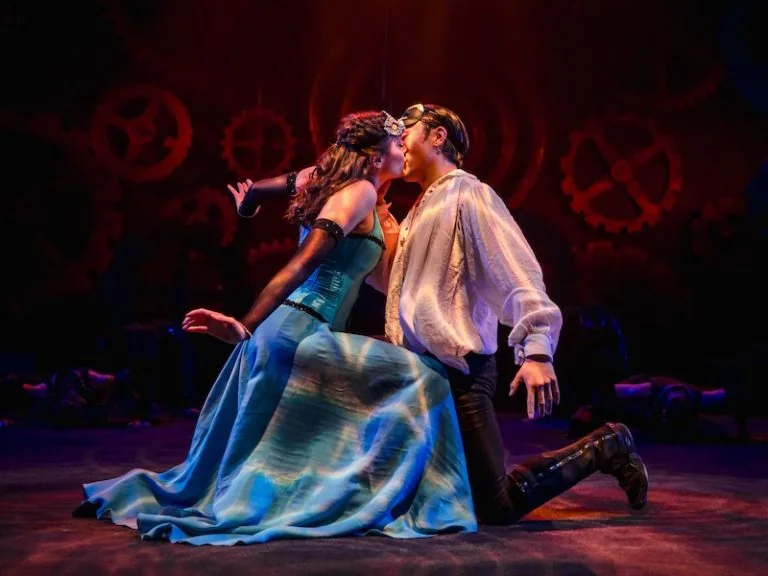
What is Shakespeare without the Bard’s words? Director Paata Tsikurishvili’s Romeo & Juliet at Synetic Theater dares to imagine a Shakespearean tragedy without witty wisecracks or romantic lamentation. The dance-based performance tells the familiar tale with no dialogue, expressing the action and drama of the story through mesmerizing movement, deliberate lighting and sound design, and powerful performances from a cast that knows how to convey emotion without a single word.

The great emphasis of this performance is time. The set design is industrial and sparse, consisting almost solely of large clock gears and a swinging pendulum. Tsikurishvili is keen to introduce time as a character itself — one could say the ultimate villain of the story. In many scenes, the two lovers, Zana Gankhuyag as Romeo and Irina Kavsadze as Juliet, whirl across the stage through shifting gears being spun by other dancers. In other scenes, the dance movements themselves become mechanical and robotic, mimicking the clicking gears of an unforgiving timepiece.

Without dialogue, the old story takes on a fresh simplicity. Plot points are condensed and a few characters are cut from the original material. This allows the show to cleanly and clearly reflect the conflicts and tensions of the story without words. Familiarity with the storyline is a plus, but even for those who haven’t read the star-crossed lovers’ tale in quite some time, the story is easy to follow. Tsikurishvili somehow makes the story feel more timeless than ever in a performance that transcends language.

This presentation of Romeo & Juliet is gritty, dark, and eerie. Without the flowery prose and dirty jokes of the original play, this rendition could easily descend into a place completely grim and hopeless, but moments of humor save it from this fate. Mercutio, played by Tony Amante, brings much-needed comic relief with his electric performance. Amante is lively and hilarious, a feat all the more impressive when you consider he did it without speaking a word. Another performance that brightens up the show is Janine Baumgardner as Nurse. Small moments of physical humor that she brings to the stage are just enough to occasionally make us forget the true tragedy of this tale.

Sound design is crucial to a wordless show, and Konstantine Lortkipanidze (with additional design from Irakli Kavsadze and Paata Tsikurishvili) does a spectacular job of providing the soundtrack. An unusual touch is a beeping sound that returns over and over during moments of intensity, a raw noise that at first might make you think, “Who forgot to turn their phone off?” It’s a jarring and off-putting use of sound, but the unconventional method creates a bleakness that adds a rich texture to the performance. The lighting design by Brian S. Allard adds to the mood, at times making the stage feel completely eerie and spectral.

The performances of the two star-crossed lovers are extraordinary. Irina Kavadsze as Juliet brings a lightness and innocence to the stage, and Zana Gankhuyag is just as sure-footed and confident as you would want a Romeo to be. Their movements are precise and unfaltering. The show excels with a particularly striking scene that uses shadow to convey a moment of intimacy between the two, a moving display that was one of the most memorable points of the performance.

This production of Romeo & Juliet has been brought back to the stage at Synetic Theater many times since its first performance in 2008. This is the last time it will open at the Crystal City location, as Synetic Theater will be on the move as of April. This bittersweet occasion makes the show feel even more powerful and exciting. Just as Romeo and Juliet run out the clock, so does the Synetic Theater company. However, while the ending is tragic for our Shakespearean lovers, the Synetic Theater is sure to use this as a fresh start, a chance to explore new venues and new ideas, and if Romeo and Juliet is anything to go off of, I’m sure whatever they do next will be fantastic.

How It Feels to Flee LGBTQ+ Persecution: Kendra Frith Shares Her Story

By Abby Stuckrath

This article was originally published in Tagg Magazine here.

Elated over her success in organizing the first Jamaican Pride celebration, Kendra Frith drove home believing she made a difference for her conservative community. It wasn’t until a police officer pulled her over that her bubble of hope burst. 

She remembers the officer gesturing to the backseat, asking why she had a pride flag. “He said I should be careful because it could have been a different police officer, and things could have gone differently,” recalled Frith. 

It was this moment that made Frith begin to seriously question the role of the Jamaican Police to serve and protect all persons in the country. “It made me feel threatened,” she said.

Still, when Frith bought her round-trip ticket to the United States two years later, she had no intention of leaving home for good. Eight years after arriving, Frith has yet to board her return flight.  “I came to the U.S. on a round-trip ticket just to chill,” she shares. “When I was here, things just got worse back home, and I was like, ‘Okay, I can’t go back.’”

With the help of the Rainbow Railroad—a nonprofit organization dedicated to assisting LGBTQ+ individuals escaping state-sponsored violence—Frith was able to stay in the U.S. and request asylum. 

“I wanted to stay [in Jamaica] and help make my country better,” says Frith. “Nobody wants to leave their home and leave everything behind.” 

Frith’s brother, Christopher, said her departure was devastating. “It was not easy watching her leave,” he says. “It was extremely difficult for not only me but our entire family.”

Even with the help of Rainbow Railroad, Frith’s transition wasn’t smooth. Living in New York City as an undocumented immigrant was extremely isolating. After three years of constant workplace abuse and missing the death and funeral of her grandmother, Frith attempted to take her own life. “I ended up in the hospital, and I was there for two days. After I started to get therapy, I realized that I have a new chance at life,” says Frith. 

Frith’s new chance began with moving to Virginia and later working for the same organization that helped her stay in the United States, Rainbow Railroad. As the Senior Engagement Officer, she helps refugees settle into their new lives and offers them the support system she didn’t have. 

But Frith isn’t new to the LGBTQ+ advocacy scene; back in Jamaica, it was her entire career. She worked with Jamaican LGBTQ+ organizations JFlag, Color Pink, and WE-Change. “I’m glad that I was able to be part of that organization, but it’s also the reason why I am no longer in Jamaica,” says Frith. 

Virginia brought Frith more than just a job. It also introduced her to her partner, Kelly Richards. Richards also fled Jamaica due to multiple threats against her life as a masculine-presenting queer woman. Introduced by Frith’s uncle, Frith helped Richards build her U.S. asylum case. 

“I fell in love first,” Richard shares. “Her personality and willingness to help made me want to hold on to her.” 

From assisting her partner to becoming a mentor to new Rainbow Railroad refugees, Frith loves helping others bear the burden and stress of starting over. 

Frith remembers welcoming the first member of their program at the airport. She recalls him running to her and falling into her arms, desperately crying thank you over and over again. “I was just like, ‘Okay, this is it, like this is it.’ The hug was like a weight. I was able to take something away from him,” says Frith. 

After eight years in the United States, Frith’s asylum case is still pending. Nowadays, she connects to her Jamaican roots by eating Richard’s delicious curried goat recipes and listening to old-school reggae.

Come and Get It: A Novel

By Haley Huchler

This article was originally published in the Washington Independent Review of Books here.

It’s nearly impossible for me to resist a good campus novel. Any setting that throws together people from different backgrounds and cultures is bound to create the sparks required for interesting literature. In Come & Get It, author Kiley Reid takes full advantage of her college locale to craft a drama fueled by the financial tensions her compelling, complicated characters endure.

Reid’s sophomore effort has been eagerly anticipated since the success of her debut, Such a Fun Age, about a young Black woman entangled in the lives of the wealthy white family she nannies for in Philadelphia. Come & Get It returns to the author’s fascination with issues of race, privilege, and class, this time at the University of Arkansas. The narrative alternates among the perspectives of three women: Millie, a student and resident assistant saving up to buy her own house; Agatha, a writer and visiting professor dealing with a recent breakup; and Kennedy, a transfer student struggling to adjust and make friends.

The story begins with Agatha interviewing three undergrads in Millie’s dorm for a book she’s writing on weddings. After they pepper her with anecdotes about “practice paychecks” from their parents and the “fun money” they earn at their campus jobs, though, Agatha leaves the interview more interested in the girls’ economic backgrounds. She enlists Millie’s help to continue listening in on the lives of these wealthy, out-of-touch students. Soon, both Agatha’s book project and her relationship with Millie get messy.

Abundant references to contemporary books, movies, and brands make the novel feel truly of-the-moment. Reid leaves the reader with no doubt that her story is anchored in a specific time and place. Birkenstocks, “Pitch Perfect 2,” and Victoria’s Secret all appear within the first two pages; Millie’s bookshelf holds Americanah, Sweetbitter, and The Omnivore’s Dilemma; and Kennedy’s homesickness is personified by her weeknight plan to watch “27 Dresses” while her mother simultaneously streams it at home. Such specificity makes the characters feel incredibly real; anyone who’s spent time at a Southern university in the past few years would recognize them instantly.

This plethora of detail falls in line with Reid’s style of writing. You can be sure upon meeting any character that you’ll soon know everything about them, from where they grew up to what they ate for breakfast last Tuesday. These details are particularly important in illustrating the financial tensions at the heart of the story. For example, we learn that much of Agatha’s incompatibility with her former partner stems from their out-of-sync spending habits, and that Millie’s desire to save for a home drives her every decision. In Come & Get It, everything comes back to finances. Unfortunately, it’s not always clear why.

Unexpected plot twists also make this a slightly darker book than readers might initially expect. In the first half of the novel, the stakes aren’t all that high — it feels almost like a character study — but a rapid turn of events shakes things up. While Reid certainly knows how to keep readers hooked, the story’s climax feels oddly disconnected from the book’s earlier acute emphasis on wealth (or lack thereof).

Despite the intense and unwavering focus Reid projects onto each character’s relationship with money, I can’t tell what she wants us to make of it all. Yes, Come & Get It presents a world divided by privilege and class, but it offers no conclusions. Getting to know Millie, Agatha, and Kennedy felt like peering into a zoo and being intrigued by the inhabitants’ understandable, sometimes deplorable behavior. You walk away entertained but unenlightened.

Nonetheless, it’s an enjoyable, easily digestible read with characters who’ll stick with you long after you’ve closed the book. And if you happen to be anywhere near an American college campus, you just may run into them.

Playwright Mike Bartlett asks if ‘Love, Love, Love’ is really all you need in new production at Studio Theatre

By Dillon Lewis 

This article was originally published in the The DC Line here.

In an oft-quoted 1780 letter to Abigail Adams, then-Envoy to France John Adams declared, “I must study Politicks and War, that my sons may have liberty to study Mathematicks and Philosophy … in order to give their Children a right to study Painting, Poetry, Musick, Architecture, Statuary, Tapestry and Porcelaine.” Adams’ attitude was emblematic of a new American ethos bent on building a better life for their progeny.

But in Love, Love, Love, playing through March 3 at Studio Theatre, British playwright Mike Bartlett dares to ask what happens when a prosperous generation fails to secure that life for their children, perhaps for the first time in modern history. Nevermind the play’s roots in the U.K. – the hard truths of blissful Boomer ignorance feel right at home on American soil, where those born between 1946 and 1964 possess half of the nation’s wealth. Despite this immense concentration of resources, Bartlett persuasively makes the case that the sorry state of =affairs for younger generations can be chalked up to the hedonistic entitlement of their parents, a corrupted carryover of free love and rebellion of the 1960s.

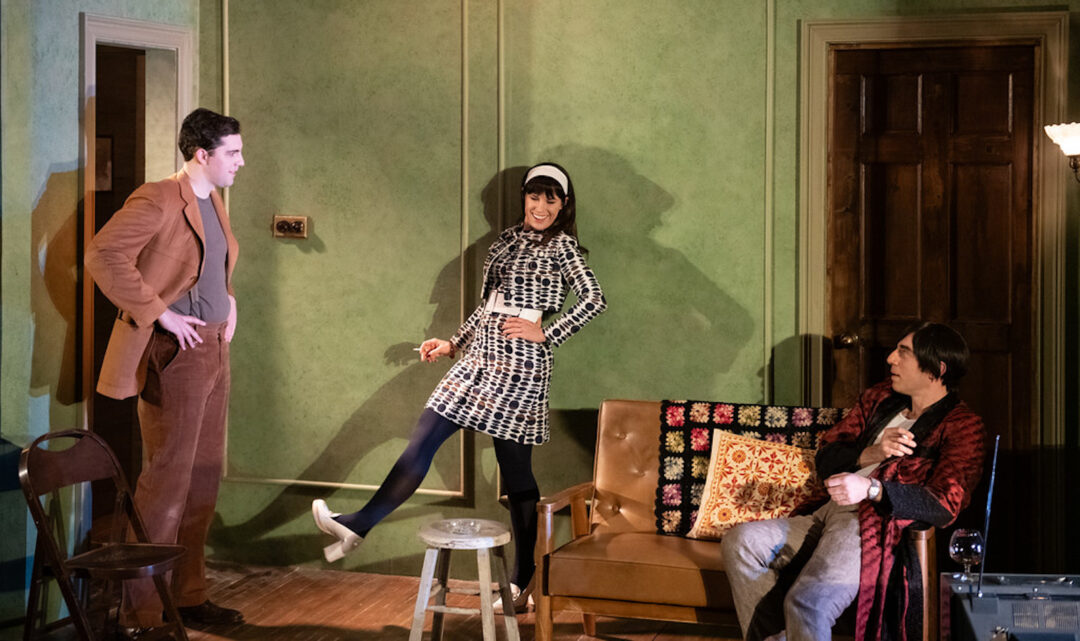
In a dingy London flat in 1967, long-haired Oxford student Kenneth (Max Gordon Moore) lounges on his brother’s couch, awestruck by a broadcast of Our World, the pioneering live multinational multi-satellite television program that saw the debut of The Beatles’ classic “All You Need Is Love.” Frustrated at his brother’s laziness, billboard installer Henry (Hunter Hoffman) admonishes Kenneth as a “layabout” who garners more cash through a government-funded scholarship than their working-class father earns at his job. Upon her arrival, Henry’s date Sandra (Liza J. Bennett), a 19-year-old Oxford student and second-wave feminist, is instantly taken with Kenneth’s progressive views and lack of concern about the future. After sending Henry out to pick up dinner, she and Kenneth begin an indulgent yearslong love affair that is marked by decadence, destruction and, eventually, divorce.

But Bartlett argues that old habits are hard to break, even among young iconoclasts. Kenneth and Sandra’s radical independence undergoes a two-decade transformation into boredom-driven infidelity and self-centered flippancy during the first of two intermissions. Having moved out of London to suburban Reading, their tastes — and attitudes — have changed with both the times and their economic prosperity. An old record player is replaced by a large stereo; plain walls painted mushy-pea green give way to chic wood paneling with abstract art; and cheap Irish whiskey cut with ginger ale is tossed in favor of French red wine. Most strikingly, bold patterns and casual clothing are swapped for chic business attire and private school uniforms worn by their two teenage children, Jamie (Max Jackson) and Rose (Madeline Seidman). And despite every indication that their kids are deteriorating faster than the likelihood of a Beatles reunion, Sandra assures herself that her broken family is superior to the loud, less affluent family who lives next door — she and Kenneth, after all, yell at each other only inside the house.

After two acts fueled by Kenneth and Sandra’s ruthless narcissism, Bartlett focuses the final act on taking a hammer to the elaborate facade they have erected of a successful family — despite the intervening decades they have spent as exes. Returning home for her Uncle Henry’s funeral, Rose — now approaching her middle years — seizes the opportunity to usher in a comeuppance of her parents, who are enjoying cozy retirements in their spacious homes. She makes a shocking ask: that her affluent parents buy her a home in London, relieving her of the financial struggle that accompanies the music career her parents encouraged her to pursue. Balking at her request, Sandra and Kenneth assert their strong work ethic as the driver of their prosperity, highlighting the advantages they provided to their daughter while ignoring the privileges they themselves enjoyed. Rose admonishes them for their selfishness, blaming them for her face-in-phone brother’s failure to launch and decrying their generation’s tendency toward accumulation. They consider her request and its accompanying criticism only briefly and not very seriously. And in a striking final moment, they ponder what they may instead do with the rest of their lives and their money, blissfully dancing to “All You Need Is Love” in the shadows of accumulated wealth and the frowns of their damaged children.

Directed by Artistic Director David Muse, Love, Love, Love is a bold choice for Studio Theatre. Aside from the obvious indicators of gentrification and a widening wealth gap that can be seen just outside of the theater’s 14th Street doors, regional theaters throughout the United States have long relied on the very age group Bartlett appears to be chiding. As theaters across the U.S. have grappled with identifying a sustainable audience model, ticket prices have continued to rise, putting an evening at the theater further out of economic reach for many would-be theatergoers of Rose’s and Jamie’s generation. But, if the theater is meant to inspire conversations and hold a mirror to its audience, then the selection of Love, Love, Love pays off immensely. Audiences may very well feel the tension in the room shifting, even as the bad behavior of Bartlett’s Boomer proxies becomes more and more outlandish.

It is in that behavior that Bartlett and Muse may sacrifice a portion of their audience. Though Sandra and Kenneth’s entitlement is often deeply funny, the play never fully transcends into the kind of encompassing satire that would allow Kenneth and Sandra to become sufficient stand-ins for their generation. By the end of the first act, Sandra and Kenneth are so singularly unlikable that audiences may not recognize themselves in the characters, let alone be primed for the kind of introspection that Bartlett practically begs for in the third act. Thankfully, the two subsequent acts are likely strong enough to solicit sufficient investment from a majority of the audience.

Without a doubt, Muse has assembled a first-rate cast to deliver the play. Though the accents may be spotty, the driving energy is not. Bennett is especially effective as Sandra, taking to heart the character’s pseudo-self-deprecating comment about her own chattiness. In all of Sandra’s conversational facets, whether they be flirtatious, brash or defensive, Bennett is an unstoppable force — even at Sandra’s most insufferable moments, Bennett is nothing short of engaging. Seidman’s performance is similarly engrossing. Always on the verge of tears, Seidman’s emotional Rose offers an earnestness and understanding of the larger world that neither of her parents is able to achieve. Her plea for assistance is not one of entitlement, as her parents would have you believe. It is of existential dispair. 

Muse has also engaged a talented corps of designers. Set designer Alexander Woodward leverages Studio’s Victor Shargai stage to underscore Bartlett’s critique of wealth hoarding. Beginning with an untidy, claustrophobic apartment, the size and chicness of Sandra and Kennth’s home grows in correlation with their affluence, culminating in a massive living room with two doors that open to a terrace. Notably, the ceiling continues to rise, lifting farther out of reach, accordingly. Costume designer Montana Levi Blanco nails the shifting fashion and economic landscapes the characters traverse. Lighting designer Cha See’s subtle but strong work is most effective in the play’s final moments. And sound designer Matthew M. Nielson’s use of period music as touchstones for each of the play’s three acts does well in setting both the time and mood of the onstage action.

That Bartlett chose to make “All You Need Is Love” the play’s functional theme song is a cheeky delight. While it certainly helps American audiences acclimate to the British ambiance, its self-reliant lyrics and assertion about the paramount importance of love more importantly offer an ironic throughline among such abundance. Bartlett asserts that a generation who proclaimed to need one thing has taken everything. In borrowing from the revolutionary spirit that was once a hallmark of those he takes to task, Bartlett is neither polite nor delicate in his critiques. But like finding himself at the bottom of a pyramid scheme, Bartlett asks an existential question on behalf of his generation: What’s left for us? Maybe love isn’t all you need.

One thing is clear: the kids are not OK, Boomer.