Browsing Category

Visual Arts

The Butch Boudoir Project is a Platform for Butch People to Be Unapologetically Themselves

By Clare Mulroy 

This article was first published March 29, 2021 in Tagg Magazine here.

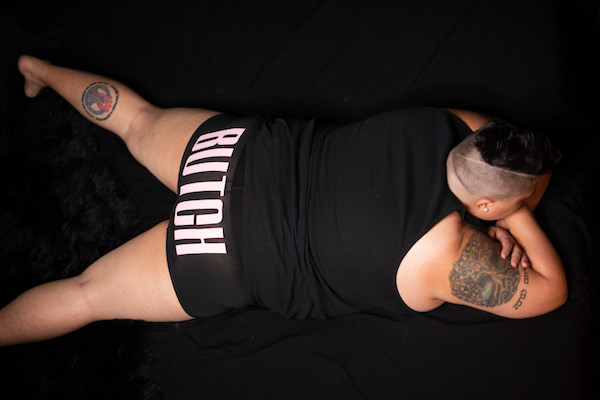
Though Gabby Horner has been “out” for over 20 years, she didn’t truly find herself until about five years ago. In the time since she’s been more comfortable identifying as butch, she’s made waves with the Butch Boudoir Project, a movement to empower butch and masculine people across gender identities.

The Butch Boudoir Project began two years ago as a photoshoot with photographer Graciela Valdes to expand the traditionally feminine concept of boudoir photos modeled by Horner herself. The revelation came when she was looking for inspiration on Pinterest and found virtually nothing.

“I can’t find butch women doing anything other than completely fully dressed, or they look like MMA fighters,” says Horner. She adds, “If I couldn’t really find anything on Google, it’s not enough.”

It was then that Horner and Valdes realized this was much bigger than just one photoshoot. The “impressive” reaction made her realize that butch visibility needed a bigger platform. Her next endeavor was an Instagram account for the project.

“The only thing I had access to was myself, [so] the only thing I could do was continue to showcase myself,” she explains. “So I started pushing myself and my boundaries to take more photos of my daily life.”

But from the moment the project became more than just one photography session, Horner knew it had to be bigger than just herself. She gathered a group of friends, known affectionately as the #ButchCrew, for another photoshoot set in a barber shop. In between haircuts and a candidly-shot game of pool, Horner says the “butch siblinghood” was powerful.

“That’s insanely underrepresented. I think it tears down toxic masculinity that is sadly common that a lot of butch people feel intimidated by other butch people,” says Horner. She adds, “Those types of toxic concepts are totally shattered if you can get a group of us together, hanging out, being friends.”

Now with over 3,000 followers on Instagram, the Butch Boudoir Project has become a hub for virtual discussions and questions. The questions have ranged from a humorous “Are you single?” to inquiries about how to best support butch people in your life.

“I thought about butch visibility, I thought about being able to see people like me,” she explains. “But I did not think about people who are attracted to butch people having questions and needing to see that representation as well.”

By nature, this is a particularly personal project for Horner, who is a graphic designer by trade and the co-founder and vice chair of Ignite Community Services.

Horner identified as a “tomboy” at a young age but struggled with how her discomfort with femininity fit in with her gender identity.

“I thought you couldn’t be a girl and also want those things,” Horner says. “I firmly identify with being a woman, and that’s not a question for me, but I don’t identify with being feminine.”

That changed when she found other people who celebrate masculinity within their womanhood and individuals who prefer gender-neutral terms. Now, at 35, Horner says it’s an indescribable feeling when someone tells her she’s handsome.

Next year, she is looking forward to creating a calendar featuring the growing #ButchCrew. The Butch Boudoir Project will likely expand to more in-person conversations when the coronavirus pandemic ends. However, the virtual community they have online is something she never wants to abandon.

“Those conversations are also a big deal, they’re important,” says Horner.
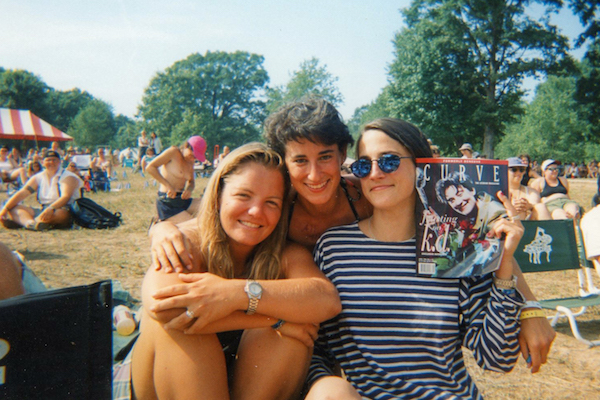
Ahead of the Curve is the Story of Franco Stevens, Curve Magazine, and Lesbian Visibility

By Clare Mulroy

This article was first published March 17, 2021 in Tagg Magazine here

Jen Rainin had no directing experience before taking on Ahead of the Curve, but she knew it was a story she had to tell.

Her wife, Frances “Franco” Stevens, the founder of Curve Magazine, told stories over the years — taking out a dozen credit cards and betting on horses to come up with money for the magazine. She won three times and used her winnings to launch Curve Magazine (formerly Deneuve) in 1991.

Armed with these stories and a garage full of archives from Stevens’ life, Rainin spent the next three years making the documentary, which is set for its worldwide premiere on Apple TV and Amazon Prime on June 1.

“As I was researching for it, I realized how little our history as queer women has been documented,” she explains. “I realized I actually think I owe it to the community to tell this story first as a nonfiction film.”

Rainin says the best part of creating Ahead of the Curve was learning about her wife through the eyes of those who knew her decades before the two met.

“She has such trust in me. She knew that I was going to tell a balanced and fair and honest story,” Rainin says. “She’s a badass, but she’s a flawed human, like everybody, and she wanted people to see that.”

The filming and post-production process had its own plot twists, however. During filming, Stevens received an email from the current owner of Curve Magazine saying that the magazine might not be able to survive another year. Stevens sold the magazine in 2010 after a disabling injury.

The coronavirus pandemic also modified the film’s festival circuit. The crew was set for a grand debut at The Castro Theatre in San Francisco for Frameline44, but when in- person events closed, co-director and producer Rivkah Beth Medow suggested changing the event to a drive-in screening. The event was held on the day originally slated for Dyke March, and the audience rolled up decked out in pride and protest gear.

“We’re focused on making sure that our historical stories and our present-day stories are told and shouted from the rooftops,” Rainin says.

PBS Spotlights Local Black Artists in New Documentary, Kindred Spirits

By Kelly McDonnell

This article was first published February 4, 2021 in The DC Line here.

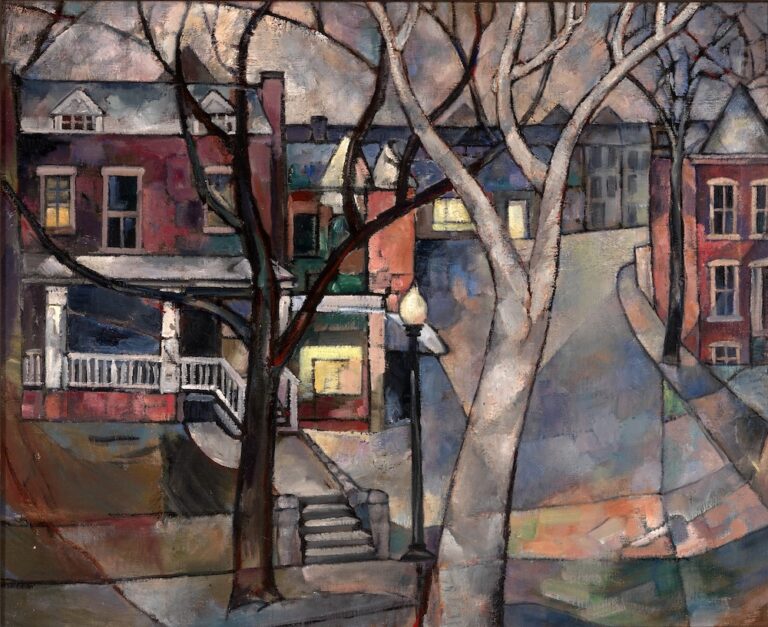
When documentary filmmaker Cintia Cabib was showcasing two films at the Historical Society of Washington, D.C.’s 2014 conference on local history, she spotted an intriguing painting of the corner of Rhode Island Avenue and 3rd Street NW while perusing a small brochure. The modernist, geometric red hues of homes lining the LeDroit Park street and a gleaming, leafless tree bisecting the frame compelled Cabib to explore the work of the artist, Hilda Wilkinson Brown.

Years of research culminated in a new documentary produced and directed by Cabib called Kindred Spirits: Artists Hilda Wilkinson Brown and Lilian Thomas Burwell. The short film is being broadcast locally by PBS stations WHUT and MPT on Feb. 4 and by WETA’s World Channel on Feb. 10. PBS stations around the country have scheduled airings of the film for Black History Month programming.

The film rediscovers Brown, a mid-20th-century artist who painted DC’s neighborhoods and scenery; was a professor at Miner Teachers College in DC at a time when schools were segregated; and influenced her niece, Lilian Thomas Burwell, to become an artist as well.

Hilda Wilkinson Brown’s “Third and Rhode Island,” oil on canvas, is in the collection of the Smithsonian American Art Museum as a gift of Lilian Thomas Burwell. (Image courtesy of Lilian Thomas Burwell)

In the film, Burwell, now 93 years old, recalls the life and artistry of her aunt and talks about growing up in DC — struggling against segregation and discrimination as she pursued her own abstract expressionist art career.

Cabib said her goal with this film was to bring both women’s art into public view. Brown has pieces in collections of the Smithsonian American Art Museum and the Metropolitan Museum of Art in New York. Her piece Third and Rhode Island, which initially caught Cabib’s eye, is part of a traveling exhibit by the Smithsonian. Burwell is opening a new exhibit of her abstract pieces in the Berry Campbell Gallery in New York City in April.

Cabib believes both women deserve more credit, especially during Black History Month.

“I hope [the film] makes people think about other Black artists,” Cabib said. “Who else has been unrecognized? Who else is out there?”

The influence that Brown and Burwell had in nurturing Black artists still resonates in DC’s artistic space. As an educator, Brown encouraged many Black women to pursue careers despite discriminatory and segregationist barriers. Burwell also taught art for years, building on the legacy of her aunt. Alongside its exploration of these women’s histories, Cabib’s film also details the stories of the historic Black institutions and neighborhoods that shaped their artwork.

The documentary shows that Brown’s work was celebrated in the Barnett Aden Gallery, the nation’s first Black, privately owned gallery. It opened in LeDroit Park as an integrated art space and after World War II became primarily an exhibitor for Black artists who were rejected from white-owned galleries. Cabib said she wanted to feature the history of the LeDroit Park neighborhood, which was bursting with Black creatives like Brown, scientists, civil rights activists and more.

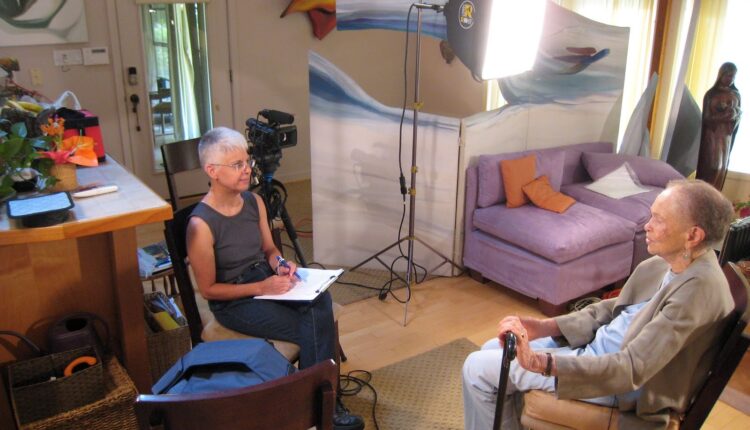
Documentary filmmaker Cintia Cabib interviews Lilian Thomas Burwell at her home in Highland Beach, Maryland. (Photo by John Z. Wetmore courtesy of Cintia Cabib)

Brown’s artwork was featured during her lifetime in The Crisis, the official NAACP publication founded by W.E.B. Du Bois, and The Brownies’ Book, the first magazine for Black children.

“It’s important to recognize the opportunities Black people made for themselves and each other after they’d been denied,” Cabib said.

The documentary was an official selection of the Martha’s Vineyard African American Film Festival and has been shown locally at events like the DC Black Film Festival and Alexandria Film Festival

Cabib was able to host one in-person screening of Kindred Spirits at the Avalon Theatre in March 2020, just before DC declared a public health emergency due to the COVID-19 pandemic. The film was shown to high school students, and Cabib said she was encouraged by the attendees’ questions and engagements with the film and history. At subsequent virtual screenings, Cabib said Lilian was able to join discussions and share more of her story with audiences. 

Cabib’s story came full circle in November when she showcased her film virtually at the 2020 DC History Conference, bringing Brown’s and Burwell’s stories into focus — not just in a brochure, but on screen.

Breaking Gender Norms: Mainstream Invisibility of Black LGBTQ Fashion

By Kelly McDonnell

This article was first published January 28, 2021 in Tagg Magazine here.

When Harry Styles graced Vogue’s pages in a floor-length, faded blue gown in early November, social media and pop culture discourse erupted. Most fans were elated and praised Styles for his consistent disregard for gendered, masculinized fashion. In the interview, Styles says, “There’s so much joy to be had in playing with clothes. I’ve never thought too much about what it means.”

On the other side were people like Candace Owens, a politically conservative author, who ridiculed the end of “manly men” in a tweet that targeted Styles’ cover. Owens later went on to say during an Instagram livestream that she loved the dress, but that Harry didn’t look feminine, but just “stupid.”

Does breaking gender fashion norms contribute to a liberation of gender identities? When we ask questions like these, we seem to be focusing on white, cis-gendered celebrities, bestowing them praise and recognition for their one-night-only red carpet designs that bend fashion rules. It’s just enough to capture attention, but not enough to make anyone uncomfortable.

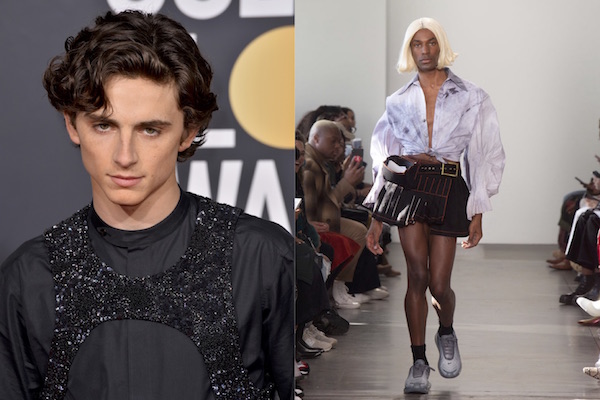
During the 2019 Golden Globes, actor Timothee Chalamet wore a glittering harness and received much love for embracing a feminine silhouette. At the same event, Julia Roberts wore pants (with a golden train skirt) and was met with equal attention for going after a masculine-type style.

Someone who consistently raises eyebrows for gender-breaking fashion is actor Billy Porter. He’s graced red carpets in dresses, skirts, feathers, sequins, and glitter. His outfits mix fabrics, colors, and shapes, and people always commend his style. However, the same praise for breaking norms isn’t always applied. No Twitter trends are amplified or debates started over his fashion, like what happened with Harry Styles.

Do we only give praise to straight celebrities who break from the binary of fashion when it’s unexpected? What about those who make it their mission to disregard gender when it comes to fashion?

We expect queer people to dress exuberantly, flamboyantly, outrageously, because the identities of LGBTQ people are also often viewed as “other.” When straight people adopt the fashion standards LGBTQ people created, they receive praise while Black, queer people are overlooked. They are not seen as the revolutionary icons that they truly are.

Paris Is Burning, the amazing documentary that glimpses briefly into the lives of many Black drag queens and queer men in the 1970s New York ballroom scene, showcases that gender bending fashion is not the product or brainchild of influential white celebrities but of less fortunate yet imaginatively creative and resourceful young Black people competing for recognition and self-identification.

One notable figure in Black queer history and in fashion was Dorian Corey who stars in Paris Is Burning.

When talking about fashion in the film, Corey says, “Black people have a hard time getting anywhere, and those that do are usually straight. In a ballroom, you can be anything you want. You’re not really an executive, but you’re looking like an executive. You’re showing the straight world that, ‘I can be an executive if I had the opportunity because I can look like one,’ and that is like a fulfillment.”

Over decades, Black women have been the ones altering fashion trends. Starting in the 1930s, Josephine Baker embraced feminine glamour while also trending towards clothes that emphasized her boyish facial features. In the 1940s, blues icon Gladys Bentley, who openly shared her queer identity, dressed often in pantsuits and top hats for performances, though she rarely received the red carpet credit for breaking the rules that white celebrities constantly get today. Androgynous style is still empowered by Black stars like Janet Jackson and Rihanna.

When Rihanna began her own fashion lingerie company, Fenty, she became the first Black woman in charge of a major luxury fashion house. In an interview with the New York Times, she catalogued her simplistic view of fashion: “It’s sweatpants with pearls, or a masculine denim jacket with a corset. I feel like we live in a world where people are embracing every bit of who they are.”

That idea, of embracing yourself, despite racial discrimination or gender boundaries, is why so many Black LGBTQ people use fashion to rebuke gender binary ideologies in culture. It’s not about being reviewed on a red carpet look but about finding an authentic self.

Black gay designer Willi Smith is constantly overlooked for his Philadelphia-based fashion that introduced the concept of streetwear in the late 70s. His styles embraced varied body types, average fabrics, and mixed patterns to encourage the everyday lay person to break gender binaries in fashion.

Today, a Los Angeles brand named No Sesso, which translates from Italian to “No Sex,” embraces agender fashion styles. Designed by Pierre Davis, who is a Black trans woman, these styles upcycle fabric that can fit any body, as long as it makes them happy.

Black LGBTQ designers have been and continue to be critical in expanding the fashion industry into one that allows white men like Harry Styles to wear dresses and receive praise. It’s encouraging that celebrities across race or gender identities are expanding their closets and bending gender norms, but the constant recognition of their images rather than the hard work and legacies of LGBTQ individuals, primarily Black people, jeopardizes any actuality of allowing fashion to be truly non-binary or racially conscious.

Love Wins: Travel Style Company Unveils Black LGBTQ Beach Towel

By Clare Mulroy

This article was first published January 9, 2021 in Tagg Magazine here.

Kinyatta Gray, founder of FlightsInStilettos, has a vision for the future of travel — accessories that look and feel representative of her customers.

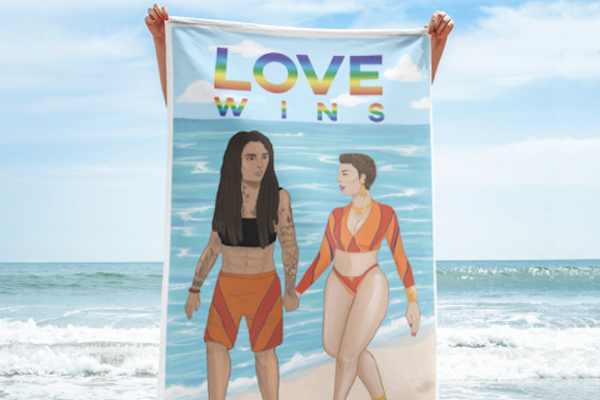
Her latest endeavor is the first ever LGBTQ beach towel that features a Black lesbian couple. Gray released the latest design, the “Love Wins” beach towel, as part of her 2021 Glam Girl Beach Towels collection. The “Love Wins” towel features a Black queer couple holding hands on the beach.

“You don’t see a lot of these images on beach towels at all, and then to drill down even deeper, you definitely don’t see a lot of images of people of color,” says Gray. “Go even deeper, [images of] Black lesbians…it does not exist.”

The design is inspired by Gray and her wife, who got married in 2017. Gray’s motivation was to create a towel that featured images of a lesbian couple, opposed to the typical pride colors or designs. The microfiber beach towel is also in response to the lack of images of people of color in travel accessories.

Since the release of the “Love Wins” towel, Gray says she is impressed by the outpouring of support from the community. Women who have similar hair or tattoos see themselves in the images represented in the new beach towels. The entire 2021 Glam Girl Collection features women of different races and body types sporting unique beach outfits.

“I’m very confident that it may really be one of the first beach towels that has that kind of image on it,” she says. “It’s almost shocking, and it’s surprising. [Customers] are like, ‘Gosh, someone is thinking about us.’” According to Gray, she even submitted the towel to the Guiness Book of World Records to confirm the “Love Wins” towel as the first ever Black LGBTQ beach towel.

Not only does Gray incorporate representation in the images of women, she also tries to weave it throughout her entire business. FlightsInStiletto originally started as a travel blog but quickly turned into a brand once Gray realized that she didn’t see a lot of accessories that represented her or reflected her personal style.

She began designing products in mid 2018. Now in 2020, FlightsInStilettos has appeared in New York Fashion Week and has a growing presence online. Between customizable luggage sets and the “Traveling Tiaras” children’s travel accessories with images of young jet-setting girls of color, Gray’s mission is to incorporate representation of her customer base and her own travel style.

Ultimately, Gray believes there is an opportunity for the entire fashion and travel industry to step up and increase representation.

“I think there are a lot of organizations that are really stepping up to the forefront. [We need] to see advertising, and clothing and all kinds of travel destinations that really speak to you and let you know, ‘Hey, you are welcome,’” says Gray. “It’s something that we’re seeing more and more, but we can always do better.”

OML’s New Series Dating ‘In’ Place Explores Romance in the Age of Covid

By Clare Mulroy

This article was first published November 20, 2020 in Tagg Magazine here.

While many film and TV productions are halting due to the coronavirus pandemic, OML’s Dating ‘In’ Place incorporates the pandemic into the central storyline. The 10-episode comedy series, which debuted on Revry on November 1, follows two women exploring long-distance dating as the coronavirus pandemic turns their worlds upside down.

Dating ‘In’ Place was created by actress and producer Shantell “Yaz” Abeydeera and Marina Rice Bader. The cast and crew filmed and produced the entire series remotely, with meetings and rehearsal done over Zoom and filming done individually on HD smartphone cameras.

According to Abeydeera, the process was challenging as both an actor and producer. Post-production file transfers sometimes had to be done standing in the street with masks on, passing drives back and forth.

“As the actor, we had to do everything: setting up the lighting, the audio, all that kind of stuff,” Abeydeera says. “Some of the shots took almost two hours to set up and then the other actor would call in…and you would act for seven minutes.”

Still, the payoff was big. Abeydeera had never even been in the same room as her co-star, Emily Goss, when the two played characters falling in love. Despite the physical distance and virtual acting, Abeydeera says that she loves the energy the cast created and the chemistry they were able to find.

The content creator says she is grateful for the chance to get to tell queer stories during such an unprecedented time. The reason for making it a comedy and love story was simple — to show how connection was possible amid seemingly impossible circumstances.

“At the beginning of the pandemic I felt like everyone was really scared and everyone was spending an exorbitant amount of time online,” Abeydeera says. “What I saw was that people really needed a distraction…something else that they can hold onto that felt positive within the negative.”

Writing the series amid a pandemic also gave Abeydeera a chance to reflect on her own life. She knows living with her wife in Los Angeles means that they have the privilege of walking down the street holding hands without fear of harassment. Others don’t have the same opportunity.

“I understand that there are people all over the world that go to digital platforms to find content like this, to find answers,” she says. “And also so that they don’t feel alone.”

Queer representation is “everything” she says, but being able to tell those stories on a platform like Revry, which is ad supported by companies that support the LGBTQ community is equally important.

Abeydeera also serves as director of content and partnerships at OML, which provides free, accessible LGBTQ content to 186 different countries worldwide. According to OML’s website, its mission is to aggregate quality LGBTQ content in one place for the community to find and enjoy.

“This is specifically what I want to be doing,” she says. “I want to be making queer content and I want to be serving my community and making the stuff that I didn’t get to see when I was younger.”

LGBTQ History: Compton Cafeteria Riots

By Kelly McDonnell 

This article was first published October 20, 2020 in Tagg Magazine here.

Three years before the Stonewall Riots, transgender activists fought police brutality in San Francisco.

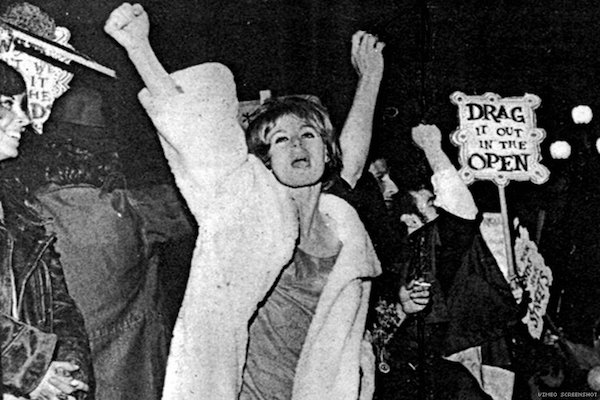
In San Francisco, 1966, transwomen resisted police intimidation and brutality outside of a popular LGBTQ gathering spot and all-night diner.

Gene Compton’s restaurant chain was a popular spot for transgender women, who had been denied entry to gay bars, to hang out, but management frequently called police on transgender patrons. Police arrested transwomen for the crime “female impersonation” because cross-dressing was illegal.

Transgender and gay people picketed police injustice and the restaurant’s management outside of Compton’s Cafeteria. Police arrived and attempted to arrest protesters, then one transwoman threw coffee at the police. A multi-day riot began, though it’s unclear for how long or how intense the protests were since police records of the year no longer exist, and the event wasn’t covered by newspapers.

A plaque at the former Compton’s Cafeteria site says, “Here marks the site of Gene Compton’s Cafeteria where a riot took place one August night when transgender women and gay men stood up for their rights and fought against police brutality, poverty, oppression and discrimination.”

Many people involved in the riot were part of the first American gay youth organization, Vanguard, founded in 1965. Vanguard and the Glide Memorial United Methodist Church organized multiple equal rights protests against businesses that refused to serve LGBTQ people.

Documentary filmmakers Susan Stryker and Victor Silverman interviewed riot survivors and local transwomen of the San Francisco Tenderloin District for her 2005 film, Screaming Queens: The Riot at Compton’s Cafeteria.