Browsing Category

Visual Arts

Centuries: Imagining Black Women Cycling Across Time

by Oluseyi Akinyode

This article was originally published in DC Trending, here.

Walking on the trails near home, I’m filled with longing as cyclists swish by. There’s something about riding a bike — You can cover more terrain than by walking. Two weeks ago, I took the first step to fulfill that yearning by taking an adult biking class for beginners with a group of about 20 sponsored by the Washington Area Bicyclist Association (WABA). The group included ten Black people, and eight of them were women. It’s a rarely represented activity in my daily life and one that I find compelling given the perception that Black women don’t ride.

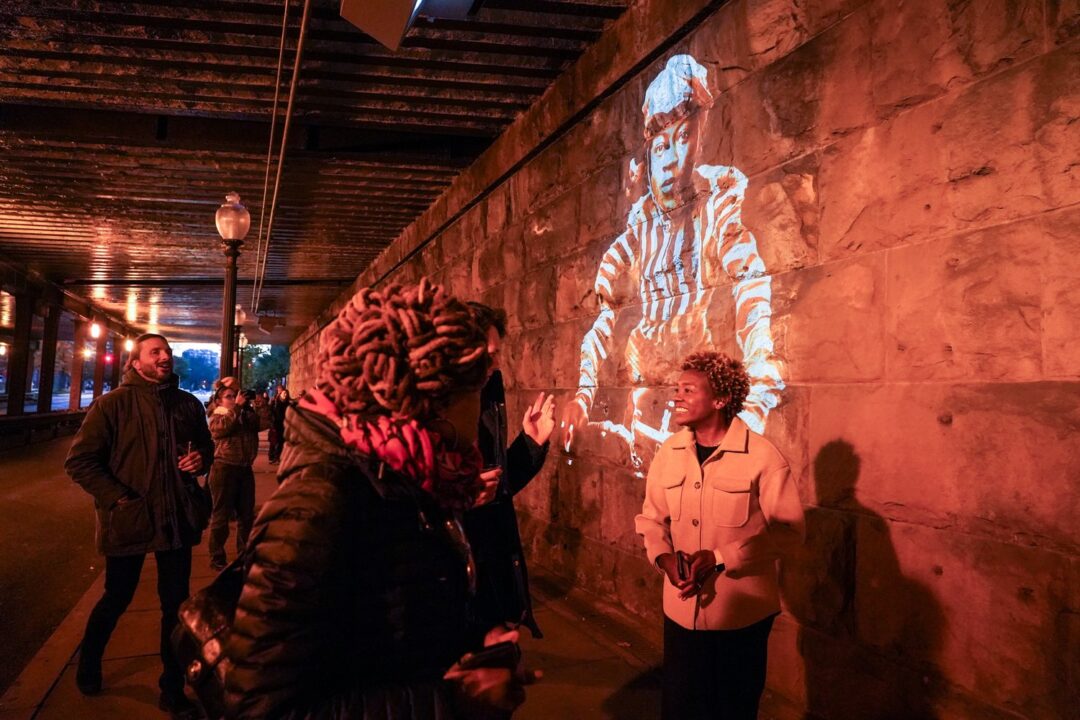
As part of my biking journey, I was intrigued to go check out Centuries, an immersive digital art installation by Nekisha Durrett at the K Street Virtual Gallery, honoring five Black women cyclists (Marylou Jackson, Velma Jackson, Ethyl Miller, Leolya Nelson, Constance White) who biked on a 250-mile journey over three days from NYC to Washington, DC in 1928.

Cycling represents not just physical mobility but also socio-economic mobility. It signifies the presence of leisure time beyond daily responsibilities and the presence of expendable income. It also lends itself to exploration and movement through space without barriers. The journey of these five Black women takes on audacious meaning considering the social and racial climate then. 

The K Street Virtual Gallery is an initiative by NoMaBid that allows artists to create digital art installations projected onto the K Street underpass that sits between First and Second Streets NE as part of a broader revitalization of the area. According to the virtual gallery creators, it was their goal to create a space where people could stop, reflect, and enjoy their day. NoMa BID President Maura Brophy explained, “The gallery brings light and color to an otherwise dark space, but the rotating exhibits allow us to use the space to bring new pieces to the gallery and tell unique stories. The exhibits will change over time, allowing people to experience something new and exciting with each piece.”

The first K Street Virgual Gallery installation was created by artist My Ly, who used abstract colors and shapes moving across the walls of the underpass to render the multiplicities of transportation modes in the underpass. 

This second installation, entitled Centuries and created by Durrett, continues the theme of movement from a different perspective by paying homage to the journeys of these five Black female cyclists. Projected onto the rough-hewn stones of the underpass are AI-generated images of ten Black women cyclists dressed in period outfits spanning the past to the future. The selection includes a cyclist from Victorian times, a nod to the possibility that Black women have ridden earlier than imagined. Texts like “WE OUTSIDE WE OUTSIDE” and “BLACK WOMEN CYCLE” amplify the theme of stories in motion. 

A challenging cycling traverse was among the inspirations for Durrett’s installation. On a ride, the artist recalls suddenly hearing shouts from a group of Black women cyclists above — “Sis, you’ve got this; you’re so close. You’re walking the path of your ancestors.” Durrett believed that only with their encouragement did she emerge from the traverse. She shared that her goal for the exhibit was to remind us that “the paths we take have been paved by those who have gone before.”

This installation is in keeping with past works by the artist, such as Go-Go Belongs Here at the National Portrait Gallery, True Grit at James Madison University, and Don’t Forget to Remember (Me) in the cloisters at Bryn Mawr College. Employing text, materials, and imagery, these narratives tell the stories of individuals who have been forgotten while also envisioning limitless possibilities for the future that incorporate their unique experiences.

Durrett used AI to overcome artistic limitations, intending only to include photographs of Black women in the installation. However, the only available photo, most likely sourced from a Newspaper microfiche, was of poor quality and not suitable for reproduction. So Durett opted to use Midjourney, an AI application that generates images from texts. This allowed her to vividly portray Black women cycling, tying into Durrett’s practice of imagined realities. While sifting through AI-generated images for the installation, the artist couldn’t find images that captured her vision. So instead, she trained the AI model by inputting specific phrases to generate the images of the ten Black women featured in the installation. This experience serves as a reminder that the experiences of Black individuals may often be overlooked or forgotten in a rapidly advancing world driven by AI technology.

Given its recent past as a homeless encampment, an underpass filled only with passersby would be inadequate. The K Street Gallery is a clever approach that reflects a myriad of the city’s perspectives all the while embacing goals for redevelopment. In the future, after learning to ride, I may be one of those cyclists riding through the K Street underpass, continuing the journey of those who came before. 

The K Street Gallery will feature a roster of installations by artists throughout the year. Artists, artist teams, and designers interested in participating in the K Street Virtual Gallery can contact events@nomabid.com. Centuries will be running for the next six months at the K Street Gallery, located close to 100 K St NE.

Transgender Massage Therapists Share Tips On How to Find LGBTQ+ Friendly Services

By Abby Stuckrath

This article was originally published in Tagg Magazine, here.

LGBTQ+ massage therapists are creating new spaces for queer and transgender patients to feel not just accepted but seen. As practitioners work to craft gender-affirming spaces, there are multiple tactics that LBGTQ+ clients can use to ensure adequate care. 

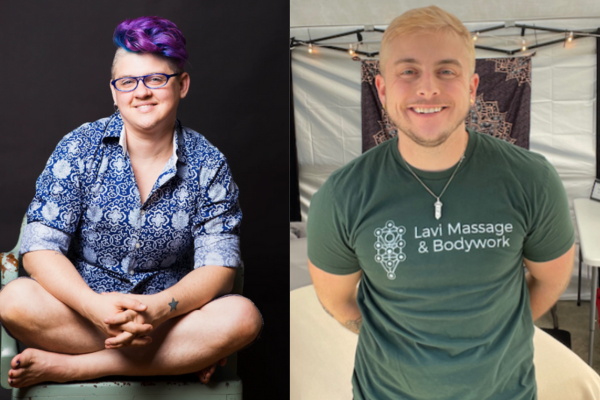
Frances Reed, a massage therapist and educator in Washington, D.C. is teaching a new generation of LGBTQ+ inclusive practitioners, as well as leading medical research behind chest binding health. 

Washington D.C. is the only state or district that requires LGBTQ+ competency training for massage therapy licensure, says Reed. Anyone not living in the D.C., is left with the burden of educating therapists on transgender and queer care. 

Reed teaches that long-term binder compression can cause upper chest and back pain, as well as other serious health issues such as shortness of breath and loss of sensation in arms or fingers. Massaging the chest area can help mitigate chronic pain and significantly increase quality of life for binding individuals. 

To make sure that transmasc and genderqueer folks are receiving adequate care, Reed suggests bringing their binders to the session. 

“Some massage therapists don’t know what a binder really is,” says Reed. “So they imagine something that is not usually accurate, and that will affect how they might go about treating pain that you’re having from binding.” 

Thomas Lavi, a transgender massage therapist based in Oakland, California, says those recovering from postoperative top surgery, must discuss their physical limitations or recovery methods with their therapists. 

“Often your range of motion is limited to the parallel with your shoulder, you wouldn’t wanna stretch someone up above their head,” says Lavi. 

Again, Lavi stresses that many practitioners won’t be familiar with these limitations, so patients must be prepared to educate them on the main protocols of post-operative care. 

For those unable to access an LGBTQ+ specialist, Lavi says there are three things to do and look for when looking for an inclusive therapist: check their vibe, check their license, and make sure they respect draping and clothing techniques. 

“You have the autonomy to wear anything that you want and any trained massage therapist should be able to work with articles of clothing,” says Lavi. “That’s totally okay. It shouldn’t affect the impact of the massage and if they tell you that it does, they’re lying and you shouldn’t work with them.”

Reed says that gender affirming therapy offices don’t just accept transgender existence but make transgender clients feel seen and heard.

“When spaces understand what it is to be trans in the world socially, what it is to be in a transitioning body, are comfortable talking about bodies in language that de-emphasizes gender; you’ve actually created an actively affirming space, not just a space without discrimination or harassment,” shares Reed. 

For those concerned about cost, Reed says that transgender and queer therapists often offer a sliding scale or scholarship system. 

“It’s hard to be really focused on queer and trans community and not see the economic disparity that exists and so most of us tend to respond to that with some kind of financial model that allows for support of people who can’t afford the full rate,” says Reed. 

Since many massage therapists lack in-depth knowledge of transgender and queer care, Lavi and Reed suggest finding an LGBTQ+ massage specialist. 

“We’re having to teach our doctors what it is to be trans, what it means and what we need and that’s why it’s so special to have a trans therapist who can take that load from you,” says Lavi.

D.C. Leaders Are Improving Food Security with LGBTQ+-Friendly Spaces

By Abby Stuckrath

This article was originally published in Tagg Magazine, here.

The D.C. LGBTQ+ Community Center’s  new collaboration with regional supermarket chain Wegman’s highlights food insecurity within the LGBTQ+ community and how Washington D.C. advocates are working to fight against it. 

One in four LGBTQ+ adults experience food insecurity, according to the Williams Institute. Kimberely Bush, Executive Director of the D.C. LGBTQ+ Community Center, says that food insecurity is one of the most pressing challenges for queer people. 

“Just waking up brown, black, a woman, non-binary, trans, queer, can definitely be a barrier to equal and fair housing, equal and fair job opportunities, access to resources, which directly contributes to food insecurity,” Bush told Tagg

Bush is leading the center’s new partnership with Wegmans. The supermarket chain will not only help supply food for the pantry but also provide nutritional cooking classes and support for their annual Thanksgiving dinner. 

Bush says the pantry will be a “one-stop-shop” for those searching for a new home or a place to feel loved and accepted. 

The COVID-19 pandemic has played a significant role in perpetuating food insecurity amongst the LGBTQ+ community. In a 2021 study by the Williams Institute, 20 percent of transgender individuals experienced food insecurity, compared to eight percent of cisgender adults. Moreover, LGBTQ+ people of color experienced food insecurity three times more than their white counterparts. 

Bush notes that she sees the everyday implications of these statistics at their food pantry. 

“Our brown, black, LGBTQ+ siblings who come into the center in search of food are exactly those members of our community,” says Bush. 

LGBTQ+ individuals’ ability to access nutrition programs and food pantries can be difficult, according to Alex Ashbrook, Root Causes and Specific Populations Director for the Food Research and Access Center.  

“The paperwork necessary to apply for programs may require someone to select an option that does not match their gender identity or a food pantry may be located in a faith-based institution that does not welcome or feel welcoming to LGBTQIA+ people,” Ashbrook wrote in a statement to Tagg

Bush says their pantry is made for this exact reason.

“We need a safe and affirming space to come to receive vital life and human services,” Bush notes. “It is paramount that we have access to healthy foods at no cost to our people.” 

In Washington, D.C., individuals in Ward 7 and 8, the largest majority Black neighborhoods, face disproportionate access to grocery stores. 

“​​There is only one full-service grocery store – a Giant on Alabama Ave – for 73 thousand residents compared to Ward 3, with 16 full-service grocery stores for 77 thousand residents,” Ashbrook said, citing a study conducted by D.C. Hunger Solution. 

Bush says that the pantry will work to target residents in these Wards and help provide them access to the center’s resources. 

“We want to make sure that all of our LGBTQ+ siblings in those Wards continue to be informed about our food pantry, as well as the upcoming educational opportunities we are planning,” Bush states. 

To support food security amongst the LGBTQ+ community, Ashbrook urges individuals to support the Equality Act — a bill that protects against discrimination based on gender and sexuality — and connect LGBTQ+ people to federal nutrition programs. 

For Bush, she is confident that their new space will help create a “healthy spirit that will feed them and feed their day to be able to wake up again and have a fighting chance of not only surviving but thriving.” 

The LGBTQ+ D.C. Community Center’s pantry will be launched at its new location, 1827 Wiltberger St. NW, Washington, DC on an undetermined date. 

At a new Picasso-inspired exhibit, an interesting conversation that’s missing context

By Jakob Cansler

This article was originally published in the DC Line here.

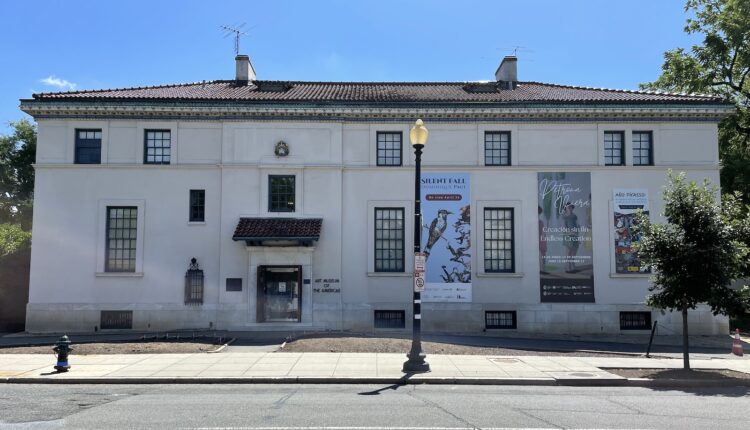
Tucked away in a small room on the third floor of the Art Museum of the Americas (AMA) is a series of works that all seem to be in dialogue with one another. Their media, style and color vary, but among them is a clue to their conversational starting point: a singular painting by Pablo Picasso.

The exhibit, titled Year of Picasso: A Dialog With the Americas, is being presented 50 years after Picasso’s death in 1973 and is one of dozens of exhibitions across Europe and North America celebrating the iconic artist. 

Unlike most of the other shows taking place this year, though, the exhibition at the AMA ⁠— a contemporary Latin American and Caribbean art museum that is part of the Organization of American States (OAS)⁠ — is focused almost exclusively on how Picasso and his work influenced artists in the Americas throughout the 20th century.

In 1973, three years before the museum opened, the OAS held a tribute exhibition to Picasso featuring works from all of the organization’s member states. Although much smaller in size and scope, A Dialog With the Americas is inspired by that exhibition.

The featured Picasso work is “L’aubade,” which he created while living in German-occupied Paris. A cubist painting designed to highlight the feeling of imprisonment — and perhaps the slightest feeling of hope — of that time, “L’aubade” is a showcase of the ways in which Picasso influenced other artists⁠ both in style and in his belief that all art is political.

In some of the works in the AMA’s exhibition, those influences are obvious. Colombian artist Alejandro Obregon’s “The Dead Student (The Vigil)” has a composition that seems inspired by “L’aubade,” and features a similar style. Obregon created the work in 1956 as a protest against the police killing of a group of students in Bogotá two years earlier under the authoritarian government of Gen. Gustavo Rojas Pinilla.

“The Last Serenade,” a painting by Argentine artist Emilio Pettoruti, seems to be directly inspired by Picasso’s “The Three Musicians,” while Mexican artist José Luis Cuevas’ “Homage to Picasso: The Real Ladies of Avignon” is a direct response to one of Picasso’s most famous works — “The Young Ladies of Avignon,” which was seminal in the development of cubism. Cuevas’ work approaches a similar tableau but with a more exaggerated, almost grotesque style.

Colombian artist Carlos Caicedo, meanwhile, explores Picasso’s work through photography in his “Imitando a Picasso” by using light to make it seem as if a real man and ox are casting Picasso-esque shadows on the ground. The effect is a marriage of the real world with the mind of Picasso.

Some of the conversations between the featured artists and Picasso do seem, admittedly, more indirect. Cuban painter Amelia Pelaez’s “The Waiting Lady” and Uruguayan artist Carlos Paez Vilaró’s “Rodoviario Saltimbanqui” both clearly draw from cubism and other styles associated with Picasso, but also pull from many other inspirations. Palaez’s painting, for instance, features bright, vivid colors inspired by art in Cuba in the early 20th century.

Perhaps the least obvious connection, despite its name, is Argentine artist Alicia Orlandi’s “Canto-Monumento a Pablo Picasso,” an optical illusion-style work that, interestingly, is placed in a space outside the room, where a visitor likely won’t see it until they leave the exhibition. In that sense, it is the final stop in Picasso’s influence.

That influence, this exhibition makes clear, was not simply in style and composition but also in how artists approach their work, and as a result, how their work reflects the world. In the oeuvre of these Latin American and Caribbean artists, the outsized impact of Picasso can be seen but perhaps not fully understood. 

What A Dialog With the Americas seems to be missing is context. This collection raises — but doesn’t address — interesting questions of how Picasso’s influence reached the Americas and what made the dialogue with his work different in that region than in the rest of the world. How did these artists and their peers view Picasso and his work? How is that reflected in the work?

Inclusion of that context could take what is a small exhibition ⁠— in terms of literal size and thematic scope ⁠— to the next step of truly reflecting on an artist with such an enormous impact, on art and culture writ large, 50 years after his death.

Joanna Hiffernan Through the Looking Glass

By Thais Carrion 

This article was first published August 7, 2022 in DC Trending here.

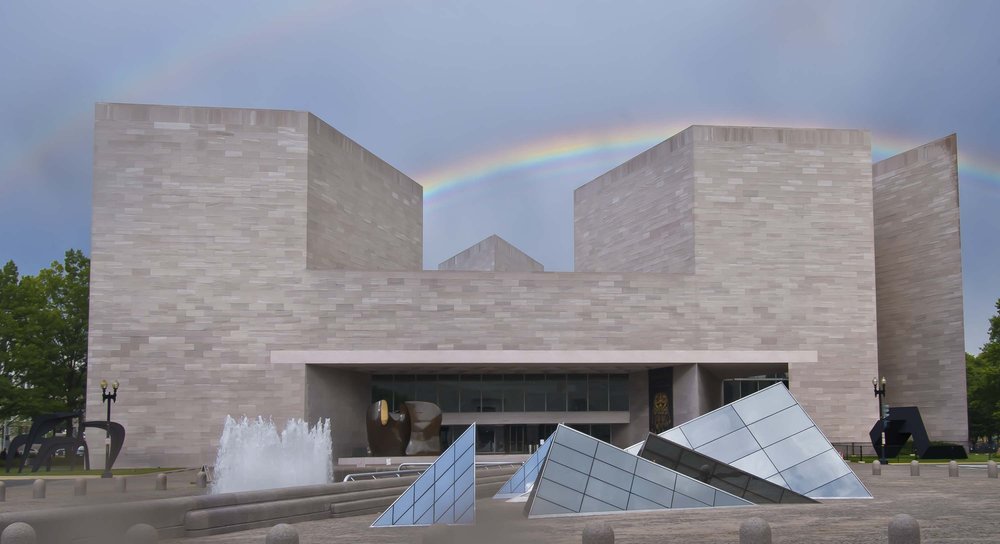
This past June, the National Gallery of Art celebrated the re-opening of I. M. Pei’s light-filled East Building, following a series of renovations and structural changes that have been taking place since its most recent closure in February of this year. The exhibition chosen to inaugurate the iconic space is Margaret MacDonald, Anne Dumas and Charles Brock’s The Woman in White: Joanna Hiffernan and James McNeill Whistler, a beautiful and essential exploration of Whistler’s most important subject, Joanna Hiffernan. On view through October 10th, Whistler’s many depictions of Hiffernan provide an exquisite impressionist contrast to the bold colors of Rothko and random splatters of Pollock currently housed in the East Building’s permanent collection. 

Few gallery spaces are as dynamic and visitor-centered as the National Gallery of Art’s East Building, whose quirky trapezoidal shape and abundance of light has seen important infrastructural changes with the new renovations. With Pei’s original vision at the forefront of renovation initiatives, new skylights have been installed to both filter out paint-harming UV rays and restore the level of light within the building to what it was at its opening in 1978. New galleries have been installed, as well, to house the growing permanent collection and temporary exhibits that find themselves within the East Building.

“I’ve always found this building very uplifting and full of life. The architecture is very movement-oriented and the way the light enters the building is truly special,” says Susan Wartheim, Chief Architect, National Gallery of Art.

With the integrity of the building as a work of art in and of itself at the center of the renovations, the gallery has been transformed into a more technologically modern, accessible space.  In contrast to the symmetrical, rectangular galleries of the neoclassical West building, the dynamism of the East building provides open gallery spaces full of personality.  “As an architect, I think the architecture and the modern art really go well together,” says Wartheim, “there’s undeniably a conversation taking place between the East and the West [buildings]”. 

This conversation takes place between the art and architecture within the East building as well, with James McNeill Whistler’s white-clad muse in The Woman in White reminiscent of the light-filled  atrium just outside the three connecting rooms that make up the exhibition. “It’s very intriguing to put 19th century art in modern galleries like the East building because it gives [the public] a new perspective on how relevant they are to modern design and certainly that’s the case with this [exhibition], ” says Charles Brock, Associate Curator of The Woman in White exhibit.

Filled with ethereal white dresses and her signature wild red hair, The Woman in White, is Margaret Macdonald, Anne Dumas, and Charles Brock’s attempt to piece together the human behind Whistler’s depictions of Hiffernan and to explore the resonance of Whistler and Hiffernan’s collaboration for Victorian culture as a whole in the late 19th century. Posed just at the entrance to the exhibition, Hiffernan stares out at her voyeurs atop the menacing skin of a wolf in Symphony in White Number 1, the wild eyes of the dead animal at her feet seemingly acting as a vessel for whatever hidden emotions run beneath Hiffernan’s composed surface. Despite the curator’s best efforts, Joanna remains at arm’s length throughout the exhibition, which ends up revealing more about Whistler’s gaze than the subject herself.

The curators have done an excellent job at taking Whistler off his pedestal and asking questions about the nature of his relationship with Hiffernan throughout. The audience is included as an active investigator throughout the exhibit with wall texts urging us to consider Joanna Hiffernan beyond Whistler’s portrayals and to “discern a difference between the ‘real’ Hiffernan and a model playing a role” (wall text). Regardless of Whistler’s own reputation and importance within the world of art, the curators make it clear that none of his standings would be possible without his most important muse. 

Furthermore, once having seen what influence Hiffernan held in other impressionist and modern works of her time period, one can hardly help but ask how it is possible that so little is known, or available about her today. As part of the reclaiming of Hiffernan’s agency as a collaborator in Whistler’s art, the exhibition includes a dedicated wall containing quotes from DC area models that speak to the ironically anonymous position they hold within the world of art and creation. This through-line drawn to illustrate the continuity of the anonymity imposed upon Hiffernan despite her central role in the various artworks displayed throughout the exhibition is powerful, and draws on her historical position to inform viewers of the model’s silent role today. 

The collaboration between the stunning improvements to the East Building’s lighting and facilities, as well as MacDonald, Dumas, and Brock’s audience-centered investigative exhibition, results in the reclaiming of the East Building as a space made for congregation, a building with the enjoyment of its visitors at the forefront of its infrastructure. “To see [Hiffernan’s] image at such a large scale within the very modern spaces of the East Building speaks very eloquently to the point of the exhibition,” says Brock. 

The East Building’s wide open spaces, fascinating geometric layout, its natural feel brought forth through gentle sunlight, and the ficus trees planted into the ground all act in conversation with the modern and contemporary art housed within its walls, a conversation that places the audience and their participation as a key figure. The Woman in White is one of the first of its kind, an exhibition that encourages museum-goers to look past the supposed genius of its painter and instead take part in the search for humanity within the subjects of the paintings themselves.

DC-area art therapists explore ‘Resilience Through Art’ in online exhibit

by Dylan Klempner

This article was first published in The DC Line here.

As the COVID-19 pandemic continues to drive demand for mental health services, a DC-based group of art therapists is participating in an online exhibit that highlights the potential for cultivating resilience through art making. 

According to the Kaiser Family Foundation, 35.9% of adults in the District reported symptoms of anxiety and/or depressive disorder in a survey conducted from Sept. 29 to Oct. 11, 2021. This figure is somewhat higher than the 31.6% of adults nationwide who reported these symptoms.

As the need for mental health support has grown, therapists themselves have also reported symptoms of burnout. Some concerned about increased demand on already-strained mental health professionals are labeling this “another pandemic mental health crisis” and are calling for changes in the nation’s mental health system, including added support for therapists.  

Amid these trends, art therapists in the greater Washington, DC, area are using an online art exhibit to build community and share personal examples of art’s therapeutic potential. 

Works by 25 art therapists are part of “Resilience Through Art in 2020 – 2021,” an online exhibit available on the website of the Potomac Art Therapy Association (PATA), a professional organization serving the Washington area. The group is a chapter of the national American Art Therapy Association (AATA) based in Alexandria, Virginia. 

An untitled work by Tyler Strusowski, president of the Potomac Art Therapy Association’s board, is part of the exhibit of works by 25 art therapists. (Photo courtesy of Tyler Strusowski)

Tyler Strusowski, president of PATA’s board, is one of the art therapists whose work is in the show. 

Prior to the pandemic, he had been working as an art therapist and artist-in-residence at the McClendon Center, which provides mental health services in DC and operates an art studio for its clients.

Tyler Strusowski

A month into the spring 2020 lockdowns, the DC-based art therapist remembers craving the art making he was missing. “When I was working at the McClendon Center, art was in my life, every day,” said Strusowski. “When we went into lockdown, it wasn’t.” 

Inspired by the tulips and poppies blooming in his Northeast DC neighborhood, Strusowski bought a large canvas and began collecting collage materials. 

While working on his piece at home, Strusowski learned that a client he had become close to had died. As he dealt with his feelings about her death, art making served a therapeutic role, he said. “I was mourning her through that process.” 

Art therapy defined

Research has confirmed the effectiveness of art therapy, a mental health profession that specifically integrates psychotherapy theories and practices with the intentional selection of art materials, according to Jordan Potash, associate professor in the Art Therapy Program at George Washington University. 

“With an art therapist, a substantial amount of time is going to be spent actually creating artwork,” said Potash.  

Making art during an art therapy session can help clients relax, a welcome contrast to how they might respond in a different context, said Tally Tripp, associate professor and founding director of the George Washington University Art Therapy Clinic in Alexandria, Virginia. 

“It doesn’t have quite the same stress involved in the purely verbal therapeutic relationship,” she said. 

Tripp said that some clients, especially those who have dealt with trauma, may have difficulty accessing words and emotions. Art making offers tools she can use as their therapist.

“We can work with clay or experiment with different kinds of media, and that’s going to promote a healing that is really strengths based,” Tripp said.

Tracy Councill, program director and co-founder of the DC-based nonprofit Tracy’s Kids, created prayer flags for the exhibit. (Photo courtesy of Tracy Councill)

Art therapy can help people cultivate resilience because it is an “active and engaged practice” that provides a sense of control, said Tracy Councill, program director and co-founder of the DC-based nonprofit Tracy’s Kids

“It puts you in a position of control. And that can be very meaningful to people in therapy,” she said. 

Like other mental health professionals, art therapists must undergo academic and clinical training before obtaining credentials to practice, said Potash. 

The Art Therapy Credentials Board, a group based in Greensboro, North Carolina, offers testing that leads to a national credential for art therapists. Practitioners may also need to pursue additional licensure in their home state. More than a dozen states, including Maryland and Delaware, have passed laws granting licensure specifically for art therapists, and DC recently followed suit.

“Licensure laws, in general, are there to protect the public,” said Potash, who serves as chair of PATA’s licensure committee. “Only somebody who has the unique education and qualifications of an art therapist will be able to call themselves an art therapist.” 

The Professional Art Therapist Licensure Amendment Act was signed into law in DC by Mayor Muriel Bowser in April 2020. The law, passed by the DC Council at PATA’s behest, lists qualifications and standards to practice as a professional art therapist in the District. 

Art therapy and resilience 

Councill said many art therapists use their personal art practices to process their own experiences. “In my work, there is a lot of sadness and loss, right, because I work with a lot of kids with serious illnesses.”

Tracy Councill

Though she rarely makes art directly about losing a patient or someone close to her, Councill has a “need to be creatively engaged. I need to have an arena in which I feel that sense of agency and that ability to respond and be resilient.”  

That’s the line of thinking that led Kelly Jacobs, PATA’s vice president of communications, to come up with the idea for the online art show. 

She said that as the shutdowns took hold, she tried to think of creative ways in which members could connect and share their artistic experiences without requiring a Zoom call. Together, she and her colleagues settled on the idea for the show’s title, which focuses on the idea of resilience. 

Jacobs said she heard from art therapists in the early days of the pandemic about the stress they were under, the challenges they faced, and the adaptations they made. 

“It was hard, but there was so much creativity that was happening. And that all seemed to just kind of relate to this idea of resilience,” said Jacobs. “Adapting, being creative, growing from the experience.”

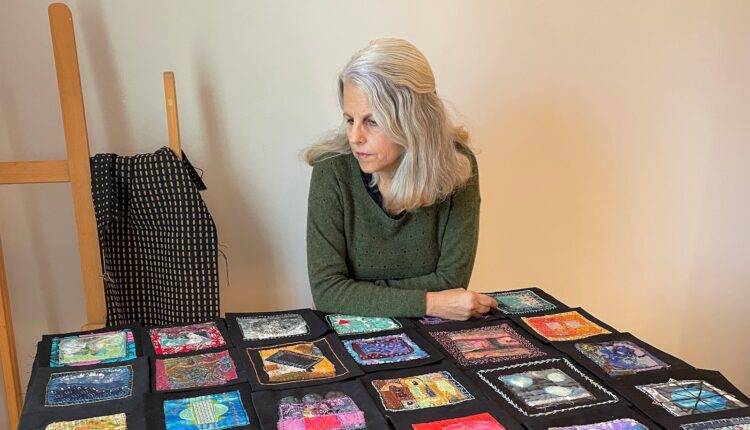
For the artwork she submitted to the PATA art show, Tripp used a technique known as slow stitching, which emphasizes the use of needle and thread for art making rather than for their more practical purposes, such as mending. Tripp said the practice is good for stress reduction. “It was just a way to be focused and relaxed.”

Tally Tripp submitted her stitching project for the online exhibit. (Photo by Mark Morrow)


A half-century of art therapy in DC 

The history of art therapy locally goes back at least a half-century. In 1971, Bernard Levy and Elinor Ulman co-founded George Washington University’s Art Therapy Program, one of the nation’s first. 

The DC area has also been home to leading art therapy programs including Creative Forces: NEA Military Healing Arts Network, a partnership of the National Endowment for the Arts and the Department of Defense that began in 2004. 

Tracy’s Kids, a medical art therapy program for children dealing with cancer, had its start at Georgetown Lombardi Comprehensive Cancer Center. The nonprofit now also supports seven other art therapy clinics at pediatric cancer hospitals, including Children’s National Hospital. 

Art therapy and the political sphere 

Art therapy has long enjoyed bipartisan backing from politicians and their families. 

Just a few months after the Sept. 11, 2001, terrorist attacks, Hillary Rodham Clinton – then a newly elected New York senator – read a Congressional Record statement supporting art therapy as a mental health field. 

Marcelle Leahy, wife of Vermont Sen. Patrick Leahy, is a Tracy’s Kids board member, while Karen Pence, former Tracy’s Kids board member and former second lady, has played, perhaps, the most visible role in raising awareness about the field. 

Shortly after the inauguration of President Donald Trump in 2017, Pence announced that art therapy would be her signature cause. 

But many art therapists challenged the AATA’s willingness to embrace the second lady as an ally. In protest, more than 1,700 joined a Facebook group known as Art Therapists for Human Rights. 

“We demand that AATA respond to Karen Pence’s stated commitment to our field by asking her to publicly take action for the rights of … all people who are in danger as a result of the policies of the current administration,” reads a statement on the group’s page describing its mission during the Trump administration. 

Pence’s interest in art therapy prompted a lot of conversations among art therapists about government policies and other factors that impact their clients, Potash said. 

“Systemic racism takes a toll on clients and limits their ability to access services in ways that they can’t overcome on their own,” said Potash. In the years since Pence’s endorsement, he added, AATA has reviewed its policies and practices and looked “at how to make changes in the interest of equity and inclusion.” 

Art therapy and social justice

Potash uses art therapy to facilitate intergroup dialogue. Art therapists, he said, can play a meaningful role in supporting social justice and community development.

Art can help people visualize systemic injustices, said Potash. “But just showing them might not be enough.”

Art therapists, he explained, can help untrained audiences who may not have the skills to see meaning in a work of art — a role particularly valuable when it comes to getting a deeper understanding of artwork about injustices. 

“Art therapists can help to lead meaningful opportunities for viewers to really get a sense of what it is the artists are trying to convey,” he said. 

As a result of art therapists’ training in psychotherapy and group dynamics, they can also help people use art to communicate about their differences and come up with new policies and programs.

“Art therapists can also — using our skills in groups and whatnot — create art making opportunities where people come together to create art and to try to reimagine ways in which the world could be.” 

Participants at a workshop held as part of George Washington University’s Martin Luther King Jr. Day of Service were asked to create images of a personal experience that defined their social. cultural or political outlook. (Photo courtesy of Jordan Potash and Alberta Gyimah-Boadi)

Prior to the pandemic, Potash and a colleague, art therapist Alberta Gyimah-Boadi, led a series of intergroup dialogue workshops that incorporated art making at GW during its Martin Luther King Jr. Day of Service, as well as at public libraries in the District and in Virginia, they said. 

“We ask people to come and create art [based] on an experience from their life that has led them to their current political views,” said Potash. “The goal of this is to refocus people not so much on political debate, but that people’s perspectives come from somewhere.” 

Gyimah-Boadi said she and Potash were inspired by King’s teachings that encourage people to work together to fix a flawed system. The two of them asked participants to use art making to focus on one another’s stories rather than on their individual views.  

“People may see the issue differently,” said Gyimah-Boadi. “But at the bottom of it, there’s still an issue.” 

For PATA’s virtual show, several art therapists submitted artwork focused on social justice. 

Councill contributed three pieces titled “Prayer Flag Portraits” that depict the faces of George Floyd, Breonna Taylor and Ahmaud Arbery, whose deaths prompted massive Black Lives Matter protests around the world during the spring and summer of 2020. 

Councill, who attended some of the protests, said that the prayer flags are a form of personal expression. “They’re still hanging on the front of my house.” 

She also brought the art to work at the Georgetown Lombardi Comprehensive Cancer Center, the site of one of the Tracy’s Kids art therapy clinics. Many of the children being treated there are African American, she said. 

“I wanted to make it very, very clear to the kids and families that I work with, that I want to do everything I could to be present to them,” Councill said.

“The kids also made their own prayer flags about things that they were worried about during that time,” she said. Some made art about the protests, violence and the pandemic. 

For Strusowski, art making works therapeutically for him in multiple ways. “It becomes my way of processing things that happen and developing insights as to what my feelings actually are,” he said.

He described insights that arose during the spring of 2020 while he worked on his piece for the online exhibit. Through the art making process, Strusowski said he came to realize that despite being close to a client who died, his understanding of her life was limited. 

“I didn’t live their life. And I didn’t have the things that happened to her, happen to me,” Strusowski said. “And that’s kind of where I started to come to peace with the fact that I would never see her again.” 

Virtual exhibits transform traditional museum experience with longer exhibition times, interactive elements

By Roy Gao

This article was first published in The DC Line here. It was developed within Day Eight’s week-long, 2021 summer arts journalism institute.

With just the movement of a computer mouse, a silver pitcher covered with two winged camels and foliate patterns is viewable from all angles and at various scales. This Central Asian artifact, made in the late seventh or early eighth century A.D., is just one of numerous 3D items that visitors can access through a National Museum of Asian Art virtual exhibition. The museum, part of the Smithsonian Institution, is far from alone in having launched virtual exhibits at a time when the pandemic kept museums and galleries from fully reopening.

Even as DC art institutions like the National Museum of African Art and the Hirshhorn Museum and Sculpture Gallery have gradually reopened their doors to the public, not everyone is ready to head downtown, particularly with the rise in COVID-19 cases due to the spread of the delta variant. Luckily, the city’s museums have adapted over the past year to offer an equally valuable experience through online exhibitions. Antonietta Catanzariti, assistant curator for the ancient Near East at the National Museum of Asian Art, notes that visitation to their website has doubled in the past year, and remains high even as the museum and others have reopened.

That’s hardly surprising. “Virtual exhibitions are similar to physical exhibitions, often capitalizing on the web’s capacity for a personalized experience in which the user directs their own journey,” wrote Ngaire Blankenberg in her 2014 book Manual of Museum Exhibitions. (Blankenberg, formerly a cultural consultant, became director of the Smithsonian’s National Museum of African Art in July.)

Here are examples of what you can find online from three DC museums: 


National Museum of Asian Art (formerly the Freer Gallery of Art and Arthur M. Sackler Gallery)

The Sogdians: Influencers on the Silk Roads, curated by the National Museum of Asian Art, has been open since 2019. With no specified end date, this timeframe is rare for physical exhibitions, which are usually open for weeks or months. 

Kimon Keramidas, New York University professor of digital humanities and a curator of the show, said digital exhibitions can usually last for five to six years before advances in technology lead to complications. Even then, however, they can still be updated and recovered.

Digital exhibitions also allow for the display of artifacts that might not otherwise have been available. The curators of the Sogdians exhibition, for instance, decided to go digital due to challenging geopolitical circumstances, according to Keramidas: The trade embargoes that followed Russia’s invasion of Crimea in 2014 prevented important collections from loaning objects.

The exhibition is packed with about 700 pieces of material, including 3D models, images, custom maps, drone footage and more. The exhibit’s subject matter is similarly rich in diversity. 

Julian Raby, director emeritus of the museum, calls the Sogdians an “underestimated” people. They were an ethnic group that lived in the first millennium A.D., occupying a vast terrain of Eurasia and significantly shaping Silk Roads culture and commerce. As merchants, craftsmen and entertainers, the Sogdians lived and traveled everywhere from China to the lands of the Byzantine Empire. 

In one section of the virtual exhibition, the visitor follows a historical trade route and sees a moving map, photographs of the terrain, and text describing each location. Unlike maps on gallery walls that could be easily overlooked, here the geographic tour takes center stage in the experience. 

“There is a sense of immediate rapport that could be quite powerful,” Raby said in an interview.


Hirshhorn Museum and Sculpture Gallery

Hirshhorn Museum’s Lost in Place: Voyages in Video debuted in May 2021 as a direct response to the pandemic, which the exhibition text states had “greatly diminished our radius of movement — collapsing home, office, and school into a single location — and recalibrated our sense of personal boundaries.” Drawn from the Hirshhorn’s permanent collection, the digital exhibition brought together 11 videos by contemporary artists from around the world. They were each made available for viewing in sequential and overlapping four-week spans, with the last one accessible through Aug. 20.

One of the videos, Laure Prouvost’s Swallow, inundates the viewer’s eyes and ears with a sensual intimacy that is almost unsettling. While following a group of nude bathers in a stream, Prouvost’s camera fades in and out of extreme close-ups on body parts, flapping fish, and crushed berries. This all occurs while recurrent sounds of breathing and shots of an open mouth span the entirety of the video’s run. After a year of Zoom-room socializations, such sudden closeness with bodies and nature is especially striking.

Purchase Fund, 2008 (Photo courtesy of Hirshhorn Museum and Sculpture Garden)

Among the other featured videos were Pierre Huyghe’s One Million Kingdoms, starring a digital avatar traversing a lunar landscape generated by her voice; the artist collective Superflex’s Flooded McDonald’s, a meditation on the fast-food restaurant chain’s material footprint that depicts a kitchen slowly filled with 20,000 gallons of water; Carlos Amorales’ Dark Mirror, featuring animations of wolves, bears, falling airplanes, and other images evocative of danger; and Guido van der Werve’s Nummer Negen (#9): The Day I Didn’t Turn with the World, a time lapse of the geographic North Pole, where the artist stood for 24 hours facing away from the sun.

National Museum of Women in the Arts (NMWA)

The NMWA’s online exhibitions, which are running indefinitely, mimic carefully crafted walking tours. They employ sequences of web pages that are as immersive as museum displays, which viewers navigate with their mouse and arrow keys.

The first online exhibition curated by the museum is the ongoing show A Global Icon: Mary in Context, which launched in 2015. The featured sculptures and paintings of the Virgin Mary come from Europe as well as Japan, Ethiopia, Mexico and more. With each page turn, the web window can zoom into a detail of the work or present an explanatory video that highlights the various contexts in which the biblical figure Mary appears.

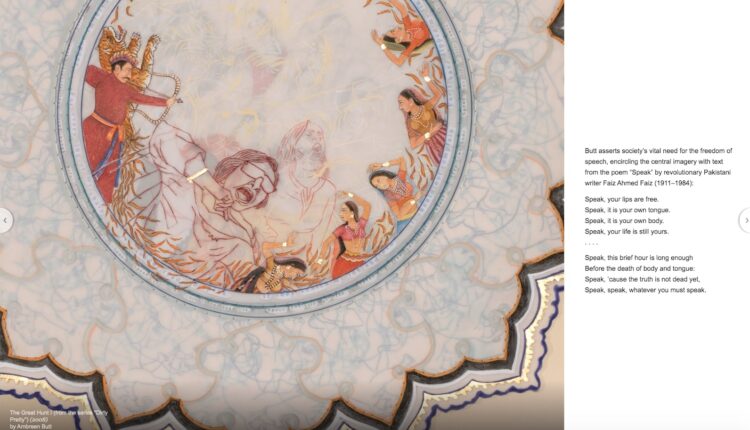
The same kind of seamless passage from content to content characterizes NMWA’s newer exhibitions, like Ambreen Butt — Mark My Words, which launched last year and interlaces videos of her work process with displays of her paintings, prints and collages.

In June 2020, the museum redesigned its website to host its online exhibitions as part of an ongoing effort to enhance its digital platform. Laura Hoffman, the director of digital engagement, explained that the pandemic had prompted discussions in the field about what a museum experience without physical access ought to look like. 

With NMWA undergoing a major two-year renovation as of Aug. 9, Hoffman said the pandemic provided a useful — and timely — opportunity to explore the museum’s digital capabilities leading up to its temporary closure.

“The pandemic almost felt like a test run for all the digital possibilities there are,” Hoffman said.

Roy Gao was born in Boston, MA, but grew up in Pittsburgh, PA and in Beijing, China. Before college, he lived in and studied in both the United States and China. Roy received his bachelor’s degree in 2021, from the University of Pittsburgh, with a double major in Art History and Philosophy. For the fall, he has been admitted to the Master’s program in Modern and Contemporary Art History at the School of the Art Institute of Chicago. In 2020, Roy was a top-ranked applicant for the Fine Foundation Fellowship at the Carnegie Museum of Art (before the fellowship was cancelled due to COVID-19). He was the curator of “Footsteps” at the China Millennium Monument in 2019, and co-curator of “This Is Not Ideal: Gender Myths and Their Transformation” held at the University Art Gallery of the University of Pittsburgh in 2018.