
by Mary Holiman
First published in DC Trending substack November 15, 2025, here.
My interview with first-generation Congolese artist, registered nurse, and community advocate Elizabeth “Liz” Mputu, one of the featured artists in VisArt’s Flip It & Reverse It: Spectacles of Blackness in Popular Media exhibit in Rockville, Maryland, was more like two girlfriends having a “yap sesh” than a formal interview. Our conversation flowed naturally, without the awkwardness that comes from asking questions, as we shared stories of similar upbringings and familial elders.
It was raw, real, and uncut, much like her early adulthood. But, it was also a moment steeped in the unique culture of Blackness — a little bit of sisterhood, long-lost kinship, and our ability to feel at home with people all across the diaspora.
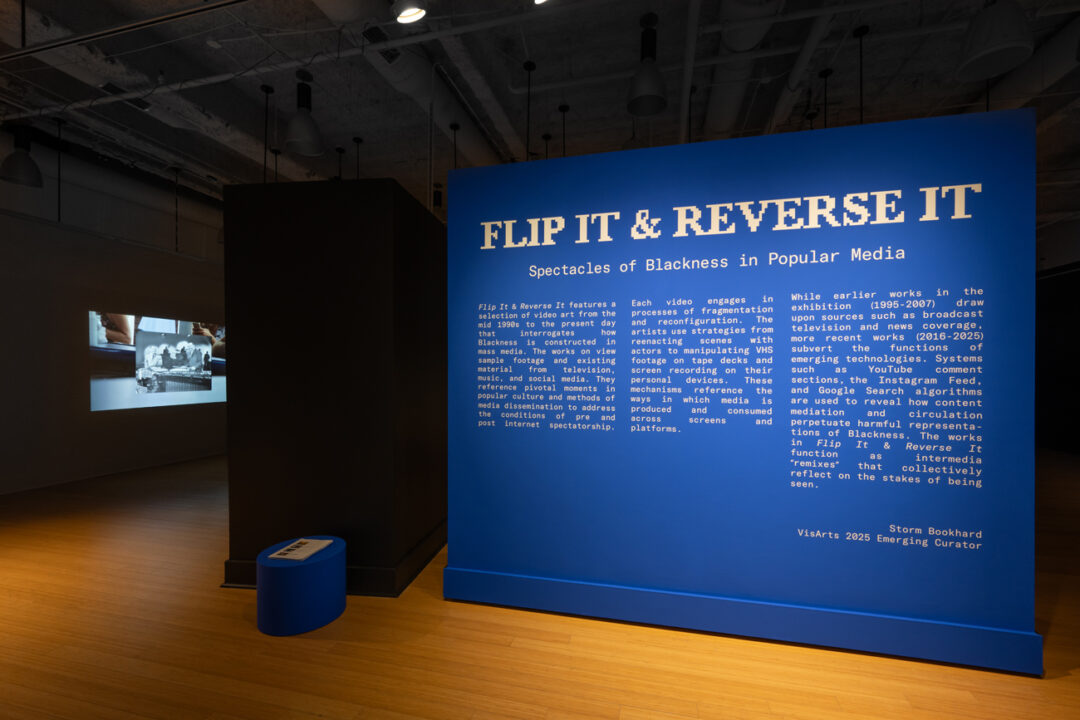
Flip It and Reserve It, now showing at the Kaplan Gallery, features a selection of video art from the mid-1990s to the present day, interrogating and challenging how Blackness shows up in mass media. Carefully curated by Storm Bookhard, it features seven talented and creative artists reflecting on the cost of being seen.
Liz started as an artist, studying at the Art Institute of Chicago after dropping out of DePaul University. A sheltered kid, she couldn’t focus on the coursework and, in her own words, “was a loose cannon, chasing highs and neglecting my health.” An experience of growing pains and a lot of trial and error that I resonated with. Through laughs, she recalls the time she performed a piece in a very public space on campus using a dildo. Now, keep in mind, DePaul is a Catholic university, so one can picture the embarrassment turned humorous, much like the way Liz says, “Black people have this unique ability to bring humor into trauma, our people —we process pain abstractly.”
A self-proclaimed club kid, a term associated with the New York City-based artistic and fashion-conscious youth movement, she found community in doing performance art simultaneously at parties and online, running an underground magazine. Liz recalls that much like neighborhoods, towns, and forests, the digital space is its own ecosystem, one where people learn from and hold space for each other. In fact, her online experiences led her to a perspective that might surprise some: she rejects the idea that formal training defines a professional artist. “You don’t necessarily need to go to art school,” she says. “You just need artsy friends and spaces. And you don’t have to be an artist to create art.” This rejection of what she calls the illusion of the professional, the belief that if you have a body, you can dance, is evident throughout her work.
Yet, like many artists and creatives, art wasn’t paying the bills. She became a receptionist at Planned Parenthood, then a certified nursing assistant, and eventually trained as a registered nurse during the COVID-19 pandemic lockdown— a career she maintains today. This shift in career path led her to where she is now. Liz says, “wellness and healthcare have inversely influenced my creative praxis…I like to use my video art as propaganda. Art is one of those ways we can control the narrative: What it means to show up and assert ourselves in the media. With capitalism, there’s a need to control, so there’s always a pimp and a ho.”
In recent years, terms such as social prescribing and arts-on-prescription have been integrated into healthcare. Holistic approaches to health and wellness, social prescribing, and arts-on-prescription are models of care that connect people to community-based and/or art activities to improve their well-being. People are social beings by nature, and in an era of capitalist individualism, connection with others is more important than ever.
“People are experts of their own bodies, and everyone isn’t looking for a solution. Some people want to be seen.” -Liz
Being seen, and using art to do so, is a practice Liz believes in, firm in the idea that art is an act of liberation, and there’s a connection, a correlation, between health and creativity. In a world where Black people have historically been experimented on for the sake of medical advancements, from J. Marion Sims to the Tuskegee Experiment, Henrietta Lacks, and more recently, Adriana Smith, she finds value in the lived experience and the idea that knowledge doesn’t always come from scientific experts.
“Indigenous people and our ways are efficient, advanced technology is just an advanced system.” -Liz
And it’s an ideology she hopes the audience sees, too. When asked what people should take away from the Spectacle of Blackness exhibit, she encouraged audiences to go into it with an open mind and respond organically without overthinking. Then, she dished out a challenge: “Unpack the discomfort, and sit with it.”
Flip It & Reverse It: Spectacles of Blackness in Popular Media is an exhibit that explores and addresses how Blackness is structured in mass media through a selection of video art. The title borrows from popular rapper Missy Elliot, an icon known for her artistic music videos and specifically from her 2002 hit single Work It. Flip It and Reverse using popular culture to propose avenues for Black self-determination and liberation. It also exposes the racial biases in technology and the digital space, such as the paradox of what happens when Black people are seen.
The Spectacles of Blackness exhibit is located in the Kaplan Gallery (Floor 2) at the VisArts Center in Rockville, MD. The exhibit is free and open to the public now until January 18th, 2026.

No Comments