
At Woolly Mammoth, a play about the war in Ukraine ⁠— and so much more

By Jakob Cansler

This article was originally published in the DC Line here.

Eleven years ago, celebrated Ukrainian playwright Sasha Denisova won Russia’s highest theater prize. That play was one of 25 she has produced in Moscow.

Today, though, none of her plays are performed there, or anywhere in Russia for that matter. 

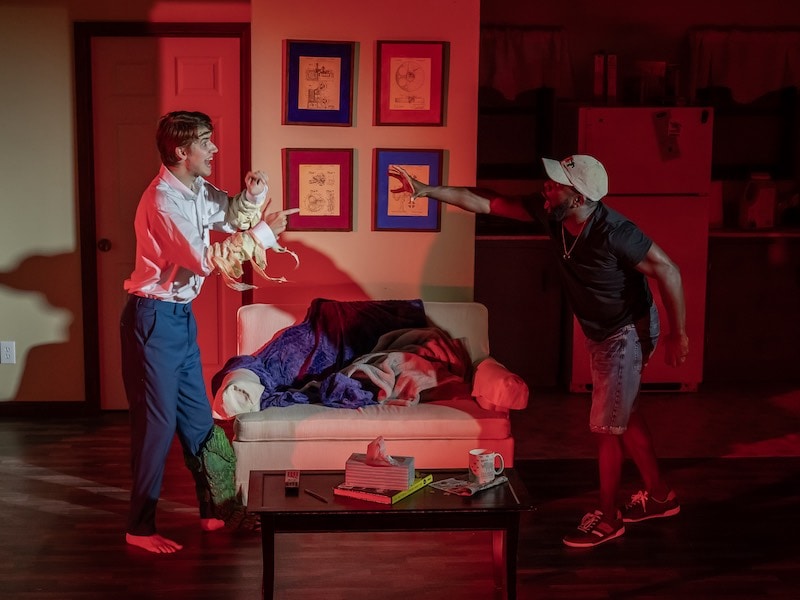
Denisova fled Moscow for Poland shortly after Russia’s invasion of Ukraine in February 2022; since then, she has focused her work on the war, having written and staged four new plays. The world premiere of one of them, My Mama and the Full-Scale Invasion, runs through Oct. 8 at Woolly Mammoth Theatre Company in a co-production with Philadelphia’s Wilma Theater, where the show will be produced early next year.

Denisova specializes in political theater that combines documentary with fantasy, and My Mama certainly fits that bill, with the script inspired by ⁠— and, in some sections, taken verbatim from ⁠— conversations the playwright had with her mother, Olga. 

At 82, Olga decided to stay in Kyiv, where she has lived her whole life, amid Russia’s onslaught on Ukraine, including her city. That puts Olga on the frontlines of the war, both literally and in Denisova’s imagination.

At one point in the play, Olga tells her daughter that Russian soldiers are making their way to the “decision-maker.” 

“Apparently my mama regards herself as the decision-maker,” Sasha, played by Suli Holum in the show, says in response. In the increasingly fantastical scenarios that follow, Olga strategizes with Ukraine President Volodymyr Zelenskyy, flies a fighter jet and converses with other world leaders. 

The play “is a combination of a document and of a fantastic world,” Yury Urnov, the show’s director, said in an interview. “So the biggest ⁠— in a good way ⁠— challenge was how to give space to both of these, ⁠⁠the real reality and fantastic reality on stage and how they can coexist.”

The two extremes also make for a play that is tonally complex, as over-the-top comedic sequences segue into moments depicting the harsh realities of war. In one section, a lighthearted moment of song and dance is cut off by a nighttime air raid.

Denisova, Urnov and the rest of the creative team had to find a way to strike the right balance among all of these different elements. The result is a production that features a rotating set piece, a soundtrack that ranges from classical music to disco, approximately 100 custom-made projections, actor Lindsay Smiling playing a dozen characters, and deepfakes of the leaders of France and Germany.

Fitting all of that into a 90-minute play, and to make it cohesive, is challenging enough, but My Mama also had to be translated from Denisova’s native Russian.

“We had like a group of five people⁠ — bilingual and American⁠, and Sasha, certainly ⁠— in presence who were pretty much going line by line through this play and and trying to make it work in English,” Urnov said. “It’s not just about the words, it’s about the contexts. It’s about the associations that resonate with English-speaking audiences.”

For the creative team, the drive to overcome these challenges wasn’t just an artistic responsibility. A play like this comes with political and social responsibilities, too, which raises the stakes. 

More than a year and a half after Russia invaded Ukraine, during which time U.S. news coverage of the war has waned, My Mama serves as an explicit reminder of the toll Russia’s invasion has taken on Ukrainians. For Urnov, who was born and raised in Russia, the responsibility also feels personal.

“We are at a place where Putin’s regime is doing everything to normalize [the war]. There is a danger in the normalization of that,” he said. “We’re opening in DC. I think that’s the place where it needs to open. I hope people who can⁠ — who are politicians and the people who affect politicians’ decisions — will come and see it.”

And yet, to say that My Mama is simply a play about the war in Ukraine would be a mischaracterization. Much of it focuses on Olga’s life and her relationship with her daughter. Their dynamic is complicated, sometimes even antagonistic — and it shifts amid the war and after Olga decides to stay in Kyiv.

“At the heart of the play, really, is a mother’s love — not only for her child, but for her country,” said actor Holly Twyford, who plays Olga. “And she says I’m not going anywhere. And don’t you dare come here. And that is very powerful. I think it’s very powerful.”

After all, what most American media covers of the war is strategic, logistical or political⁠ — offensives and counteroffensives, bombing reports, document leaks, summits, aid deals. What is lost in that kind of reporting is the story of what it’s like for the Ukrainians on the ground, which is exactly what My Mama conveys.

As Twyford describes it, the play has both a “micro human element and very macro human element,” telling the story of Ukraine and the war through one woman’s thoughts and experiences. 

“It will absolutely make you laugh, but it also won’t make you forget the reality of the situation. And I think that’s, I don’t know, that’s kind of the definition of hope, isn’t it?”
Shakespeare Theatre Company’s ‘Evita’ offers fresh look at the rise of Eva Perón

By D. R. Lewis

This article was originally published in The DC Line, here.

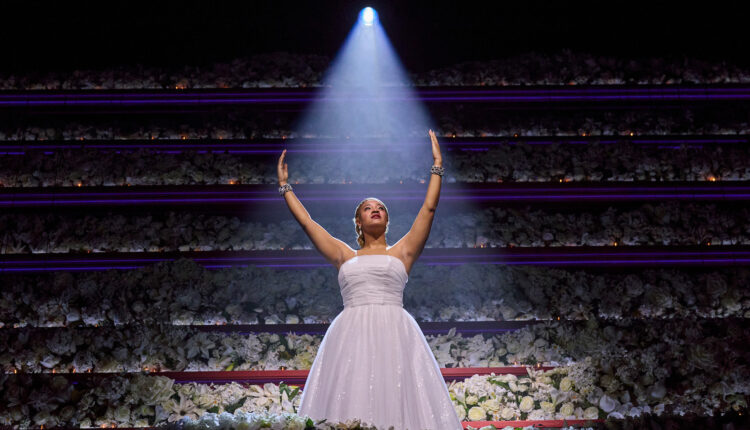
Sammi Cannold’s Evita begins and ends with the same striking image: an angelic white gown floating over rolling fields of white flowers. The metaphor isn’t difficult to discern as the world continues to grapple with the legacies of Eva Perón’s meteoric rise to become first lady of Argentina in the 1940s and the subsequent Andrew Lloyd Webber/Tim Rice megahit that has kept her firmly in the international consciousness long after her death. But in this fresh production, running through Oct. 15 at Shakespeare Theatre Company’s Harman Hall and produced in association with American Repertory Theater, director Cannold forces a closer, neon-tinged look at the myth-making of Eva Perón and the alchemy required to become a populist icon.

After originating as a concept album in 1976, Rice and Lloyd Webber’s Evita premiered in London’s West End in 1978 ahead of a 1979 Broadway transfer. Telling the story of Eva’s early life, relationship with eventual Argentine President Juan Perón, reign as first lady and death at age 33, Evita was among the first “British Invasion” musicals and rock-style scores to hit Broadway. Now, having enjoyed countless revivals, productions and tours around the globe, plus a 1996 film starring Madonna, Evita could be easily treated as a period piece and a relic of a bygone era. Even its iconic anthem, “Don’t Cry for Me Argentina,” has been covered by the likes of Sinéad O’Connor, Donna Summer, Olivia Newton-John, and the cast of Glee.

But in the wake of a new American populism, Cannold invites her audience to take another look at Evita and interrogate the unpredictable events and mythologizing that allow an individual to capture (and hold on tightly to) a nation’s attention. Eva Perón may have been a singular sensation, but she also benefited from the good fortune of being in the right place at the right time with the right people and having the good sense to seize her moment. “Now, Eva Perón had every disadvantage you need if you’re gonna succeed” is a striking lyric that comes early in the musical, but sets the tone for the relentless social climbing and wily opportunism that catapulted her to the Casa Rosada. We watch as an impoverished young Eva (a strong Shereen Pimentel) attaches herself to a philandering lounge singer in order to get to Buenos Aires, leverages her beauty and agency to reap social advantages from well-positioned men, launches her career as an actress and radio star, and eventually introduces herself to Juan Perón (a sincere Caesar Samayoa), whose own star is rising. Eva carefully curates the narrative of her own ascent, never relinquishing her pull-yourself-up-by-the-bootstraps origin story and doubling down on her assertion that she is the “savior” of the Argentine poor. Her self-aggrandizing is foiled only by cynical narrator Che (an effective Omar Lopez-Cepero), who refreshingly fades in and out of the action to relate unsavory details of the Perón regime that Eva would rather not share.

Soon after securing her place as Juan Perón’s partner, Eva expels his mistress from the household in a scene where Cannold’s handiwork can be seen most clearly. Where past productions have lazily utilized “Another Suitcase in Another Hall” as an illustration of Eva’s viciousness, Cannold instead conjures a depth and magic that afford Eva a moment to quietly consider the fantastic series of events that accelerated her rise. Mimicking the staging of an earlier sequence where Eva interacts with a carousel of men to her increasing benefit, she now looks on as the cast-off young woman maneuvers through a similar sequence with the same men, but fails to acquire the same social advances as Eva. In this brief, breathtaking moment, the audience sees Eva recognize the fragile nature of her opportunity and make the firm decision to run full speed ahead to secure her spot at the top. Nevermind that the road ahead will be full of contradictions, greed, corruption and unrest. 

Eva soon ignores the ideals she once held and the working class from which she rose in favor of desperate grasps at respect from the Buenos Aires elite she purports to abhor. Still, as she becomes more separated from the harsh realities of the country’s poor, potentially embezzles money under the guise of charitable giving and faces her own mortality within the walls of the presidential palace, she sings the old familiar tunes and becomes increasingly possessive of those who she could once reliably call “my people.” In her final moments, Pimentel’s Eva strains to maintain her grasp on life as much as her grasp on power, which have become one and the same. When the requiem that starts the show returns to complete it, one can’t help but wonder whether the public displays of mourning are entirely sincere, or simply the logical consequence of Eva’s myth-making.

The production’s designers borrow heavily from the gilded nature of Eva’s reign to great effect. As the show begins, single beams of lush white flowers covering the stage ascend to the rafters, revealing Jason Sherwood’s dark, utilitarian set whose five arches serve as portals for movement and windows into the Perón administration’s abuses. Emily Maltby and Valeria Solomonoff’s embellished choreography most often culminates in an unexpected political transaction or surprising power shift. Alejo Vietti’s gray but detailed costumes serve to blend the ensemble into monotonous groups — as Eva herself often refers to them, such as “the middle classes,” “a clutch of stuffed cuckoos,” or simply, again, “my people” — rather than to distinguish individuals. The uniformity is offset only by Eva’s white garments and flashes of deep red from Che’s undershirt. When combined with Bradley King’s excellent neon lighting, which frames the stage and scant structures of Eva’s world, you cannot escape the sense that you are watching a person write, stage and perform the story of her own life within a proscenium that she thinks she alone can see. Even so, in a first act that begs for a percussive electricity to match Eva’s hunger, a muted, electronic soundscape steals a bit of the bite.

Stories of politics and those who peddle power will always hold a special place in the hearts of Washington audiences and Evita, one of several co-productions slated for this season, is a strong start for Shakespeare Theatre Company. With Cannold’s fresh take, which serves more to reframe than reconceive the material, audiences have all the more reason to grapple with the persistent question of whether musicals like Evita (and Broadway’s current Imelda Marcos disco musical, Here Lies Love) work to glorify the legacies of complicated figures, or serve as cautionary tales of political ascension. Regardless of which side one may land, perhaps by interrogating the populists of the past, we can better understand those who wish to harness that same power today. Don’t worry, Eva. We won’t cry for them, either.

Comedy delivers a punch in ‘Monumental Travesties’ at Mosaic Theater

By Daarel Burnette II

This article was originally published in DC Theater Arts here.

What should we do with all the cultural vestiges of America’s racist past?

Today, the clothing, language, and statues that were created to assemble and glue together a system that subjugated Black people litter our day-to-day lives in sometimes embarrassing ways.

Do we ignore these cultural vestiges, hold onto them as a haunting reminder of our past, or expunge them as a way to combat contemporary forms of racism?

Monumental Travesties, written by Psalmayene 24 and directed by Reginald L. Douglas, now being shown by Mosaic Theater Company at Atlas Performing Arts Center, aptly tackles this provocative question in a tightly wound comedic plot.

The world-premiere play is delivered with a punch by Louis E. Davis, Jonathan Feuer, and Renee Elizabeth Wilson, standout stars who at times left their majority white spectators visibly squirming.

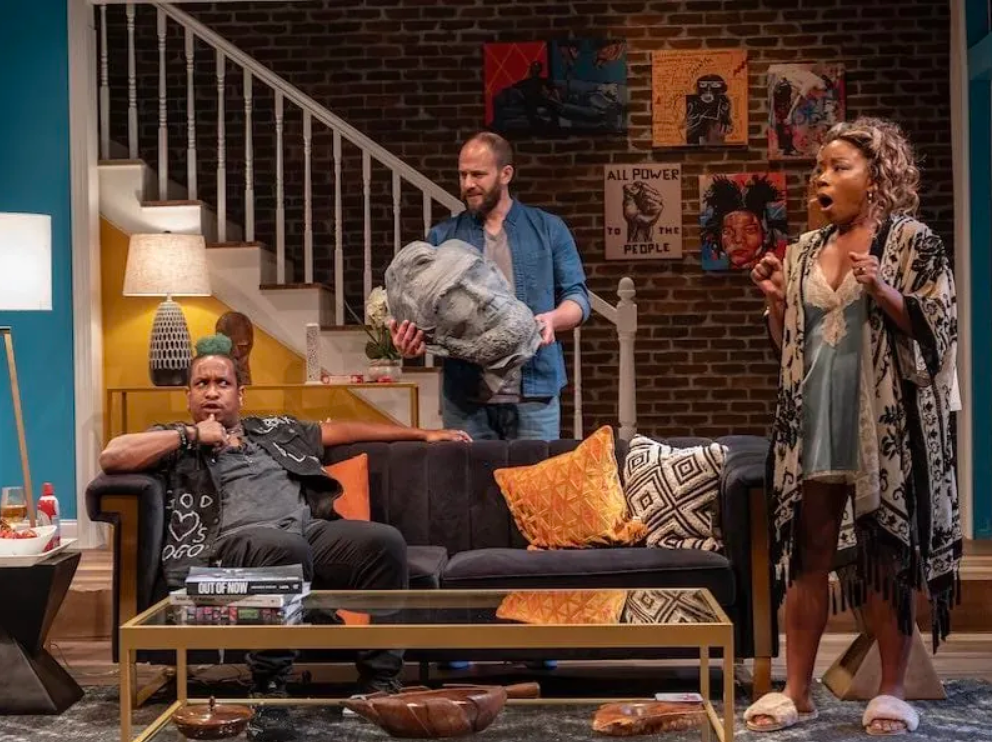
Louis E. Davis as Chance, Jonathan Feuer as Adam, and Renee Elizabeth Wilson as Brenda in ‘Monumental Travesties.’ Photo by Chris Banks.

Psalmayene 24 centers his plot around Thomas Ball’s Emancipation Memorial, a statue that has been controversial since freed slaves raised money to erect it in 1876.

The statue depicts a larger-than-life Lincoln standing over and “freeing” a mostly naked and kneeling Black man, whose feet are wrapped with a ball and chain.

We learn at the beginning of Monumental Travesties that Chance, played by Davis, has climbed the statue in the middle of the night, sawed off Lincoln’s head, and, being chased by the cops, dumped it in the garden of his white next-door neighbor Adam, played by Feuer.

In most plays about racism, playwrights require their Black characters to grapple with the many ways racism knocks at their confidence, warps their perceptions, tangles up their family lives. White characters are tasked with being a bit less racist.

But in Monumental Travesties, Psalmayene 24 flips this model on its head.

Adam is having a full-blown identity crisis, wracked by what he sees as whiteness destroying the world and feeling compelled to shed his white identity. A recent bout with COVID has apparently depleted his memory.

Chance and Brenda, played by Wilson, are confident with their Black identity, as is evident in the set, designed by Andrew Cohen, which features African print, furniture, and pottery, and Jean-Michel Basquiat art. But their marriage has recently been sexless. Brenda is underemployed and Chance has decided to quit his job to be a full-time radical performance artist. They somehow are able to afford a gentrified home in DC.

In this wonder of a script, Psalmayene 24 gives his characters lines that are poetic and biting and knee-slapping funny. He punches up at the sometimes surprising reactions white people had to George Floyd’s murder and their insistence that we scrub our society of language that looks and feels racist — the same white folks who were then less bullish when it came to changing racist policies.

Davis, Feuer, and Wilson deliver their lines with comedic perfection. They throw their entire bodies into their characters, play off the audience’s shock.

Feuer especially is unafraid to delve into the darker aspects of white identity and delivers some of the play’s most piercing lines.

Costume designer Moyenda Kulemeka found some of the most interesting and appropriate outfits for Chance and Adam. Outfits that scream, “I’m not a racist.” And outfits that scream, “Black people don’t belong here.”

I have a few quibbles: the head of the Lincoln statue was at times treated as if it was heavy; at other times, as if it was light. Davis, whose hair is dyed neon green, performs at a level 10 for most of the play, when sometimes it requires his character to be at a level six. And some of the characters’ time off stage to grab one or two items seemed excessive. Nothing that can’t be ironed out.

At the beginning of the production I attended, Douglas, who serves as Mosaic’s artistic director, said he wants Mosaic to be a “catalyst for change and community building.”

With Monumental Travesties, Mosaic hit the bullseye.

Trans Women CEOs Are Redefining What It Means To Be A Leader

By Abby Stuckrath

This article was originally published in Tagg Magazine here.

Empowered by her community of Black trans women, Elle Moxley works to create space for all people to live authentically, including herself. She’s one of two trans women leaders we spoke to who are transforming the nonprofit and corporate industries.

“I feel celebrated when I get to go into every room, authentically myself without any compromise about who I am and what I want,” Moxley tells Tagg Magazine.

Moxley is a co-founding member of the Black Lives Matter organization and founder and CEO of the Marsha P. Johnson Institute, an organization created to protect the lives of Black trans women through racial, gender, reproductive, and gun reform advocacy.

“My work is to utilize my influence to create something different than what exists when most people want things to stay the same,” says Moxley.

For Moxley, she understands that as a Black trans woman, she doesn’t fit the stereotypical CEO image: “I don’t fit the trope that any of us have when we think about what a leader looks like or who a leader is,” she says.

In 2022, less than one percent of Fortune 500 companies had an LGBTQ+ CEO, with only two trans women on the list.

While the number of LGBTQ+ leaders is low, trans women have found a way to transcend norms. For example, in 2013, Martine Rothblatt was the highest-paid woman CEO in the United States, a monumental moment for trans women in the corporate business industry.

While there is still more work to do to create a diverse business field, Moxley notes how revolutionary her position and work are.

“Black trans women, CEOs, and leaders that exist now didn’t exist ten years ago or not even five years ago,” Moxley tells Tagg. “There’s been so much community and opportunity building within the past few years.”

Michaela Mendelsohn, founder of TransCanWork and businesswoman with more than 40 years of leadership experience under her belt, has witnessed both trans celebration and discrimination in the corporate industry.

“The support of corporate America has been, in my experience, the single most important part of LGBTQ+ growth,” Mendelsohn tells Tagg. “When I see corporations start to push back against political entities that are negative, it makes a positive difference.”

However, she said corporate leaders can still be hesitant to be trans-inclusive. Mendelsohn recalled when she asked Steve Sather, then CEO of El Pollo Loco, to install inclusive LGBTQ+ training in the workplace.

“He said, ‘No, don’t tell me how to run my company,’ and he basically ran me out of the office,” Mendelsohn recalls.

Mendelsohn and Moxley feel the most accepted and supported when companies put their money where their mouths are. “I feel celebrated when we are able to receive support financially and when we have the same opportunities for grants as other nonprofit organizations,” says Moxley.

Mendelsohn agrees: “There’s a lot of power in the almighty dollar.”

Support doesn’t only come in the form of money; family and friends play an integral part in their professional and personal achievements.

Mendelsohn hasn’t been fighting the corporate business world alone. She has built a loving family with her partner, giving her a brighter purpose and sense of self. “Raising my children has been the best part of my life,” Mendelsohn says.

Moxley’s found family and friends are the backbone of her success. She said that for any aspiring trans woman activist and leader, they must build a community of support.

“Build a network of friends who you know have your best interests at heart. You’re going to need people to hold you and love you,” Moxley advises . “When people tell you that you’re awful and that you’re doing a horrible job or that your identity is a disservice to humanity, you’re going to need that.”

At a new Picasso-inspired exhibit, an interesting conversation that’s missing context

By Jakob Cansler

This article was originally published in the DC Line here.

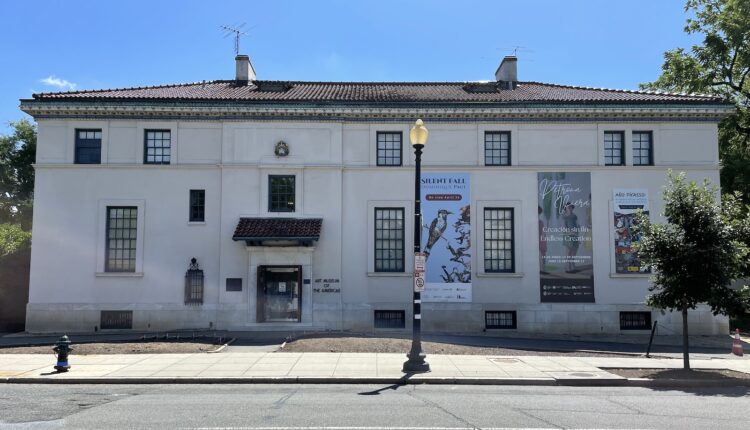
Tucked away in a small room on the third floor of the Art Museum of the Americas (AMA) is a series of works that all seem to be in dialogue with one another. Their media, style and color vary, but among them is a clue to their conversational starting point: a singular painting by Pablo Picasso.

The exhibit, titled Year of Picasso: A Dialog With the Americas, is being presented 50 years after Picasso’s death in 1973 and is one of dozens of exhibitions across Europe and North America celebrating the iconic artist. 

Unlike most of the other shows taking place this year, though, the exhibition at the AMA ⁠— a contemporary Latin American and Caribbean art museum that is part of the Organization of American States (OAS)⁠ — is focused almost exclusively on how Picasso and his work influenced artists in the Americas throughout the 20th century.

In 1973, three years before the museum opened, the OAS held a tribute exhibition to Picasso featuring works from all of the organization’s member states. Although much smaller in size and scope, A Dialog With the Americas is inspired by that exhibition.

The featured Picasso work is “L’aubade,” which he created while living in German-occupied Paris. A cubist painting designed to highlight the feeling of imprisonment — and perhaps the slightest feeling of hope — of that time, “L’aubade” is a showcase of the ways in which Picasso influenced other artists⁠ both in style and in his belief that all art is political.

In some of the works in the AMA’s exhibition, those influences are obvious. Colombian artist Alejandro Obregon’s “The Dead Student (The Vigil)” has a composition that seems inspired by “L’aubade,” and features a similar style. Obregon created the work in 1956 as a protest against the police killing of a group of students in Bogotá two years earlier under the authoritarian government of Gen. Gustavo Rojas Pinilla.

“The Last Serenade,” a painting by Argentine artist Emilio Pettoruti, seems to be directly inspired by Picasso’s “The Three Musicians,” while Mexican artist José Luis Cuevas’ “Homage to Picasso: The Real Ladies of Avignon” is a direct response to one of Picasso’s most famous works — “The Young Ladies of Avignon,” which was seminal in the development of cubism. Cuevas’ work approaches a similar tableau but with a more exaggerated, almost grotesque style.

Colombian artist Carlos Caicedo, meanwhile, explores Picasso’s work through photography in his “Imitando a Picasso” by using light to make it seem as if a real man and ox are casting Picasso-esque shadows on the ground. The effect is a marriage of the real world with the mind of Picasso.

Some of the conversations between the featured artists and Picasso do seem, admittedly, more indirect. Cuban painter Amelia Pelaez’s “The Waiting Lady” and Uruguayan artist Carlos Paez Vilaró’s “Rodoviario Saltimbanqui” both clearly draw from cubism and other styles associated with Picasso, but also pull from many other inspirations. Palaez’s painting, for instance, features bright, vivid colors inspired by art in Cuba in the early 20th century.

Perhaps the least obvious connection, despite its name, is Argentine artist Alicia Orlandi’s “Canto-Monumento a Pablo Picasso,” an optical illusion-style work that, interestingly, is placed in a space outside the room, where a visitor likely won’t see it until they leave the exhibition. In that sense, it is the final stop in Picasso’s influence.

That influence, this exhibition makes clear, was not simply in style and composition but also in how artists approach their work, and as a result, how their work reflects the world. In the oeuvre of these Latin American and Caribbean artists, the outsized impact of Picasso can be seen but perhaps not fully understood. 

What A Dialog With the Americas seems to be missing is context. This collection raises — but doesn’t address — interesting questions of how Picasso’s influence reached the Americas and what made the dialogue with his work different in that region than in the rest of the world. How did these artists and their peers view Picasso and his work? How is that reflected in the work?

Inclusion of that context could take what is a small exhibition ⁠— in terms of literal size and thematic scope ⁠— to the next step of truly reflecting on an artist with such an enormous impact, on art and culture writ large, 50 years after his death.

Black queer dancer O’Shae Sibley killed in suspected hate crime: update

By Abby Stuckrath

This article was originally published in News Is Out in partnership with Tagg Magazine here.

The suspect in the fatal stabbing of O’Shae Sibley reportedly turned himself in, according to the New York Police Department. The suspect, who is 17 years old, was charged with murder in the second degree with a hate crime enhancement and criminal possession of a weapon.

An impromptu voguing session in a gas station parking lot turned deadly when a prominent Black queer dancer was killed by a suspected teen yelling homophobic epithets, according to police.  

On Saturday night, O’Shae Sibley, 28, and friends stopped at Mobil Gas station in Brooklyn to refill on gas after a day trip to the Jersey Shore. While stopped, Sibley and his friends began jamming and voguing to Beyonce’s album “Renaissance,” according to media reports.

Security footage shows a group of men exiting the Bolla Market calling out to the group of dancers, reportedly shouting homophobic slurs and insults. Sibley approaches the men in defense, where the argument escalates when a man in black shorts pulls out a knife and stabs Sibley. 

Otis Pena, a witness and close friend of Sibley, held the stab wound near his heart until paramedics arrived. He was pronounced dead on arrival at Maimonides Medical Center. 

On Saturday, Aug. 5, the suspect in the fatal stabbing turned himself in, according to the New York Police Department. The 17-year-old suspect was charged with murder in the second degree with a hate crime enhancement and criminal possession of a weapon.

Voguing, especially in New York City, is deeply tied to the BIPOC queer community. The New York ballroom scene, starting in the 1960s, was the birthplace of ball and vogue competitions. It was a safe space for the socially ostracized Black and Hispanic queer community.

“Vogue has always been a celebration in resistance because of the lifestyles that we chose,” said Devon Webster, a ballroom artist known as Pony Zion, in an article with Insider. “Ballroom is the resistance, but voguing is a celebration. Voguing as resist? No, it’s irresistible. It’s about feeling good about who and what I am, and not because of something else.”

For Sibley, this innately queer act, voguing, a mere act of celebration, made him a target for violence. 

“They murdered him because he was gay because he stood up for his friends,” said Pena in a Facebook Live. “Just pumping gas, listening to Renaissance, just having a good time.” 

Violent, senseless acts against BIPOC LGBTQ individuals continue to be a prevalent global issue. Last month, an openly queer singer Josiah’ Jonty’ Robinson of Beaulieu, was strangled to death on Grenada Beach in the Caribbean. The Anti-Defamation League (ADL) and national LGBTQ organization GLAAD have reported more than 350 incidents of harassment, vandalism, and assault against LGBTQIA+ individuals from June 2022 to April 2023.

In response to the attack, Beyonce wrote, “Rest in Power. O’Shae Sibley” on the front page of her website. 

Her album “Renaissance” is widely accepted amongst the Black queer community. The album – dedicated to her late Uncle Johnny – a gay man and LGBTQ+ advocate who died of AIDS-related complications – is an amalgamation of ballroom vogue references and features artists like Big Freedia, Honey Dijon, Syd, Moi Renee and so much more. 

Sibley was deeply immersed in the ballroom and queer dance scene. As a professional dancer, he performed at the Lincoln Center in a digital media exhibit, “An Electric Dance to the Moment in Time”.  Director Kemar Jewel,  a close-found family member of Sibley, told NY Daily News about Sibley’s notable choreography work in his dance video, “Soft: A Love Letter to Queer Black Men.”

“He could sing, he could do hip hop, jazz, ballet, tap, and he was an incredible voguer! That’s how we became close,” wrote Jewel in a Facebook post.  

Sibley’s death has sent ripples across the queer dance community. 

“This news is absolutely heartbreaking, and we believe no one deserves to be targeted for simply being themselves and living in their truth,” said Philadanco!, Sibley’s old dance company, in a Facebook post. “We are keeping high hopes that Justice will be served.” 

“I’ll make sure that every Black Queer artist I meet knows that I am who I am because you poured into me and believed in me, even when no one else did,” said Jewel. 

This story was updated 8/7/23 with new information.

Poignant and packed ‘Monsters of the American Cinema’ at Prologue Theatre

By Daarel Burnette II

This article was originally published in DC Theater Arts here.

Actor Fletcher Lowe makes a mean monster. He sprawls his limbs, curls his fingers, and makes a guttural noise so freakish I squirmed.

It’s too bad that the plot of Monsters of the American Cinema — presented by Prologue Theatre at Atlas Performing Arts Center through August 6 — fails to make much sense of his character Pup’s monstrous tendencies. There are moments throughout this 90-minute play, directed by Jason Tamborini, co-starring Gerrad Alex Taylor as Remy Washington, that were intimate, frightening, funny, and sad. But the dots are never connected for me to make sense of it all. The stakes are never raised enough for me to care.

Playwright Christian St. Croix stuffs a kaleidoscope of identities with fraught pasts into two characters, parsing out their backstories in a series of monologues. 

Remy is a Black gay man who fled his abusive family and the racist South to work in San Diego, where he meets and falls in love and marries Pup’s father, who soon dies of a heroin overdose and leaves Remy his drive-in movie theater and straight, white teenage son, beset with recurring nightmares, to look after.

Pup and Remy bond over their love and deep knowledge of 1930s horror films, clips of which are projected on two giant screens that border the stage.

Scenic designer Nadir Bey assembled an elaborate set, giving us a glance at Pup’s messy room, walled off from a neat living room and kitchen. Two-thirds of the way through, the characters move to the roof of the set, which doubles as the drive-in.

The set is enhanced by designer Helen Garcia-Alton’s lighting, which flashes from the ground and the sky and the sides of the stage, and sound designer Dan Deiter, who projects pounding noises that make the seats shake.

Pup and Remy crisscross the set, entering and exiting, pausing to give long monologues before interacting with each other. This can be hard to follow for the average theatergoer who can handle only so much information and subplots at once. Are we supposed to pay attention to Pup’s growing racism and homophobia? Or his nightmares? Or Remy’s struggles to take care of Pup and the drive-in? All three?

Taylor lands some funny jokes through his characterization of Remy.

And the bonding and intimacy displayed between Pup and Remy is poignant and convincing. Remy’s arms are tangled up with Pup’s as they wrestle over a cell phone. Remy bounces on Pup’s bed as he plays Candy Crush.

But I wasn’t convinced, honestly speaking, by Remy’s reaction to the moments Pup used the F and N words, a lazy way to indicate that Pup loves his stepfather but is disgusted by his identity (being called a slur, while hurtful, is not the most typical or potent form of racism and homophobia for Black gay people).

The highlight of this show is Lowe’s acting, who would shine in a play about monsters that made more sense.