2023 Capital Fringe Review: ‘The Road to the End’ by Bella Panciocco

By Whit Davis

This article was originally published in DC Theater Arts here.

It’s been said that laughter is the best medicine. The Road to the End uses comedy to tell a story of grief and how we can use it to process our feelings. In 75 minutes the play examines themes of loss, grief, memories, friendship, bravery, and forgiveness.

What appears to be a fairly regular road trip to the Grand Canyon for a father and son, Steve and Henry, actually turns into something surprising. They pick up a hitchhiker by the name of Dabria. She helps the characters to peel back the layers of their rocky relationship. In many ways, Dabria and Henry are alike. They’re both travelers with heavy baggage who are looking to escape from the pain they’re feeling. Over the course of their journey, Henry and Dabria help each other make peace with their past and the people they love.

 The play uses two sets of characters for the past and present, which could have made the story difficult to follow, but the actors were very committed to their characters. The actors maintain the relational dynamics between the characters in the present and references to the past, and as a result, we always stay aware of the story.

I left this play reflecting on road trips, a seemingly mundane thing but a shared experience many of us can relate to.

If you’re interested in a quirky heartwarming story that confronts the sometimes complicated relationships between a child and their parent — especially an adult child and their parent — I recommend this play.

2023 Capital Fringe Review: ‘I could have set the world on fire’ by Shaun Michael Johnson

By Whit Davis

This article was originally published in DC Theater Arts on July 18, 2023, here.

Can the accents of characters drive a story? I could have set the world on fire, making its debut at Capital Fringe, asks us to consider.

This play is for you if you love hearing a variety of accents and they make you laugh. Unfortunately, the play fails to inspire much beyond admiration for the accents of the performers.

The play centers around Ernest Williams, an American with a posh accent sharing his old stories of working in film from his hospital bed with his Southern belle ex-wife and their daughter. As Ernest recounts his life stories, he embellishes and tries to gloss over the anti-Black roles he felt obligated to accept if he wanted to have a career in showbiz. The play also taps into how anti-Black racism can wreck the body and how the healthcare system experiments on Black bodies.

 However funny the play attempts to be, the jokes don’t find a solid place to land. The accents do a lot of heavy lifting for the play by distracting from the plot’s flimsiness. Lying underneath are strong themes that don’t quite get the support they need. The dialogue doesn’t easily flow between the characters, and the lack of chemistry is evident among them making me wonder if the director and playwright understood each other’s goals. With competing levels of connection to their characters, the play is stuck in rehearsal.

The play could have set the festival on fire but instead does little more than make a case for the playfulness of accents.

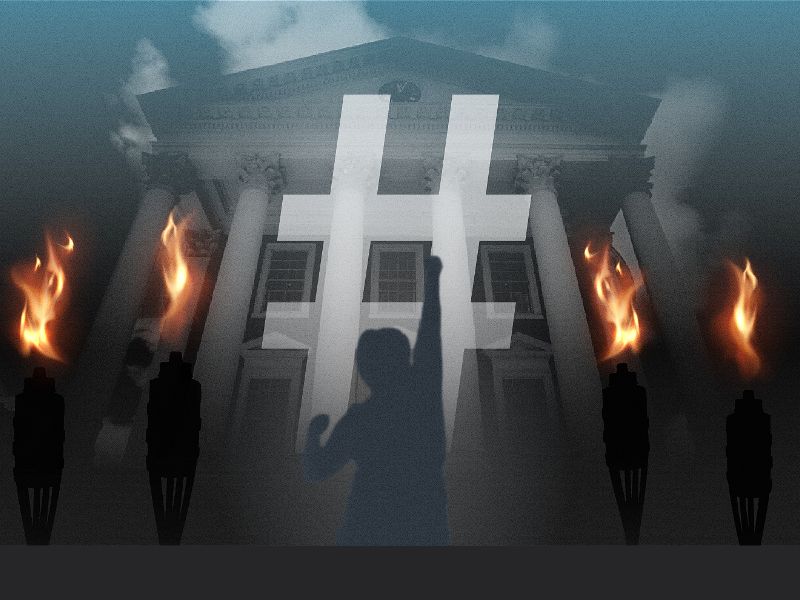
2023 Capital Fringe Review: ‘#Charlottesville’ by Priyanka Shetty

By Daarel Burnette II

This article was originally published in DC Theater Arts here.

I love theater for its potential to synthesize and succinctly reflect back to us traumatic moments in history, and serve as a healing device.

The 2017 rally in Charlottesville, Virginia, that resulted in the senseless death of Heather Heyer when a white supremacist rammed his car into a crowd of counter-protestors is a wound that’s still fresh.

Priyanka Shetty doesn’t flinch in her dynamic production of #Charlottesville, playing during this week’s Capital Fringe festival presented by Voices Festival Productions. In 75 minutes, she muscles through the leadup, clash, and fallout of a day most Americans would rather forget.

Her research is comprehensive. Her acting is poignant. Her stamina is stunning.

It’s exceedingly difficult to tell recent nonfiction stories about race. Our identities, politics, and chaotic modes of news consumption pollute our memories. And mainstream American culture has inconveniently deemed day-to-day conversations on race as taboo.

Priyanka, under the direction of A. Lorraine Robinson, exploits the tools of theater to walk audiences through the many ways residents, UVA students, activists, and politicians perceived the taking down of the Confederate statues, the election of President Donald Trump, and that fateful day when it all came to a head.

Dressed in khaki pants and a black turtleneck, Priyanka does a spot-on characterization of multiple witnesses, sensitively respecting their perspectives while also upholding the truth of what did and did not happen.

Effective use of lighting, sound, and stage direction keeps the narration succinct. What results is a salve that deserves recognition beyond DC.

2023 Capital Fringe Review: ‘A Bro’s Tale’ by Majdy Fares

By Daarel Burnette II

This article was originally published in DC Theater Arts here.

Majdy Fares has all the markings of a standout comic: He’s confident, perceptive, and has great comedic timing. But he fails in his one-hour standup A Bro’s Tale, playing during this week’s Capital Fringe, to deliver a cohesive story with clear takeaways.

He sets himself up for a great punchline. On a simple comic’s stage, complete with a mic stand, table, and bottle of water, he begins his act by describing an intimate love story in a seemingly foreign land, Dearborn, Michigan.

The son of Palestinian immigrants, Majdy is pressured at an early age to both assimilate into American cultural norms and uphold his parents’ Palestinian traditions. It’s here where Majdy is at his best, giving us lessons on how to actually pronounce his name (it’s Mahj-DEE), poetic descriptions of Dearborn (its own planet, covered in clouds of cologne, populated with hookah-bros), and punching up at Americans’ bizarre stereotypes and hangups with race (his description of his father’s bafflement after leaving the war-torn Middle East to arrive in the middle of Detroit’s 1967 race riots is hilarious).

When Majdy falls in love with an aspiring investigative journalist, he tailspins into an identity crisis. It’s here where he loses the thread of his story. By the time he finishes jokes about a cross-country road trip, apple shopping, and the obligatory (and exhausting) rant about free speech, he has little time to flesh out important plot points and central characters including his now-wife.A Bro’s Tale and Majdy have potential. A healthy edit will sharpen this necessary voice.

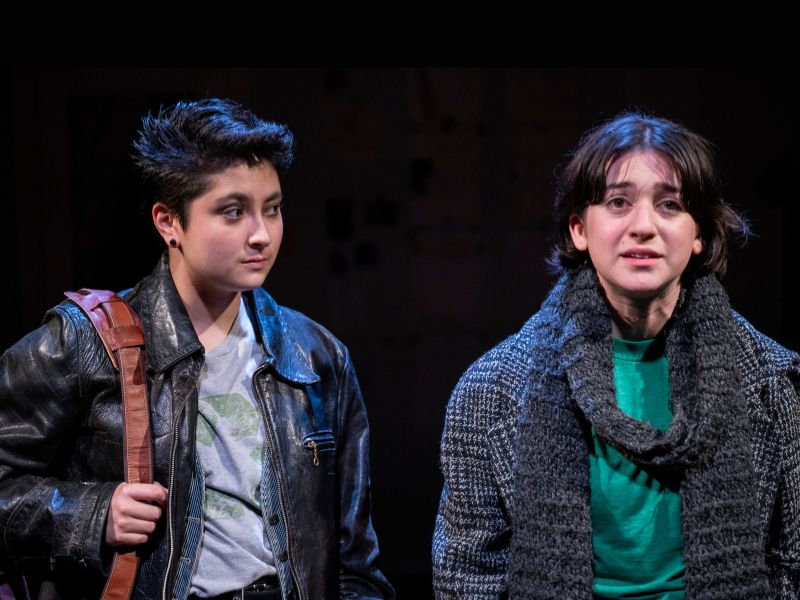
A rousing coming-of-age musical is right on time in ‘Fun Home’ at Studio Theatre

By Daarel Burnette II

This article was originally published in DC Theater Arts here.

What binds together the LGBTQ community most is what’s commonly known as the coming out process: grappling to find language to describe an incoherent feeling that’s deemed unnatural, revving up the courage to say those words out loud, and then waiting to see who will accept or reject this realized version of you.

The distinguished cast of Fun Home, now playing at Studio Theatre under the commanding direction of David Muse, manages to pack what for many of us is a years-long, awkward, and sometimes tortuous experience into a 90-minute, rousing coming-of-age musical.

Actors Bobby Smith (who plays the father who’s coming to terms with his own sexuality) and Andrea Prestinario, Maya Jacobson, and Quinn Titcomb (who play different ages of daughter Alison, who’s also coming to terms with her own sexuality) deliver standout performances, climbing up and down the wide range of emotions experienced by those who have come out the closet.

There’s a reason Studio’s concession stand is selling packs of tissues. Buy two.

Fun Home is based on the 2006 graphic memoir written by the cartoonist Alison Bechdel. Lisa Kron and Jeanine Tesori adapted it into a musical, and after its 2015 Broadway debut, it became one of the first mainstream musicals on Broadway to feature a lesbian. It’s won plenty of awards.

In the meta-musical, a modern-day version of Alison sketches a graphic memoir of her life, in the process reflecting on growing up under the watchful eye of a closeted father, Bruce, who also happens to be a perfectionist. Her mother, Helen (played by Rebecca Pitcher), grapples with whether to keep secret Bruce’s growing proclivities, especially when his relationship with a young man named Roy (played by Adante Carter) turns inappropriate, and then again when he runs afoul of the law.

Siblings Christian (played by August Scot McFeaters) and John (played by Teddy Schechter) offer a lilt to this at-times dark tragedy.

There’s pitch-perfect, harmonious singing, and lots of disco dancing.

Because the plot is nonlinear and jumps back and forth between, among other things, Alison’s studio, a funeral home, a highway, a living room, and a college dormitory, creating a tidy set that makes sense is a bit of a puzzle. But set designer Debra Booth was helped tremendously by lighting designer Brian Tovar, who, for example, flickered bright lights on Small Alison’s face to indicate she’s watching the television, or flashed up and down the aisles passing headlights to let the audience know they were now on the highway.

Costume designer Sarah Cubbage serves the ultimate alley-oop, though, by picking the most perfect, blast-from-the-past outfits: lots of plaids and stripes, too-thick ties, browns matched with pinks, and starched collars and glittery platform heels.

Actors pantomimed their ways through other parts to keep the necessary props to a minimum. This can be confusing. Sometimes Alison draws with a pencil. Other times, she draws with an imaginary pencil. Actors face the audience, hands to their side, to indicate they’re on the phone with other actors on stage. And no driver’s hand ever touches an imagined or real steering wheel.

But this quirk at times frees actors to display their superb acting skills, which will resonate with LGBTQ and straight audiences alike.

Bruce and Roy longingly and disturbingly stare at each other. Alison, John, and Christian tussle for their father’s approval. Helen is enraged by her husband’s behavior, before experiencing bouts of embarrassment and grief.

Watch especially Bobby Smith’s version of Bruce: the way he erupts at the slightest imperfection that could bring embarrassment to himself and his family, the way his secret physically bears down on him through the decades, the way his hand quivers when trying to describe his fears. (Bruce’s “Edges of the World” is performed in a way that will stick with me for a very long time.)

Watch Maya Jacobson’s version of Medium Alison, after she for the first time experiences sex with college classmate Joan, played by Thani Brant. Alison’s “Changing My Major” is a comical song of self-discovery and heartfelt romance, rarely provided to queer characters on stage.

And please, please, please watch Quinn Titcomb, whose stellar performance of Small Alison conveys some of the most complicated, at times conflicting emotions of LGBTQ youth: the way she pauses for an extra beat when her father demands that she wear a dress, the look of confusion expressed in “Ring of Keys” when struggling to find the way to describe the familiarity she felt when she first met a gender-nonconforming woman, and her longing wish to one day fly away.

Subtle but piercing.

Coming out en masse was a linchpin of the LGBTQ movement in the 1980s and ’90s and why its activists managed to gain so many allies at the height of the AIDS crisis.

Studio has a long tradition of exploring the nuances of LGBTQ lives. So much, in fact, that a coming-of-age musical about a lesbian grappling with her sexuality may seem retro and even basic for a DC theater that was draped in pride flags just last week.

What more is there to know?

Today, the internet provides young trans people with both community and language that have blossomed into a new coming-out movement. That, in turn, has frightened a large swath of Americans, and the government in response has turned to muting the teachers and artists who shape their coming out experience.Fun Home’s return to the stage is right on time.


An Interview with Sandra Worth

By Thais Carrion

This article was originally published in Washington Independent Review of Books here.

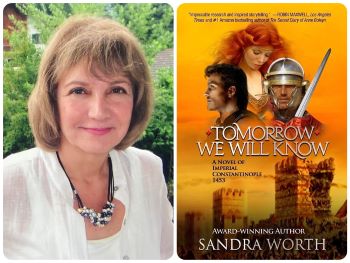
Sandra Worth’s most recent novel, Tomorrow We Will Know, is an epic situated during the fall of Imperial Constantinople and told through the romance between Emperor Constantine and Zoe, the daughter of his grand duke. Navigating this tumultuous period and the personal stories of three main characters, Worth weaves a riveting tapestry of the love that drove the actions at the heart of Constantinople’s fall. The familiar tale of the cowardice at the root of the city’s end is turned here into one of intense bravery and emotion that considers the humanity behind the events that took place. 

Tomorrow We Will Know unfolds in a rapidly changing Constantinople. What inspired you to turn your attention to this time and place?

I first became intrigued by Constantinople when I read mention of the mysterious light phenomena that had plagued the city in the last days of its existence — phenomena that still baffle modern scientists. All I knew then about the ancient city was that it had been the seat of the Roman Empire for 1,100 years and was all that remained of that great civilization when it fell. Years later, I came across another mention of Constantinople, and an image of fire, death, and crumbling walls flashed into my mind. I began to read about the period, and the more I read, the more engaged I became. 

The novel explores these events through the lens of a love triangle between Zoe, Constantine, and Justiniani. How did you develop their stories? And were there any characters that you found especially intriguing to write about?

All my novels are set in wartime and driven by the love story, because war is dark, and love is the only light. Sometimes, the love story is writ large in the historical record, but sometimes it’s buried, as it was with Constantinople. The picture that emerged — the love triangle — surprised even me. 

Emperor Constantine’s story is a matter of record. When he wept for his people, his ministers witnessed his tears. We know his character and his hopes and dreams. We know he was a man of great courage who refused to flee his country, though his ministers begged him to leave. Into this dangerous world hovering on the edge of extinction came brave, dashing, princely Justiniani for the noblest of reasons. He was closer to Zoe’s age than Emperor Constantine. It was a time of crisis. Did he fall in love with her? How did Zoe feel about him? 

I modeled Zoe’s character on what was known of her in Venice. She had a good heart, was generous, resourceful, and of high intellect, with a literary bent. I found nothing to indicate a relationship of any kind between her and Justiniani, but that is not surprising. Affairs of the heart were more likely to fuel gossip than record-keeping. 

You ask about an especially intriguing character, and that has to be Justiniani. Constantinople was expected to fall within days to the Ottomans, but Justiniani changed that. Thanks to his courage, charisma, and military brilliance, 5,000 men withstood 150,000 enemies for seven weeks and nearly won an unwinnable war. Yet Justiniani abandoned his post just as the sultan was about to call the final retreat and Constantinople was about to win the war.

How did you tackle narrowing down the scope of this story? 

As significant, momentous, and far-reaching as time has proved this historical event to be, the people in this extraordinary tale are what I focused on. History offers a stunning backdrop to the story, but it is the human heart and the resilience of the human spirit that I find awe-inspiring. Turkey won. They went on to win for a very long time. It took Europe 125 years after the fall of Constantinople to win its first victory against the Ottomans. It took Europe another 125 years to finally liberate itself from the threat of annihilation. Only Justiniani and a few brave Italians answered the emperor’s call for help. My book salutes their valor.

Your novel intertwines fiction with real events. How do you navigate the line between staying true to historical events and incorporating imaginative elements to engage readers?

Historical accuracy is always paramount for me because my readers expect it. Sometimes, there are conflicts in the historical accounts, and I’m obliged to choose which to follow. But when I have to fill empty spaces, I always strive to connect the dots between the events as plausibly as I can because I’m searching for the way it really happened. In the case of Constantinople, there weren’t any blank historical spaces to fill that I can recall. Except for Justiniani’s motivation at the end, we know from the diaries and writings of the many survivors precisely what happened. Only romance left wide blank spaces free for my imagination. 

More relevant to storytelling is the need to keep the reader engaged by creating drama. I didn’t find that difficult here. Those who came before us lived with an appalling amount of drama in their lives. How they dealt with it and kept going when we ourselves might have given up is what keeps me enthralled. It all comes down to the resilience of the human spirit. They may have won the battle and lost the war, but even across the ages, their deeds blaze with light and warm the heart. They deserve to be celebrated. Even 600 years later, they have something to teach us. We can learn from their fortitude when we face our own battles in our modern life.

‘Radio Golf’ plays a round below par at Round House

By Daarel Burnette II

This article was originally published in DC Theater Arts here.

August Wilson gifted American theater with some of its most dynamic and animating Black characters whose wisecracks, soaring speeches, and knockdown fights deepened our collective understanding of the many ways racism wrecks Black communities.

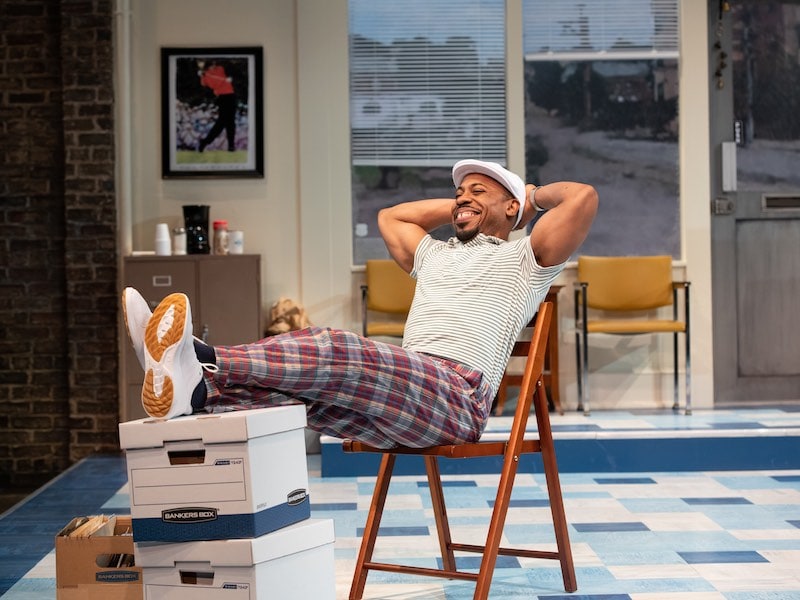
So it was unsettling to watch the mismatched cast under the direction of Reginald L. Douglas work their way through Wilson’s Radio Golf, playing this month at Round House Theatre in Bethesda.

Roosevelt Hicks, masterfully played by Ro Boddie, jabbed.

Mame Wilks, passionately played by Renee Elizabeth Wilson, prodded.

Sterling Johnson, convincingly played by Kevin Mambo, hustled.

And Elder Joseph Barlow, wittily played by Craig Wallace, griped.

But in each scene, to each antic, Harmond Wilks, an aspiring politician and real estate developer played by Jaben Early, seemed numb to just about every stimulus tossed his way.

That made Radio Golf a bit of a letdown.

Radio Golf is the last play Wilson wrote before his unexpected death in 2005.

It’s also the least produced and one of the more complicated works in his ten-play American Century Cycle, which explored the lives of Black residents in the Hill District in Pittsburgh. But while the business dealings in Radio Golf can sometimes be hard to follow, its overall theme still resonates today when so many Black neighborhoods undergo rapid change.

Radio Golf centers on Harmond Wilks’ decision to run for office while also trying to secure a federal grant to redevelop a blighted block in the Hill District. But he and Roosevelt, his development partner, run into trouble when he learns that one of the houses on the property was seized by the city in an underhanded way.

The play explores themes of access and opportunity and who benefits and suffers from Black capitalism.

And it’s clear the majority of the cast have a deep understanding of their character, their convictions, and what exactly would spark rage and passion.

Ro Boddie, who plays Roosevelt, has a vocal range and kinetic energy that leaps from the stage and (somehow) manages to build as the plot thickens and the stakes for his livelihood are raised. Kevin Mambo delivers a memorable version of Sterling that humanizes often stereotyped poor Black men trying to make a living. And Craig Wallace steals the show with his version of Elder Joseph Barlow. His nonsensical rants, pauses, side-eyes, and limped entrances and exits are perfectly timed and laugh-out-loud funny.

I appreciate the detailed and realistic set, designed by Meghan Raham: The early-era Mac on the desk, the scattered momento-filled boxes, the CD-tape player (where’d they find that?), the backdrop of the Pittsburgh skyline, and the rusty tin ceiling with the faded motif.

And costume designer Moyenda Kulemeka plucked the sort of flashy three-piece suits it’s easy to imagine Black businessmen would wear in the mid-1990s.

But other choices made by the creative team kept jolting me in and out of 1995 Pittsburgh and 2023 Bethesda. The Pittsburgh Post-Gazette the characters read from, the crumpled deeds slapped on Harmond’s desk, and the Crayola-colored files yanked out of the filing cabinets didn’t at all look authentic. Sometimes the characters looked lost on stage, disengaged from the dialogue, picking actions that confused rather than clarified their motivations.

And then there’s Harmond. Early, who plays Harmond, exudes the look of young Black politicians who were elected in the mid-’90s and early 2000s to become some of America’s first Black mayors. He’s tall, muscular and has a charming smile that’s hard to look away from. But looks can only get you so far in an August Wilson play, which taps into so many emotions that you become suspicious of anyone on stage who’s not in some way reacting.

For an aspiring politician who’s launching a multi-million-dollar project, Harmond’s monotone verses, stiff actions, and frequent hands-on-hips stance doesn’t make any sense. Does he really care?

He leans back and stares blankly when Elder Joseph Barlow details his relationship with the American flag or when Sterling shoots off a series of ideas on how to fix the traffic and improve the policing. And when Roosevelt yelps and does a praise dance to a landed business deal, Harmond can’t match his energy.

Because Harmond almost never leaves the stage and he narrates so many of the pivotal parts of this play, his lack of stimulus can be confusing for those trying to grasp the direction of the play, which, in some parts, is bogged down with lots of legalese.

There’s a reason August Wilson’s work has been replicated thousands and thousands of times. His plots are engrossing. His characters are relatable. His dialogue is masterful. Round House’s attempt at Radio Golf is an admirable one that has room to improve.