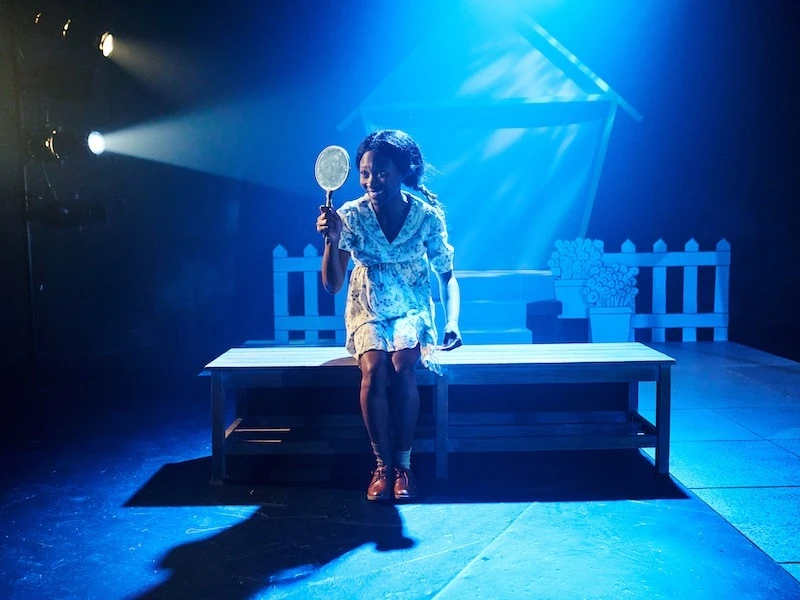
‘The Bluest Eye’ at Theater Alliance honors a giant, Toni Morrison

By Whit Davis 

This article was originally published in DC Theater Arts here.

Since the passing of Toni Morrison in 2019, newer and younger audiences are gravitating toward her brilliant, canonical works. A world without Toni Morrison’s physical presence has caused all of us to reach for her through books, YouTube clips, documentaries, TikToks, and plays. The theatrical adaption of The Bluest Eye by Lydia R. Diamond is a remarkable jewel, and the local performance by Theater Alliance in Anacostia honors a giant.

The Bluest Eye is a story about a Black girl named Pecola Breedlove who prays for blue eyes so that she’ll be treated with a femininity only available to little white girls. Instead, she experiences abuse from those who should protect her, and she feels and believes that her “ugliness,” which is her Blackness, keeps her trapped in these horrifying experiences. This play is a true testament to the cruelty of anti-Blackness.

The Bluest Eye is worthwhile viewing. From the set design (by Tiffani I. Sydnor) to the costume design (by Danielle Preston), the audience gets a glimpse into what it looked like to grow up in the 1940s. The set reinforces the hardships of that era and the beauty of making the most out of what you have. The costume design reminds you of how much gendered ideas are a part of clothing. The expectation of the female characters is to be feminine and dainty, and yet they “should know better” when it comes to life lessons.

It can be tricky for adults to play children because not only are the actors expected to look younger in character, but they must also tap into their youthfulness — and this cast succeeds. Amiah Marshall captures the nature and pain of Pecola. Devin Nikki Thomas plays brilliantly Maureen Peal, the light-skinned classmate Pecola connects with — but only briefly because she turns out to be a mean girl. Thomas also transitions to playing a neighboring gossiping adult and is believable as both characters. Finally, Melanie A. Lawrence plays the narrating voice of the story, Claudia, a character both strengthened and shattered by everyone’s desire for whiteness as beauty.

The cast works well together, possessing the chemistry needed for a play with deep complexities of themes like anti-Blackness, colorism, poverty, abuse, and friendship. The actors seem close to the story and yet possess enough distance not to be swallowed by its power. Morrison’s works tend to have that effect.

The play is not without fault. It’s an adaptation turned into an interpretation by the director, Otis Cortez Ramsey-Zöe. Some scenes with mature content where abuse occurs feel more like scenes from The Three Stooges. Yet the trauma Pecola is experiencing remains concretely humorless due to the profound storytelling ability of Morrison.

The legacy of Toni Morrison stands tried and true. Her absence drives a longing for us all to become more deeply acquainted with her works, especially as she continues to be on the list of banned books. The Bluest Eye has solidified itself as a classic, and the stage adaptation reinforces its ability to be timeless no matter the form. It’s hard to do wrong with a work of art so close to perfection.
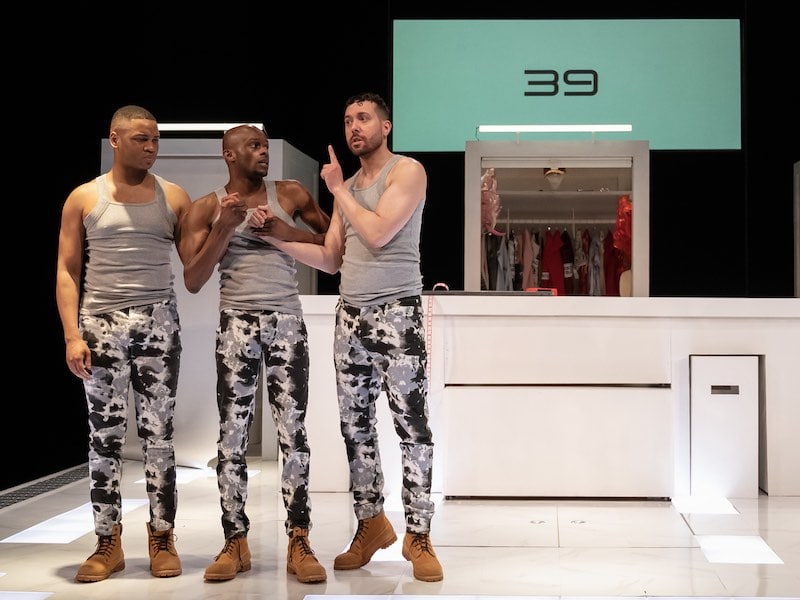
Mosaic’s unabashed ‘one in two’ lifts stigma of HIV+ Black male bodies

By Daarel Burnette II

This article was originally published in DC Theater Arts here.

What’s so engrossing about Mosaic Theater Company’s one in two, playing this month at Atlas Performing Arts Center, is the way its Black male actors fling their bodies into each scene.

It’s the way Justin Weaks curls up his 6-foot, 140-pound frame on a plastic folding chair, or Ryan Jamaal Swain rolls and twists his half-nude body while vacuuming dirt off the stage, or Michael Kevin Darnall cradles the bare knees of his partner as he details an especially painful experience. Or when all three, playing their unhindered childhood selves, chase each other across the stage in an exuberant game of duck, duck, goose.

Since its inception, American theater has fetishized, dehumanized, and exploited Black men’s bodies. But here, Director Raymond O. Caldwell forces us to stare at and engage with the physical and emotional contours of three Black male bodies and poses a provocative and still-relevant question: how will you react if you learn one of those bodies is now diagnosed with HIV?

Almost half of all Black American gay or bisexual men are expected to be diagnosed with HIV in their lifetime, according to an ominous 2016 CDC prediction. Playwright Donja R. Love explores in this humorous, incisive play how the ongoing stigma of HIV has distorted the relationships Black gay men have with each other, their families, and themselves.

What’s most impressive about this play is the stunt Darnall, Swain, and Weaks pull off at the beginning of the show. As part of an effort to explain what one calls the play’s “amorphous…non-existent ass plot,” they break the fourth wall and ask the audience to vote, through a round of applause, on which actor they want to take the lead role, Donté — recently diagnosed with HIV and tasked through a series of scenes to walk through the many ways his community responds to the revelation of his status. The other two actors decide, through a game of rock paper scissors, who will play which supporting roles.

Considering this unusual stunt, it’s very possible that your experience inside Atlas Performing Arts Center’s Sprenger Theatre will vary drastically from mine depending on who’s voted to play the lead and supporting roles.

But the show’s overall message is a worthwhile one for Washington, DC-ers to grapple with (more than 11,000 people in the District, the majority of them Black and gay, have been diagnosed with HIV).

The astronomical rate of HIV within the Black gay community has been explained away in past decades as indicative of their promiscuous behavior, their refusal to wear condoms or seek medical care, God’s punishment, and a “medical mystery.”

 We now know that it’s the result of a confluence of factors that include their disproportionate lack of access to healthcare and insurance, their doctors’ unwillingness to ask them about their sexual activities, the prison and military industries’ sloppy handling of HIV diagnoses, the insular nature of Black gay communities, and, yes, culture.

When Black gay men are diagnosed, the rampant stigma associated with the disease — immoral, cursed, dirty, infectious — shames them into refusing to tell their sexual partners, families, and friends, compounding the crisis.

Playwright Love, who was diagnosed with HIV on December 13, 2008, found himself a decade later in a depressive and suicidal state, and decided to type out on his phone as a form of therapy a play about the “ugly, dark moments” HIV and its stigma has caused.  A run-in with another alcoholic, HIV-positive Black gay man who refused to take his medication led him to decide to get his sketch of a play produced.

“I would love it if I could be able to give this to my community, to help heal,” he said in a 2019 interview before a New York City run of the play.

What a courageous decision.

The stage, designed by Nadir Bay, is first presented as a hospital waiting room with three wardrobes, but throughout the 90-minute production it transforms into a playground sandbox, a gay bar, a bedroom, a bathroom, a hospital room. There are dozens and dozens of props (Deb Thomas, designer) that spring from backstage, behind set pieces, and underneath the floor.

Lighting designed by John D. Alexander and projections designed by Deja Collins provide crucial subtext, helping the stage transform between time and place and dictating to the audience a series of stats (some of which are eventually explained and some of which are not).

In the performance I saw, Darnall played Actor #1 (Donté), Weaks played Actor #2 (Mom, Banjii Cunt, Trade, Person at Bar), and Swain played Actor #3 (Bartender, Nurse, Kinda Ex-Boyfriend, Married Man). That they each managed to remember their lines, change into the appropriate costumes (designed by Brandee Mathies), and pick up the right prop through the intermission-less show is jaw-dropping.

The acting is conversational, fast-paced, at times improvisational. The code-switching —  something Black gay men, who straddle femininity and masculinity, white, and Black have long had a knack for doing — is convincing.  And the conviction the actors deliver is the type that only real-life experience could bring to the stage.

Weaks throughout toys with the audience’s emotions in a masterful way, exaggerating movements, drawing laughter, slipping into and out of sagging jeans and frilly pink hats.

It’s here that I should stop and point out the exceptional work of Sierra Young, the show’s fight and intimacy director.

Darnall, Swain, and Weaks are visibly aware of the space they take up and unabashedly use their bodies to tell their stories. A sex scene is at once believably intimate and then immediately cold. The hand-holding, kisses, fist bumps, and a moment when “Trade” blows smoke from his blunt into Dante’s mouth convey the respect and dignity that Black male bodies on stage are so often deprived of.

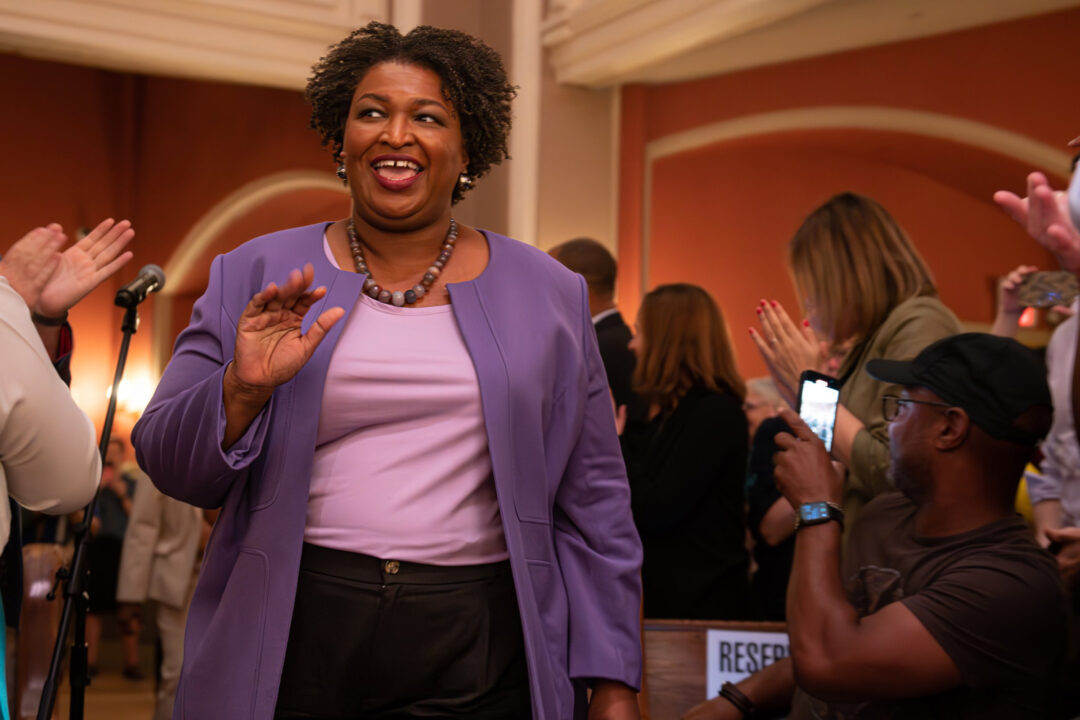
Stacey Abrams: Be curious. Solve problems. Do Good

By Samantha Neugebauer

This article was originally published in DCTRENDING here.

Stacey Abrams spoke to a packed house at Sixth & I, last week, about her new legal thriller, Rogue Justice; the follow-up to 2021’s While Justice Sleeps. While most folks know Abrams for her time serving in the Georgia House of Representatives as a voting rights activist, and her two Georgia gubernatorial runs, others are drawn to her work as a fiction writer. Abram’s discussion with moderator, Tiffany Cross, comprised not just her writing process, the nation’s current state of division and AI, but also the intricate intertwining of her political and writing careers. 

Prior to 2021, Abrams released eight romance novels under the nom de plume, Selena Montgomery. When questioned about potential concerns regarding her political career due to publishing romance novels, Abrams elaborated on the the merits of the romance novel genre and the skillful artistry required of a writer to engage readers throughout the narrative. She takes pride in her novels, and emphasized to the audience that criticizing popular works like romance novels essentially belittles those who genuinely enjoy them. The idea of refraining from demeaning and villifying others unexpectedly became the central theme of the night.

Moreover, Abrams shared how her motivation to write, and to be politically active spring from the same desire to connect with people. In both realms, she expressed, “Be curious. Solve problems. Do Good.”  When it comes to writing, doing good doesn’t necessarily imply that the characters always end up as angels. Abrams likes to create characters who embody the intersection of circumstances and the potential for various future pathways. Abrams appreciates that her character’s are willing to make morally upright choices.

In both writing and politics, she contemplates the unasked questions considering the issues that may not be apparent like our environment and judicial system, AI, and our fellow citizens whom might disagree on a fundamental level. In a country as divided as ours, Abrams stressed that we need to remind ourselves that our villains and our heroes are complicated — just like the ones in her books. At one point, Cross asked Abrams if she thought we live in a country with a majority of good people. Abrams responded that she could be having a great conversation with an individual, only to reach a “moment of departure” when the topic shifts to politics and it’s apparent they have different worldviews. However, she assured us that such differences in perspectives doesn’t mean we can’t find common ground. We should collaborate where we can despite our differences in motivations. We need not compromise our values, only our vision, because it’s not always feasible to get all we want simultaneously.

Later in the discussion, Abrams underscored the need for AI regulation — “We need rules,” she stated. She touched upon her love of biographies and urged aspiring writers to read more in this genre in order to learn how people make choices. Throughout the entire program, Abrams had the crowd in stitches. What’s more Abrams, it appears, is gifted with equal measures of grace, intelligence, and humor.

‘’Good Bones’ At Studio Theatre Sheds Light On Gentrification’s Impact From a Fresh Perspective

By Imani Nyame

This article was originally published in DC Trending, here.

If homeownership is the last pitstop to fulfilling the American dream, then it makes sense that Black Americans are encouraged to stay woke. In a country where the vast majority of homeowners are White it can be a cause for celebration when a Black family can afford to dream. Buying a house is a step towards  Black intergenerational wealth. Yet, they may unknowingly contribute to the gentrification that plagues many urban communities experiencing rising property values. But what happens when the gentrifier isn’t an outsider? Or, if the perpetrator moves back to the very place they ran from? 

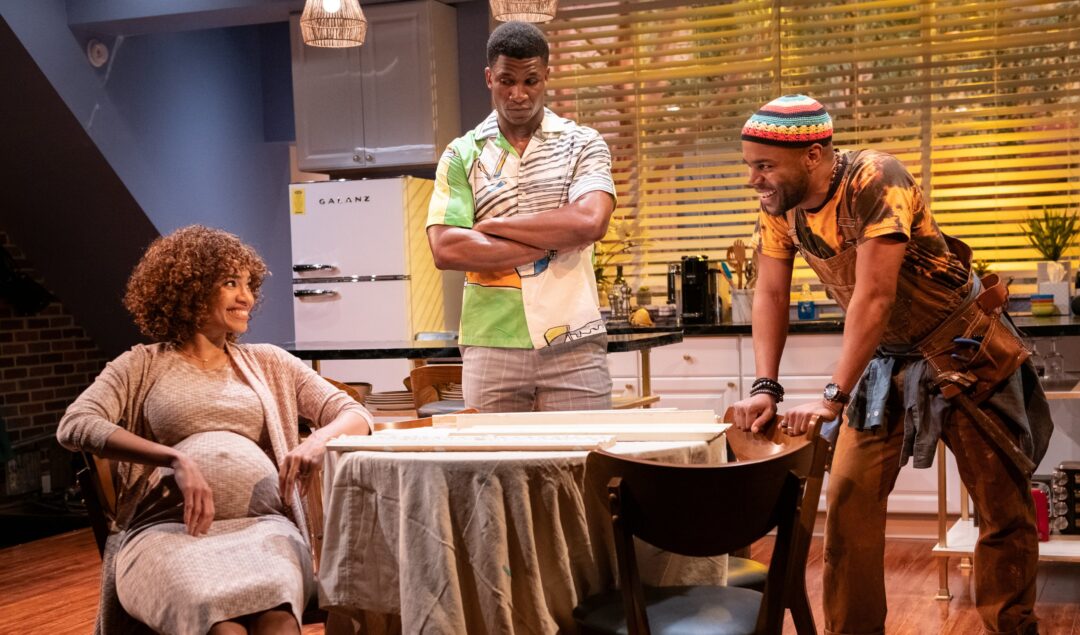
These questions are confronted in the world premiere of Pulitzer Prize winning playwright, James Ijame’s, Good Bones commissioned by Studio Theatre. Directed by frequent Studio Theatre collaborator, Psalmayene 24, this production is intimate. It features a thrust stage set in the kitchen of married, first time homeowners, Aisha (played by Cara Ricketts) and Travis (played by Joel Ashur) expecting their first born. As they employ the help of neighborhood contracter, Earl (played by Johnny Ramey) to help them finish their renovations in time for the birth of their baby, they connect with one another and to their neighborhood through candid conversation and some much needed life reality checks. 

The performance’s frank dialogue showcases each character’s undeniably strong sense of self. So it’s fitting that the majority of this play takes place in the midst of discourse. The common denominators are the headstrong and lively Aisha, and the passionate, yet hotheaded, Earl both of which are natives of the unnamed city meant to represent the many just like it. Aisha left her hometown and attained higher education to became a civil engineer; Whereas, Earl stayed. Earl is an intrinsic part of his community and is troubled  by the general disregard for its  rich history. Ramey’s “Earl” is provocative and his intensity toes the line that establishes his and Aisha’s professional relationship. Earl sees Aisha in ways that Travis cannot. Ultimately, their relatability nudges Aisha towards an impossible “what if,”  forced to reckon with who she would have become if she had stayed. 

Costume designer, Moyenda Kulemeka’s, amplifies the charcter’s archetypes and personal politics seamlessly through wardrobe. Travis, aloof, young and wealthy, sports muscle bearing polos matched with trendy shorts, and a signature high-top fade which likens him to a modern day, Carlton (The Fresh Prince). This is a stark contrast to Earls’ modest, earth-toned outfits, and splashes of color coming from what seems to be a vast collection of accessories including a kufi adorning his crown.

There’s a fifth character, outside of the  main characters, that plays a pivotal role in the story — the ghost of Aisha and Travis’ new home. Sound master Megumi Katayamaand lighting (by William D’eugenio) work together to create an ever present spirit. Random sounds, the laughter of children, and the dimness of the kitchen at different times of the day serve as a reminder that time doesn’t exist in a vacuum. 

Earl says, to Aisha, “…the past isn’t the past…it’s here. Now.” 

Ultimately, Good Bones is nothing short of some good kitchen table talk. It’s a homespun, neighborly discussion about taking responsibility for one’s community by being conscious of and actively engaged in the structures that exist within it

Gripping ‘Good Bones’ at Studio Theatre explores Black gentrification

By Daarel Burnette II 

This article was originally published in Dc Theater Arts on May 22, 2023, here.

In the spring of 2019, a protest broke out in a rapidly gentrifying neighborhood of Washington, DC, after a T-Mobile store owner was told by the police to turn down or off the clanging Go-Go music he’d blasted from outdoor speakers for decades.

Anger had been swelling for years over who in the neighborhood would have access to shrinking resources, who the police would police, and who the neighborhood really belonged to.

That scene has now been deftly brought to the stage by Studio Theatre in Good Bones,written by James Ijames and directed by Psalmayene 24.

The play forces its audience of mostly white DC residents to think critically about their own role in Black displacement and the sharing of space through the use of unsuspecting characters, the Black gentrifier.

Its acting is gripping, and the set is dynamic, though the plot is at times wanting.

Good Bones was commissioned in 2019 by Studio. Ijames, who recently won the Pulitzer Prize for Fat Ham, wrote the play based on his time in the neighborhoods around Studio Theatre and growing up in Philadelphia, according to Studio’s artistic director David Muse.

It adds to a growing genre of art that explores the Black gentrifier, who’s conflicted about their obligation to give back, their own understanding of “authentically Black,” and their newfound ability to afford.

Middle-class Black people are significantly more likely to live in low-income neighborhoods, according to a 2015 Stanford University study. This act is often spurred on by their attempts to escape anti-Black racism in white suburbs, deep kinship with family and friends in low-income neighborhoods, and bias embedded in the real estate industry. But it prevents Black children from accessing better schools and exacerbates the wealth gap, since homes in Black neighborhoods don’t accrue value the way they do in white neighborhoods.

In Good Bones, Aisha, played by Cara Ricketts, and her husband Travis, played by Joel Ashur, move into a fictionalized city undergoing a rapid demographic shift. Earl, a local contractor played by Johnny Ramey, questions the way Aisha talks, what she does and doesn’t know about the local neighborhood, and her attempt to revitalize the once-abandoned home, which is haunted.

Ashur and Ricketts bring to the stage the sort of authentic chemistry that makes their newfound love believable. Their dance breaks, which co-stars lighting produced by William D’Eugenio, is both well coordinated and entertaining.

There were moments when I thought the plot could move beyond the sometimes-predictable frictions communities across the world experience when class and race clash. We’re only given glimpses at some characters’ backstories. Some of the monologues are redundant and plodding.

Nevertheless, sometimes it’s necessary to say over and over again to an audience that their actions have consequences. That makes Good Bones worth it.

In poetic ‘Oreo Complex’ at Nu Sass, Lillian Brown solos on being Black

By Jakob Cansler

This article was originally published in DC Theater Arts here.

Before any words are spoken in The Oreo Complex, the directions are clear. In bold letters, repeated a hundred times on the background of the stage, are three words: FOLLOW THE RULES.

What are the rules? There are a dozen or so of them, appearing in the intro portion of the show. “Imitation is the sincerest form of flattery” is there, as is “Don’t call anyone racist” and “Talk about race, but not too much” and “Hand out lots of treats” and ⁠— I couldn’t remember them all, to be honest. I am, admittedly, not expected to remember them.

Lillian Brown, the writer, director, and sole performer of Oreo Complex, is expected to remember them. She is expected to follow them, too ⁠— all of them, at all times. Doing so is like a never-ending balancing act. In Oreo Complex, now performing at Nu Sass Productions through June 2, Brown expertly reveals the toll that such a balancing act has on her. 

Oreo Complex explores the experience of being Black, both generally and specifically within white institutions, and is inspired by W.E.B. DuBois’ concept of double consciousness. The show is split, essentially, into three parts, with monologues serving as bookends and a dance sequence and rendition of “Lift Every Voice and Sing” in the middle.

Brown begins, after the rules are laid out, with the definition of “oreo,” a derogatory term meant to describe a Black person perceived by others as “acting white.” From there, Brown launches into a stream-of-consciousness monologue that explores various aspects of identity and race in a short amount of time, both by directly speaking about her own experiences and understanding of Blackness and by revealing through her emotions the way that those identities affect her.

“Monologue” may actually not be quite the right word to use here. Sure, the lines flow conversationally, but there is something poetic about the way Brown speaks. The lines come fast and sometimes frantically, but there is a rhythm to the sentences, a mellifluousness that is captivating from the minute Brown defines “oreo.”

To be sure, “oreo” is not a self-description, for Brown or anyone. It is an identity placed on Brown by others. In fact, most of the various identities Brown explores in the first section of Oreo Complex are externally designated. Brown talks frankly about not feeling Black enough for the Black community while simultaneously not being considered Black by white people while simultaneously being defined by her Blackness by white people. It is telling that for much of the first section of Oreo Complex, Brown often uses the royal “you,” like even her own experiences exist outside of her. 

Much like following “the rules,” there is a balancing act to oscillating between all these identities. The frantic, stream-of-consciousness nature of this monologue derives from all the thoughts and emotions that pour out amid trying to reckon all of these identities. Her words are honest, sometimes even blunt, but they are also purposefully scattered, sometimes even contradictory.

When the dance and music come in the middle of Oreo Complex, then, they serve as an interlude of sorts. For the audience, it is a chance to digest. For Brown, it is a chance to collect ⁠— collect her thoughts, her emotions, her wording, her identity.

As a result, the second monologue in Oreo Complex is not the outpouring that the first one is. It is less stream-of-consciousness and more statement-of-purpose. There is still plenty of emotion in Brown’s words and performance, of course, but it is not the emotion that bleeds through the cracks of externally designated identities. This emotion is knowingly deployed from within.

It is also notable that for this second monologue, unlike the first, Brown sits on the floor the entire time. If the first monologue is an expression of the balancing act of being Black within a white institution, it is one that is both transfixing and hard to watch. After all, the captivation of a tightrope walk comes from the fear that at any second, the walker may fall. For Brown and for us, there is fear she may lose everything if she breaks one of the rules.In the end of Oreo Complex, though, Brown does not fall. She does not reach the end of the tightrope. She does not break any of the rules. She simply decides the balancing act is over.

In ‘Open’ at Nu Sass, a magician’s imaginary tricks reveal reality

By Jakob Cansler

This article was originally published in DC Theater Arts here.

Theater has long been obsessed with magicians. For an industry in the business of creating compelling work, there is an understandable fascination, perhaps even jealousy, with the power a good magician can hold over an audience, with their ability to create a spectacle that denies ⁠— and allows the audience to escape ⁠— reality.

It is ironic, then, that Open, a one-woman show about a magician, has quite the opposite effect. Now performing at Nu Sass Productions, Open is a heartrending magic show light on escapism and heavy on reality.

The Magician at the center of this show is nameless, and notably not a magician. She is instead a woman desperate to deny reality. To do so, she imagines herself in a magic show, and uses tricks, albeit imaginary ones, to trace her relationship with her girlfriend, Jenny, and to understand how she ended up in the harrowing moment she is in now. Despite her best attempts, her memories flood back, in the form of voiceovers. Her reality, it seems, is impossible to deny, even as her imagination runs wild.

To be clear, that the entire show takes place in the Magician’s head is not a spoiler. She tells us as much within the first few minutes. She also informs us that we, the audience, are imaginary as well, that we exist in her head to make the magic show seem real. She demands applause when she turns an imaginary egg into an imaginary parrot, when she juggles imaginary balls, when she walks an imaginary tightrope. We, the imaginary audience, cheer her on.

That we are informed early on that we are imaginary creates an immediate connection between the audience and performer, since we are essentially in the show with her. With the level of intimacy at Nu Sass ⁠— the company performs in a small, converted art gallery ⁠— that connection is even more intense.

Intimacy also works well for a show like Open, which can be, at times, heavy-handed in its subject matter. In a small space, where it often feels like the Magician is talking directly to you and isn’t afraid to make eye contact, her sincerity is impactful. In a larger space, with less direct connection between the audience and performer, such frank discussion of these themes might not carry the same weight that it carries here.

Allison McAlister’s performance as the Magician is certainly beneficial to that end. She strikes an impressive authenticity when conveying more distressing memories and emotions.

It is actually in the lighter moments of the show that McAllister could stand to be more intense. After all, Open takes place in the imagination and in a moment of desperation, and the frantic energy that often comes along with those qualities is missing here. When the Magician is candid, the desperation is there, but when she is in denial, she often seems too grounded. At times, it feels less like her imagination is running wild and more like her imagination has been carefully plotted.

Creating more variation in energy would also, presumably, speed the show’s pacing. As directed by Dom Ocampo, Open isn’t too long by any means ⁠— the runtime comes in at around only 80 minutes ⁠— but rather it relies too heavily on slow speeds to convey emotional pain. Variation would convey the wide range of emotions associated with a moment like the one the Magician is in, and in turn create a more compelling emotional arc.

Still, at the end of the day, the payoff that comes with following the Magician’s internal conflict through to the end comes through, and when it does, it hits hard. This is the kind of show where there is a gap between the final blackout and the applause because no one wants to be the one to break the tension.

In fact, there’s some irony in that blackout as well. Often, at a magic show, the loudest applause comes when the magician fools the audience, forcing them to, at least for a moment, pretend that the magic is real. In Open, the loudest applause comes when the Magician admits that it is not.