The Black Theatre Coalition Takes on Les Misérables at the Kennedy Center

By Imani Nyame 

This article was originally published in DCTRENDING, here.

There are few things more thrilling than when Broadway leaves New York and lands right in your city. Touring productions provide people, from all over, the opportunity to engage with high commercial theater close to home. They also encourage accessibility which can only promote further equity and diversity in theater spaces. In a world where the majority of theatergoers are White – we need that.  But what about the people working behind the scenes? From directors to stage hands, head electricians to hair and wigs, the ratio of white vs nonwhite people working in high commercial theater is beyond disproportionate. This isn’t because we aren’t here and capable; we are and in high numbers. We simply don’t have access. 

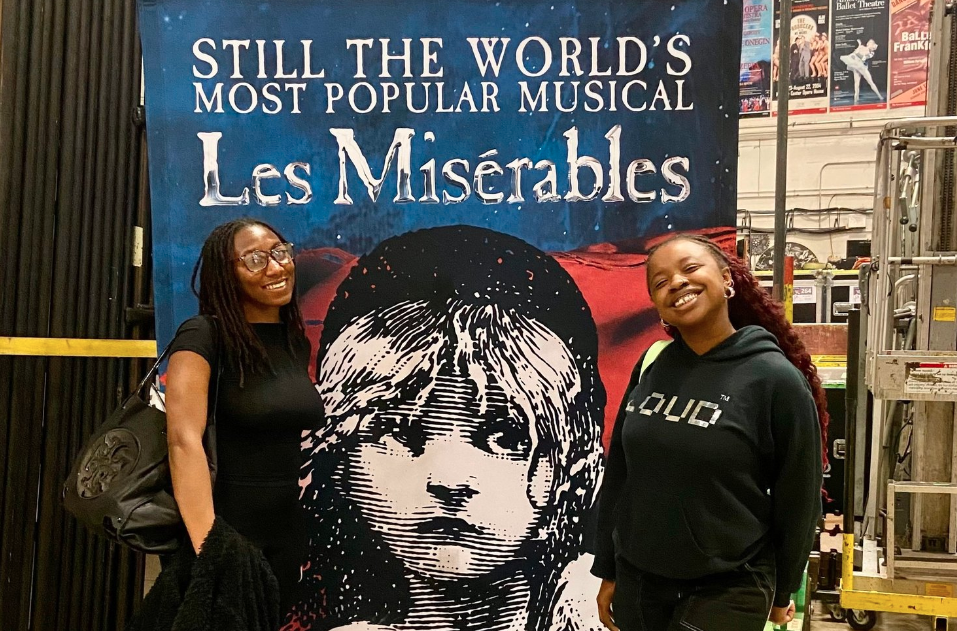
The non-profit organization, Black Theatre Coalition, is working to change that. Through their emerging apprenticeship program, they’re creating paid opportunities for young black creatives to learn alongside industry production professionals working in their cities. The primary goal of BTC is to remove the “illusion of inclusion” from theater spaces. As liberal as theater may seem, in regards to its main purpose to mirror society and advocate for change, the reality is that most theater producers and  owners are white. Meaning, the majority of the plays being produced are not employing persons of color on, or backstage. I was fortunately provided the opportunity to participate in a program, this past April, working with the Les Misérables touring company at the John F. Kennedy Center where it made its US debut in 1986.

My initial introduction to ’Les Mis’ was through the 2012 film adaptation (though mention the film to director James Powell and he’ll likely scoff at its inferiority to the live version.) This being my first time seeing the esteemed musical live, I was excited that the apprenticeship offered backstage passes, too. Some other perks included getting to shadow resident director Richard Barth. Shadowing him, I observed how he tenderly passed out notes to the cast on things he noticed might need some work like lighting, acting choices or blocking. I worked with many other departments including automations, stage management, and hair and wigs. I observed the show with follow-spot operators (Bradley and Lauren), who have the best seats in the house at the top of the theater. I also sat in the pit with the orchestra for part of the show.

I’ve been doing theater for the majority of my life — from high school to college to regional theater. And all of these experiences have been invaluable. Working on a show of this caliber and bearing witness to the many moving parts of this well-oiled machine has enhanced my perspective on what it takes to produce this level of theater. From the intense schedules, to being estranged from the comfort of immediate friends and family.  All members of the ‘Les Mis’ company sacrifice their personal lives to keep the show going. They all have a role to play, be it the stagehand, props person, or Jean Valjean, himself. So many different positions and possibilities for employment exist in theater. It was interesting to learn that many key company members had not completed their education, but were mentored by people who believed in them and opened doors to opportunities.

As the Black Theatre Coalition continues to grow, it’s my hope that they allow me to grow alongside them. Through these types of opportunities, I hope to continue learning and developing the skills necessary to realize my own dreams as an artist and storyteller. And to promote diversity and equity in all the workspaces I inhabit. I encourage students and young theater lovers, alike, interested in developing a career in theater to look into the Black Theatre Coalition and what they have to offer.

Stellar acting saves the day in ‘Clybourne Park’ at City of Fairfax Theatre Company

By Whit Davis

This article was originally published in DC Theater Arts here.

Sometimes the story is not the play; it’s the acting.

The performers in the City of Fairfax Theatre Company’s production of Clybourne Park prove that sometimes local community theater talent is on par with the pros. It is clear that director Chaz D. Pando spent intentional time casting the production, working on table reads, and guiding the team of skilled actors through rehearsal. The brilliant performances by the actors confirm that.

Unfortunately, despite Clybourne Park being a Tony and Pulitzer Award-winning play, I found it problematic. The play’s attempt to tackle topics like racism, gentrification, capitalism, homophobia, and sexism feels like a giant undertaking that was undermined by playwright Bruce Norris’ paper-thin stereotypical portrayal of the play’s Black characters.

Clybourne Park is meant to be a nod to the Pulitzer Prize-winning play A Raisin in the Sun by acclaimed playwright Lorraine Hansberry. The story continues where A Raisin in the Sun left off as the Youngers, a Black family, are about to move to a middle-class white neighborhood in 1959. In Clybourne Park, the vantage point is from the white family they’re purchasing their new home from and the other white neighbors trying to convince the current owners that they should not sell to a Black family. But bubbling underneath is a secret that has the present family deep in grief.

In Act II of the play, set in 2009, the house is dilapidated, undergoing a renovation by a young white yuppie family following the trend of gentrification as they receive pushback on the modifications they are trying to make to their new home on the Southside of Chicago. An argument ensues bringing the tension between them to the surface.

The actors turn this material on its head by embodying the characters so that you believe you have traveled to 1959 and 2009. You feel you’re in the house with them as the dialogue unfolds, partly due to the 1959 set design by Roger Ray and costume design by Remeja Murray. The 2009 set feels less realistic, with bright blue, red, and yellow graffiti that spells out the word cop.

In the play’s first act, Ann Brodnax plays the wife Bev, and Kevin Dykstra her husband Russ. Together they give you the homespun feeling you’d expect from a TV show set in 1959. In the second act (each actor in Clybourne Park reappears as a new character for the second act set in 2009), Brodnax returns as the quirky lawyer Kathy and Dykstra as a construction worker named Dan, providing a much-needed dose of humor to the story. Eric Kennedy takes on the part of the priest Jim with a recognizable Southern accent. In the play’s second act, he plays Tom, a lawyer wanting to appear laidback. Later, Kennedy tackles the part of Kenneth in a jarring flashback scene at the end of the play. Karl, played by Rob Gorman, is a nosy, racist neighbor who believes he is doing the right thing for his community by fighting against a Black family moving into the neighborhood. In the second act, Gorman mirrors his character, but this time as a more modern younger version, Steve, suggesting that preconceptions and bigotry pass down from generation to generation.

The two Black characters in the play fall into recognizable tropes: the Black woman with an attitude and an aggressive Black man. A white playwright, Norris appears to have little insight into the inner lives of Black people. He writes from a place of assumption and stereotypes. Khanner Hancock plays the quick-witted characters of Francine and Lena. Tokunbo Adedeinde portrays the characters Albert and Kevin, Black men who go along to get along until they become angry. It’s disappointing to see Black characters written without any character development. Despite the play’s shortcomings, these actors make the most of their roles by giving the audience memorable performances.

Clybourne Park was praised as a nod to A Raisin in the Sun when it won the Pulitzer Prize in 2011. But in 2023, its flat portrayal of Black characters makes it feel like an attempt by the playwright to attach himself to a notable play and use it as a vehicle to garner interest in his work.

In the end, you should see this play because of the performances by a stellar cast. They are a great reminder of the value of local theater. The acting can be the whole story, and the performances in the City of Fairfax Theatre Company’s production are truly the best part of Clybourne Park.

Silver Spring Stage brings ‘Pride and Prejudice’ to authentic life

By Jakob Cansler

This article was originally published in DC Theater Arts, here.

To note that Pride and Prejudice is well-known is perhaps a truism, so obviously accurate that it need not be said. Jane Austen’s 1813 novel is a classic for a reason ⁠— its deceptively simple story has aged well, or maybe even not aged at all. Today, it is so oft-referenced that non-readers will recognize at least the main characters.

Still, obvious as it may be, the fame of Pride and Prejudice is important to remember for a theater company staging an adaptation of it. After all, it means that theater-goers will have an idea of what this show is, an expectation for their theater-going experience.

That can be both a gift and a curse. Expectations create a million different options for bringing a story to life, ranging from staying true to the original source material to straying far away from it. No option is wrong, but all come with their own challenges.

In the case of Silver Spring Stage’s production of Pride and Prejudice, now in performances through May 14, the former option has been chosen. In a production faithful to its source, the community theater company has brought Austen’s classic to life and, for the most part, overcomes the challenges associated with doing so.

It should be noted, too, that this production also overcame several challenges unrelated to the source material. Just two weeks into rehearsal, a global pandemic delayed the show. Three years later, with much of the same cast and crew finally ready to complete the process, unexpected construction at Silver Spring Stage’s home theater forced the company to stage the production at The Writer’s Center in Bethesda, a city that is notably not Silver Spring.

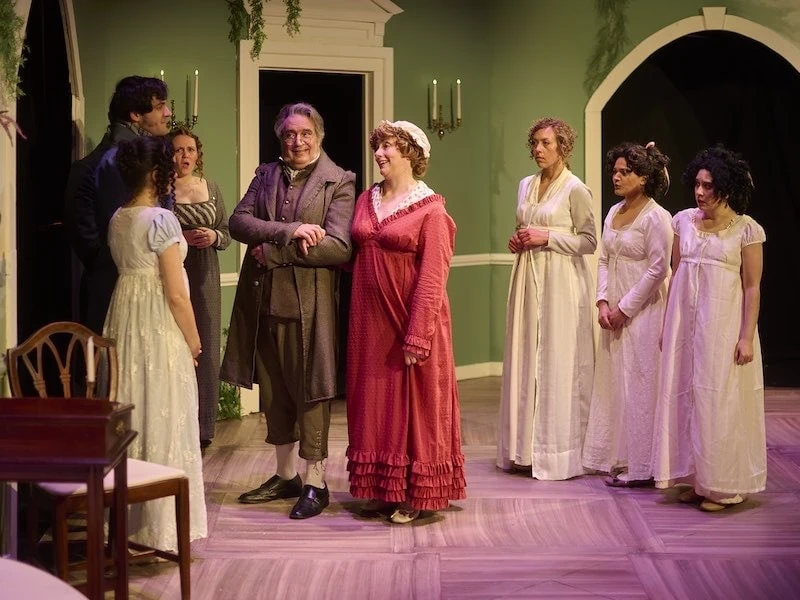
Now, as directed by Madeleine Smith, Austen’s story has finally made it to the stage. At the center of that story is Elizabeth Bennet (Katherine Leiden), the second-eldest of five daughters in the Bennet family. Mrs. Bennet (Andrea Spitz) is desperate, for inheritance purposes, to marry off at least one of her daughters to a wealthy man.

The main prospect for the eldest, Jane (Stephanie Dorius), is Mr. Bingley (Judah Hoobler), a bachelor who has just moved to town with his best friend, Mr. Darcy (Nicholas Temple). Jane and Mr. Bingley immediately like each other. Elizabeth and Mr. Darcy immediately hate each other. Everyone around them is immediately intrigued.

This specific adaptation, by Christina Calvit, stays true to all the essential plot points of the original novel and pulls much of the dialogue from Austen’s work. Where Calvit does stray is in how the plot is conveyed. Most importantly, Elizabeth serves as a narrator, speaking directly to the audience to reveal important information and confide her feelings. Townspeople, as well, gossip about the relationships forming and unforming.

Smith, for her part, has made the specific decision to keep this production true to the cultural context of the era ⁠— that is, the Regency era in the early 19th century ⁠— in which the story takes place.

Aesthetically, detailed attention has been given to the scenic design (by Brigid Kelly Burge), hair and makeup designs (Maureen Roult), and costumes ⁠— for which the team of Nathaniel Cavin, Nora Galil, and James Carey created over 50 individual garments. So too do the mannerisms, accents, music, and dancing (choreography by Stefan Sittig) fit the Regency era.

The choice for historical authenticity makes Silver Spring Stage’s Pride and Prejudice as close to a true period piece as is possible for a community theater company. Of course, period pieces come with obstacles ⁠— most notably the linguistic and cultural disconnect that can make a work less engaging for modern audiences.

Those obstacles can be overcome, though, and there are many instances in this production in which they are. Some sections of the script purposefully move the story along quickly, and Smith’s staging emphasizes snappy transitions, sometimes even overlapping scenes. During those sections, the pace keeps the show engaging. Some of the actors ⁠— in particular Leiden as Elizabeth and Spitz as Mrs. Bennet ⁠— are also skilled in delivering old-fashioned dialogue with enough variation to keep it accessible.

There are, however, other parts of this production in which the obstacles of a period piece are not overcome, particularly in the second act. Sections that can’t utilize quick pacing struggle to stay compelling, in particular longer scenes in which the emotional tension gets bogged down in the language. In those cases, more dynamic staging and line delivery could give the tension the boost it needs.

Overall, though, theater-goers expecting a three-dimensionalized version of Austen’s classic novel will not be disappointed by Silver Spring Stage’s production. This is Pride and Prejudice, as it was written in 1813, brought to life.

‘Cassette Shop’ relays voices of asylum seekers at Theatre Prometheus

By Jakob Cansler

This article was originally published in DC Theater Arts here.

There is perhaps nothing with a more transportive effect than music. It has the power to conjure memories long forgotten, to blend the past with the present, to transcend reality. For those seeking asylum ⁠— people who have been forced to leave their old lives, but whose new lives have not officially begun ⁠— that effect can be particularly powerful. It is not only transportive but humanizing.

That effect is central to Theatre Prometheus’ production of The Cassette Shop, a new play devised by Asif Majid and the Storytellers, a group of local asylum seekers. Now in performances at Anacostia Arts Center through May 20, The Cassette Shop is better in concept than in execution, but nevertheless reveals the humanity of people who are so often dehumanized.

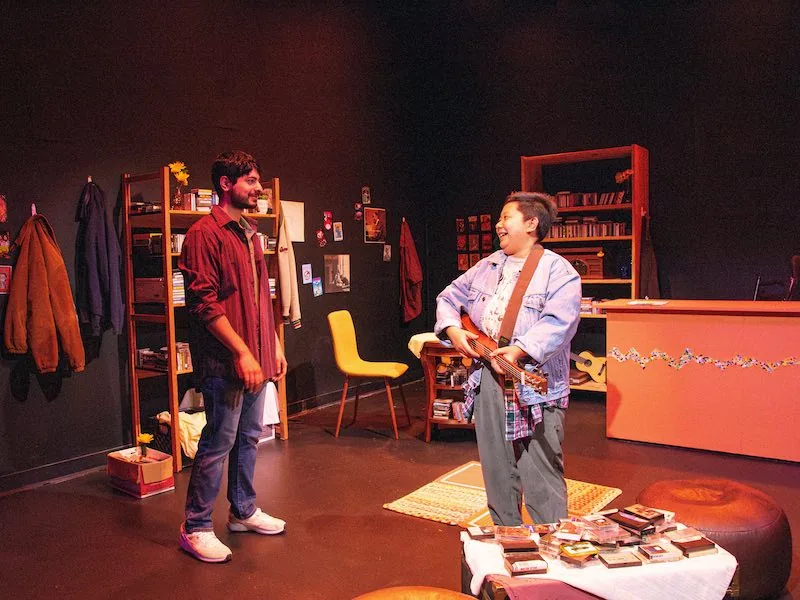
The Cassette Shop centers on two asylum seekers, Alé (Shan Khan) and Luciar (Kartika Hanani). Set entirely in Alé’s vintage Cassette Shop in Montana, the two quickly form a connection over their shared experience and love for music. The play follows their present friendship along with their past lives, which are revealed through monologues between scenes, in which they are transported through music into their memories.

Those monologues are taken verbatim from interviews with real people seeking asylum in the DC area. For this production, Theatre Prometheus partnered with AsylumWorks, a nonprofit that helps asylum seekers in the area rebuild their lives here. Majid and dramaturg Sarah Priddy interviewed asylum seekers, after which Majid used the transcripts from those interviews as the basis for this play. As a result, The Cassette Shop serves as both a form of community-building and as a megaphone for people whose stories are often not heard.

Most important, many of the stories featured in The Cassette Shop are not about the process of seeking asylum but instead focus on memories from home countries, defining people by the lives they have lived and are living, rather than by the legal status they are seeking. Majid’s script does an effective job of blending those interviews with the story of Alé and Luciar, communicating the experience of feeling stuck between lives via embodied memories.

As a concept and as words on paper, the potential for The Cassette Shop to be a unique storytelling experience is high. As a performance, Theatre Prometheus’ production, directed by Lauren Patton Villegas, unfortunately never reaches that potential.

Specifically, sluggish pacing holds The Cassette Shop back from communicating the emotional tension and personal conflict that builds throughout the play. One particularly climactic moment toward the end of the play never feels quite like a peak, leaving what could be the most heartrending moment of the play unrealized.

Shan Khan as Alé and Kartika Hanani as Luciar in ‘The Cassette Shop.’ Photo by Barbara Fluegeman.

Conservative staging choices, as well, mean that the performers spend virtually the entire play standing still. That could be an effective choice with highly skilled actors. In this case, though, more dynamic movement ⁠— or even abandonment of realistic movement entirely, during some sections ⁠— could give the performances the boost they need to be compelling.

The Cassette Shop does get a boost from some design choices. Specifically, Nitsan Scharf’s stunning projection design translates the transportive effect of music into a visual format, creating an all-encompassing world for the performers to share memories with the audience. Hailey LaRoe’s evocative lighting design, too, helps to differentiate the realism of the main story from the emotive world of memory.

It is in that emotive world, the moments in which the characters are transported back to their old lives through music, that this production gets the closest to the poignancy it seeks. Those moments also serve as a reminder of what this show could potentially be, and given its political and social weight, I look forward to seeing The Cassette Shop reach that potential in the future.

An Interview with Alberto Roblest

By Thais Carrion

This article was originally published in the Washington Independent Review of Books here.

In his forthcoming collection, Inquilinos Mudos/Silent Tenants, Mexican poet, multimedia artist, and professor Alberto Roblest celebrates the power of being bilingual. Divided into two sections comprising 19 poems printed in English and Spanish, the work takes readers on an exploration of the richness of language, playing with form and word choice to create vivid scenes that evoke a range of emotions. Taken as a whole, the collection is a love letter to the trials and triumphs of expressing oneself through multiple tongues.

Themes of migration, colonialism, and history are central to this collection. How did writing in both English and Spanish help you explore them more deeply?

One of the central themes of the book is language and people who learn another language. In “Silent Tenants,” language is perhaps the main protagonist of the collection; of course, it touches on themes that have to do with migration, but also with love, music, friendship, and learning. When one can carry [on] a conversation with another person for, say, 15 minutes, it’s a very big achievement. You can feel it. I can tell you from personal experience. Speaking the official language makes one feel more secure, regardless of skin color, accent, manners, clothing, etc.

“Silent Tenants” is essentially about my neighbors in Columbia Heights, from their life experiences, from their difficulties to continue working two shifts in order to pay the rent, but also from their pleasure in learning another language, having other friends, non-Latinos, talking with co-workers, etc. In general, the success of being bilingual. Some poems are based on real people, like the one titled “Clara.” This poem is about a woman I met at a language school where I worked teaching Spanish. She was learning English and worked for a cleaning company specializing in movie theaters, arenas, and other entertainment venues.

What was it like to explore these themes in two languages? And what does literature in translation mean to you?

It’s always good to have your book translated since it addresses two audiences and more readers. Maritza Rivera, the English translator, did an excellent job. She took great care to find the right words that preserve the original meaning of the poems. When a translator manages that, it is of great benefit to the book. As for the writing, sometimes I think the poems in Spanish, and other times in English. I like to go to the National Gallery of Art to have coffee, surround myself with artistic pieces, and read. Washington is a privileged place in that sense, where the museums are free and so many places exist where you can read and be inspired.

When it comes to creative expression, how does working in video or digital media compare to writing?

I started writing at a young age — I would have been about 10 years old or so — inspired by a magnificent literature teacher. My mother wanted me to be a doctor or an architect, so I wrote all my life in secret. I did not share my poetry for fear of being branded corny, cheesy, and ridiculous. Many of my early poems have been lost to time. I didn’t publish anything until I was 19, when I was about to enter university. What I want to say is that I define myself as a poet. Video semantics [are] just an additional tool. I make use of video tools. With them, I “write” poetry. I do the same with the art installations I’ve created, and many of my digital prints are conceived or designed as poetry. That is to say, I consider them poems rather than collages, digital paintings, montages, or installations.

You experiment with form throughout this collection. When writing poems, does thinking in terms of form complicate or enhance the process?

I like experimentation. It’s like playing. Particularly, I think you must have fun while performing the creative act. I experiment not only with form, but also with content. I get bored doing the same thing all the time. I [lose] interest, and after a while, I don’t like it anymore. So, I vary my approach a bit. Obviously, making a video takes more time. Sometimes, there’s a long preparation process; sometimes, it involves a team, etc. The good thing about poetry is that it remains such an intimate act that it can be written anywhere, even on the subway, on the way from home to work. While many people are immersed in their phones, I am immersed in my poems. I put them on old-fashioned paper, with an old pencil, in a small notebook that I keep in my jacket pocket. I believe that poetry itself is an act of experimentation with the word and nothing more.

Are you thinking about the visual component of a poem — and how it might impact the reader — when experimenting with form?

I like visual poetry. I am not very given to esoteric, metaphysical, or symbolic poetry. I prefer the poetry that is written about the events that happen around me — the poetry that feeds on reality to become a sign or a metaphor. I do not think that the experimental form is inconvenient for reading; if the language and the meaning of the poem serve their purpose, it can be as experimental as a Dada poem.

Classic ‘Anything Goes’ captivates at Catholic University

By Jakob Cansler

This article was originally published in DC Theater Arts here.

It has been said that Anything Goes lives and dies by its Reno Sweeney.

She is not technically the musical’s main character, nor is her romance the central plotline, but she is its star, the center around which everything else orbits. There is a reason that, over the course of the show’s nearly 90-year history, virtually every review of major productions leads with Reno ⁠— if the actress in that role is worth seeing, the show likely is as well.

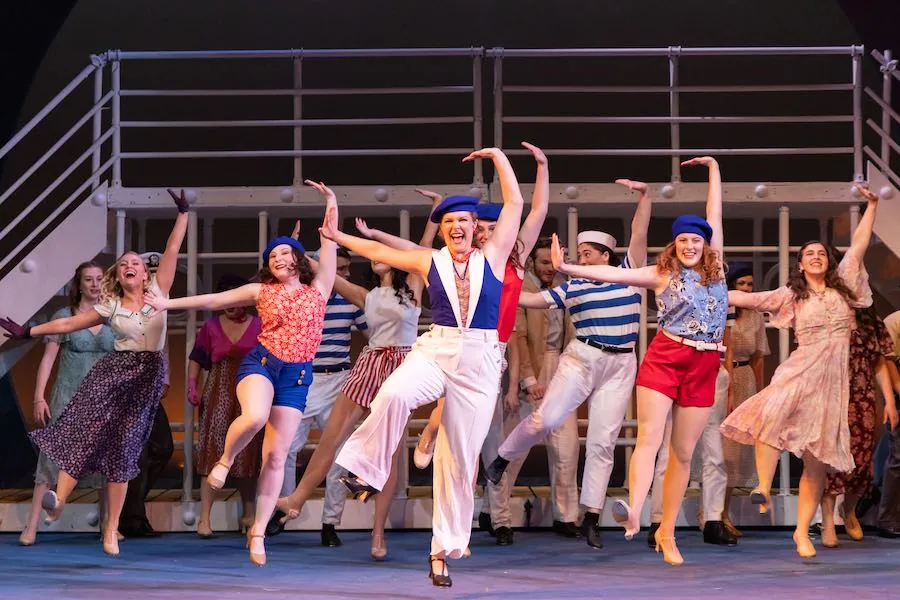
Catholic University, then, is lucky to have Emma Mangiacotti in the role for its production of Cole Porter’s 1934 classic, now performing at the Hartke Theater until April 23. At its best, Catholic University’s Anything Goes is captivating, largely because it plays to its strengths, including, yes, its Reno.

Set on the London-bound SS America, Anything Goes is built around a number of romantic, comedic, and romantic-comedic plotlines. At the center of the conflict is Billy Crocker (Ethan Turbyfill), a young Wall Street broker who is supposed to be selling stocks for his boss but instead sneaks onto the ship to follow Hope Harcourt (Brooke Daigle), with whom he fell in love after spending one night together, much to the chagrin of Reno, who loves Billy herself.

Also onboard is Hope’s wealthy English fiancé Lord Evelyn Oakleigh (Patrick Payne), Hope’s mother (Alexis Griess), Public Enemy #13 Moonface Martin (Jimmy Bartlebaugh), and a whole slew of other kookie characters. Chaos, of course, ensues.

If the script seems messy, that’s because it is. No fewer than six people are credited with writing the book ⁠— for the original script: P.G. Woodhouse, Guy Bolton, Howard Lindsay, and Russel Crouse; for the revised script: Timothy Crouse and John Weidman. It wouldn’t be unfair to say that, as funny as it may be, the plot of Anything Goes is largely a vessel for a plethora of Cole Porter classics.

The glue holding it all together, of course, is Reno. On a ship full of zany characters, she is seemingly the only one that is normal ⁠— a calm, cool, and confident presence. In order for Anything Goes to work on an artistic level, Reno needs to have an almost inhuman level of effortless charm and swagger, captivating the audience’s attention anytime she is onstage.

That assignment, it appears, has been understood by Mangiacotti. As Reno, she embodies a level of coolness that is magnetic, helped along by a set of chic period pieces (costume design by Ashlynne Ludwig) that make the other character’s garb seem drab.

Mangiacotti also has the singing and dancing chops to carry many of the musical’s best songs, which is good news, considering that of the six or so famous numbers in Anything Goes, Reno leads five.

The show-stopping title track is indeed show-stopping ⁠— especially in front of J.D. Madsen’s simplistic yet striking set ⁠— as is the crowd-pleasing “Blow, Gabriel, Blow,” both featuring impressive, if indebted heavily to the show’s 2011 Broadway revival, choreography by Kimberly Schafer. For both, an orchestra that somehow features only seven musicians brings a pack of energy.

“Friendship,” a number much more comedic than enthralling, also stood out, largely because of Bartlebaugh’s performance as Moonface. Both in that number and throughout the rest of the show, he displayed a particular knack for comedic timing and physical comedy. His partner in crime, Carolyn Tachoir as Erma, has the same skill, even as that character doesn’t get nearly the same spotlight.

Still, Bartlebaugh and Tachoir’s ability to toe the line between caricature and character also stood out because some other actors struggled to do the same. Some went overboard with comedy, making the jokes too obvious, while others didn’t quite go far enough, leaving potentially hilarious lines untapped of their energy. (It certainly didn’t help that microphone issues meant that the sound of breathing distracted from the dialogue in many scenes.)

Luckily, though, Director Jay D. Brock seems to know how to play the cards he’s dealt, and in the case of this production brings the cast’s strengths to the forefront. In this case, that would be the musical performances, especially by Mangiacotti and Turbyfill’s Billy, and the aforementioned comedy duo of Bartlebaugh and Tachoir.

That’s a smart move on Brock’s part and is particularly fitting for a musical like this one, which is, at its best, spellbinding enough for its weaknesses to become forgettable. As a result, even with those weaknesses, Catholic University’s Anything Goes makes for a commendable night of entertainment.

Dr. King’s last night alive in powerful ‘Mountaintop’ at Greenbelt Arts Center

By Daarel Burnette II

This article was originally published in DC Theater Arts here.

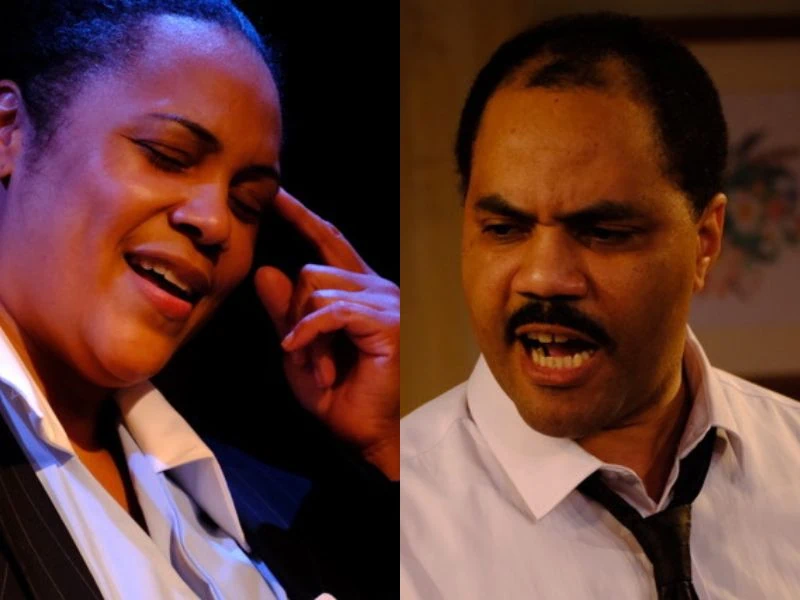
What resonates most about Greenbelt Arts Center’s rewarding twist of the play The Mountaintop is the way Director Rikki Howie Lacewell and her crew deftly deploy sound, props, and lighting to place, humanize and deify Martin Luther King Jr., masterfully played by Ryan Willis, on the day before he was assassinated.

In one scene, King, conspiratorial, frustrated with the direction of his movement, and visibly exhausted, twists the receiver of the black rotary phone situated in his Lorraine Motel room to assure that the FBI is not spying on him. He then dashes off into the bathroom where we hear for 15 seconds the sound of him ranting and urinating before stumbling back to his desk where he manages to sketch out the outlines of the Poor People’s Campaign in less than two minutes.

In another particularly emotional scene, sound designer Jim Adams ramps up the noise of a Memphis thunderstorm: whooshing wind, splattering raindrops, and ear-splitting cracks of lighting, which sends King’s heart racing: he’s not scared of the KKK or the American government or God (who’s here cast as a woman). But, it turns out, he’s petrified of lightning.

The whole of Black American history can be so depressing, violent, and overwhelming for its consumers that playwrights are prone to sum its parts up into more palatable, usually uplifting stories about heroes and villains. This focus on the extremities drains civil rights leaders of their fallibilities, distorts our mainstream understanding of how average Black and white people navigate the bizarre nature of America’s caste system, and, outside the theater, has us all on the constant lookout for the next magical hero who will fight today’s perceived villain.

The Mountaintop, which was written by Katori Hall and debuted in 2009, interrupts this narrative.

On the evening of April 3, 1968, King is serviced at the Loraine Motel by Camae (Lydia West), an attractive maid with a bottle of whiskey and a pack of cigarettes stuffed in her bra, a sketchy past, and unusual ideas on what Black civil rights looks like.

Camae, it’s revealed partway through the 90-minute play, is an angel of death, and King begins to contemplate through a series of monologues what Black folks will do without him leading the movement.

It’s clear from the opening lines of the play that Director Lacewell, who also designed the set, spent an inordinate amount of time during rehearsals paying attention to detail.

Willis’ southern drawl, which he impressively maintains throughout, is eerily similar to King’s. The blocking made it clear there was thick sexual chemistry between Martin and Camae.

And the lighting interchangeably halos Camae and Martin.

You’re reminded over and over again through this powerful script, Lacewell’s choices, and Willis and West’s stealth acting, that King was an imperfect man. His socks are stinky and have holes in them. He begs for a cigarette when he gets anxious. Before his wife calls to update him on the latest threat she’s received, King perversely stares at Camae’s backside.

You’re also reminded, though, how much hope Americans placed in King to snuff out our caste system and how he so boldly volunteered to do so.

Lacewell’s prologue leaves us with a call to action that I found stirring. She manages to do with Black history what more artists should: complicate, elevate, and force us all to reflect on our varied roles.