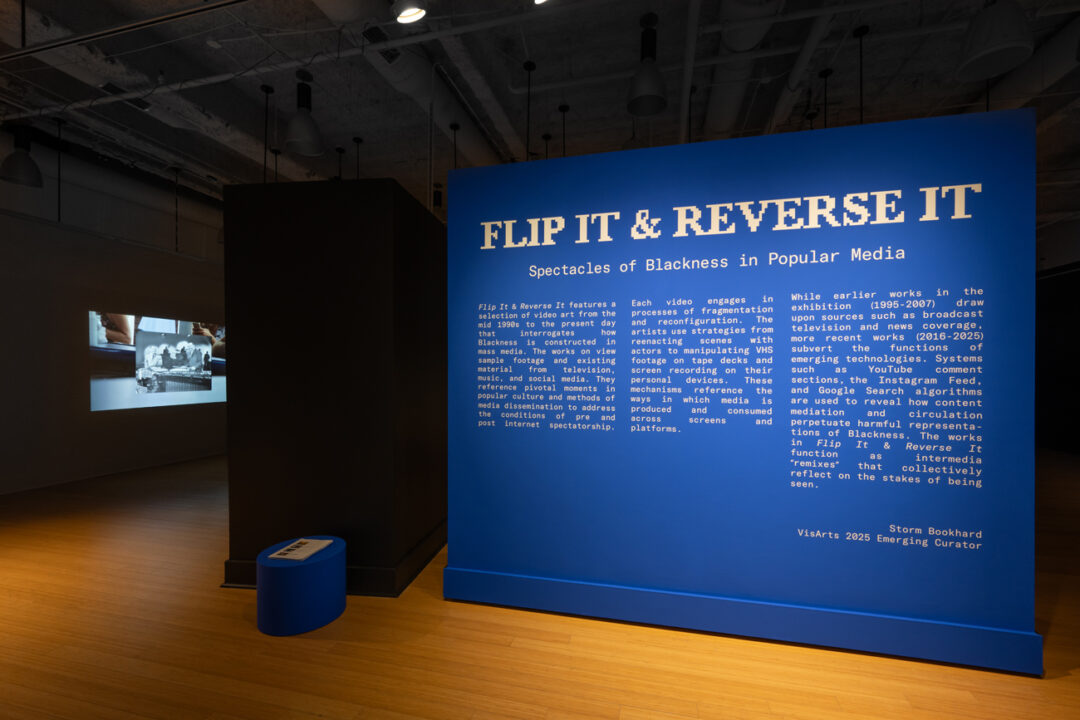
Spectacles of Blackness: In Conversation with Artist Elizabeth “Liz” Mputu

by Mary Holiman

First published in DC Trending substack November 15, 2025, here.

My interview with first-generation Congolese artist, registered nurse, and community advocate Elizabeth “Liz” Mputu, one of the featured artists in VisArt’s Flip It & Reverse It: Spectacles of Blackness in Popular Media exhibit in Rockville, Maryland, was more like two girlfriends having a “yap sesh” than a formal interview. Our conversation flowed naturally, without the awkwardness that comes from asking questions, as we shared stories of similar upbringings and familial elders.

It was raw, real, and uncut, much like her early adulthood. But, it was also a moment steeped in the unique culture of Blackness — a little bit of sisterhood, long-lost kinship, and our ability to feel at home with people all across the diaspora.

Flip It and Reserve It, now showing at the Kaplan Gallery, features a selection of video art from the mid-1990s to the present day, interrogating and challenging how Blackness shows up in mass media. Carefully curated by Storm Bookhard, it features seven talented and creative artists reflecting on the cost of being seen.

Liz started as an artist, studying at the Art Institute of Chicago after dropping out of DePaul University. A sheltered kid, she couldn’t focus on the coursework and, in her own words, “was a loose cannon, chasing highs and neglecting my health.” An experience of growing pains and a lot of trial and error that I resonated with. Through laughs, she recalls the time she performed a piece in a very public space on campus using a dildo. Now, keep in mind, DePaul is a Catholic university, so one can picture the embarrassment turned humorous, much like the way Liz says, “Black people have this unique ability to bring humor into trauma, our people —we process pain abstractly.”

A self-proclaimed club kid, a term associated with the New York City-based artistic and fashion-conscious youth movement, she found community in doing performance art simultaneously at parties and online, running an underground magazine. Liz recalls that much like neighborhoods, towns, and forests, the digital space is its own ecosystem, one where people learn from and hold space for each other. In fact, her online experiences led her to a perspective that might surprise some: she rejects the idea that formal training defines a professional artist. “You don’t necessarily need to go to art school,” she says. “You just need artsy friends and spaces. And you don’t have to be an artist to create art.” This rejection of what she calls the illusion of the professional, the belief that if you have a body, you can dance, is evident throughout her work.

Yet, like many artists and creatives, art wasn’t paying the bills. She became a receptionist at Planned Parenthood, then a certified nursing assistant, and eventually trained as a registered nurse during the COVID-19 pandemic lockdown— a career she maintains today. This shift in career path led her to where she is now. Liz says, “wellness and healthcare have inversely influenced my creative praxis…I like to use my video art as propaganda. Art is one of those ways we can control the narrative: What it means to show up and assert ourselves in the media. With capitalism, there’s a need to control, so there’s always a pimp and a ho.”

In recent years, terms such as social prescribing and arts-on-prescription have been integrated into healthcare. Holistic approaches to health and wellness, social prescribing, and arts-on-prescription are models of care that connect people to community-based and/or art activities to improve their well-being. People are social beings by nature, and in an era of capitalist individualism, connection with others is more important than ever.

People are experts of their own bodies, and everyone isn’t looking for a solution. Some people want to be seen.” -Liz

Being seen, and using art to do so, is a practice Liz believes in, firm in the idea that art is an act of liberation, and there’s a connection, a correlation, between health and creativity. In a world where Black people have historically been experimented on for the sake of medical advancements, from J. Marion Sims to the Tuskegee Experiment, Henrietta Lacks, and more recently, Adriana Smith, she finds value in the lived experience and the idea that knowledge doesn’t always come from scientific experts.

“Indigenous people and our ways are efficient, advanced technology is just an advanced system.” -Liz

And it’s an ideology she hopes the audience sees, too. When asked what people should take away from the Spectacle of Blackness exhibit, she encouraged audiences to go into it with an open mind and respond organically without overthinking. Then, she dished out a challenge: “Unpack the discomfort, and sit with it.”

Flip It & Reverse It: Spectacles of Blackness in Popular Media is an exhibit that explores and addresses how Blackness is structured in mass media through a selection of video art. The title borrows from popular rapper Missy Elliot, an icon known for her artistic music videos and specifically from her 2002 hit single Work It. Flip It and Reverse using popular culture to propose avenues for Black self-determination and liberation. It also exposes the racial biases in technology and the digital space, such as the paradox of what happens when Black people are seen.

The Spectacles of Blackness exhibit is located in the Kaplan Gallery (Floor 2) at the VisArts Center in Rockville, MD. The exhibit is free and open to the public now until January 18th, 2026.
At Its Heart, Play On! Is a Musical About Love 

by Teniola Ayoola

This article was first published in The Washington City Paper August 25, 2025, here.

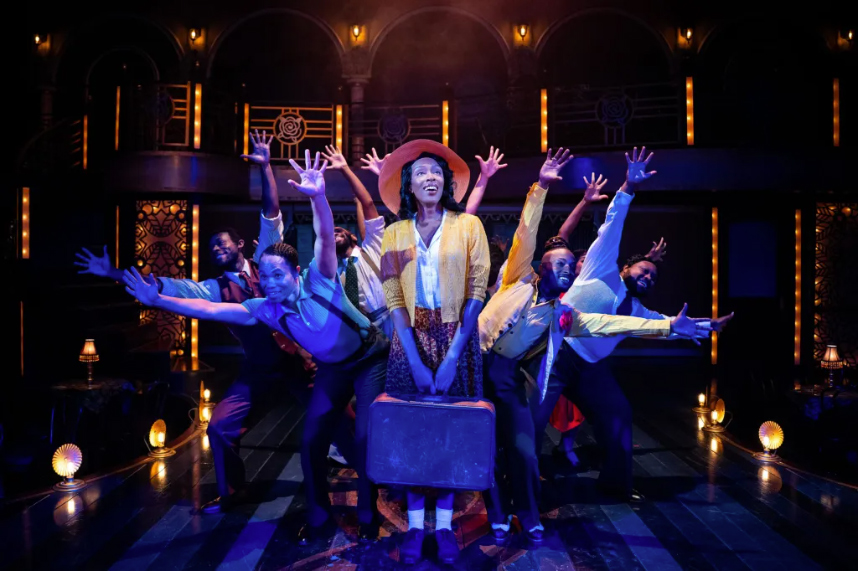
Some of D.C.’s most memorable productions of the past few years have been born from unlikely pairings—take, for example, the combination of ballet and hip-hop in The Hip Hop Nutcracker or Step Afrika!’s remounted The Migration: Reflections on Jacob Lawrence, which blended step dancing and visual art. Now, Signature Theatre joins that trend with its season opener, Play On! Fusing William Shakespeare and jazz, the musical dazzles by taking the story of Twelfth Night and setting it to the sounds of D.C.-born composer Duke Ellington.

Play On!, conceived by Sheldon Epps with a book by Cheryl L. West, weaves Ellington’s music so seamlessly with Shakespeare’s plot that viewers leave convinced that the jazz great’s  compositions were not only meant to be performed, but dramatized. Director Lili-Anne Brown, who created vibrant ensemble work for Fela! at Olney Theatre Center in 2023, brings the same synergy here. Together with musical director Jermaine Hill, they guide the cast through comedy and heartbreak. 

Walking into the theater is like stepping into another era. Scenic designer Dan Conway has transformed the theater into a 1930s jazz cabaret: red-cushioned tables with glowing lamps, an expansive stage framed by ornate railings, sunflower-shaped chandeliers above, and the band perched on a balcony. The effect is total immersion, sweeping audiences into Harlem’s Cotton Club. Lighting designer Jason Lynch amplifies this transportive world, shifting the atmosphere from the cool melancholy of “Mood Indigo” to the loneliness of “In My Solitude.”

The show begins with the ensemble stepping, clapping, and moving together in Breon Arzell’s choreography to Ellington’s “Take the ‘A’ Train.” They embody the Harlem Renaissance in suspenders, vests, red dresses, green trousers, and period hats. Instead of a shipwrecked Viola washing up in Illyria, here Vy (Jalisa Williams) arrives from Mississippi to 1930s Harlem, determined to write songs with Ellington. Facing the barriers of misogyny, she disguises herself as a man to be taken seriously in the music world. As in Shakespeare’s original, love triangles and comic mishaps ensue.

The show’s brightest star is not Ellington, but Awa Sal Secka as Lady Liv. Known for her work in local productions such as Ladies of Jazz, Jaja’s African Hair Braiding, and Wolf Trap’s Broadway in the Park, Secka brings a dash of Lady Day at Emerson’s Bar and Grill energy to the role. We hear Secka’s wardrobe tantrums before we see her, but Samantha C. Jones’ costumes transform the character into a vision of diva glamour: indigo gowns studded with rhinestones, velvet gloves with diamond bracelets, necklaces, and a sweeping blue fur-trimmed robe.

Barely a few lines into “Black Butterfly,” Secka strips off her shoes, gloves, and jewelry. “I can’t do this,” Liv says. Then she unleashes a voice that cuts through anger and heartbreak with raw defiance. Her Act 2 performance of “I Ain’t Got Nothin’ but the Blues” delivers the night’s knockout, letting Ellington’s music do the lashing. It’s a performance that says: I’m furious, I’m heartbroken, and I refuse to be ignored.

Miss Mary (Kanysha Williams) shines in “It Don’t Mean a Thing (If It Ain’t Got That Swing).” Her scatting embodies Ellington’s genius for rhythm and improvisation, soaring to high notes and dropping into gravelly lows as she and her friends teach the uptight Rev (Chuckie Benson) how to let loose—a number that is both hilarious and breathtaking.

Though West’s book modernizes the dialogue, Shakespeare is never absent. Lines such as “If music be the food of love, play on,” “Better a witty fool than a fool in wit,” and, “Some are born great, some achieve greatness, and some have greatness thrust upon them” land with winking resonance. 

For all the disguises and hijinks, Play On! is, at its heart, a musical about love: the diva who longs to be truly seen, the men who resist commitment until it nearly costs them, even the couple who bicker endlessly but always return to each other. Unlike Twelfth Night’s bittersweet end, every character here finds joy. This adaptation stands as a love letter to Ellington’s genius and to the enduring power of performance to cross boundaries of time, culture, and identity.

Play On!, conceived by Sheldon Epps, book by Cheryl L. West, and directed by Lili-Anne Brown, runs through Oct. 5 at Signature Theatre. sigtheatre.org. $47–$133.

Beyoncé’s Fourth of July Show Redefined American Music, Legacy, and Spectacle

By Teniola Ayoola

This article was originally published in Washington City Paper here.

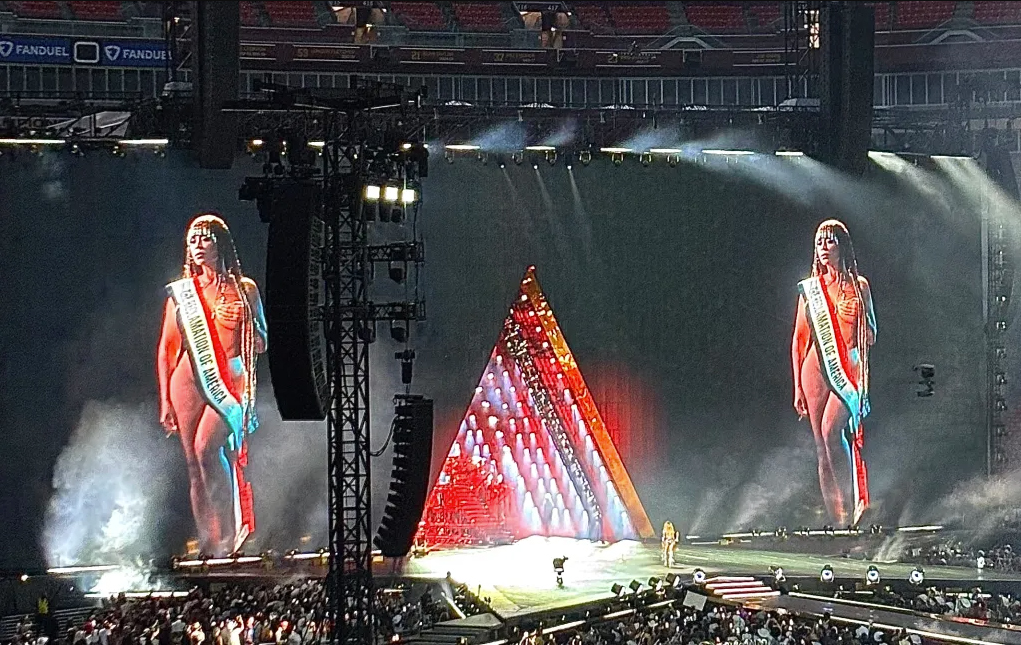
On the Fourth of July, Beyoncé Giselle Knowles-Carter stood center stage at Northwest Stadium in Landover and redefined what American music, legacy, and spectacle looks like. Her Cowboy Carter Tour stop wasn’t just a concert—it was a living, breathing art installation, a cultural exegesis, a Black feminist thesis, a family archive, and a stage production worthy of Broadway.

In one of the night’s most visually arresting moments, Beyoncé appeared on screen as a larger-than-life figure, strutting through major cities across the U.S.—from Houston to New York to Las Vegas. But when she arrived in D.C., gliding past the White House, towering over the Washington Monument and Lincoln Memorial, the stadium erupted.

There is no place more loaded with meaning on July 4 than D.C. For Beyoncé to perform this show—one rooted in Southern Black identity, defiance, and American reclamation—on this date felt like a deliberate choice. The show opened with a knowing wink: Beyoncé at the center of a screen flashing red, white, and blue, performing “The Star-Spangled Banner.” Her version, however, was laced with the rebellious instrumental arrangement originally performed by Jimi Hendrix at Woodstock in 1969.

Despite Cowboy Carter’s musical brilliance, some critics and country purists questioned whether Beyoncé belonged in the genre at all—a familiar refrain for Black artists in traditionally White spaces. The song “Texas Hold ’Em” was initially rejected by some country radio stations, reigniting long-standing tensions about gatekeeping in American music. After rejecting a listener’s request for “Texas Hold ’Em,” the manager at Oklahoma radio station KYKC, explained, “We do not play Beyoncé on KYKC as we are a country music station.”

Beyoncé addressed the criticism head-on. The backlash didn’t undermine her message—it amplified it. From the moment fans trickled into the stadium—many clad in denim, fringe, rhinestones, boots, and custom cowboy hats—it was clear this wasn’t just a tour; it was a movement. And when the singer finally emerged, cloaked in a massive American flag robe, Beyoncé made it known: This wasn’t about performing for a nation. This was about reclaiming it.

Backed by pounding drums and glittering visuals, Beyoncé asked the 50,000 or so audience members, “Can you hear me? Do you feel me?” The audience responded loudly. What followed was a dynamic set list that unfolded over roughly two hours. There were songs from Cowboy Carter, but also from 2003’s Dangerously in Love, 2008’s I Am… Sasha Fierce, 2011’s 4, and more. As strangers in the crowd belted out, “To the left, to the left…” in unison, it felt like more than a duet—it felt like community.

Midway through the concert, Beyoncé mused, “Genre is such a weird concept.” In that moment—surrounded by country riffs, rock undertones, voguing interludes, ballet pirouettes, trap beats, tap dancing, the iconic bounce-on-that-shit Riverdance step, and a drop into the gritty “Nigga ask about me” from Crazy in Love (Homecoming Live)—her point landed. She moved from elegant to guttural, soft to sharp, as if to ask: Who said I had to choose?

And in D.C., where musical legacies run deep, Beyoncé’s refusal to be boxed in echoed one of the city’s most defining genres: go-go. Born in the District and pioneered by the legendary Chuck Brown, go-go has never been just one thing. It fuses funk, soul, gospel, and call-and-response rhythms, drawing energy from both pop and percussion-heavy West African traditions.

Back onstage in Landover, Beyoncé honored her lineage. A graphic featured Black icons like Tina Turner. And at the start of “Formation,” her dancers broke into a clean, syncopated hat routine—gyrations and hip thrusts delivered with precision—a quiet, but unmistakable homage to Michael Jackson.

Outside the spectacle, the show struck deeply personal chords for the audience. For many, it was a night of full-bodied joy—dancing in the stands, sipping drinks on the party bus, and bonding with strangers over shared lyrics. Singing “Irreplaceable” together wasn’t just serendipity. It was the communal spirit Beyoncé cultivates—on and off stage.

Through it all, Beyoncé didn’t just perform. She reminded the crowd that she—and Black people, especially Black women—are America. Not in the political sense, as in presidents or lawmakers, but in the mythic one: the soul, rhythm, and story of the nation itself. Her journey from Houston girl group prodigy to global powerhouse is a story of grit, grace, and genre defiance—but also a reflection of Black resilience, ingenuity, and creative power. On July 4 in D.C., Beyoncé didn’t just put on a show—she claimed space. It wasn’t about fitting in. It was about standing firm.

Leveling Up: Ctrl+ Creates Space for Queer Black Gamers

by Rasheeda Campbell

This article was first published in TAGG June 18, 2025, here.

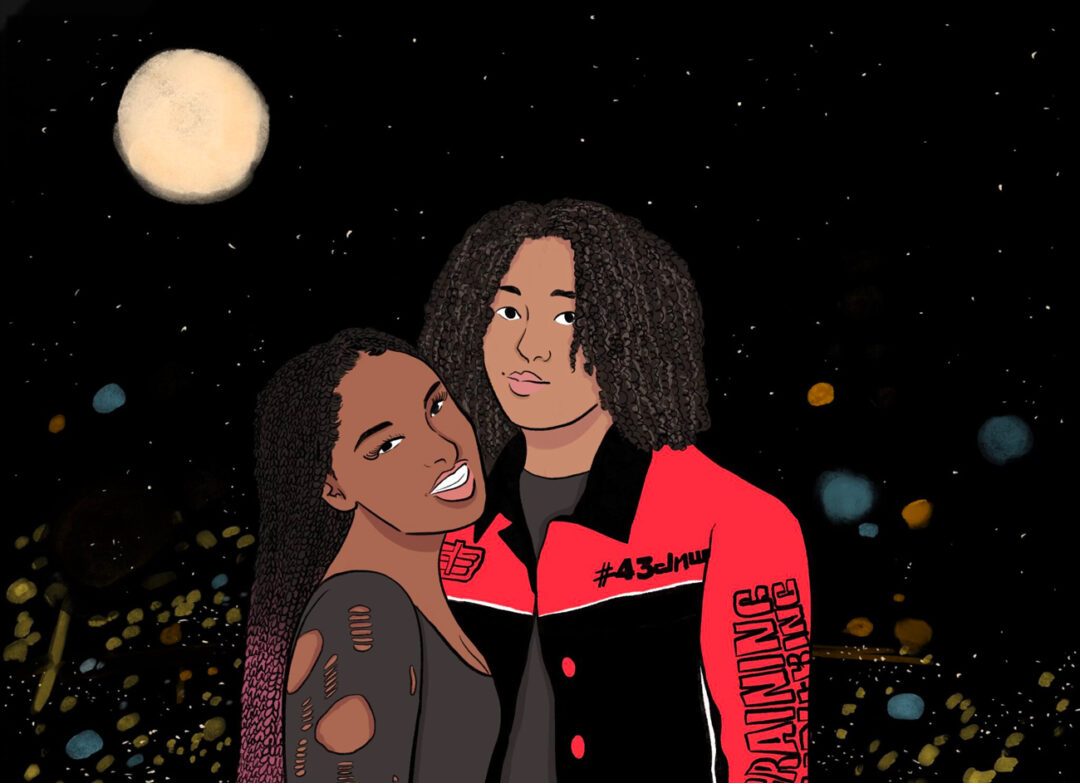
Here’s something to download into your mind: Ctrl+, an inclusive gaming collective, is reshaping the social scene in the DMV—specifically in Silver Spring and Washington, D.C. More than just a gathering of gamers, Ctrl+ fuses video games, nightlife, and community, all filtered through a queer, Black lens. The collective hosts everything from competitive tournaments and casual game nights to themed parties, vendor markets, and collaborations with local queer artists and businesses. Founded by Shannon Miller (she/her) and Sierra Stansberry (she/her), Ctrl+ grew from their shared love of gaming and a mutual frustration with the lack of spaces that felt like home. “We were tired of waiting for a space that spoke to us,” they said in an email interview. “The DMV has tons of gaming events, but none made specifically for queer Black people.” After noticing a lag in said spaces, Ctrl+ was born. 

The Origins of Ctrl+

“We wanted a space where queer Black people could show up fully, have fun, and take up space unapologetically,” Miller and Stansberry said. The concept behind Ctrl+ sparked from their own experiences. Miller and Stansberry felt the absence of welcoming spaces that feel like home for queer Black gamers. In 2024, they officially launched Ctrl+ with their debut event, Tourney Up. Attendees showed up, showed out, and made it clear that this kind of space was not only wanted, but urgently needed. Encouraged by the turnout, the collective returned this year with Tourney Up: Black Pride Edition, held right before the start of Pride Month. The sold out event was a clear sign that the DMV area is hungry for gaming spaces rooted in joy, identity, and community.

What to Expect at a Ctrl+ Event

A typical Ctrl+ event includes various games, music, dancing, and all the socialization you need to satisfy your inner social butterfly. Tickets are typically priced between $10 and $25, with limited free tickets available for laid-off workers and federal employees. “We’re committed to making our events accessible while still supporting sustainability,” the two founders shared.. During an event, there are multiple things happening at once. According to its founders, it wouldn’t be a surprise to walk into a Super Smash Bros. or Mario Kart tournament in one part of the venue, a DJ mixing tracks and people dancing in another, and a group playing party games or just enjoying the atmosphere in another area. Whether you’re in it to win or just want to relax and socialize, Ctrl+ offers a space that welcomes all levels of play. Miller and Stansberry’s perspectives help them have an idea of what makes an event exciting, accessible, and community-driven. “We know what it’s like to be left out, and we’re making sure no one else feels that,” they explained.

Overcoming Challenges

As with many grassroots projects led by marginalized voices, the road hasn’t been easy. According to Miller and Stansberry, funding events for the gaming collective has been a challenge. The two have also voiced that they’ve had to educate people about why Ctrl+ and its mission matters. “[We’ve had to] fight the assumption that gaming spaces can’t be cultural or political. But we’ve been resourceful and resilient,” they shared. Miller and Stansberry are motivated to control-alt-delete the absence of inclusive gaming spaces and create more opportunities where queer Black gamers can feel “seen, celebrated, and centered” with Ctrl+. “Our mission is to reclaim joy, build community, and create a vibe that feels like home,” they said. 

Looking Ahead

Currently, Ctrl+ events are held monthly or every other month, depending on scale. Their next event—on June 14—will celebrate World Pride. Long-term, Miller and Stansberry hope to expand Ctrl+ beyond the DMV. New York is already on their radar. In five years, they envision a dedicated gaming lounge that’s open weekly, featuring memberships, regular events, and community-driven programming. “[We see it as] a place where joy is resistance and gaming is the gateway to connection,” they said. You can follow Ctrl+ on TikTok and Instagram.

Shakespeare Theatre Company’s Latest Production Recenters Frankenstein on the Women at Its Heart 

By Teniola Ayoola

This article was originally published in Washington City Paper here.

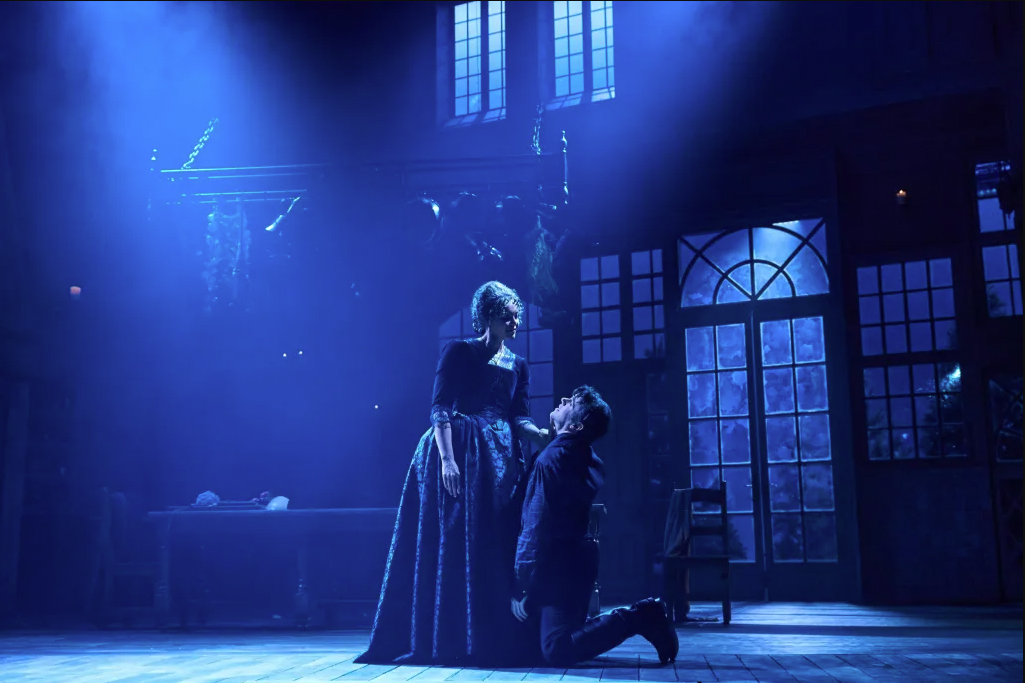
It is a packed house on opening night of Shakespeare Theatre Company’s production Frankenstein. Onstage angular, dark wood beams frame a tall, imposing fireplace and a singular chair sits with a robe hanging on its back. Atmospheric lighting by Neil Austin and an eerie soundscape by André Pluess create the sense of haunting loss that anchors the production. But no green-skinned monster ever grunts into the frame. Instead, the monster in British director and writer Emily Burns’ adaptation is grief, privilege, and masculine neglect.  

Burns, known for her incisive adaptations and storytelling precision at the National Theatre and with the Royal Shakespeare Company, is making her American directorial debut with Frankenstein. A project that began in 2020, when Burns, who has worked with STC’s artistic director Simon Godwin for nearly a decade and adapted last year’s star-studded Macbeth, submitted a seven-page treatment to STC, envisioning a version of Mary Shelley’s Frankenstein told through a feminist lens. The company commissioned her to develop it into a full production. Over the next several years, with input from STC’s dramaturg, Drew Lichtenberg, she worked on her adaptation.

Burns began by interrogating what she saw as a contradiction at the heart of Shelley’s story: Frankenstein is one of the most iconic horror and science fiction novels ever written, and it was authored by a woman—yet both the original text and many of its best-known adaptations revolve almost entirely around male characters. 

“I was thinking about how male-focused Nick Dear’s 2011 stage adaptation is and how male-focused the novel is, and yet how it’s a female writer,” she says, before asking, “Why is it focused on men?”

With the goal of recentering the women in Shelley’s story, Burns turned to the original 1818 Frankenstein, where Victor Frankenstein’s abandonment—both of his wife, Elizabeth, and the Creature—is clearly condemned. Later revisions blurred that line, she says. According to Burns, the original, released anonymously, was far more emotionally raw and politically pointed. “It’s filled with ambitious men who are trying to create a name for themselves in their world,while she [Shelley] is at home trying to conceive, birth, and raise these children,” she says.

Before Victor brought his creature to life, Frankenstein was already a story shaped by maternal loss and abandonment. Shelley wrote the original story while in the throes of pregnancy, nursing, and grieving the death of her first child. The suicide of her sister also likely influenced her writing as did her husband’s—the poet Percy Bysshe Shelley—alleged affairs. It’s no surprise, then, that the 1818 version lays clear blame at Victor’s feet for abandoning the creature he created.

Deemed “too radical for Victorian sensibilities,” the second edition, released in 1823—with a manuscript edited by her husband—and a later version in 1831 softened that critique. Victor’s behavior became more fatalistic, his ambition framed as inevitable rather than negligent. Burns’ adaptation returns to the urgency of Shelley’s original. “Victor’s culpability and acceptance of culpability is kind of the central focus,” she says. “It’s not an immaculate conception. It’s this idea of a man creating life and then not taking responsibility for it.”

The result, now on stage through June 29, is a retelling that shifts the center of gravity—away from Victor’s ambition and toward the emotional, moral, and maternal fallout left in his wake. It’s about men, stitched together by ego and the privilege to walk away—from their partners, their children, their responsibilities—and still be worshipped for what they “created.”

Burns draws a direct line from Shelley’s lived experience—her personal tragedies echo throughout the play—to Elizabeth’s fictional fate. Multi-hyphenate artist Rebecca S’manga Frank, who plays Elizabeth, says she felt those parallels deeply: “I know this woman. This is the woman that’s us. And she wrote that.” 

For Frank, Frankenstein isn’t just a Gothic story—it’s a map of female survival, of turning pain into expression. “Mary had miscarriage after miscarriage, she had children die … she had this incredible husband-lover situation, but then it turned into tragedy.”

That transformation—of tragedy into art—is something Frank sees as a uniquely powerful human instinct, and often a feminine one. “The potential to take something dark or tragic and to turn it into something beautiful—that is a choice,” she says. “Because you could choose to stay in the darkness … or you could choose to follow the light.”

She likens it to alchemy: composting what’s been discarded or devalued and repurposing it into something luminous. “You bring it back up to the light and transform it.”

With Frank at the helm, Burns has created a play that doesn’t just reinterpret Shelley—it reclaims her. Her adaptation captures what was always there but rarely centered. It honors the trauma of motherhood, the clarity of womanhood, and the slow, devastating truths about the men we mythologize as geniuses—without asking who was sacrificed along the way.

Shayn Green: Making Art You’ll Want to Stick Your Nose In

By Rasheeda Campbell

This article was originally published in Tagg Magazine here.

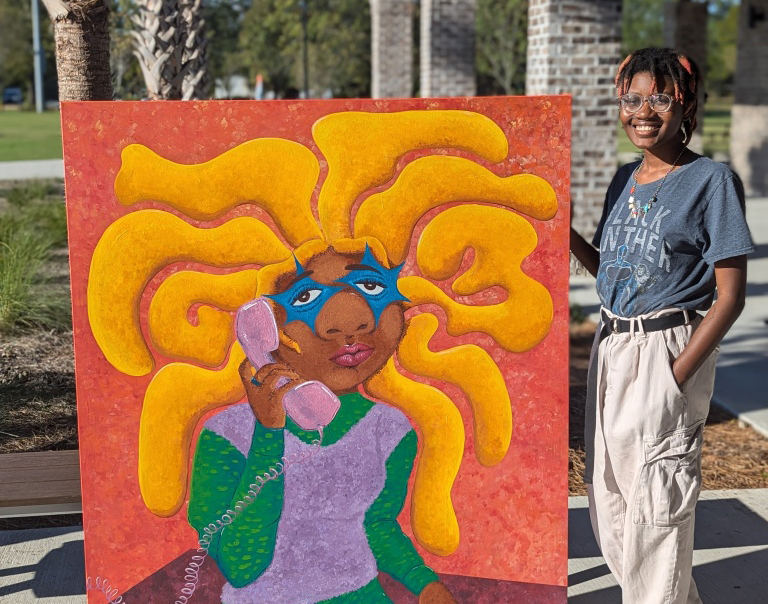
Hardworking, creative, and passionate are three words artist Shayn Green (she/her or they/them) uses to describe herself — and rightfully so. As the creator of Big Nose Baddies, Green has built a vibrant, unapologetic art collection that celebrates Black features and redefines traditional beauty standards. Through her bold use of bright colors, diverse textures, organic elements like plants and flowers, and—of course—beautifully rendered big noses, Green’s work glorifies ethnic features often underrepresented in mainstream art. 

Back to the Beginning

It all started in 2021 with Green’s first piece titled, Afropunk. Inspired by a photo of herself taken at the Afropunk Festival in Atlanta, Georgia, she found herself moved by the celebration of Black identity that surrounded her through the festival’s music and culture, and the sheer presence of people who looked like her. “I wanted to create artwork that would resonate with the Black people in my community with similar features and experiences,” she said.

The Inspiration Behind the Work

To Green, Black people and the connection within the Black community has influenced her art the most. Much of her inspiration also comes from her own family, where large noses are a proud and recurring trait. “Facial features like this that are passed down not only connect us to each other but to our origins, and in some cases can be one of the most ancestral connections we can make,” she said.

Representation in Art

“Representation in the art world has become more accessible than in the past and it’s easier to connect with artists of diverse backgrounds … [but] in the future I’d like to see even more representation and diversity in large galleries, art shows and residency programs for BIPOC and LGBTQ+ creatives,” said Green. Growing up around Black art, music, and entertainment at home helped her find inspiration early. But outside of home is where she quickly noticed the lack of wider representation. “A large portion of the representation we did receive was mostly centered around Black hardship [and] although there should be space held for those stories, it is only a fraction of what we are,” she noted. As a Black and queer woman, Green puts her identity into her art hoping to reach the person who was teased for their natural hair or was told their nose and lips were too big. Her bright and bold pieces are her way to show the world that Black features are beautiful and deserve to be seen.

Overcoming Challenges and Looking Ahead

Despite facing challenges like limited time, financial strain, and burnout, Green has learned to give herself grace and let her creative process unfold naturally. Recently, she completed a Big Nose Baddies Spring Collection featuring flowers, fruits, and clouds. Her upcoming Summer Collection will celebrate LGBTQ+ pride and the fun elements of summer she loved as a child. Her advice to emerging artists is to try different mediums, explore what speaks to you, and “…don’t compare yourself … or feel discouraged when starting out because everyone’s journey is different and you will find your rhythm in time.”


District Fringe to pick up where Capital Fringe Festival left off

By Leah Cohen

This article was originally published in DC Theater Arts here.

After nearly two decades of spotlighting local theater, the Capital Fringe Festival went dark, just when the arts needed it most. District Fringe is picking up where Capital Fringe left off.

“There’s a vibrant community of artists. They deserve a place where they can afford to do it. They deserve a chance to get on stage,” said Karen Lange (artistic director, Pinky Swear Productions), one of District Fringe’s leaders.

Not unlike Capital Fringe, District Fringe will work to unite the DC theater collective but with a stronger emphasis on community and collaboration. Led by three artistic directors and longtime Capital Fringe supporters, Tracey Erbacher (artistic director, Theater Prometheus), Aubri O’Connor (artistic director, Nu Sass Productions), and Lange, District Fringe is on a mission to “promote and propel the strong independent theater tradition in the DC area.”

When the news broke in December that Capital Fringe would not be returning, the now leaders went to work to begin production of District Fringe — recruiting applications, fundraising, and searching for spaces to hold the festival, which will take place in July.

District Fringe is coming at a time when the Trump administration is targeting performing arts and diversity initiatives, particularly in once-vibrant cultural spaces like The Kennedy Center.

“Part of what fuels me is they wouldn’t be bothering with the arts if the arts weren’t important,” Erbacher said. “This is an opportunity to expand outward and support those voices.”

Because of the original festival’s finances and space availability, Capital Fringe accepted applications from artists on a first-come, first-served basis. Being in its first year, District Fringe will limit the number of shows to about 10 to 20, depending on space, following an application process. After receiving over 40 applications, the festival’s leaders and team of readers ultimately made decisions based on what excites them most and reflects DC’s diverse artistic collective.

While the team is still working to secure a venue or venues to host the festival, no matter where they choose, there will be a community space for festival goers and artists to gather. Lange recalled having a similar space during the early years of Capital Fringe.

“Most of us met each other there. We actually got to hang out and have a drink and party late into the night, dancing together. That was really special and one of the things we really want to bring back,” Lange said.

District Fringe will be an opportunity to celebrate not only the artists but also the volunteers and donors who have helped with the festival’s production.

“I’ve been running a company for 11 years and I’ve never had this level of community support where people are coming out of the woodwork to be like, ‘Hi, I care about this, this is important, how can we help?’ Which is really moving,” Lange said.

The District Fringe team is looking for volunteers with experiences doing artistic producing, media and press outreach, technical support, and on-the-ground support when the festival begins. And, donations big and small.

“Donations have such a direct impact. A little bit of money goes so far given how low our fundraising goal is compared to other big theater efforts, and that’s going straight to making art possible for more artists,” said Erbacher.

With one of the main goals of the festival being to make local art as accessible as possible, the team has set admission at $15 per show (including fees), with additional options like discounted ticket bundles, buy-one-get-one offers, and an all-access festival pass.

“Everybody’s art makes everyone else’s stronger because you might not hear about one individual company making one small show, but you hear about Fringe and everyone’s working together,” Erbacher said. “It’s about the power of the community there banding together and making a festival.”

For those looking to get involved and volunteer with District Fringe, reach out to info@districtfringe.com for more information.