Browsing Category

Literary Arts

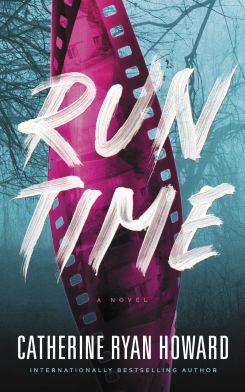
Run Time: A Novel

Reviewed by Olivia Kozlevcar

This article was first published in Washington Independent Review of Books here.

It’s chilling enough being the sole woman trapped in the woods with a group of men and no phone reception. But in Catherine Ryan Howard’s Run Time, the men are also producing a low-budget horror film — one that only shoots in the dead of night.

Relying on psychological manipulation rather than gore, Run Time follows last-minute fill-in Adele Rafferty, a former soap star, as she returns home to Ireland from Los Angeles to play the movie’s lead, Kate. She carries a failing career in one hand and an NDA in the other. When she arrives on the set of “Final Draft,” Adele notices eerie details that start to become unsettling. But are they merely strange or something more sinister?

The novel is a quick read made possible by the quality of its plot development. Adele is a solid everywoman, capturing readers’ attention by inviting us into her head and embracing her own shortcomings. Her travails offer an unpolished look at the complexities of being a young woman in a sometimes-vicious industry and trying to withstand the emotional and physical toll — and fear — that comes along with it.  

Howard breaks up the text by inserting sections of the “Final Draft” script between chapters. It’s a bold, innovative move that helps build suspense from one plot point to the next. Even better, the parallels between the script and the main narrative allow readers to take a stab at guessing what’s coming next in the story:

KATE

(whispering)

You’re okay. You’re okay.

(voice breaking)

You’ll be okay.

And then –

A pinprick of white light appears in the distance.

Kate stops. She blinks, squints.

We see the light from her POV, her vision blurred by tears and rain, and watch as the light comes into focus, splits into two, each orb growing brighter, bigger –

Kate, lit now by the approaching white light, raises a hand to shield her eyes from it.

And now we hear something too: an ENGINE. A car is coming up the road. Kate runs toward it, into the middle of the road, waving her arms. 

Dramatic interludes aside, Run Time is flawed. Coming on the heels of the author’s critically acclaimed 56 Days, it has large shoes to fill. While both novels are set during the pandemic, covid-19 is integral to 56 Days but is merely a plot device here. Howard’s frequent heavy-handed one-liners on the subject detract from Run Time because the pandemic is unrelated to the story at hand.

To her credit, the author evidently conducted a great deal of research on the entertainment industry prior to writing this book (she cites her brother, an actor, as part of her inspiration). Unfortunately, her allusions to things like #MeToo vis-à-vis the film business often feel clumsy and draw the reader away from the action. She might’ve done better by focusing more on Adele’s particular underlying fears and allowing them to speak broadly for the trials endured by women in the trade.

Moreover, while the ending isn’t obvious, the story’s main twist is predicted early on by Adele. It left me wondering why the author would choose to reveal the novel’s most interesting development before it’s had time to grow. In addition to this self-inflicted wound, some of the book’s other turns are predictable, as when the only “nice guy” on the set turns out to have his own malicious motives (à la “Promising Young Woman,” a film whose writer/director, Emerald Fennell, is alluded to early on).

Overall, Howard’s novel is an entertaining read. The twists and turns of Adele’s sordid tale are interesting, and the narrative is well written. If you’re just dipping your toe into horror, Run Time is a good place to start. Avid fans of the genre, however, may feel let down. So, proceed with caution.
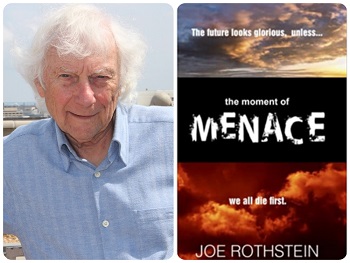
An Interview with Joe Rothstein

By Olivia Kozlevcar

This article was first published August 9, 2022 in Washington Independent Review of Books here.

Given our current political climate, it’s hard to imagine writing DC-themed fiction that’s stranger than truth, but Joe Rothstein has done just that in his new novel, The Moment of Menace: The Future Looks Glorious…Unless We All Die First. Rothstein, whose long career spans both politics and literature, braids the two worlds together in a riveting story that gives readers a glimpse of what our democracy could become — for better or worse.  

Your deep knowledge of politics comes through in this book. Is it challenging writing fictional stories about a very real system?

Think about what it means to be a candidate. Depending on the political office at stake, you will need to raise considerable campaign money, much of it by personally asking friends, family, co-workers, strangers. In a real sense, you will have to learn to beg. You will have to hire a professional staff and recruit dozens, hundreds, possibly thousands of volunteers, a hugely difficult exercise in high-pressure management. You will need to appear in public every day, sometimes in the media, weighing every word lest it be misinterpreted, often purposely, by the opposition.

Tension will increase as Election Day approaches, whether the polls have you ahead or behind. The money won’t be enough. The attacks on your character will increase, all in public media. Your family will feel under siege. You will get conflicting advice. Every day, you will need to make decisions, any one of which could cause you to win or lose the election. This is stuff of high drama, and I lived it through more than 200 campaigns. Marriages were…destroyed, so were reputations, wealth, hopes, and dreams. I don’t need to use my imagination to develop characters and situations. I just need to remember.

Your novel follows a charismatic American president named Isabel Aragon Tennyson. How did you shape this character? 

During my campaign career, I met many strong, capable, and courageous women: candidates, spouses, campaign leaders, and others. We’ve never elected a woman president. I decided that I would, and that she would be a composite of many women I met who would have made great real-life presidents.

This book is as much a dystopian novel as a thriller. Do you find it difficult to approach the dystopia genre without being overly pessimistic?

I’m a democrat with both a small and capital D. But democracy is struggling to effectively meet the challenges of the 21st century. And because democracy is underperforming, anti-democratic forces are presenting a serious challenge. It’s essential to recognize and meet this challenge. So, I write not as a purveyor of doom but rather with a call to action. Rather than write essays about this, I’ve chosen to write entertaining thrillers and wrap them around real public problems.

What does waiting to write until you’ve gained some life experience bring to the resulting work?

Perspective. The curved edges of “good” and “evil” and “right” and “wrong.” Living through chapters of life to see many of them resolve, gaining insight from experience.

What’s next for you?

One of my summer-vacation jobs in college was with an automobile stunt show, sort of a car circus of smashed cars, daredevil motorcyclists, and a finale with a car and driver being shot out of a cannon. We traveled the country as the Motor Olympics. I was “Suicide Saunders.” That’s my next book.

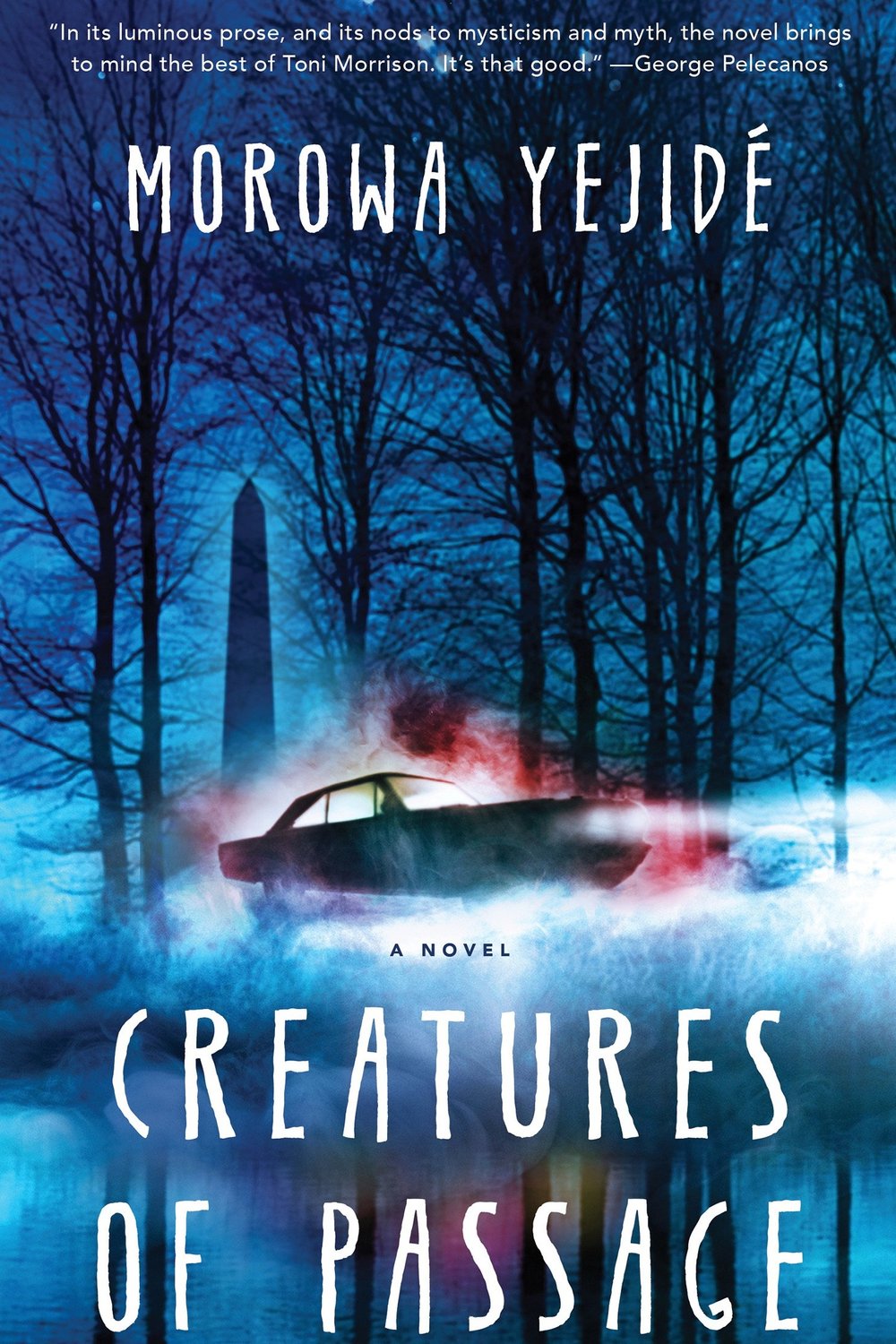
Celebrating Women’s Fiction: Creatures of Passage by Morowa Yejide

By Thais Carrion

This article was first published in DC Trending here. 

Creatures of Passage pays tribute to an unseen southeast DC, a magical, dark, humid space where the dead walk amongst the living and intuition rules the land. Blending Egyptian mythology and the strong black history of Anacostia, author Morowa Yejidè, gives us a world where there are no states or counties, instead, kingdoms and fiefdoms spread out along the East Coast.  A cast of characters find themselves inevitably drawn to the mystical realm of Anacostia, a place where “Dreams come true even when you don’t want them to.”  In an endlessly dark story, the tragedies faced by each character interconnect and join in a heart-racing climax, where many must finally confront their ghosts in order to move forward with their lives.

We first learn about Nephthys Kinwell — a mysterious driver with a half-finger and a supernatural sense for lost souls — when she is summoned by the wandering hearts of Anacostia’s residents. She never fails to show up in her haunted 1967, blue Plymouth Belvedere, which never breaks down, runs out of gas or gets pulled over despite her inebriated state of driving. She is a somber character, always on the move, so as not to feel the pain after losing her twin brother, Osiris. 

Nephthys, her nephew Dash, and his mother Amber Kinwell (the death witch of Anacostia) are simultaneously reviled and rendered indispensable residents of Anacostia. For all the fear and mysticism generated around the family, the Kinwells guide the wandering hearts of Anacostia through their painful journeys and individual tragedies.

Helplessness is center to the story and Yejide masterfully cultivates dramatic irony across every new scene and character. Jumping through timelines, the narrator never fails to include the developments of the future that render our character’s present conflicts and worries futile. Much like the nature of death and rebirth, futility and the promise of change play big roles in the undercurrents of the story as characters are swept up in their respective paths and ultimately forgotten by the future and the gentrification of Anacostia’s black history.

Yejide’s intensive use of dramatic irony is a nod to our own privileged lives.  Writing about places of privilege within the structures that govern so much of our daily lives is a topic Yejide navigates subtly, but clearly drawing a line between the reader and the realities of her characters.

The magical kingdom descriptions of the east coast and its neighboring states work to further separate the Anacostia of the ‘70s and our own understandings of the United States and its history.  Anacostia’s black heritage feels like an otherworldly, anachronistic place, one fully separate from the development and gentrification that has taken over the area today.

Yejidè is careful in telling her story with its histories and complex inner worlds. Much like a ride through the river Styx, Creatures of Passage starts off with a clear purpose, loses its way in the tragedy of the lost souls along the path, but finds purpose anew as tragedies are weaved in and move closer towards closure and release.

Yejidè’s odyssey confronting relevant current societal issues has set her apart as one of 16 nominees for the Women’s Prize for Fiction long list. Championing the voices of women writers on the global stage, the Women’s Prize for Fiction goes beyond a simple award by working with libraries, and writers, organizing reading groups, and events, and prioritizing free resources to honor the work of historically marginalized writers.

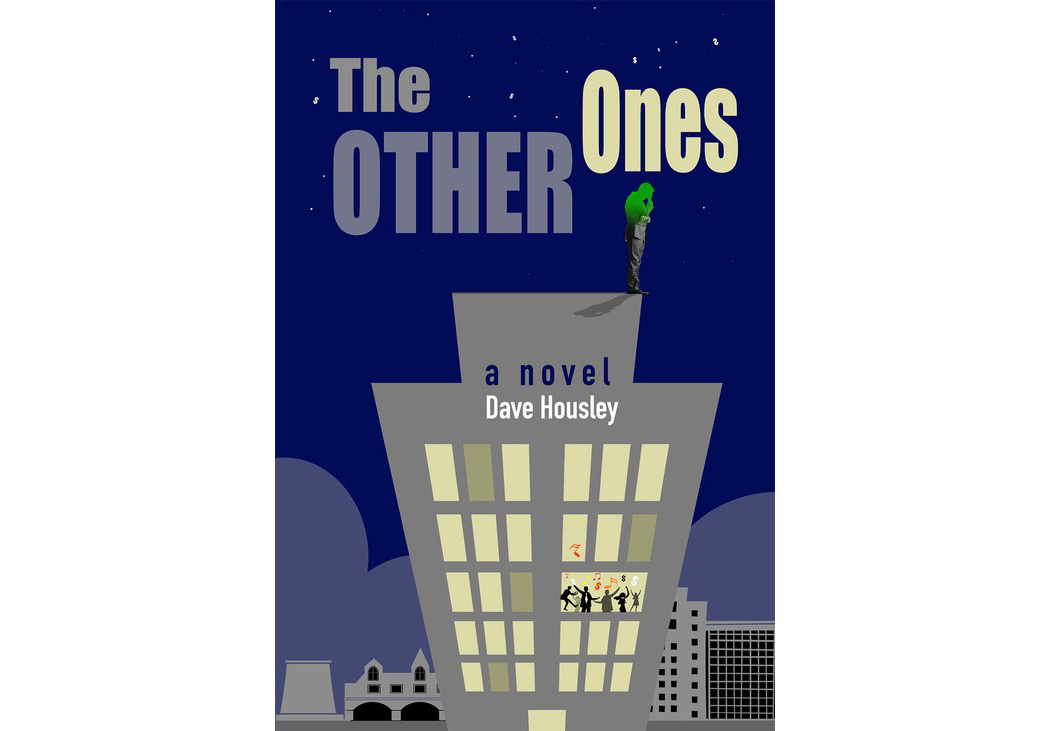
Wealth Disrupts in The Other Ones

by Michael Sainte-Andress

This article was first published May 17, 2022 in DC Trending here.

I was unfamiliar with Dave Housley’s other work, so I didn’t know what to expect from his third novel, The Other Ones, published by Alan Squire Publishing. His other novels are Howard and Charles at the Factory  and This Darkness Got to Give. Housley is also one of the founding editors of Barrelhouse, a D.C.-based, national literary magazine, small press, and literary-based non-profit.

The Other Ones centers on 13 employees of an advertising firm, Keystone Special Marketing Solutions, winning the lottery and walking away with 8.8 million dollars each. The story is told from the perspectives of seven characters, beginning with a 63-year-old, 243-pound accountant named Yoder. As the book opens we are with him, five stories up and reacting to the situation by contemplating suicide:

“Yoder fights the tingle in his fingers and toes. He looks over the edge. The landscaping people are moving lawn mowers and edgers over from the parking lot and the sound of their Spanish drifts up from five stories below. He holds his foot over the edge and butterflies swarm in his stomach. He looks at his belly, protruding like half a basketball is stuffed into his shirt. He looks straight ahead. He takes the step.”

Yoder recurs periodically as an invisible  presence in the homes of some of the lottery winners observing how they are now living and occasionally using his powers as a specter to create havoc.

The story introduces us to a host of interesting characters including Lawson, the company’s assistant director, an ambitious company man who is resentful of the lottery winners. We meet more of the employees: there’s Jennifer Chastain, a hard-working young woman who cringes at the thought that, “Those jackasses won the fucking lottery?” There is Craver, a slacker marketing associate, who isn’t sure if he played the lottery that week or not, followed by Andre, a young Black system administrator who is considered an up and coming player in the company and thinks playing the lottery is stupid. 

The story is not told as a straightforward narrative, but rather in an episodic manner from the points of view of those seven characters. This format is engrossing and could be more interesting if their reflections had been more consistent and revelatory, and if they’d each contributed more to the overall storyline. Instead we see splintered, incomplete depictions of situations that do not necessarily connect to an ongoing scenario. Housley gives bits and pieces of events that occur, without providing an understandable context.

One has to assume the connection that some of the characters have without any verification. For instance, are Sarah and Lawson a couple or just business partners? What is Chad’s and Nicole’s (the consultants brought in to restore the company morale) particular interest in Andre? Do they see themselves as his mentors, and what about him makes them believe he’s such a potentially successful young man?

“Craver is considering finally getting out of the car when the email vibrates into his phone. Cowens? What the fuck would Cowens be emailing him for? He has a moment of dumb animal thrill–a quickening in his pulse, everything goes blurry and he closes his eyes. They have  reviewed everything and determined that he did play. He was right. He’s a millionaire.”

Although the episodic storytelling was a bit problematic for me, it still comes across compellingly, and I wager it would be appealing to many readers. The questions it raises are thought-provoking and provide an interesting insight into the workings of people’s minds and responses to certain circumstances. 

A subtle thread throughout the novel shows the ways money—whether earned at the workplace or won in the lottery’s windfall—destroys lives. The Other Ones invites readers to an unfortunately believable and emotionally complex world, revolving around the ways that money can rule our lives. The depression we witness at the story’s opening contrasts purposely with the hypothetically joyful premise of winning the lottery. Across the stories of interconnected characters, Housley invites readers to consider and judge the ways money can disrupt and frame modern relationships.

Plain(tive) Text

By Mercedes Hesselroth

This article was first published in Washington Independent Review of Books here. This article was produced within the New Book Critics project, a part of Day Eight’s 2022 Crisis in Book Review conference.

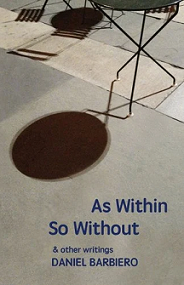
Double bassist Daniel Barbiero has spent decades thinking and writing about the interaction between music and other artforms and the places in which these cross-sections of time, space, and sound collide. His recently published essay collection, As Within So Without: & Other Writings, covers a wide-ranging slate of art-related topics, including Surrealism, poetry, dance, the nature of musical improvisation, and the meaning of meaning itself (or lack thereof).

The majority of these 20 essays first appeared in the art and literary journal Arteidolia, which also owns the press that published As Within So Without. Consequently, Barbiero’s book is not for the uninitiated. Art-history novices, for instance, shouldn’t expect much orientation in the chapter “Is Silence Golden?” when Barbiero weighs in on a century-old debate between Surrealists and musicians surrounding the limits of musical expression compared to other artforms.

Readers meeting key players like Andre Breton and Giorgio de Chirico for the first time might be lost for most of this chapter — and the rest of the book. And if you’d never seen an asemic text prior to picking up As Within So Without, the chapter “Writing Pushed Beyond Writing” won’t necessarily give you the tools to envision one of these written images.

Part of the problem lies in the form in which this essay appears in print. The original online version of “Writing Pushed Beyond Writing” begins with artist Cy Twombly’s asemic piece Cold Stream (1966). For a highly intertextual book so focused on comparative art, visual systems of writing and notation, and spatial division, the exclusion of the pieces discussed from As Within So Without results in most of these unrevised essays appearing without full context.

In the chapter “Dancing with the Hands,” Barbiero implores readers to “look again at the dancer’s hands as they pick up an object,” but the photograph of two dancers frozen in motion as they lean over an array of fossils featured in the Arteidolia version of the piece is nowhere to be found. Neither are there any additional written descriptions to make up for the missing visual reference.

The lack of visual material also leaves readers at the mercy of Barbiero’s interpretations of the works with no room for additional input or disagreement. To wit: In “The Angel of Contingency,” he describes the creature of Angelus Novus (1920) by Paul Klee as “a blocky physique facing us with a bland expression.” To me, the angel’s bared teeth and lowered eyes appear anything but bland, and I’m reminded of a crude version of Leonardo da Vinci’s Vitruvian Man (1490).

Such is the varying and unique experience of art Barbiero himself talks about in several observations on “idiolectic” theory — the idea that language holds different associations and references for everyone — throughout the book. But readers without access to the central pieces referenced in his essays miss the opportunity to apply the theories while reading. The book also contains numerous typos, awkward spacings, and misspelled words that, oddly, don’t always appear in the original online essays.

Further, there are multiple points where Barbiero’s writing extends too far into the abstract. In the titular essay of the collection, “As Within So Without: The Painter as Clairvoyant,” he writes that “the occasions and locations associated with travel — by train or any other means — naturally continue to elicit powerful emotions,” but neglects to define what these emotions are, ambiguously stating that they are “scenes of deep emotional meaning” with “specific emotional meanings” cast “in a certain emotional light.”

In “On Russell Atkins’ Poetics of Objectified Mind,” Barbiero discusses “Atkins’ signature gesture of substituting an apostrophe for the omitted ‘e’ before the ‘d’ at the end of a past-tense verb [in] order to conflate its functions as an adjective and verb,” but this passage never showcases a sentence from Atkins that would demonstrate his intended grammatical effect.

The strongest parts of As Within So Without are the essays about music and dance, especially the artistry and experience of improvising music live. One can imagine these essays fitting neatly into an undergraduate conservatory curriculum, young musicians ruminating on the sonic landscapes they shape and the temporal spaces they occupy while performing.

But for the layman who wants to dive into one of Barbiero’s many areas of artistic expertise, these writings are best enjoyed in their original multimedia home on the Internet and not as the plain, unadapted text in this book.

Between loneliness, capitalism and immigration, ‘Against the Wall’ has a lot to say about life

By Clare Mulroy

 This article was first published in The DC Line here.

“Whoever says you can’t live in two places at the same time is dead wrong” is my favorite line in Alberto Roblest’s recently published book of short stories, Against the Wall. Capitalizing on themes of loneliness, power and self-discovery, Roblest delivers a collection that masterfully comments on the human condition.

Translated from Spanish, Roblest’s prose brings readers through a variety of first-person and third-person accounts of human life. While many of the characters in Against the Wall are not tasked with anything particularly remarkable, even a journey like moving a mattress to a new home or going to a casino provides a vehicle for social commentary.

Roblest, a local author and founder of Hola Cultura, has a lot to say about the crumbling myth of the American dream and the overwhelming disappointment of mainstream politics. In one notable story, “Blackened Obelisk,” the Washington Monument becomes encased in roaches. The nation panics. White House officials and strategists propose blowing up the monument and rebuilding it to profit off of the tourism and sponsorship it’ll attract. You would’ve thought filmmaker Adam McKay himself took inspiration from this short story for his December release Don’t Look Up. 

But there are more subtle conversations about national identity and capitalism throughout the book. Immigration is an undercurrent in almost all of Roblest’s short stories, showing how natural-born citizens often treat immigrants as if they’re disposable, even though they are the backbone of this country’s labor and production. Even when immigration doesn’t seem at the forefront of a particular story, there is a throughline of expedition and feeling lost in all of his work. 

The magic of Against the Wall is that each story builds on the previous one to create a sort of time-capsule memory — by the time you get to the latter half of the collection, each new story with new characters feels charmingly familiar. Sometimes it feels like we already know the character after just a few paragraphs, and often it’s painful to leave a character and move onto the next story so soon.

The book’s weakness is the jarring way it sometimes toggles between realistic fiction and mystical storytelling. In one story a man moving with his family reflects on political scandal and class differences, and in the next a female monster chases a man through a maze of garbage and starving children. Just as you feel you’ve grasped the essence of Roblest’s writing style, he pivots, sometimes leaving you puzzled.

Still, it’s captivating enough to slip into these stories. “Lost and Found” sees a man waking up trapped in a bus terminal, unsure how he got there. As he searches for his luggage, the tale becomes more intense with each step. Reading the story felt like waking up from a puzzling dream, sitting in bed trying to interpret what it is my brain is telling me. “Cat Life” features a character who is led to out-of-body experiences through the felines that live in the house where he rents a room. Stories like this are sometimes so abstract it’s hard to pull yourself back down to earth, but at least spending so much time in the clouds makes you think.

Roblest’s storytelling gives the feeling of gathering bits and pieces of a puzzle until, in the last paragraph of each story, you are finally able to push back your chair and see the entire masterpiece. Roblest skillfully buries messages just below the surface; lessons about immigration, capitalism and the passage of time masquerade as everyday human interactions.

In the collection’s last story, “The Apparently Abandoned God-Forsaken City,” the narrator speaks candidly to the reader: “Whenever I get scared, I grab my balls.” While the detail is a slightly graphic one, the paragraph ends with a beautiful tribute to the human body and the connection between our soul and physical being. 

“Holding onto myself, I face the world and proceed.”

This last story rounds out the entire book, which is filled with people setting out on journeys — either metaphorical or real. In these varied stories, Roblest comments on living in the present while looking toward the future, on being in New York City and on the contributions of immigrants to this country. And though the stories’ connections aren’t always obvious, readers can see humanity of all shapes, sizes and colors at the forefront of the book’s most important themes — destruction, growth, change and time. I am not an immigrant and have not experienced the attendant discrimination and xenophobia, but the skill of their portrayal nonetheless allows me to feel a personal connection to the characters. Roblest marries narratives that might not be recognizable to every reader with human experiences that all of us share.

In the last section of the final short story, Roblest seems to break the fourth wall, telling us, “So I’m finally here … telling you my life story.” And while it may just be the voice of another character, I can’t help but think that maybe Roblest has lived a thousand other lives before.

Against the Wall: Stories by Alberto Roblest and translated by Nicolás Kanellos (134 pages, $18.95) was published in September 2021 by Arte Público Press.

This article was produced in conjunction with Day Eight’s February 2022 conference on “The Crisis in Book Review.” The DC Line worked with conference organizers on the New Book Reviewer Project, an initiative to grow the cohort of qualified local book reviewers. Clare Mulroy is one of eight writers assigned as part of the conference to write a review for The DC Line or the Washington Independent Review of Books.

An Ode to Joy (and Pain)

By Edgar Farr Russell III

This article was first published in Washington Independent Review of Books here. This article was created within a New Book Critics project and within Day Eight’s 2022 “The Crisis in Book Review” conference.

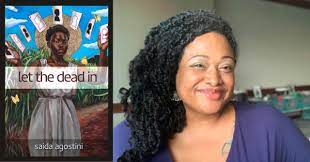
For those compelled to ponder how the past molds the experiences of the present, the powerful language of Saida Agostini’s first full-length collection of poetry, let the dead in, not only offers the opportunity to see and hear people’s interactions in her world, but to smell, taste, and feel their joy and pain. Readers unfamiliar with this sphere will likely find Agostini’s words and imagery resonating within themselves — recalling their own experiences and emotions.

The collection, a finalist for the 2020 New Issues Poetry Prize and the Center for African American Arts & Poetics Poetry Prize, is divided into three parts: “notes on archiving erasure,” “we find the fantastic,” and “american love.” The first begins the story in Guyana, where past generations tell their stories of young love at first sight, of brutal treatment of women at the hands of men — whether husbands or lovers — and of children hungry and wailing for their absent daddies.

We also experience the environment where these people live and work and suffer — such as the sugarcane fields where they toil, the rivers of “dark cool moving waters,” and the homes where the families exist — with or without love.

But, most of all, this section introduces us to the power of women — full of passionate love or jealousy; suffering but surviving — role models to be emulated or not. The author also affords us an initial look at the fantastical world of spirits and demons, such as the Jumbees. The general belief is that a person who has been evil in life will remain evil in death and continue to exert his or her power over the living.

The second part further introduces readers to the creatures of this world, including the ole higue, a myth created by Dutch enslavers in Guyana of a hunchbacked old woman “said to depart her skin at night and beguile young women into killing their families.” Ironically, such spirits provide an emotional outlet for women betrayed or abandoned by their men. Others, such as the moongazer — a bloodthirsty monster created to stop slaves from stealing sugarcane from the fields after dark — inspired Agostini to transform this horrific mythology into a glorious dream of being reunited with a deceased lover:

“…what I have done

to find my darling; look at her

crowned by nothing but the stars

in this bowl of sky. Her dark hands lifted

soft and warm, my gaze

a patient delight. Look at her

there beyond the moon…”

Also in this section is a sequence of six poems introducing us to a man who may serve as a symbol for many men in this culture. He is known as chickenfoot, “all sinew and black amble.” He offers romantic passion to women but will cause them great heartbreak. Chickenfoot also loves his granny and weeps for a man he adores and can never touch. In his macho environment, such feelings cannot be tolerated. Here, Agostini demonstrates that pain is often a universal constant for children, women, and men.

The third part of the collection features the ironic title “american love,” for here we are reminded of past and present examples of Black men and women who have been killed by police, used or abused by those with greater power, or convicted of killing their abusers. Agostini’s poems in this section cover multiple locations and span decades, even centuries.

Some of the names — Freddie Gray or Eric Garner — may be familiar. Others, such as Recy Taylor, hark back to 1944. In “Bresha Meadows Speaks on Divinity,” Agostini offers these words on the resilience of children beaten by their parents: “god is a black girl in love with living, a sacrament on how to be disbelieved, forgotten and rise a thousand times over.”

While her poems appear to be about one subject, Agostini often uses them to express an entirely different emotion. She writes “whoever died from a rough ride” as a gentle meditation for her love of Baltimore in all its complexities — her memory of the feel of her mother parting her hair on Sunday with a purple fine-toothed comb; to a stranger seeing Agostini weeping and placing his hand on her shoulder to express concern for her welfare; to viewing the falling houses behind her, whose bones chant, “we won’t leave we won’t leave.” 

At the same time, some of the brutal experiences she has endured recur in multiple poems. Agostini finds grace, however, in the collection’s penultimate poem, “who we are human to,” as demonstrated by her closing words:

“we are nothing if not houses to each other that can hold

all sorts of brutal tender memory, make rooms of flesh

and light where we bear witness to the most horrible

rock each other in our arms and whisper yes yes 

I know”

Readers willing to journey with Saida Agostini will find their path full of conflicting emotions and painful choices which must be made. In return, the reward offered is one of richer insight and greater empathy for those whose lives she has illuminated.

Edgar Farr Russell III is a fine artist, writer, director, and performer. His art was selected for the Joslyn Art Museum’s Biennial XX. His plays have been produced for NPR, the stage, and television. Russell produced and reconstructed the lost 1938 Orson Welles’ Mercury Theatre On the Air production of Julius Caesar. This new presentation featured members of Welles’ original Broadway cast. Russell has performed at the Library of Congress and the Kennedy Center. A lifelong enthusiast of Abraham Lincoln, he served as president of the Lincoln Group of DC, as well as president of the Washington, DC, chapter of the National Society of Arts and Letters. His most recent poem was published in November as part of the anthology We Were Not Alone, which features a foreword by singer/songwriter Jewel.