Browsing Category

Literary Arts

An Interview with Alberto Roblest

By Thais Carrion

This article was originally published in the Washington Independent Review of Books here.

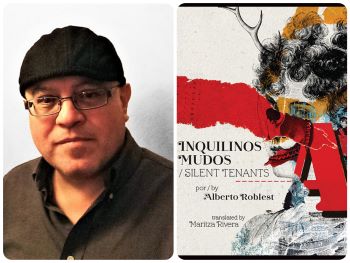
In his forthcoming collection, Inquilinos Mudos/Silent Tenants, Mexican poet, multimedia artist, and professor Alberto Roblest celebrates the power of being bilingual. Divided into two sections comprising 19 poems printed in English and Spanish, the work takes readers on an exploration of the richness of language, playing with form and word choice to create vivid scenes that evoke a range of emotions. Taken as a whole, the collection is a love letter to the trials and triumphs of expressing oneself through multiple tongues.

Themes of migration, colonialism, and history are central to this collection. How did writing in both English and Spanish help you explore them more deeply?

One of the central themes of the book is language and people who learn another language. In “Silent Tenants,” language is perhaps the main protagonist of the collection; of course, it touches on themes that have to do with migration, but also with love, music, friendship, and learning. When one can carry [on] a conversation with another person for, say, 15 minutes, it’s a very big achievement. You can feel it. I can tell you from personal experience. Speaking the official language makes one feel more secure, regardless of skin color, accent, manners, clothing, etc.

“Silent Tenants” is essentially about my neighbors in Columbia Heights, from their life experiences, from their difficulties to continue working two shifts in order to pay the rent, but also from their pleasure in learning another language, having other friends, non-Latinos, talking with co-workers, etc. In general, the success of being bilingual. Some poems are based on real people, like the one titled “Clara.” This poem is about a woman I met at a language school where I worked teaching Spanish. She was learning English and worked for a cleaning company specializing in movie theaters, arenas, and other entertainment venues.

What was it like to explore these themes in two languages? And what does literature in translation mean to you?

It’s always good to have your book translated since it addresses two audiences and more readers. Maritza Rivera, the English translator, did an excellent job. She took great care to find the right words that preserve the original meaning of the poems. When a translator manages that, it is of great benefit to the book. As for the writing, sometimes I think the poems in Spanish, and other times in English. I like to go to the National Gallery of Art to have coffee, surround myself with artistic pieces, and read. Washington is a privileged place in that sense, where the museums are free and so many places exist where you can read and be inspired.

When it comes to creative expression, how does working in video or digital media compare to writing?

I started writing at a young age — I would have been about 10 years old or so — inspired by a magnificent literature teacher. My mother wanted me to be a doctor or an architect, so I wrote all my life in secret. I did not share my poetry for fear of being branded corny, cheesy, and ridiculous. Many of my early poems have been lost to time. I didn’t publish anything until I was 19, when I was about to enter university. What I want to say is that I define myself as a poet. Video semantics [are] just an additional tool. I make use of video tools. With them, I “write” poetry. I do the same with the art installations I’ve created, and many of my digital prints are conceived or designed as poetry. That is to say, I consider them poems rather than collages, digital paintings, montages, or installations.

You experiment with form throughout this collection. When writing poems, does thinking in terms of form complicate or enhance the process?

I like experimentation. It’s like playing. Particularly, I think you must have fun while performing the creative act. I experiment not only with form, but also with content. I get bored doing the same thing all the time. I [lose] interest, and after a while, I don’t like it anymore. So, I vary my approach a bit. Obviously, making a video takes more time. Sometimes, there’s a long preparation process; sometimes, it involves a team, etc. The good thing about poetry is that it remains such an intimate act that it can be written anywhere, even on the subway, on the way from home to work. While many people are immersed in their phones, I am immersed in my poems. I put them on old-fashioned paper, with an old pencil, in a small notebook that I keep in my jacket pocket. I believe that poetry itself is an act of experimentation with the word and nothing more.

Are you thinking about the visual component of a poem — and how it might impact the reader — when experimenting with form?

I like visual poetry. I am not very given to esoteric, metaphysical, or symbolic poetry. I prefer the poetry that is written about the events that happen around me — the poetry that feeds on reality to become a sign or a metaphor. I do not think that the experimental form is inconvenient for reading; if the language and the meaning of the poem serve their purpose, it can be as experimental as a Dada poem.

Dr. King’s last night alive in powerful ‘Mountaintop’ at Greenbelt Arts Center

By Daarel Burnette II

This article was originally published in DC Theater Arts here.

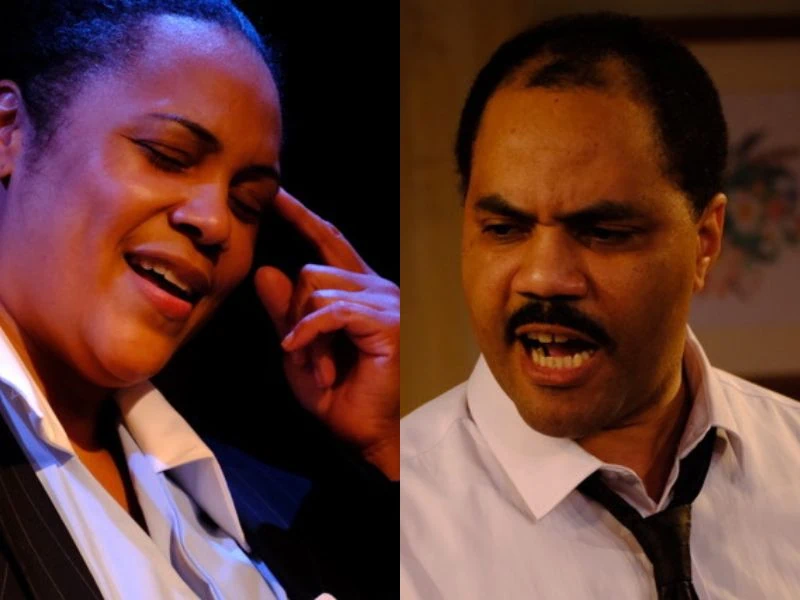
What resonates most about Greenbelt Arts Center’s rewarding twist of the play The Mountaintop is the way Director Rikki Howie Lacewell and her crew deftly deploy sound, props, and lighting to place, humanize and deify Martin Luther King Jr., masterfully played by Ryan Willis, on the day before he was assassinated.

In one scene, King, conspiratorial, frustrated with the direction of his movement, and visibly exhausted, twists the receiver of the black rotary phone situated in his Lorraine Motel room to assure that the FBI is not spying on him. He then dashes off into the bathroom where we hear for 15 seconds the sound of him ranting and urinating before stumbling back to his desk where he manages to sketch out the outlines of the Poor People’s Campaign in less than two minutes.

In another particularly emotional scene, sound designer Jim Adams ramps up the noise of a Memphis thunderstorm: whooshing wind, splattering raindrops, and ear-splitting cracks of lighting, which sends King’s heart racing: he’s not scared of the KKK or the American government or God (who’s here cast as a woman). But, it turns out, he’s petrified of lightning.

The whole of Black American history can be so depressing, violent, and overwhelming for its consumers that playwrights are prone to sum its parts up into more palatable, usually uplifting stories about heroes and villains. This focus on the extremities drains civil rights leaders of their fallibilities, distorts our mainstream understanding of how average Black and white people navigate the bizarre nature of America’s caste system, and, outside the theater, has us all on the constant lookout for the next magical hero who will fight today’s perceived villain.

The Mountaintop, which was written by Katori Hall and debuted in 2009, interrupts this narrative.

On the evening of April 3, 1968, King is serviced at the Loraine Motel by Camae (Lydia West), an attractive maid with a bottle of whiskey and a pack of cigarettes stuffed in her bra, a sketchy past, and unusual ideas on what Black civil rights looks like.

Camae, it’s revealed partway through the 90-minute play, is an angel of death, and King begins to contemplate through a series of monologues what Black folks will do without him leading the movement.

It’s clear from the opening lines of the play that Director Lacewell, who also designed the set, spent an inordinate amount of time during rehearsals paying attention to detail.

Willis’ southern drawl, which he impressively maintains throughout, is eerily similar to King’s. The blocking made it clear there was thick sexual chemistry between Martin and Camae.

And the lighting interchangeably halos Camae and Martin.

You’re reminded over and over again through this powerful script, Lacewell’s choices, and Willis and West’s stealth acting, that King was an imperfect man. His socks are stinky and have holes in them. He begs for a cigarette when he gets anxious. Before his wife calls to update him on the latest threat she’s received, King perversely stares at Camae’s backside.

You’re also reminded, though, how much hope Americans placed in King to snuff out our caste system and how he so boldly volunteered to do so.

Lacewell’s prologue leaves us with a call to action that I found stirring. She manages to do with Black history what more artists should: complicate, elevate, and force us all to reflect on our varied roles.

The Language of Trees: A Rewilding of Literature and Landscape

Reviewed by Samantha Neugebauer

This article was originally published in The Washington Independent Review of Books here.

One of my earliest memories is of driving down Roosevelt Boulevard with my grandmother. This was in Northeast Philadelphia in the early ‘90s, a time when that road was an ocean of colossal oaks. It was autumn. The light was golden. My grandma steered her boat-like Chrysler New Yorker carefully with both hands, and by some trick of the light, the enormous oak-leaf shadows raced through the car, painting themselves on the dash, our arms, pants, and her honey-brown leather seats.

I can still see those shadows fleeing from us, like shooting stars, over our heads and out the back window. How was it trees could be so magisterial yet so playful?

When we’re small, people say, things seem bigger than they are. That’s normally true, but these trees really were giants. Even the adults said so. Or maybe trees just turn grownups into kids again. Young or old, we all have our tree stories. There are birches we’ve loved and lost. Poplars we look forward to seeing like they’re old friends. We walk down one street instead of another because of its weeping willows. We choose the smaller apartment with a Japanese maple out front over the larger unit without one. We survey stark city blocks or box-store stretches and think, “This would be so much nicer with some trees.”

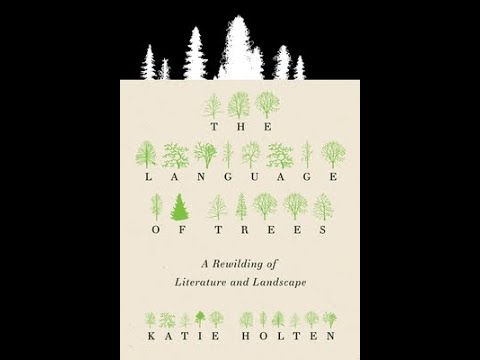
For all these reasons, Katie Holten’s The Language of Trees (an expansion of her 2015 book, About Trees) is a joy. Holten, an Irish artist and environmental activist, has invented “a new ABC” for us, a tree alphabet, by taking each of the 26 letters of the Latin alphabet and creating a corresponding arboreal illustration. S, for example, is a sycamore, H a horse chestnut, P a pine, etc. Her tree glyphs are careful, calming little portraits; they come in uppercase and lowercase. On the page, they appear dark green, almost black. None are larger than my thumb.

The Language of Trees is a compendium of parallel texts, with English on one side and Holten’s tree language on the other. The collection features more than 50 contributors from around the world comprising various perspectives and disciplines. There are personal essays, poetry, scientific accounts, testimonials, creation myths, warnings, and even recipes. Did you know the U.S. Constitution was written with oak gall ink? Whether you did or not, Rachael Hawkwind shares how to make your own tree ink. There’s also a recipe for acorn bread, which you should eat so that “the wisdom of the oak [can] reside in your body,” explains Lucy O’Hagan.

Exceptions to the book’s parallel structure occur via scattered quotes by the likes of Ursula K. Le Guin, Jorge Luis Borges, and Zadie Smith; lyrics from Radiohead (“Fake Plastic Trees”); diary entries from Irene Kopelman; and pieces by Åse Eg Jørgensen and Jessica J. Lee incorporating Danish and Chinese, respectively.

While Holten’s tree language is the book’s essence, other connective tissues are at work, too. Many pieces explore the relationship between trees and literature. In his introduction, Ross Gay explains how the word “beech” is the Proto-Germanic antecedent for the English word “book.” He also makes the case for how “the best libraries” feel like being in a forest. In another piece, Thomas Princen shares a bittersweet story about the keyboard stand he made from an American elm that had once graced the campus where he worked. One day, he and his son came upon the tree being felled. Initially, he believed it was “another victim of Dutch elm disease.” Only later did he learn the university removed it to make way for a sidewalk.

Despite the deforestation that many of these pieces speak to, the book’s tone is rarely pedantic. More than anything, the writing is revelatory. And Holten’s tree translations are wondrous, especially when it comes to the poetry entries, such as Ada Limón’s “It’s the Season I often Mistake.”

In her afterword, Holten calls The Language of Trees “a love letter to a vanishing world.” She says by reading in her font, we’re forced to slow down and “re-read everything.” It’s true, like when you begin reading in a second language. Moreover, we can download her Trees font and write with it ourselves, which is what I did with this review after first completing it in English. It seemed only fitting to talk about those long-gone oaks of my childhood in a language celebrating their world. Try it yourself.

An Interview with Donna Andrews

By Olivia Kozlevcar

This article was first published on October 4, 2022 in Washington Independent Review of Books here.

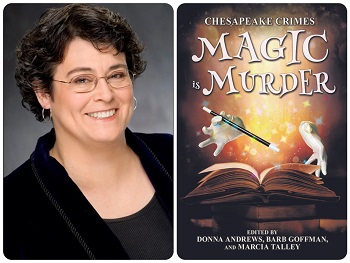
Magic Is Murder, a new story collection sourced from the talented members of the Chesapeake Chapter of Sisters in Crime (SinC), offers a thrilling, modern blend of mystery and the supernatural. Here, Donna Andrews, one of the anthology’s editors, shares a peek at the collection and the people behind it.

As you and your colleagues mention in your editors’ note, the overarching theme of the anthology is crime. What drove you in this direction?

What drove us was that we’re all crime writers. Magic Is Murder is the latest in a series that the editors — Barb Goffman, Marcia Talley, and I — have done to showcase the wealth of writing talent in the Chesapeake Chapter of Sisters in Crime. SinC is an organization founded in 1986 by a group of women crime writers who wanted to combat misogyny in publishing. They saw that women were at least half the readers in the mystery genre, but women weren’t getting half of the publishing contracts — and when they were published, they weren’t paid as much as male writers and didn’t receive as many reviews or award nominations. So they set out to level the playing field.

Marcia, Barb, and I are all longtime SinC members — in fact, Marcia is a past president of SinC National, Barb and I are both past chapter presidents, and we’re all three still active in the chapter. Although the anthology isn’t an official chapter publication, we limit submissions to chapter members, and we donate to the chapter any royalties generated after the publisher pays the contributors.

It’s been a rewarding project. Over the years, quite a few writers have had their first professional publication in the anthology series, including several who have gone on to thriving careers in publishing. We like to think that it’s a good opportunity for relatively new writers, appearing beside more established authors in a successful anthology series — successful and award-winning. Stories from the first nine volumes in the series have won the Agatha, Anthony, Derringer, and Macavity awards — in fact, a total of eight awards and 20 additional nominations. In short, the anthologies have done pretty well so far, and we like to keep building on that.

The collection also combines the dual themes of magic and murder. Why this subgenre?

We like to choose a theme for each anthology — past volumes have included Invitation to Murder (stories must involve an invitation); Fur, Feathers, and Felonies (stories must involve an animal); and Storm Warning (stories must involve the weather). Wildside Press, our publisher since the third volume in the series, likes the thematic approach — it definitely helps give each book a distinctive identity, which helps with sales and marketing. We editors think having a different theme for each anthology helps spark our contributors’ imagination. And we hope it’s fun for the reader, seeing the wonderful variety you can get when you turn a bunch of very different writers loose on the same theme.

When we chose magic and murder as the theme for the latest anthology, we did so because we know that these days, genre-blending is very popular. There was a time when many mystery readers disapproved of crime stories that involved magic or the supernatural, but today they’re one of the bestselling subgenres in the field. And we were also hoping to get a few crossover sales from fantasy readers.

Why is this collection meaningful to you?

Apart from the fact that having a book out never gets old, Magic Is Murder represents a milestone. Our team has been putting out an anthology every two years, and this is the 10th volume in the series. And yes, we only do this every two years because we like to give our contributors plenty of time to create and polish their stories — and give ourselves plenty of time to do the editorial and pre-publication work, because we do this as volunteers on top of our own busy careers in crime writing. So, the release of this volume marks two decades of working to shine a light on the talented writers of our local chapter — and producing anthologies that we are proud to present to mystery readers.

Now that the anthology is out, what’s next?

We’re already hard at work on the next volume, Three Strikes — You’re Dead! All the stories in that volume will feature sports. And we’re also pretty busy with our own writing careers. Barb is highly in demand as a freelance developmental editor on top of her career as a multiple-award-winning short-story writer — her work has appeared in Alfred Hitchcock’s Mystery Magazine, Ellery Queen’s Mystery Magazine, and dozens of anthologies. Marcia is also a prolific short-story writer, and Severn House recently released Disco Dead, the 19th book in her Hannah Ives mystery series. And I’m currently working on what will be the 33rd book in my Meg Langslow series — number 31, Round Up the Usual Peacocks, came out in August, and number 32, Dashing Through the Snowbirds, will be out in October. In short, what’s next for all of us is a lot more crime…but only on paper.

[Editor’s note: This article was written with support from the DC Arts Writing Fellowship, a project of the nonprofit Day Eight.]

Olivia Kozlevcar is an undergraduate at American University who dreams of pursuing law. She is currently the Life managing editor of the American University Eagle, as well as one of the hosts of its podcast, District of Cinema. Follow her online at @oliviakozlevcar.

An Interview with Joe Rothstein

By Olivia Kozlevcar

This article was first published in Washington Independent Review of Books here.

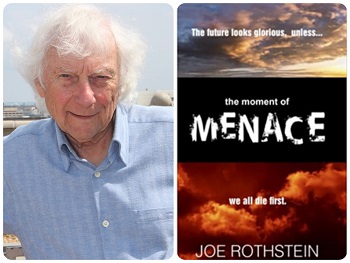
Given our current political climate, it’s hard to imagine writing DC-themed fiction that’s stranger than truth, but Joe Rothstein has done just that in his new novel, The Moment of Menace: The Future Looks Glorious…Unless We All Die First. Rothstein, whose long career spans both politics and literature, braids the two worlds together in a riveting story that gives readers a glimpse of what our democracy could become — for better or worse.  

Your deep knowledge of politics comes through in this book. Is it challenging writing fictional stories about a very real system?

Think about what it means to be a candidate. Depending on the political office at stake, you will need to raise considerable campaign money, much of it by personally asking friends, family, co-workers, strangers. In a real sense, you will have to learn to beg. You will have to hire a professional staff and recruit dozens, hundreds, possibly thousands of volunteers, a hugely difficult exercise in high-pressure management. You will need to appear in public every day, sometimes in the media, weighing every word lest it be misinterpreted, often purposely, by the opposition.

Tension will increase as Election Day approaches, whether the polls have you ahead or behind. The money won’t be enough. The attacks on your character will increase, all in public media. Your family will feel under siege. You will get conflicting advice. Every day, you will need to make decisions, any one of which could cause you to win or lose the election. This is stuff of high drama, and I lived it through more than 200 campaigns. Marriages were…destroyed, so were reputations, wealth, hopes, and dreams. I don’t need to use my imagination to develop characters and situations. I just need to remember.

Your novel follows a charismatic American president named Isabel Aragon Tennyson. How did you shape this character? 

During my campaign career, I met many strong, capable, and courageous women: candidates, spouses, campaign leaders, and others. We’ve never elected a woman president. I decided that I would, and that she would be a composite of many women I met who would have made great real-life presidents.

This book is as much a dystopian novel as a thriller. Do you find it difficult to approach the dystopia genre without being overly pessimistic?

I’m a democrat with both a small and capital D. But democracy is struggling to effectively meet the challenges of the 21st century. And because democracy is underperforming, anti-democratic forces are presenting a serious challenge. It’s essential to recognize and meet this challenge. So, I write not as a purveyor of doom but rather with a call to action. Rather than write essays about this, I’ve chosen to write entertaining thrillers and wrap them around real public problems.

What does waiting to write until you’ve gained some life experience bring to the resulting work?

Perspective. The curved edges of “good” and “evil” and “right” and “wrong.” Living through chapters of life to see many of them resolve, gaining insight from experience.

What’s next for you?

One of my summer-vacation jobs in college was with an automobile stunt show, sort of a car circus of smashed cars, daredevil motorcyclists, and a finale with a car and driver being shot out of a cannon. We traveled the country as the Motor Olympics. I was “Suicide Saunders.” That’s my next book.

New poetry collections contemplate the human experience via music, rituals and exhortations

By Morgan Musselman

 This article was first published in The DC Line here. This article was produced within the New Book Critics project, a component of Day Eight’s 2022 The Crisis in Book Review conference.

Three recently published poetry collections explore themes of loss, devotion and self-love, demonstrating the art form’s capacity to express the depth of the human experience. 

The Shomer by Ellen Sazzman; published in 2021 by Finishing Line Press (85 pages, $21.99)

A striking debut collection from poet Ellen Sazzman, The Shomer takes its title from the traditional Jewish practice of designating a guardian — a shomer — to watch over the body of a deceased person until burial, protecting them against desecration until they are safely interred. As poet-guardian, Sazzman guides readers through significant life events as well as daily routines; her poems offer glimpses into the realm of memory wherein loved ones are safeguarded. 

Split into three parts, The Shomer first watches over the speaker’s familial relationships, the poems securing the memories of those once in her care — mothers, fathers, children and grandchildren — and protecting them from the erosive nature of time and forgetting. In this initial section — which begins with “To Chaya (1915-2014),” an elegy for her deceased mother — the speaker travels from orphaned adulthood to childhood and back again, exploring the relationships parents have with their children, each other and themselves. The poet’s reflections are deepened and complicated by her own experiences of aging and parenting. In “October in the Neonatal ICU,” the speaker directs these words to her newborn grandson: 

Over stigmata pricked on your flesh, 

I bend, touch your forehead. 

The generations’ shared claim: 

to swaddle you beyond suffering,

line your transparent manger

with the straw of names. 

In these poems, loved ones’ bodies — eyes, hands and lungs — are preserved through memory along with hopes, failures and loves.  Threads of forgetting and destruction expand to questions of tradition and rite in the collection’s second section, “The Body Sanctuary,” where the poems attend to old practices and rituals of life in the face of time, loss and persecution — particularly as they relate to Judaism. From “Seek and Hide in Prague’s Old Jewish Cemetery” to “Jewish Girl’s Guide to Guacamole” and “Renewing Vows in the Atlantic,” the speakers in these poems search for asylum in the spaces once occupied by other bodies — loved bodies, lost bodies, and former versions of oneself. In “Peeling the Orange,” for example, the speaker breaks open the skin of an orange and reminisces about the way her father did the same each morning throughout her childhood, concluding, 

                The peeling 

releases nectar that clings to my fingers,

perfumes my palms for hours. Perhaps we can

tease out the pungencies, reconstitute

the fullness, un-seamed, returned to one another.

These spaces grow more tangible toward the collection’s end as Sazzman turns her eye to the physical, flesh-and-bone body as well as the material objects it handles and fills: a grandmother’s sealskin coat, for example, or another person’s thighs. This final selection of poems progresses steadily through themes of sensuality and pleasure as Sazzman recounts adolescent flirtations. In a reprieve from the collection’s generally heavier tone, readers get a fleeting taste of the author’s wry humor before moving to loss and unfamiliarity as she ruminates on the ways bodies begin to say their goodbyes. To watch over the body corporeal — our own and others’ — is to see damage and desire, fruit and rot, these poems suggest. But “Better to / welcome the wounding, no matter how deep the cut” than remain unscathed.

Sazzman explains her thematic choices in the collection’s introduction: “Under the best of circumstances the Shomer gains a glimpse into the liminal, into what happens in the space between love and loss, hunger and fulfillment, forgetting and remembering.” Though the collection’s final portrayals of memory are clouded by grief, nostalgia, age and human fallibility, The Shomer succeeds in its role as guardian, artfully preserving the poet’s love for those who welcomed her into this life and those whom she has welcomed in turn. Here, loved ones are held fast in memory, preserved through poetry, protected until we are all buried. And what a blessing to be so lovingly guarded by a poet as skilled as Ellen Sazzman.

Riffs & Improvisations by Gregory Luce; published in 2021 by Kelsay Books (33 pages, $19) 

Music is the master key to emotion, declares Gregory Luce’s collection Riffs & Improvisations. Here, when music plays, fervent sentiment spills forth, filling the poems with earnest and reverential contemplations of sensuality, yearning, wistfulness, loss and, above all, love. 

As these poems traverse emotions, so too do they span place and time, from a Metrorail station in “Music to It” — where the speaker perpetually searches for the right song to play in his life’s soundtrack — to awaiting divine judgment after death in “Richard Strauss in Purgatory.” Most of the poems portray a lone speaker isolated by time, death or his own thoughts, pondering music and the moods it conjures, each contributing a line in an ardent love letter to the art form.

In one of the collection’s more sorrowful pieces, “Satie in the Dark,” the speaker turns off the lights and plays Gymnopédie No. 1, intentionally invoking memories of “old lovers, my dead– / my father and mother / and the others.” It’s a solitary séance that reminds the speaker of his own inevitable death, only to be snapped out of his reverie by the start of a new song. Here and throughout the collection, as music opens the speaker to emotion, it also functions to facilitate eulogy and memory, linking past and present.

With a title such as Riffs & Improvisations, there comes an expectation that the poems within feature rhythms and meters, evoking the very compositions with which they are preoccupied, but most poems here are free verse without a noticeable musical pattern. Luce tends toward explicitness over subtlety when painting a scene and, rather than mimicking song, what many of his poems capture is the sensation of listening to music. In “Aspirins and Coffee,” Coltrane plays, and the speaker is consumed by the sound: 

Jimmy’s bass notes step up my spine and thump

      the base of my skull

Elvin’s sticks tattoo the back of my head from the inside

McCoy’s chords shatter like fine crystal behind my eyes

“a Love Supreme a Love Supreme”

and then Trane’s lines burn up from my gut like raw liquid sugar

      like hot syrup like pure honey

To experience Riffs & Improvisations to best effect, readers might want to play aloud the music referenced therein as they read each poem. When the notes of “A Love Supreme” accompany “Aspirins and Coffee,” readers can truly feel the impact of the beat, their own fingers tapping in tandem with the speaker’s as he sits at his kitchen table. 

Luce’s collection ends with a revisit to this song and these moving lines: “I try to work my pen / for Trane the way / he played his sax / for God.” This is Riffs & Improvisations at its finest: a poet composing in awe of others’ craft, enveloping himself and the audience in a love of music. 

My Poetry Is the Beauty You Overlook by Kim B. Miller; self-published in 2020 (73 pages, $16)

Kim B. Miller wants more from you. And more for you, too. Demanding readers’ attention from the beginning, her collection My Poetry Is the Beauty You Overlook opens with a poem that ends with the following lines:

My name is poetry and I will never be what you want to hear

But truth cannot be ignored

Poetry is not what I do

Words are what I breathe and I decided to come exhale on you

Part poetry collection and part motivational guide, My Poetry presents the work of the first African American to serve as the poet laureate of Prince William County, Virginia. Emboldened by experience and the personalization of her craft, Miller is determined to speak her truth and inspire others to do the same. 

My Poetry’s themes are wide-ranging, from the truth-telling role of poetry to the struggle against anti-Black racism. The collection incorporates an unconventional format: Each chapter explores a different theme through a sequence of one free-form poem, followed by a featured haiku, six more haiku, and finally a so-called “Kimism.” These Kimisms are candid sayings that clinch each chapter’s theme — for instance, “Some of you are too busy trying to explain your journey to someone who will not be going with you” comes at the end of a chapter urging confidence and self-love. 

Given Miller’s professional experience as a motivational speaker, it is unsurprising that many of her poems adopt this style. Nearly every poem in My Poetry adopts a second-person point of view, addressing the reader directly. The many haiku are key examples of Miller’s motivational tone, as in the featured haiku of the chapter “Mom, Gone Too Soon”: 

You cannot divide

Yourself into fractions to

Make someone else whole

This inescapable “you” present throughout the collection consistently demands more of the reader — more attention, more introspection, more accountability, and more love. 

Miller’s haiku also exemplify her taste for playing with tradition. While adhering to the established five-seven-five syllable structure of a classic haiku, Miller often makes inventive modifications to the words’ arrangement within lines. Three times in the first chapter, she makes the two syllables of “poet” stretch from one line to the next. In “Judging,” she writes, 

Just cause they don’t po-

et like you poet that doesn’t

mean they aren’t poets.

The splitting of po-et while sticking with traditional structure underscores Miller’s meaning: Poetry is malleable, and the liberties taken with art do not negate the writer’s artistry.

In this way, Miller has learned to claim more for herself, to declare her own love and praise — and she insists that her readers do the same. The opening free-verse poem in Chapter 8, “Poetry Is,” reads: 

Poetry is unsolicited help

It holds us up when pain tries to erase our voice

It allows us to pour into emptiness and create peace 

Like much unsolicited help, it can be tough to swallow. Bold, funny and earnest, My Poetry Is the Beauty You Overlook knows that there is beauty in truth and insists that you see it.

Morgan Musselman is a reader and writer living in Washington, DC. Morgan holds a bachelor’s degree in English Literature from the University of Iowa. Upon graduation, she moved to Washington, D.C. and began her current position working in the fundraising and communications department of a local nonprofit. In her free time, Morgan can be found at coffee shops around the city, desperately trying to clear up space on her to-read shelf, or at a bookstore undoing all her progress.

An Interview with Marilyn Oser

By Olivia Kozlevcar

This article was first published in Washington Independent Review of Books here.

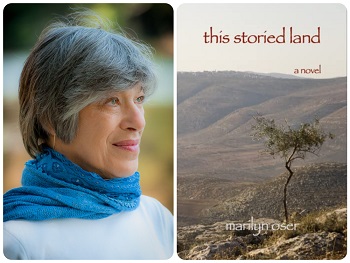
It takes a cognizant, careful writer to create works that honor the lives of ordinary people thrown into political and cultural turmoil. Marilyn Oser, author of the new novel This Storied Land, is such an author. This Storied Land tells the tale of a small circle of people living in Palestine during the British Mandate, and how their lives are shaped by it.

This novel is historical fiction that moves through a number of years in the early 20th century. How much research went into writing it?

My novels ordinarily have their beginnings with a question or a problem that I want to answer. In the case of This Storied Land, I wanted to know what happened in Palestine during the British Mandate, 1920-48. How did the conflict affect ordinary people’s lives — a farmer, say, or a laundress, a partisan, a nurse, a student. I started in my usual way, by reading novels of or about the period to see how fiction had treated the subject and whether I had something to add. I did. The novels written in the 1950s — Exodus, The Haj — provided an introduction to the issues but proved way too one-sided, favoring the Jewish settlers, ignoring or belittling Arab culture. (I use the term Arab or Arabic rather than Palestinian for clarity since Jews, too, were considered Palestinians at the time.) I moved to novels by Israeli authors, including S.Y. Agnon, Amos Oz, and Meir Shalev. (If you’re looking for a good read, by the way, I recommend Shalev’s Two She-Bears).

I had a deep background in Zionism through the research I’d done for my blog, Streets of Israel, which provides information about the people behind the street names of Tel Aviv, Haifa, and Jerusalem. Now, I began reading and taking notes from histories written by Israeli, British, and (current) Palestinian scholars. Not surprisingly, I became thoroughly confused amid a welter of conflicting claims by classical, revisionist, and post-revisionist scholars. What was the god’s honest truth? The same quandary has arisen in my research for two of my previous novels, Rivka’s War, set during World War I, and November to July, set at the Paris Peace Conference. Experience told me that, sooner or later, the wheat would separate from the chaff, and I would have facts that I could rely on by the weight of the evidence.

I continued to search out novels written during the period, as well as memoirs of that time, since those were the most likely to provide the little details that bring a story to life — what people were eating, or what cigarettes they were smoking, how they bought their food, what games the children played, what families did on outings at the beach. These were general impressions. Once I began writing, I used the internet to look up specific pieces of information that I needed. It was an online source when I was researching Rivka’s War that told me the color and texture of the soil in Ukraine, a detail I needed when Rivka dug a garden. In This Storied Land, to depict the Palestine Broadcasting System’s first moments on air, I used the internet to search out radios being produced in Europe circa 1936: what they looked like, how much they cost, which ones were available in Palestine.

My major research was finished by the time I started writing. By then, I had a good sense of the daily lives and concerns of Jews, Arabs, and Britons, and what they would confront. Over my two years of facing the page each day, I continued looking for specific bits of information; went on reading work by Jewish and Arabic poets and essayists; sought out photographs and watched [historical] videos to deepen my sense of the times; and listened to traditional Middle Eastern music, especially the oud, a stringed instrument of great emotional depth.

With This Storied Land, what responsibility did you feel in terms of depicting the history of Israel and Palestine accurately?

In the summer of 2019, I was hiking in the Caucasus Mountains when I fell into a conversation with a fellow hiker whose familiarity with the Palestinian Nakba (catastrophe) was far greater than my own. What she told me was food for thought that I kept chewing over long after the trip was done. Part of the impetus for writing this novel was my intention to do justice to the plight of the Arabs. I like to call my style of writing “history forward.” I feel a responsibility — no, an obligation — to my reader to get the facts right and portray the history faithfully in its effect on ordinary people. When the course of the narrative demands that I invent a fiction, I try for a workaround wherever I can, and usually I find one. I’m aware of only one factual change I made in This Storied Land: I moved up the destruction of an Arab village by one month to suit the demands of the narrative. Other than that — and a typo in Ben-Gurion’s date of death — I believe that the history I’ve depicted is accurate, and I think the story I tell is more compelling because of it.

You split the story up in sections, sort of like vignettes, some of which include definitions and clarifications. Why?

When I told an Israeli friend of mine that I was working on a novel set in Palestine, she hesitated — mused — [and] then said, “You can’t.” I laughed, wondering what she meant. But once I started doing my research in earnest, I discovered how extraordinary these times were. Things of consequence happened virtually every day, and Arabs, Jews, and Britons found themselves locked in an ever-shifting, toxic triangle. Meanwhile, world events weighed ever more heavily on them all — along with a trail of history going back into antiquity. Since I wasn’t up for a thousand-page tome with long expository passages, I needed a way to bring in a lot of information in an economical format. I was stumped.

Then, while reading Colum McCann’s Apeirogon, I realized I could adapt a technique he used to encompass the current Israeli-Palestinian morass. I began looking for allusive quotations to incorporate into the narrative — from newspapers, the Old Testament, the Qu’ran, Jewish and Arabic poetry, eyewitness accounts, and bits of knowledge from the science and the arts of the period. Employing this narrative structure enabled me to tell a multifaceted story in just 285 pages. It also provided thematic material. Schrödinger’s Cat was one of the scientific breakthroughs I included in This Storied Land; another was Einstein’s entangled particles. I was able to use Schrödinger’s conceptualization of being simultaneously dead and not dead as a metaphor in the novel, and to play with Einstein’s concept of entanglement in various ways involving people and things.

What’s next?

For the first time since starting Rivka’s War, I don’t know what will come next. I haven’t had much leisure in the last several years for recreational reading. I’m going to spend the next six months catching up on my long list of books to enjoy, while playing around with ideas for future writing of