Browsing Category

Performing Arts

New musical ‘Push the Button’ sets social satire to hip-hop at Keegan Theatre

By Gaelyn Smith

This article was produced within the New Theater Critics project, a component of Day Eight’s 2023 arts journalism conference.

This article was originally published in DC Theater Arts here.

While physical newspapers have become a thing of the past, Sunday morning cartoons can make even the most serious adult become a kid again. In a few words scribbled beside colorful pictures, comic book artists and writers make astute and comical observations about the world around us.

This is the world of Drew Anderson and Dwayne Lawson-Brown’s new hip-hop musical, Push the Button, directed by Duane Richards II. A product of the Keegan Theatre’s Boiler Room Series, the show is a hilarious social commentary on power dynamics and the appearance of good versus evil in a world driven by spectacle.

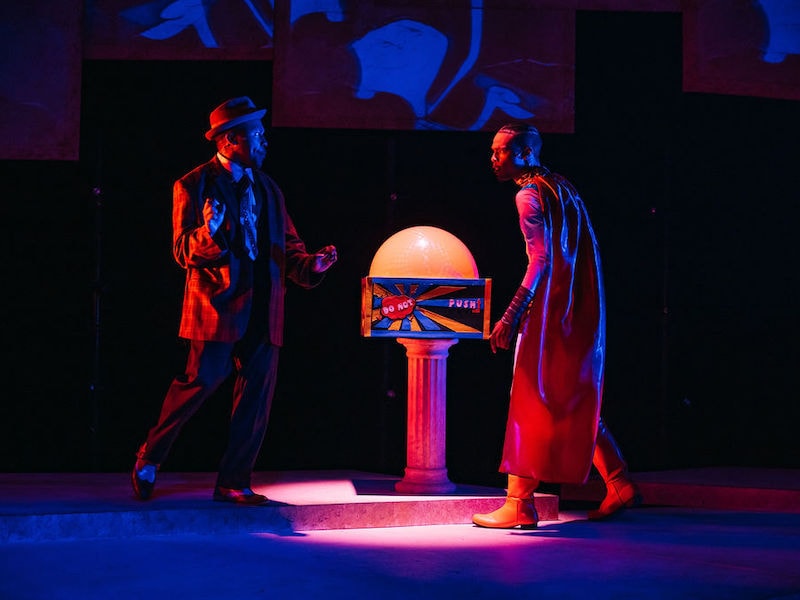
The plot is simple. A button (yes, a large red button) gets pushed in a town that is very likely Washington, DC. Because of Villain’s history of pranking the town, he becomes the prime suspect. Of course, it does not help that Hero, whom everyone loves, says that he saw Villain commit the crime. But Journalist, a young woman with a unique relationship with the criminal justice system, sets out to find the truth. The themes in the show are reminiscent of Jordan Peele’s Nope, another post-pandemic look at our society’s obsession with sensationalism instead of seeking truth and understanding.

The show comes in at just about 55 minutes. The fast-paced and exciting performance will have children and adults alike wanting to know who pushed the button!

Push the Button is a different kind of musical. The show takes popular songs from the last two years and satirizes/parodies them to create new pieces that narrate the show’s plot. For example, “Villain Song” utilizes “XO Tour Llif3” by Lil Uzi Vert and “Bad Guy” by Billie Eilish to allow Villian, played brilliantly by Tre’mon Kentrell Mills, to tell us about his history with crime and plead his innocence to Journalist (and us). In the “Trial Song,” Hero (played by the charming and funny Quincy Vicks) and Villain go back and forth about the events surrounding the pushing of the button over the Silk Sonic hit “Leave the Door Open.” The show was at its strongest in the moments when Vicks and Mills were on stage, separately and together.

Matthew J Keenan’s set design is perfect for a show that teeters on the edge of children’s theater. Different characters move the large button and other furniture on and off the stage when needed. As a result, the choreography by Ashanti Symone Branch, who also plays Journalist, shines. Projections, by Zavier Augustus Lee Taylor, give this story of good versus evil a cartoonish edge.

Because of the energy of the music and strong performances from Hero and Villain, it was easy to forgive specific technical and narrative issues. At moments, the music was louder than the microphones, making it difficult to hear the actors. When Hero and Villain were off stage, the show felt stagnant, and the songs seemed to summarize the dialogue rather than keep the story moving. However, if you are taking young children to see the show, that repetition will likely create a greater understanding of what they have just seen.

But the minor issues did not take the show down. The fun is infectious. The actors were having fun even when the story was not moving along. This show reminds me of what it was like to see theater as a young child for the first time. The lights, colors, costumes, and music were so much fun. Even for the hip-hop averse, it is difficult to avoid getting drawn into the story.

Push the Button invites us to consider how we can all be heroes. At the end of the show, Journalist lists things like “helping your mother with the groceries” as examples of small ways we can all be heroes. In a world where critical thinking skills seem to be dwindling, Push the Button is a hero, reminding us to think critically about how we feed into harmful power dynamics and about the information we consume daily.
The Godmother of Rock ‘n’ roll: Not to Be Forgotten

By Vivian Thurman

This article was produced within the New Theater Critics project, a component of Day Eight’s 2023 arts journalism conference.

This article was originally published in DC Trending here.

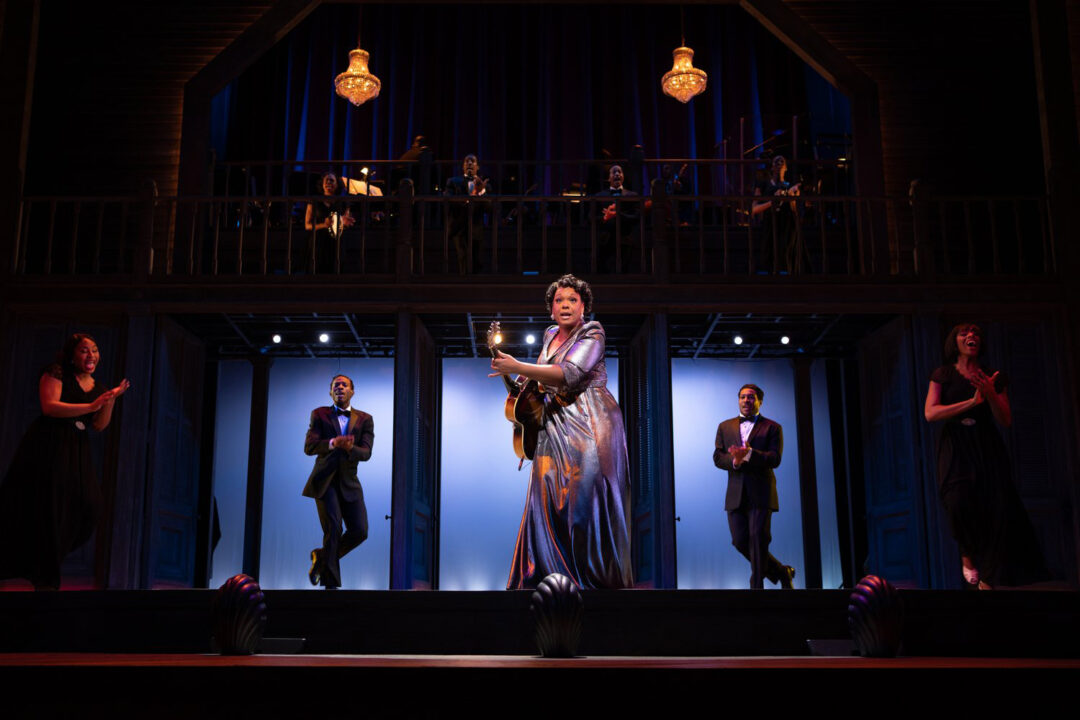
It’s not often that a night at the theater leaves you feeling like “you’ve been to church.” This raucous bio-musical now playing at Ford’s Theatre follows the pioneering life of Sister Rosetta Tharpe (1915-1973) and bares the soul of a talented and influential, “guitar-shredding” woman ahead of her time.

Sister Rosetta is played by Broadway alum Carrie Compere (The Color Purple, Holla If Ya Hear Me), whose voice alone could blow the roof off of the historic Ford’s Theatre. Rich with resonance and gritty at times, Compere’s vocal stylings weave together the church-based gospel of Arkansas with the secular jazz-blues-devil’s music of Chicago (circa 1935-1945). Sister Rosetta was known for “rockin’ the R’s” and the “duck walk.” Compere mastered both.

Shout Sister Shout! is based on the award-winning book, “The Untold Story of Rock-and-Roll Trailblazer Sister Rosetta Tharpe” by Gayle F. Wald. The stage adaptation is written by Cheryl L. West, a widely recognized playwright whose works include Akeelah and the Bee, Pullman Porter Blues, and the Charles McArthur award-winner for Outstanding play Before It Hits Home.

The storytelling narrative comes in the form of a series of flashbacks. Memories evoke strong emotions when Rosetta’s mother disowns her for singing anything other than gospel. Sister Rosetta’s guitar playing style was an early influence to rockabilly artists like Jerry Lee Lewis, Johnny Cash, Chuck Berry and others. Known as the Queen of Strings, at the height of her popularity in Europe, Rosetta was asked who was most influential in developing her musical personality. Was it Elvis? “I’ll tell ya about your Elvis,” she said, implying her originality was her own.

The strongest influence in Sister Rosetta’s life was her mother, Katie Bell (played by Carol Dennis), a traveling evangelist who pushed a young Rosetta to accompany her on the guitar in church. And later, encouraged her to “look down that road” for a higher calling. Carol Dennis, whose credit includes performing in the original Broadway cast of  The Color Purple, balances the domineering and opinionated love of a single mother. The vocal powerhouse and the on-stage chemistry of Compere and Dennis is satisfyingly explosive.

A complicated love life in search of happiness has Sister Rosetta marrying three times. But it was her risky relationship with Marie Knight (played by Felicia Boswell) that gave her a deep sense of happiness like nothing she had known before. Marie, a stunning and accomplished pianist, is played for Mahalia Jackson.

The live orchestra is set on an elevated deck playing double duty as the Big Band in some of the showcase numbers. The hidden orchestra music performances such as the gospel “Glory, Glory, Hallelujah,” the bluesy  “Lonesome Road” and the uptempo “On My Way” are guided by the skillful baton of Victor Simonson, also plaing the keyboard. Orchestration and arrangement by Joseph Joubert expertly highlights everything from the subtle guitar solos, the piano and voice duets to the eight member band’s toe-tapping accompaniments. Much credit goes to Sister Rosetta who wrote most of her own songs.

A notable mention must be made for the costume design by Alejo Vietti and the wig and make-up design by Charles G. LaPointe. This design team immediately sets the time period with soft curls and simple dresses on young Rosetta, as well as well-fitted suits on the various gentlemen. With each chapter in Sister Rosetta’s life, her concert dresses become more sophisticated. Her jewelry and fur coats set a regal presence that could be felt as she entered a room or arrived on a stage.

The ensemble is filled with talented singers and dancers playing multiple roles. During gospel songs that required jubilant expression from the choir, this critic found that the hyper exuberant choreography stole focus. The choreography was aerobic at times but well-rehearsed, which was perfectly suited for the Nicholas Brothers, and Cab Calloway’s “Jumpin’ Jive.” Choreography is by award-winning William Carlos Angelo.

‘Clyde’s’ at Studio Theatre plays it safe

By Imani Nyame

This article was originally published in The DC Line here.

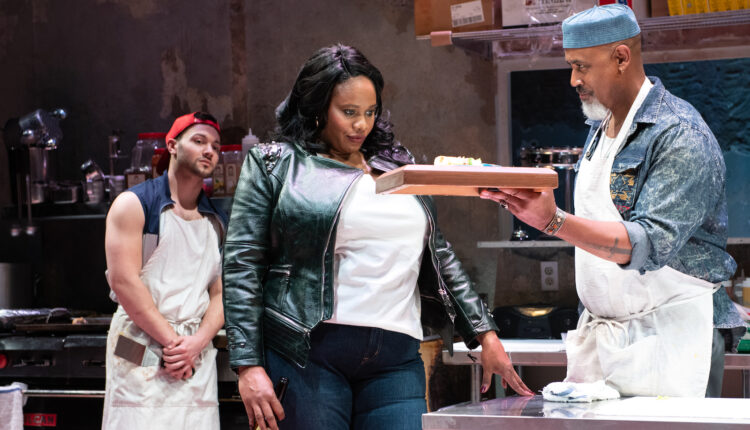
Toting a bottle of beer, Clyde (Dee Dee Batteast) comes on stage clad in a busty denim dress, a synthetic wig from the local beauty supply and a little too much blush. With gusto that can only be earned from a hard-knock life, she comes to be the owner of a beat-up truck stop sandwich shop, home to a staff of formerly incarcerated men and women who have nowhere else to go. When veteran employee Montrellous (Lamont Thompson), connoisseur of sandwiches and second chances, urges her to try something new to expand the business, she is pessimistic and immovable. He coaxes, telling her to remember her mother’s cooking, to which she responds: “My mother never cooked anything. … That woman was like peanut brittle, sweet and salty, and I was never sure whether I actually liked her.” 

The same can be said for the current Studio Theatre production of Clyde’s, written by Pulitzer Prize-winning playwright Lynn Nottage and directed by Candis C. Jones. Notwithstanding the effectiveness of the script’s message and humor, I left the theater thinking that some parts lacked intention — a weakness exacerbated by uneven pacing as the result of direction that plays it safe. We witness a story stenciled in from the proverbial “when life gives you lemons” complex — but in this case it’s “when life gives you a criminal record, a ‘licensed dominatrix’ as an employer and a random box of swiss chard … get creative and make a sandwich.” 

With shabby concrete walls and red-and-once-white checkered tile flooring, Clyde’s kitchen, designed by Junghyun Georgia Lee, is a universally familiar hole in the wall where you can expect good grub aside from the occasional stomach ache. (The audience might as well be in the kitchen, transported by aromas, like chocolate in a climatic scene, pumped through the vents of the theater by sensory consultant Miriam Songster.) Questionable health and safety practices — such as wiping knives on the backs of dingy aprons or spraying disinfectant spray over an open container of fresh tomatoes — scream that Clyde’s is far from any Michelin recommendation. 

The staff of ex-convicts includes Letitia (Kashayna Johnson), a stylish young Black mom of a daughter with a rare genetic condition; Rafael (Brandon Ocasio), a classic example of Latin machismo; and Jason (Quinn M. Johnson), a reserved yet temperamental white male. Individually these characters are dynamic, but as an ensemble they fall flat. The caricatures, though written with an indelible urgency, need perhaps a bit more spontaneity from a cast that takes things a bit too seriously. Parts that are meant to be funny don’t always land, and parts made out to be serious don’t quite fit. Adequately entertained but not truly invested, I found myself wanting to find out more about who these people are and what led them all to Clyde’s. 

Nottage’s use of food as an agent of freedom brings her spunky, gritty script to life. It’s lighthearted and deep in perfect balance. The fatherly Montrellous provides a counterpoint to an imperious Clyde. Smooth and somewhat of a martyr, he is the glue that holds the spirit of the place intact. In platitudinous fashion, he encourages his co-workers to use the art of crafting a perfect sandwich as an extension of their realities. Mastering their ability to create perfect harmony with the ingredients at their disposal is how they will take control of their lives. (Are we still talking about sandwiches?) 

Clyde is not impressed, however. She dominates the place with a steel presence, intimidating her employees and belittling them with invasive insults. She knows they have nowhere else to go and revels in the fact. I was thrilled at the chance to witness a truly malicious female villain even if in the realm of an unappealing sandwich shop. 

But something about Batteast’s Clyde feels unsure, her prowess not quite earned. Perhaps it is that the tackily flashy costumes, designed by Danielle Preston, don’t hit quite the right note. Instead of showcasing a businesswoman who apparently has a little extra money to spend on behalf of a gambling problem, her clothes look cheap and ill-fitting. That’s a shame because — irrespective of Clyde’s discourteous disposition — something tells me she is a woman of immense style, a trait that could only bolster her confidence. Batteast’s Clyde is instigative, choosing to knock things over or out of her staff’s hands as punctuation to her outrageous rants, bringing to mind a high school bully who craves attention. Maybe it’s just me, but it’s hard to believe that a room full of people convicted of brazen crimes would stand for this. 

Despite such shortcomings, this production holds together well enough to keep the audience involved, if not convinced. Crafty transitions detail the fast-paced environment of a busy restaurant — the ring of madam Clyde’s call bell signifying there is yet another sandwich to be made. There is an undeniable charm to Clyde’s. If you are willing to take the ingredients this production provides and to experience the show for what it is, you too can improvise a refreshing glass of lemonade … or a satisfying sandwich.

‘Blue’ Oversimplifies Police Brutality, Delivers Stellar Performance

Review by Daarel Burnette II

This article was first published in DCTRENDING here.

Blue, an opera by librettist and director Tazewell Thompson, and conducted by Joseph Young and Jonathan Taylor Rush, is a coming-of-age tragedy that’s as much about forgiveness, identity, and the false hopes and expectations of Black men, as it is about police brutality. While the plot is as simplistic as the set, the outsized performances by Kenneth Kellogg and Joshua Conyers make the show worthwhile.

The two-hour-and-fifteen-minute-long production at the Kennedy Center, featuring music by award-winning Jeanine Tesori, and a majority Black cast, a rarity in opera, was canceled in 2020 due to the pandemic. 

In the few years since, Americans have witnessed the videotaped murder of George Floyd at the hands of a Minneapolis police officer; a #BlackLivesMatter rally that amounted to the nation’s largest protests in America’s history; a movement to “defund the police;” a marked uptick in crime in majority Black communities; and a concerted political effort to ramp up policing.  

Knowing all this, Blue’s plot came across as wanting. 

A father, played by Kenneth Kellogg, takes on a job as a police officer for the stable pay, benefits, and an opportunity to fight crime. But his son, played by Aaron Crouch, is soon radicalized by what he sees as abusive treatment of Black men by the police and, to the chagrin of his father, starts participating in street protests where he’s shot and killed. The father, in his grief, goes into a rage and vows revenge against the officer who killed his son.

A bit surreal.  

Yet this stellar cast sings with such conviction that a rousing aria, performed by Ariana Wehr, in which she evokes real-life police shootings, generated in me the same flash of anger and grief I feel every time I watch yet another video of police officers senselessly abusing Black men. 

And I can’t help but admire Thompson’s decision to cast the father as a police officer (an earlier draft cast the father as a jazz musician). That’s a plot twist that we’re now grappling with in the real-life beating of Tyre Nichols, a Black father, at the hands of four Black Memphis police officers. 

Are Black police officers first Black or blue?  

In the opening scene of Blue, we see the work of costume designer Jessica Jahn, spot lit by lighting director, Robert Wierzel, switches from the uniform of a Black man – a Negro league baseball crew coat, baggy blue jeans, and a fitted sports cap– into the uniform of a cop–creased, blue slacks, crisp, blue collared oxford, blue peaked hat, silver officer badge and a black handgun. 

This opening scene is the most dynamic that the set, designed by Cindy Oxberry, ever gets.  Throughout the production, cast members roll visibly cheap and mismatched, black and white furniture on and off the stage, which is backlit by Harlem row houses whose lights confusingly flicker off and on.  

In the next scene, we’re serenaded with an aria sung by a whimsy cast of girlfriends played by Ariana Wehr (soprano), Katerina Burton (soprano) and Rehanna Thelwell (mezzo-soprano), as they first praise the mother, played by Brianna Hunter (mezzo-soprano), for snagging a “big-everything” Black man but are then horrified to learn she’s expecting a Black baby boy.  How, they ask, will she protect a Black boy from a racist society? How will she (?) a Black boy from the police?  

The plot delves into a century-old trope perpetuated by the casting of Black men on stage: victims with no agency, or rage-filled perpetrators. This is damaging and something I hope the opera world will soon move beyond.

Blue is at its best during arias where the cast, led by the baritone reverend (Joshua Conyers), grieves over the son’s loss. But there are several subplots that leave the audience with more questions than answers. This renders the complications around police brutality for opera’s majority-white audience distant, abstract, and easy-to-fix.    

Further, the impact of rampant crime in Black neighborhoods on victims and perpetrators–what accused police departments are solely charged with addressing– is a distracting hole in Blue

Today, civil rights activists are in the throes of a century-long battle trying to make Black communities safer and policing more effective.  It’s a drama worth accurately telling.  

As the opera community grapples with its stained history of Blackface, refusing to cast Black performers, and subjugating Black stories, Blue is a welcome attempt to reverse course. 

Two rewarding one-acts, ‘paper backs’ and ‘Life Jacket,’ from 4615 Theatre

By Jakob Cansler

This article was first published in DC Theater Arts here.

It would seem, on the surface, that the plays in 4615 Theatre Company’s double bill could not be more different. One centers on a queer couple who just begun living together. The other, on two friends taking a boat out to sea.

Below the surface, though, both paper backs and Life Jacket, now performing at The Writer’s Center through February 26, have a lot in common. Both are premieres. Both speak to similar, and compelling, themes. And both ask of audiences exceptional attention.

paper backs by Tristan B. Willis, the first of the double bill, features a queer couple ⁠— named only The Writer (Caro Dubberly) and The Artist (Jessica Ludd) ⁠— who have just moved in together. Through a series of short scenes connected by poetic monologues, we watch as a rift forms in their once-strong relationship and connection turns to disconnection.

Their respective art forms are, in a tragically ironic sense, the biggest driver of that disconnect. The Writer struggles to understand The Artist’s art. The Artist struggles to understand the Writer’s literature. That failure to connect over their passions drives a wedge between them. After all, these are people whose art is their identities ⁠— it is how they express their emotions, their understanding, their connection with the other. To fail to connect over art is to fail to connect over identity.

Willis navigates this theme in compelling fashion, but the language of the play does perhaps more to hinder than help. The monologues and dialogue alike utilize an elevated language that is at once blunt and enigmatic, requiring a level of constant analysis to be understood.

And yet, understanding what is being said in paper backs is much less important than understanding what isn’t. That is where the directing, acting, and design choices shine through. Through subtle movements, Director Stevie Zimmerman’s staging brings the subtext of the deepening conflict between these two characters to life, while Ludd’s performance in particular complements the direction with an impressive emotional range. Jordan Friend’s soundtrack and Pierce Stonburner’s stirring lighting evoke the emotional arc of the characters as their alienation from one another grows.

As a result, paper backs in many ways punches above its weight. The same could be said of the second play in 4615’s two-part performance.

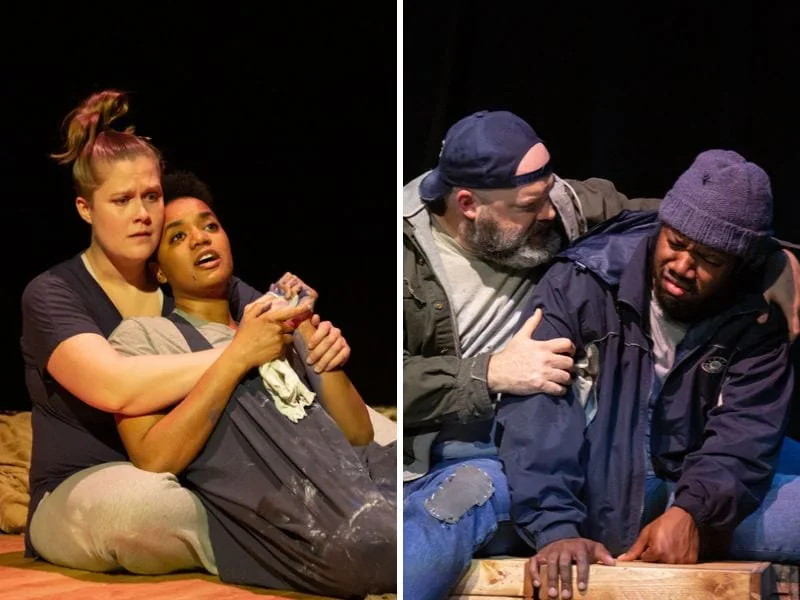
Life Jacket, written by Caridad Svich, centers on two adult friends, played by Jonathan Del Palmer and Eamon Patrick Walsh, from a small oceanside town, who go out on a boat as they do every Sunday. Normally, their ritual involves a quiet day on the water drinking PBR. This time, though, things go differently, as a combination of fighting, stormy weather, and a spiritual encounter (that may or may not be real) makes their trip increasingly tumultuous. That experience drives them apart and together simultaneously.

Svich’s writing in Life Jacket is unique, constantly blending traditional dialogue with fourth-wall-breaking narration, memories, and fantasies. This chaotic structure makes for a text that is fascinating but difficult at first to find an entry point into, as the characters move between the main action of the play to monologues to memories and back so quickly that it is difficult to keep up. As a result, there are plenty of moments when trying to understand what is going on distracts from, well, what is going on.

And what is going on is poignant. Life Jacket could be considered ⁠— much like a certain famous boat-based novel that is referenced throughout the play ⁠— to be a metaphor. The experience of the characters, real and potentially not real, speaks both to the universal feeling of isolation and the specific need for connection at this moment in time.

Here, as in paper backs, the directing and design choices are important in helping the audience navigate those themes. Director Friend, playing double-duty here, provides a staging that sometimes feels arbitrary at first but always ends up elevating the themes of the text.

Similarly, Stonburner’s lighting in Life Jacket gets increasingly striking as the action gets increasingly chaotic, while also creating visual cues to help traverse the play’s blend of storytelling formats. Sarah Beth Hall’s scenic design ⁠— which involves a floor of repurposed wood, moveable crates, and clouds made of fish nets ⁠— evokes both the rickety boat the characters set out on and the imagination the play seems to live in.

In fact, it is Hall’s scenic design that most effectively ties this double bill together. The two directors use the space Hall has designed differently, but the cohesive aesthetic, which works equally well for both paper backs and Life Jacket, creates an immediate mental connection between the two plays. They may tell different stories, but they utilize the same building blocks.Indeed, paper backs and Life Jacket are at once contrasting and complementary. Both require the audience to dig deep into the work, but promise a payoff for those who do. For both, I would argue, the payoff is worth it.

A must-see grows in ‘Native Gardens (Jardín salvaje)’ at GALA

By Ajani Jones

This article was first published in DC Theater Arts here.

The late Audrey Hepburn’s assertion that “to plant a garden is to believe in tomorrow” perfectly captures the core thesis of resistance and change explored in GALA Hispanic Theatre’s Jardín salvaje.

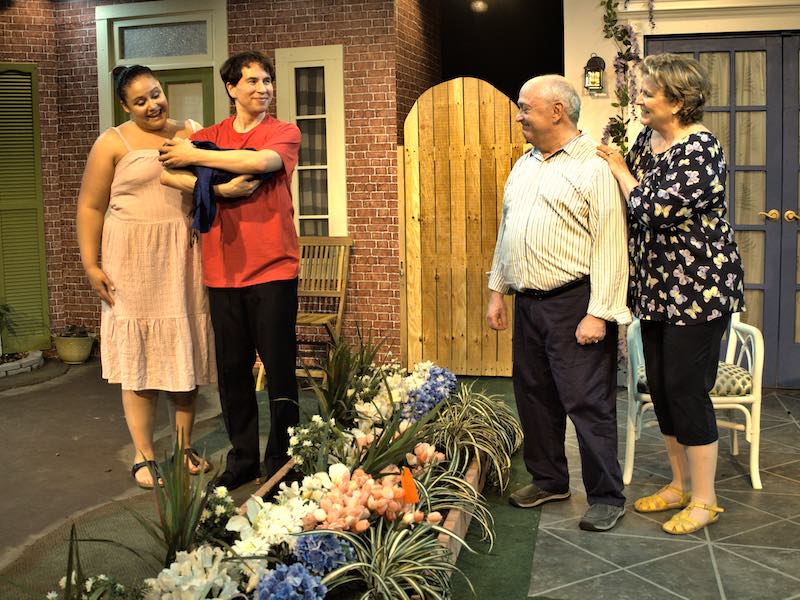
Jardín salvaje is a Spanish translation by Gustavo Ott of playwright Karen Zacarías’ Native Gardens, her self-proclaimed “love letter to the DMV.” Like its English counterpart, Jardín salvaje explores the relationships between new and old DMV residents in the interactions between two neighboring families — the Del Valles and the Blochs. As the play progresses, the families navigate their unique dynamics and needs across a shared property line all while fluidly exploring the budding tension between tradition and modernity.

As Pablo (Víctor Salinas) and Tania (Alina Collins Maldonado) del Valle come to terms with their future while settling into their new DC home, the two learn to navigate life through the metaphor of gardening — a journey they must share with their new neighbors Fabio (Juan Luis Acevedo) and Virginia (Luz Nicolás) Bloch.

Under the expert direction of Rebecca Aparicio, the play takes on compelling depth. Each scene, whether humorous, heartfelt, or even notably tense, feels empowered and intentional down to the finest details. Aparicio’s careful direction is evident in minor narrative details, like the shifted national origins of the Bloch family, that foster a compelling story arc for the two families and emphasize the play’s themes of tradition and change.

Under the guidance of this striking directorial foundation, the cast of Jardín salvaje delivers charming and powerful performances both as an ensemble and individually. The two couples balance each other out excellently. The cast’s charisma and shared chemistry are palpable in every scene.

The interactions between Virginia and Tania are especially powerful as the two women portray a genuine sense of empathy that, in spite of the rising tensions between them and their many differences, perfectly encapsulates the sincerity that punctuates the play’s final moments.

Maldonado’s passionate defense of her husband and her home is especially remarkable: as she stands her ground against Nicolás’ equally impassioned and powerful performance, her performance carries a power that leaves the audience in awe.

Jardín salvaje is also genuinely hilarious. The play smoothly integrates humor — from subtle yet poignant remarks to the more blatant yet amusing antics of the construction workers working to renovate the fence marking the property line between the two homes.

GALA’s production of Jardín salvaje elevates the viewing experience by leaning into the inherent musicality and visual appeal of Zacarías’ play. Jardín salvaje is by its nature a sensory experience. In spite of its simple setting, the show is known to maximize the limitations of its set to create a truly breathtaking theater experience. This production is no different. The stunning scenic design by Griselle González and costumes by Jeannette Christensen speak volumes as they complement the characters and their performances.

The integration of musical elements and expert use of lighting also enhance the narrative in subtle yet powerful ways. The sound design by Justin Schmitz and lighting design by Alberto Segarra are outstanding.

This production captures all the heart and narrative soul of Zacarias’ work and dials it up to an eleven through its incredible cast and phenomenal technical elements. In all, GALA Hispanic Theatre’s Jardín salvaje is a must-see.

‘The Cake’ at Prologue Theatre comes with baked-in clichés

By Jakob Cansler

This article was first published in DC Theater Arts: here.

Prologue Theatre is on a mission.

“We want the plays that Prologue produces to be a catalyst for deeper dialogue and conversation on topical issues,” said Artistic Director Jason Tamborini shortly after the company was founded. Prologue’s latest production, in association with NextStop Theatre Company, certainly attempts to fit that bill.

Now in performances at Atlas Performing Arts Center before moving to NextStop next month, The Cake by Bekah Brunstetter is also on a mission. In this case, though, that mission is too heavy-handed to be successful.

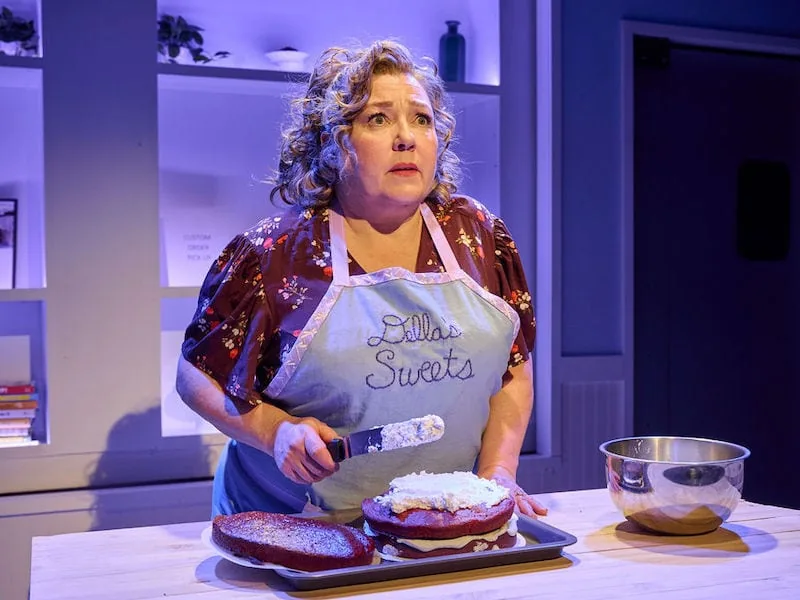
The Cake centers on Della (Nicole Halmos), a conservative Christian baker in North Carolina who is set to be a contestant on the fictional competition series Big American Bake-Off. She faces an internal conflict, perhaps the first real one of her life, when Jen (Tara Forseth), a woman she practically helped raise, asks her to bake a cake. Specifically, a cake for Jen’s wedding. Specifically, Jen’s wedding to another woman.

Based on that description, it may seem like The Cake’s goal is one in support of same-sex marriage and LGBTQ rights more broadly. Indeed, throughout the play, Della explicitly debates the topic with the other characters. She seeks some level of understanding about being queer from Jen. She debates furtively about politics with Jen’s bride, Macy (Sabrina Lynne Sawyer). She discusses the biblical arguments with her husband, Tim (Sam Lunay), a plumber who is much more set in his beliefs and expects Della to fall in line with him.

What this makes for is essentially a 90-minute rundown of the major points for and against same-sex marriage. Perhaps if it was performed for a different audience, The Cake would indeed seem primarily a pro-LGBTQ play. In front of a liberal-leaning, DC-based audience, though, Brunstetter’s mission is less about convincing people like Della to support same-sex marriage and more about convincing people who are decidedly not like Della that Della is not a hostile adversary.

In fact, Della is painted from the beginning as a well-intentioned hero whom the audience can root for to do the right thing. Halmos portrays Della’s complexities with ease, creating a funny and engaging character whose humanity the audience can understand.

Halmos’ Della is, however, one of the few things that are effective about Brunstetter’s mission in this play. The most obvious issue is The Cake’s over-reliance on surface-level ideas and clichés to make its points.

The other characters, for instance, do not have nearly the complexity that Della does. Jen, Macy, and Tim all exist to fulfill specific narrative purposes and, as a result, seem like two-dimensional stereotypes ⁠— Jen, the small-town girl discovering herself; Macy, the big-city liberal; Tim, the stubborn blue-collar conservative. Forseth, Sawyer, and Lunay do the best they can with a poor hand, but the way these characters are written makes for dialogue that feels like talking points.

Therein lies the overarching struggle of The Cake: there is simply a lot more telling than showing, and as a result, the multifaceted themes at play ⁠— like how our views are molded by religion, class, geography, etc. ⁠— end up oversimplified.

That The Cake’s points might be ineffective would not be much of an issue if the play still worked as a piece of entertainment, but unfortunately, because Brunstetter’s goals are so overstated, the purpose ends up dragging down the rest of the script with it. The pacing, dialogue, and structure all suffer from a lack of subtlety that makes it difficult to become engrossed in the world of the play.

To be sure, none of what makes The Cake ineffective comes on the part of Prologue or the artistic team. Aria Velz’s direction takes what could be a heavy production and makes it feel springy, and Tamborini’s scenic design ⁠— which features bedroom tableaus that appear from behind walls⁠ — makes for both an intriguing visual and an impressive use of a small space.

There is also, notably, one aspect of The Cake that does manage to conceal many of the script’s issues: humor. Despite the gravitas of the themes, The Cake never takes itself too seriously, which helps to break up the pacing. Brunstetter has a particular skill for deploying punchlines at just the right time so moments that could become cumbersome are lightened. The entire cast, especially Halmos, nails that timing consistently. Still, at the end of the day, The Cake is a play on a mission, and one that is not successful.

That being said, Prologue Theatre is also on a mission ⁠— to start conversations ⁠— and I’ll admit that after seeing The Cake, I did have a riveting conversation with a friend about these issues. In that sense and in this case, Prologue’s mission could be called a success.